House of Silence by Linda Gillard: Book Review

Version 1.0.0

I’ve read several of Linda Gillard’s books and House of Silence is definitely one of her best. It’s only available on Kindle but you can download it onto your computer to read if you don’t have a Kindle.

It’s one of those books that makes you want to carry on reading although you know you’ve lots of things you should be doing apart from reading, but you read on anyway.

It’s a novel about families and their secrets – in particular one family, the Donovans. When Gwen Rowland met Alfie Donovan she becomes interested in his family and persuades him to let her spend Christmas with them at the family home, Creake Hall. Gwen comes from a dysfunctional family – mother died of an overdose, aunt from drink and uncle from AIDS, whereas Alfie is the youngest and much-loved younger brother of four sisters and the model for his mother’s best selling children’s books about Tom Dickon Harry.

But  their family life  is not as Gwen imagined it. Although Gwen immediately finds a kindred spirit in Hattie, Alfie’s sister nearest to him in age, and Viv his oldest sister she soon finds there is a secret they’re all hiding. The only person who seems to be open with her is Tyler, the handsome Polish gardener. Alfie, himself seems different and his mother keeps mainly to her room, her mind drifting back to the past. Gwen is puzzled by an old photo of Alfie and then discovers scraps of letters that eventually lead her to the truth.

This is a book in which it is so easy to lose yourself, at once emotional and mysterious. I really enjoyed it – the characters are so distinctive and complex, and the setting in an old Elizabethan manor house is perfect. It raises issues of memory and identity, mental illness, loss and love.

  • Format: Kindle Edition
  • File Size: 1125 KB
  • Sold by: Amazon Media EU S.à r.l.
  • Language English
  • ASIN: B004USSPN2
  • Source: I bought it

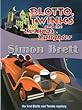
Blotto, Twinks and the Ex-King’s Daughter by Simon Brett

This is the first in what is described as ‘a gloriously silly new series set in the 1920s and featuring a pair of aristocratic siblings: the honorable and handsome Blotto, who has all the brains of a billiard ball, and his sister, the beautiful and brilliant Twinks.‘ The dedication, ‘To Pete, who always had a taste for the silly‘ is also a give-away that this book is not to be taken too seriously.

I rather liked Blotto, Twinks and the Ex-King’s Daughter. It is indeed silly in the P G Wodehouse style of Jeeves and Wooster silly, full of slang and poking fun at the amateur detective who is an expert in identifying toxins, reading clues and being several steps ahead of the plodding police. It begins when Blotto, the rather dim son of the Dowager Duchess of Tawcester, discovers a dead body in the library. The police, represented by Chief Inspector Trumbull, who although ‘deeply stupid‘, knows his place:

The role of the police was to do a lot of boring legwork and paperwork, to trail up investigatory cul-de-sacs, to be constantly baffled, and dutifully amazed when an amateur sleuth revealed the solution to a murder mystery. (page 9)

The body just happened to be that of one of the Ex-King of Mitteleuropia’s entourage,who are all staying at Tawcester Towers. Then the Ex-King’s daughter, the beautiful Ex-Princess Ethelinde is kidnapped and Blotto, together with his chauffeur Corky Froggett, sets off across Europe to rescue her. It does escalates into farce with Blotto fighting off canon balls with his cricket bat. There are also some pointed remarks about class, race and forms of government, such as this about the royal family and the British government because as Blotto explains as well as the monarch there is also:

…  this bunch of chappies called the House of Commons …  which is actually rather well named … because a lot of the boddos in there are rather common. You know some of them didn’t even go to minor public schools. Anyway they do all the boring guff … you know, making laws and increasing taxes and all that. But then there’s the House of Lords, which is where our sort of people go, and they do important things … like seeing that their own particular bits of the countryside get looked after … and finding ways of avoiding all these taxes that the little oiks in the House of Commons keep raising. It all seems to work rather well. (page 128)

And

… [democracy is] a system based on the illusion of consultation with the common people. (page 129)

As I said – I rather liked it.

  • Paperback: 224 pages
  • Publisher: Felony & Mayhem; Reprint edition (16 Feb 2011)
  • Language English
  • ISBN-10: 9781934609699
  • ISBN-13: 978-1934609699
  • Source: Review copy

Crime Fiction Alphabet – O is for One Good Turn

letter OWe have reached the letter O in Kerrie’s Crime Fiction Alphabet and my book this week is:

One Good Turn (Jackson Brodie #2)

One Good Turn by Kate Atkinson

This is the second of her Jackson Brodie series. I read Case Histories, the first one, a few years ago and the third one, When Will There be Good News? just over 2 years ago, both of which I thought were excellent. So I had great expectations that this would be equally as good. Maybe it’s me, but I don’t think it is. It is good and I enjoyed it but I thought it was over complicated, especially at the beginning with so many different seemingly unrelated characters being introduced. It’s only near the end that you find out the connections and interactions between them all. And the ending did take me by surprise – a neat twist.

My problem with this book that I’d just get interested in one strand of the story and want to find out what happened next, when the action shifted to another set of characters. There is also too much detail, background information and flashbacks holding up the action for me to say it’s an excellent book.

But it is still a book that I had to finish; I had to find out what happened and work out the puzzle, because it is a puzzle. Like the Russian dolls within dolls (which also feature in this book), there is a thread connecting it all together. Set over four days an awful lot happens changing the characters lives for ever.

It’s summer in Edinburgh at Festival time when people queuing for a lunchtime show witness a road rage incident after Paul Bradley brakes suddenly to avoid hitting a pedestrian. The driver of the Honda behind him attacks his car with a baseball bat and then attacks Paul himself.  The one good turn comes from Martin Canning, the author of the Nina Riley mysteries, who stops the attack by throwing his laptop bag at the Honda driver hitting him on the shoulder.

One of the people in the queue is Jackson Brodie, who doesn’t want to get involved but who nevertheless gives Martin his mobile number and noted the Honda’s registration number. Amongst other witnesses are Gloria, the wife of an unscrupulous property developer, and her friend Pam. I got to like Gloria, a very sympathetically drawn character. Numerous other characters are involved – Jackson’s actress girlfriend, a failing comedian, exploited Eastern European workers for a housecleaning/escort agency called Favours, and Sergeant Louise Monroe and her teenage son, Archie, amongst others.

It’s complicated and full of coincidences, a very cleverly plotted book and as Jackson says:

A coincidence is just an explanation waiting to happen.

One Good Turn is also my entry in Beth’s What’s In a Name Challenge – a book with a number in the title.

  • Paperback: 544 pages
  • Publisher: Black Swan; Reprint edition (22 July 2010)
  • Language English
  • ISBN-10: 0552772445
  • ISBN-13: 978-0552772440

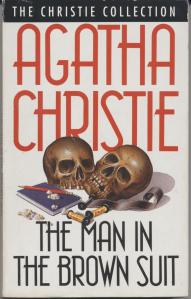
The Man in the Brown Suit by Agatha Christie: Book Review

The Man in the Brown Suit 001Agatha Christie wrote The Man in the Brown Suit whilst on a world tour with Archie Christie, her first husband, in 1922 and it was first published as a serial in The Evening News in 1923 in 50 instalments under the title of Anna the Adventurous. I think that’s an apt title as Anne Beddingfield, one of the two narrators of this book, longs for adventure, enjoying the cinema films of The Perils of Pauline. Agatha Christie, though thought it was ‘as silly a title as I had ever heard‘. But as The Evening News were prepared to pay her £500 for the serial rights she said nothing and bought a Morris Cowley with the proceeds.

She had the idea for the story from Major Belcher, a friend of Archie’s who had invited him to go with him on a grand tour of the British Empire to organise an Empire Exhibition. The Christies dined with Belcher at his house, the Mill House at Dorney and he had urged Agatha to write a detective story about it. He suggested the title The Mystery of the Mill House and wanted her to put him in it.

Agatha sketched the plot whilst she was in South Africa when there was a revolutionary crisis and decided that the book was to be more of a thriller than a detective story, with the heroine as ‘a gay, adventurous, young woman, an orphan, who started out to seek adventure.‘ But she found it hard to make the character she had chosen based on Belcher to come alive, until she hit upon the idea of writing it in the first person and making the Belcher character (Sir Eustace Pedler), Anne’s co-narrator.

I found this information in Agatha Christie’s An Autobiography, but I haven’t added the details she also added that give away who the murderer is (for of course there is a murder) – maybe she thought anyone reading her autobiography would have read all her books.

Anne’s adventure begins when she sees a man fall to his death on the live rails at Hyde Park tube station. He had a terrified look on his face and turning round Anne sees a man in a brown suit, who quickly becomes The Man in the Brown Suit both to her and the newspapers. He announced he was a medical man and that the man was dead, and as he left the station he dropped a piece of paper with some figures and words scrawled on it in pencil, which Anne picked up. A second death follows, this time a young woman is found strangled at Mill House, the home of Sir Eustace Pedler, MP. She was thought to be a foreigner. Anne decides to investigate and the trail takes her on board the Kilmorden Castle sailing to Cape Town.

The action takes place mainly on board ship and in South Africa which Agatha Christie describes so well from her own experiences.  Like Agatha, Anne suffers terribly from sea-sickness; both stayed in their cabins for three days until the ship reached Madeira and like Agatha, Anne just wanted to go ashore and be a parlourmaid. At that point in her life, Agatha had told Archie: ‘I would quite like to be a parlourmaid’. (An Autobiography page 300)

This book features the first appearance of Colonel Race, who appears in three more of Agatha Christie’s books. Anne describes him as ‘one of the strong, silent men of Rhodesia‘ and was very taken with him – ‘easily the best-looking man on board.‘ (page 54)

The novel is a mix of murder mystery and international crime organised by an arch-villain known as ‘the Colonel’, involving violence (but not graphic) and suspense. As usual there are a number of suspects and Anne has to work out who she can trust and who to believe. I found it a bit too drawn out for my liking, too many time lapses and coincidences to convince me of the plot’s credibility, but it held my interest to the end even though I knew the culprit’s identity.

Crime Fiction Alphabet – Letter L

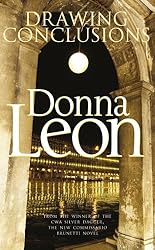
Donna Leon’s Drawing Conclusions is my choice to illustrate the letter L in Kerrie’s Crime Fiction Alphabet.

This is the 20th book in her Commissario Guido Brunetti series. Brunetti is somewhat of a rarity in crime fiction novels – a detective who is happily married with two children. He doesn’t smoke or drink to excess and often goes home for lunch to his beautiful wife Paola.

It’s set in Venice where Donna Leon has lived for many years. I was immediately drawn into this book, with its wonderful sense of locality, believable characters and intricate plot.  Anna Maria Giusti discovers her elderly neighbour Constanza Altavilla lying dead on the floor of her apartment. Apparently she has died from a heart attack but Brunetti, called to the scene because there was blood on the floor, suspects that she may have been attacked as there are bruises on her neck and shoulders. His boss, Vice-Questore Patta wants to close the case but Brunetti decides to make further investigations.

He meets Signora Altavilla’s son and visits the nursing home where she had been helping out. His suspicions are further aroused when the nun in charge of the home is reluctant to answer his questions and by the conversations he has with some of the people she visited. With the help of Inspector Vianello and Signorina Elettra, Patta’s secretary, he discovers a network of deception and lies.

This is a reflective and thoughtful book and I was completely engrossed in it. I haven’t been to Venice, but it came to life as Brunetti walks the streets:

As he walked alongside Rio della Tetta, Brunetti was cheered, as always happened when he walked here, by the sight of the most beautiful paving stones in Venice. Of some colour between pink and ivory, many of the stones were almost two metres long and a metre wide and gave an idea of what it must have been to walk in the city in its glory days. (page 63)

It’s well-paced and there are several unexpected twists that kept me wondering almost to the end what had actually happened to cause Signora Altalvilla’s death. It’s more than crime -fiction as Brunetti ponders on life, the problems of ageing, and the nature of truth and honesty. I didn’t want the book to end – that’s how good it is.

  • Hardcover: 272 pages
  • Publisher: William Heinemann (7 April 2011)
  • ISBN-10: 0434021431
  • ISBN-13: 978-0434021437
  • Source: Review copy

The Matchmaker of Kenmare by Frank Delaney

The Matchmaker of Kenmare by Frank Delaney turned out to be a mammoth read that took me far longer than I expected. I received my copy, an advanced uncorrected proof – without the lovely cover I’ve shown here – courtesy of Meier, the marketing company. It’s a story of journeys, of love and romance, and of war and mystery. I should have loved it, but I didn’t.

It’s narrated by Ben McCarthy looking back on his life as he tells his story to his children. Set during World War II, Ben, still grieving after the disappearance of his wife Venetia ten  years earlier, is travelling around Ireland collecting folklore and trying to find out what has happened to her. He meets Kate Begley, known as the Matchmaker of Kenmare and they become friends. Ireland was neutral during the war but that didn’t stop Ben and Kate’s involvement, after Kate’s husband Charles Miller, an American soldier is reported killed in action. I found it hard to get interested in the story at the beginning and in fact stopped reading it for a while. It was slow to get going and I had to keep looking back trying to work out what was happening and who was who. It didn’t help that this book follows on from a previous one that I haven’t read, which tells the story of Venetia’s mysterious disappearance.

It gathered pace for a while as Kate and Ben travelled to Europe trying to find Charles, who Kate refuses to believe is dead, and into the war action. And there is plenty of action when they are captured by the Germans, despite their Irish neutrality. Even though the war is coming to an end they are in desperate danger. This is, I think, the best part of the book, full of tension and pace. Neutrality is a theme throughout the book. As Frank Delaney writes in his Author’s Note:

… the word neutrality has many shades. For example official papers, released long after 1945, show that Ireland did, in fact, exploit the war politically and contributed many actions to the Allied cause. As to affairs of the heart, who would ever dare to define where friendship should end and passion begin?

Did Ben eventually find out what happened to Venetia and was Charles really dead? I read on, and on, and on as Kate and Ben continued to search for Charles after the war ended. The section where Kate stands waiting for the troops returning from the war, hoping to find Charles amongst them was very moving. But I became tired of their searches and by the time I came to the section where they are travelling to Lebanon in Kansas, the centre of America, the episode with a giraffe and small pig was almost too much to believe. It had all the trappings of a “tall tale”.

Overall, I did enjoy most of it. The book rambles along with many diversions from the main story, some amusing like Neddy who hires a set of false teeth, ‘a set of tombstone dentures’ to make him more attractive to a prospective wife, but mostly I found them distracting. It has a mythic quality. Ben was taught to view his life as though it were a myth, a legend and there are many hints all the way through of the tragic events that are about to unfold – too many hints, I thought, which meant that there were few if any surprises.  Interspersed with Ben’s narration are excerpts from Kate’s journal and his own journal and yet at times the text read more as an objective rather than a personal narrative.

Here is a book trailer featuring Frank Delaney reading from his book.

I agree with Dorothy in her review at Books and Bicycles, in which she says ‘The book would have worked better if told in a more direct manner, without all the editorializing from the older version of Ben and that it ‘does have its pleasures ‘” as you can imagine, the love triangle that develops between Kate, Ben, and Charles is consistently interesting ‘”unfortunately, the quality of the writing kept interfering with the fun.’

And for a more favourable review see Karen’s post on her Cornflower Books blog – ‘it’s a beautifully pitched, fluent story of charm, humour and some inspired ‘“ and even Homeric ‘“ touches.’

The Matchmaker of Kenmare

  • Hardcover: 416 pages
  • Publisher: Random House USA Inc (1 April 2011)
  • Language English
  • ISBN-10: 1400067847
  • ISBN-13: 978-1400067848
  • Source: free review copy

This is my second book for the Ireland Reading Challenge.