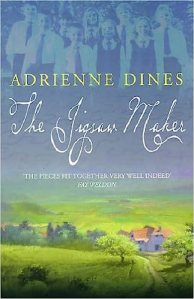
The Jigsaw Maker by Adrienne Dines

It was back in July 2007 that I bought The Jigsaw Maker and it’s been sitting on the to-be-read bookshelves ever since. It was worth waiting for as I thoroughly enjoyed it.

Lizzie Flynn has a shop in a village near Kilkenny, a sort of knick-knack shop selling a variety of goods, cards, flower arrangements, home-made sweets, that needs brightening up and bringing up to date. Much like Lizzie herself, a single lady nearing 50. Her settled life is turned upside down with the arrival of the Jigsaw Maker – Jim Nealon, a stranger who walks into her shop one morning and asks her to sell his beautiful jigsaws.

But these are no ordinary jigsaws. Jim makes wooden jigsaws, tiny intricately shaped pieces ‘finely cut so that they were more like buttons than jigsaw pieces’  And each one is individual showing a photograph of a real place accompanied by a personalised history of the scene:

It’s not just history,’ Jim said. ‘It’s real life. You don’t just know what it looks like now; you get a feel for what it was like in its heyday. It’s a personal memory. (page 8.)

He proposes to take photos of places, not the tourist attractions, but the places their ancestors might have lived and worked. He asks Lizzie to help him by writing about the scenes. To begin with he shows her a photo of the local school and asks her to picture herself back there in 1969 and write what she remembers – what it was like to be a pupil there.

It just so happens that 1969 had been quite an eventful year. This opens up the floodgates of memory for Lizzie as painful and puzzling events from that year almost over power her. Looking back at the child she was she realises that not everything was as it had appeared to her then.

It is just like a jigsaw – all the pieces are there and both the reader and Lizzie have to put them together correctly to get the correct picture. This is a beautifully written book, one with pace and tension in just the right places. I could visualise the scenes and the characters and I became anxious for Lizzie as she realised the truth not only about the events she had seen, but also about her place in those events. There are plenty of repressed secrets that come to the surface and an added mystery too – who is Jim? Why has he come to the village and why did he ask Lizzie in particular to help him?

I hope I’m not going to wait another 5 years to read more books by Adrienne Dines. There are two more: Toppling Miss April and Soft Voices Whispering.
  • My rating: 4.5/5
  • Paperback: 307 pages
  • Publisher: Transita (10 Feb 2006)
  • Language English
  • ISBN-10: 190517523X
  • ISBN-13: 978-1905175239
  • Source: I bought it
  • Author’s website and blog

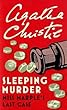
Sleeping Murder by Agatha Christie: a Book Review

Sleeping Murder is Miss Marple’s last case, published posthumously in 1976, although Agatha Christie had written it during the Second World War. Miss Marple investigates a murder that had happened 18 years ago.

 As I began to read I thought it seemed familiar and then I realised I’d watched the TV version a few years ago, with Geraldine McEwan as Miss Marple and after a couple of chapters I remembered who the murderer was. This didn’t spoil my enjoyment as I was able to see the clues as they cropped up.

Newly married Gwenda has bought a house in Devon. She had only recently returned to England from New Zealand where she had been brought up by an aunt after the death of her parents when she was a small child. She immediately felt at home in the house, but then began to have strange premonitions and whilst she was at the theatre watching The Duchess of Malfi  she had a vision of a murder at the house she had just bought. She heard the words:

‘Cover her face. Mine eyes dazzle, she died young …’

Gwenda screamed.

She sprang up from her seat, pushed blindly past the others out into the aisle, through the exit and up the stairs and so to the street. She did not stop, even then, but half walked, half ran, in a blind panic up the Haymarket (Page 27)

She is convinced that she is going mad, but she is helped by Miss Marple, whose nephew, Raymond West is a distant cousin of Gwenda’s husband, Giles. It’s a most baffling ‘˜cold case’, because first of all they have to discover who, if anyone, had been killed, where, when and why. It does all rather depend on a number of coincidences, beginning with the fact that Gwenda has bought the house that she had lived in as a very young child, but as Miss Marple explains to Gwenda:

‘˜It’s not impossible, my dear. It’s just a very remarkable coincidence – and remarkable coincidences do happen. You wanted a house on the south coast, you were looking for one, and you passed a house that stirred memories and attracted you. It was the right size and a reasonable price, so you bought it. No, it’s not too wildly improbable. Had the house been merely what it is called (perhaps rightly) a haunted house, you would have reacted differently, I think. But you had no feeling of violence or revulsion except, so you have told me, at one very definite moment, and that was when you were just starting to come down the staircase and looking down into the hall. (Pages 33-4)

That moment, as it turned out was very significant, indeed.

Sleeping Murder is a satisfying puzzle and I liked this last view of Miss Marple, compassionate and shrewd and this description of her appearance:

Miss Marple was an attractive old lady, tall and thin, with pink cheeks and blue eyes, and a gentle, rather fussy manner. Her blue eyes often had a little twinkle in them. (page 26)

  • My rating: 4/5
  • Paperback: 304 pages
  • Publisher: HarperCollins; Masterpiece edition (Reissue) edition (2 Jun 2008)
  • Language English
  • ISBN-10: 0007121067
  • ISBN-13: 978-0007121069
  • Source: I bought the book

The Woman in White by Wilkie Collins: a Book Review

I read The Woman in White (TWIW) by Wilkie Collins in January and have been wondering how to do justice to it in a post, because it’s a real chunkster of over 700 pages. (For a summary of the plot, with spoilers see the article on the book on Wikipedia.)

It’s one of the first if not the first ‘sensation novel‘. A ‘sensation novel‘ is one with Gothic elements  – murder, mystery, horror and suspense – within a domestic setting. Since reading TWIW I’ve read The Sensation Novel by Lyn Pykett, which describes such novels as a ‘minor subgenre of British fiction that flourished in the 1860s only to die out a decade or two earlier.’ They have complicated plots, are set in modern times, and are reliant on coincidences, with plots hinging on murder, madness and bigamy. They exploited the fear that respectable Victorian families had of hidden, dark secrets and explored the woman’s role in the family. There is a pre-occupation with the law – wills, inheritance, divorce and women’s rights over property and child custody. They are emotional dramas about obsessive and disturbed mental states, with villains hiding behind respectable fronts, and bold assertive women, as well as passive, powerless and compliant women.

These issues and more are present in TWIW. It has several first person narrators, who are each not in possession of the whole story. Their accounts from letters, diaries and formal statements are limited to what each one knew or had experienced, and are not always reliable. It begins with Walter Hartright’s meeting with the mysterious Woman in White, as he is on his way to take up the position of drawing master to Marian Halcombe and Laura Fairlie at Limmeridge House, in Cumberland.

 There, in the middle of the broad bright high-road – there, as if it had that moment sprung out of the earth or dropped from heaven – stood the figure of a solitary Woman, dressed from head to foot in white garments, her face bent in grave inquiry on mine, her hand pointing to the dark cloud over London as I faced her.

Just who she is only becomes clear much later on the story. During their conversation she reveals that she knows Limmeridge House and its occupants. Walter helps her, but then is filled with guilt when he is told that she had escaped from an asylum.

Laura and Marian are half-sisters, living with their uncle, Frederick Fairlie, a weak, effeminate invalid. Walter is immediately struck by the beauty of Marian’s figure, but astonished when he saw her face:

The lady is ugly! …

The lady’s complexion was almost swarthy, and the dark down on her upper lip was almost a moustache. She had a large, firm, masculine mouth and jaw; prominent, piercing, resolute brown eyes; and thick coal-black hair, growing unusually low down on her forehead.

Marian, clever and assertive is in complete contrast in both appearance and character to the lovely Laura. Walter falls in love with Laura, but she is pledged to marry Sir Percy Glyde, a marriage arranged by her dead father. Matters are complicated by the fact that Laura and the Woman in White look remarkably alike, which is central to the plot. Sir Percy attempts to gain total control of Laura’s money and property, aided by the villainous Count Fosco.

I found it a book of two halves – slow to get going, full of descriptive writing and I was beginning to wonder when something was actually going to happen. Then in the second half the pace increased, the action was fast and complicated, with plenty of tension and melodrama. I enjoyed it, although I do prefer The Moonstone.

I read this book as part of November’s Autumn Classics Challenge and The Book Garden’s Tea and Books Challenge (reading books of over 700 pages).

Crime Fiction Pick of the Month: January

I didn’t read much crime fiction in January, just two books, if you don’t count The Woman in White by Wilkie Collins. They are The Burry Man’s Day by Catriona McPherson and One, Two, Buckle My Shoe by Agatha Christie.

And I’ve chosen One, Two, Buckle My Shoe as my crime fiction pick of the month. This was first published in 1940 (in the USA it was published as The Patriotic Murders).  Hercule Poirot and Inspector Japp investigate the apparent suicide of Mr Morley, Poirot’s Harley Street dentist, who was found dead in his surgery, shot through the head and with a pistol in his hand. Each chapter is entitled after a line of the nursery rhyme and the first line contains an important clue.Earlier in the morning Poirot had visited his dentist and as he was leaving the surgery another patient was arriving by taxi. He watched as a foot  appeared.

Poirot observed the foot with gallant interest.

A neat ankle, quite a good quality stocking. Not a bad foot. But he didn’t like the shoe. A brand new patent leather shoe with a large gleaming buckle. He shook his head.

Not chic – very provincial! (page 26)

The importance of the shoe and its buckle don’t become clear until much later in the book!

Mr Morley had seemed in good spirits when Poirot saw him and had shown no signs of wanting to take his own life. Was it coincidence that his assistant, Gladys, had been called away from his surgery on that day, leaving him on his own in his surgery? As Poirot and Japp interview the other patients it becomes obvious to Poirot that it was murder not suicide. Then one of the patients, a rich Greek, Mr Amberiotis is found dead, and another patient, Miss Sainsbury Seale, the owner of the buckled shoe, goes missing. Poirot begins to wonder if Morley had been killed by mistake whilst another of the patients Alistair Blunt, a banker was the intended victim.

This really is a most complicated plot, and even though the facts are clearly presented and I was on the lookout for clues, Agatha Christie, once again fooled me. Not all the characters are who they purport to be and the involvement of international politics and intrigue doesn’t help in unravelling the puzzle. Poirot, himself, is perplexed until during a church service he is alerted to the trap that has been set for him:

Hercule Poirot essayed in a hesitant baritone.

‘The proud have laid a snare for me,’ he sang, ‘and spread a net with cords: yea and set traps in my way …’

He saw it – saw clearly the trap into which he had so nearly fallen! (page 215)

It all fell into place and he saw the case ‘the right way up’.

Written in 1939, this book reflects the economic and political conditions of the time, with  a definite pre-war atmosphere of a world on the brink of war. But Poirot is concerned with the truth, with the importance of the lives of each individual, no matter how ordinary or insignificant they may seem.

  • My Rating: 4.5/5
  • Paperback: 294 pages
  • Publisher: HarperCollins; Masterpiece edition (Reissue) edition (18 Aug 2008)
  • Language English
  • ISBN-10: 0007120893
  • ISBN-13: 978-0007120895

You can see other people’s crime fiction picks of the month at Mysteries in Paradise.

The Help by Kathryn Stockett: a Book Review

The Help is Kathryn Stockett’s first novel. I loved it. I saw the film before I read the book – Octavia Spencer won a Golden Globe award as best supporting actress for her performance as Minny – and even though I knew the story I still found the book full of tension and completely absorbing. When I wrote about the film, I said I hoped the book lived up to my expectations. In fact, it did and more. As good as the film is, the book is even better and I think it’s one of the best books I’ve read for quite a while.

From the back cover:

Enter a vanished and unjust world: Jackson, Mississippi, 1962. Where black maids raise white children, but aren’t trusted not to steal the silver…

There’s Aibileen, raising her seventeenth white child and nursing the hurt caused by her own son’s tragic death; Minny, whose cooking is nearly as sassy as her tongue; and white Miss Skeeter, home from college, who wants to know why her beloved maid has disappeared.

Skeeter, Aibileen and Minny. No one would believe they’d be friends; fewer still would tolerate it. But as each woman finds the courage to cross boundaries, they come to depend and rely upon one another. Each is in a search of a truth. And together they have an extraordinary story to tell…

My thoughts:

I didn’t find anything to detract from my enjoyment – even the fact that The Help is written in the present tense, which I normally don’t like, didn’t spoil it. I didn’t even realise it is in the present tense until I was well into the book. I think it’s better than the film because there is so much more in it, the characters are so well-defined, so believable, and the tension caused by the contrast between the black maids and their white employers is so appalling that I didn’t want to stop reading. The setting in Jackson in the early 1960s is tense to say the least. This book lives up to all the hype it created.

Aibileen, Minny and Skeeter are the three narrators and it is through their eyes that the book comes to life as they take turns telling their stories. As I was reading I could hear their voices.  Skeeter wants to be a writer and decides to write about what it is like working for white families from the coloured maids’ point of view. Aibileen is persuaded by Skeeter to tell her story in an attempt to change the prejudice and bigotry and improve the lives of the black population. Eventually other maids also tell their stories despite their fear of the consequences and the book is finally published. I was holding my breath as the story unfolded, would their cover be blown and how would the white women react?

It’s touching, poignant, funny, compelling and definitely thought-provoking. It’s a book that has stayed in my mind ever since reading it. I hope Kathryn Stockett writes more books!

  • My rating: 5/5
  • Author’s website: http://www.kathrynstockett.com/index.htm
  • Paperback: 464 pages
  • Publisher: Penguin; Reprint edition (13 May 2010)
  • Language English
  • ISBN-10: 0141039280
  • ISBN-13: 978-0141039282

The Burry Man’s Day by Catriona McPherson

This is the second in Catriona McPherson’s Dandy Gilver series.

Synopsis (taken from the back cover):

August 1923, and as the village of Queensferry prepares for the annual Ferry Fair and the walk of the Burry Man, feelings are running high. Between his pagan greenery, his lucky pennies and the nips of whisky he is treated to wherever he goes, the Burry Man has something to offend everyone wherever he goes whether minister, priest or temperance pamphleteer. And then at the Fair, in full view of everyone – including Dandy Gilver, present at the festivities to hand out prizes he drops down dead.

It looks as though the Burry Man has been poisoned – but if so, then the list of suspects must include everyone in the town with a bottle of whisky in the house, and, here in Queensferry, that means just about everyone …

Part of my interest in The Burry Man’s Day is that it is set in South Queensferry, on the south shore of the Firth of Forth, now part of the city of Edinburgh, formerly in the County of Linlithgowshire. I’ve been there once. It’s close to the Forth Road Railway Bridge:

Forth Road Railway Bridge

I haven’t seen the Burry Man’s Parade, which features strongly in this book; it must be a strange sight.

The book has a rather slow start, but it’s one I enjoyed for all its historical detail about the place, its traditions and the people. It has a great sense of place, with a map of Queensferry at the beginning of the book which helps you follow the action. I wasn’t very taken with Dandy Gilver. I liked her more in a later book in the series. In this book she comes across as a busy-body, albeit kind-hearted, and a snob, but then that’s probably just a reflection of the class structure of the times. She’s married to Hugh, who seems to spend his life hunting and shooting and managing his large estate at Gilverton in Perthshire. Dandy doesn’t have much in common with him, being rather bored by life at Gilverton and Hugh doesn’t feature much in this book.

This is Dandy’s second investigation and I suppose if I read the first book, After the Armistice Ball, I might understand her relation with Hugh and with Alec Osborne, her co-investigator. That’s one of the drawbacks of reading a series out of order.

There’s a lot more to this mystery than the death of Robert Dudgeon, who been the Burry Man for 25 years. He’d been extremely reluctant to take the part this year and the question  why was that remained unanswered for the majority of the book. I had an idea about the reason, but only guessed part of it. It’s a convoluted tale and the motive for the murder is buried deep in the descriptions of the characters and their histories. It’s a book you need to concentrate on, and at some points I did have difficulty in sorting out some of the minor characters. Other than that I think it’s a very good book, although maybe a bit too long.

  • My Rating 4/5
  • Author’s website: http://www.dandygilver.com/author.htm – where you can read an extract from this book
  • Paperback: 336 pages
  • Publisher: Robinson Publishing (30 Aug 2007)
  • Language English
  • ISBN-10: 1845295927
  • ISBN-13: 978-1845295929
  • Source: Library book