ABC Wednesday: P is for …

… Peter Rabbit and Beatrix Potter

Peter Rabbit first made his appearance in 1902 in Beatrix Potter’s The Tale of Peter Rabbit.

Peter was a very naughty rabbit, who disobeyed his mother, despite being told the terrible fate of his father who had had an accident in Mr McGregor’s garden and was put into a pie by Mrs McGregor. He squeezed under the gate into the garden, ate lots of vegetables and then came face to face with Mr McGregor and escaped by the skin of his teeth.

Helen Beatrix Potter (28 July 1866 – 22 December 1943) was an English author, illustrator, mycologist and conservationist best known for children’s books featuring anthropomorphic characters such as in The Tale of Peter Rabbit which celebrated the British landscape and rural lifestyle. (From Wikipedia)

Her original watercolour paintings and sketches are in the Beatrix Potter Gallery at Hawkshead, Cumbria. Hill Top, the house which she bought with the proceeds from sales of her books and which she used as an artistic retreat from London, is in Near Sawrey, near Hawkshead. She left it to the National Trust. It is open to the public and it remains just as it was when Beatrix lived there.

I love the watercolours in her books and this is my attempt at painting Peter Rabbit, copied from The Tale of Peter Rabbit.
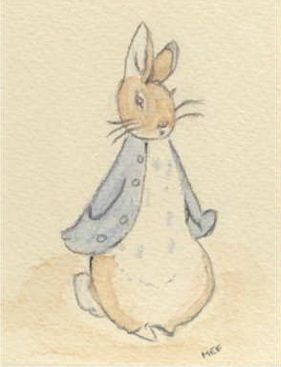
Peter Rabbit 002

An ABC Wednesday post.

Weekend Books & A New Challenge

This weekend I’ve been reading:

  • The Private Patient by P D James. I finished this yesterday and I’ll be writing about it for the next Crime Fiction Alphabet post this week.
  • The Blood Detective by Dan Waddell. I started this a few days ago.

I see that José Ignacio from The Game’s Afoot has found an interesting challenge and it is indeed a challenge:

2011 Challenge ‘Do not Accumulate, Read!!’

The rules are simple, before you buy another book, make a list of six from your TBR pile and read them. Once done you can go ahead, buy the book and, of course, read it. At the same time make another list of six books before buying the next one, and so on and so forth.

This will be difficult as this last week I’ve acquired nine books (bought and borrowed) and so I should make nine lists (and read 54 books) before I buy/acquire any more. That is some challenge, so I’m going to start the challenge from today and read 6 of my to-be-read books before I buy any more!

The new to me books this week are:

  • Her Fearful Symmetry by Audrey Niffennegger. I’ve previously borrowed a copy from the library but took it back unread. It hadn’t appealed at the time, but when I saw it on a secondhand bookstall selling in aid of the Teenage Cancer Trust I wondered if the time was right to give it another go.
  • The Weather in the Streets by Rosamond Lehmann. This is my local book group choice for May. We chose a romance due to the Royal Wedding this month.
  • Small Island by Andrea Levy – borrowed from a friend because I enjoyed The Long Song so much and she said this one is better.

Then two watercolour painting books to help me paint flowers:

I hope these will help me to paint like this. (Click on image to enlarge it.)

I’ve also recently downloaded these onto my Kindle:

  • Adventures of Pinocchio by Carlo Collodi – because I no longer have a printed version
  • THE COMPLETE FATHER BROWN MYSTERIES COLLECTION by G K Chesterton
  • The Unbearable Bassington by Saki
  • Gently Does It (Inspector George Gently 1) by Alan Hunter

I’m not sure what I’m going to read next, apart from The Weather in the Streets by Rosamond Lehmann, because that’s the May book group book, but they will all be from my to-be-read books.

ABC Wednesday – O is for On the Balcony by Berthe Morisot

I only ‘discovered’ Berthe Morisot a couple of years ago, but I really like her paintings, especially this one,  On the Balcony, which is of her sister and niece on a balcony in the Passy suburb of Paris, looking out at the city – shown in the distance. It’s a small painting in oil, 1871 – 1872, now held in the Ittleson Collection in New York.

She was one of the French Impressionists and was married to Edouard Manet’s brother, Eugene. Her paintings are often studies of women, either out of doors, as in this one, or in a domestic setting.

An ABC Wednesday post.

ABC Wednesday – M is for Manet

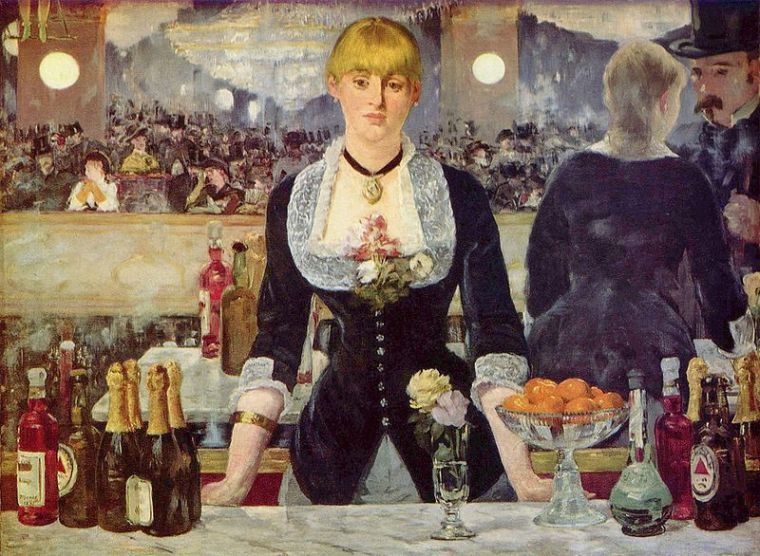
I love the paintings of Edouard Manet, one of the French Impressionists. It is so hard to pick just one painting to show his work, but I’ve chosen A Bar at the Folies Bergère, which to my mind is just marvellous.

I’ve seen this in the flesh, as it were, at the Courtauld Institute at Somerset House on The Strand in London. It’s a lot smaller than I imagined it would be. It’s an ambiguous painting as some see the barmaid as not just selling her wares but as a prostitute and the man reflected in the mirror as a potential client. It’s also intriguing because it’s difficult to tell if the scene in the background is a mirror reflecting what is in front of the barmaid, but then her reflection is not in the right place, nor are the bottles matched up.

I love all the details and colours of this painting as well as the overall effect. I love the atmosphere it creates , with the barmaid isolated, lost in her own thoughts in a crowded room. She is the still point in a busy, noisy place.

Manet A Bar at the Folies Bergeres

Manet painted this in 1882, oil on canvas.

An ABC Wednesday post.

L is for L S Lowry

L S Lowry was an English painter well known for his urban paintings of industrial towns like Salford in Lancashire, scenes peopled by his ‘matchstalk men and his matchstalk cats and dogs‘ (I always thought it was ‘Matchstick’ not ‘Matchstalk’, until I checked the song lyrics today!)

What is less well known (at least to me) was that he also painted many scenes of Berwick-upon-Tweed a seaside town he regularly visited from the 1930s until a couple of years before his death in 1976.

There is a Lowry Trail around the town and here are some photos of one of the locations:

This is ‘On the Sands‘, oil on canvas 1959 (click on the photo to enlarge), showing his matchstick figures. The shelter became dilapidated and was restored in 2001. This is how it looks today:

There is actually a little beach behind this scene:

This is my contribution to ABC Wednesday L is for …

ABC Wednesday – I is for Irises

Irises by Vincent Van Gogh, 1889

Van Gogh painted Irises after he committed himself to the asylum at Saint Paul-de-Mausole in Saint-Remy, France. He began the painting only one week after he entered the asylum. He was probably influenced by Japanese woodblock prints; the black outlines in Irises is typical of the Japanese prints.

Irises is on the list of the most expensive paintings ever sold, selling for 54 million dollars in 1987.

It’s beautiful.