Castles

As a lover of history (as well as books) I love castles, particularly ruined castles – or as my grandson calls them smashed castles. Here are some photos of one near us.

This is Norham Castle, high above the south bank of the River Tweed, parts of it date back to the 12th century.

It was repeatedly attacked and besieged and was largely destroyed by James IV of Scotland in 1513 before the Battle of Flodden Field.

The photo below shows the remains of the huge Great Tower, where the Bishop of Durham  and his guests would stay when they visited the Castle.

J M W Turner painted several views of the ruined castle – they are in the Tate Collection. And I like this 1836 engraving of Moon Rise at Norham Castle by William Miller:

An ABC Wednesday post for the letter C.

‘Young Man at the Window’ by Gustave Caillebotte

Young Man at Window by Caillebotte (1876)

File:G. Caillebotte - Jeune homme à la fenêtre.jpg

(Photo courtesy of Wikimedia Commons.)

I’m quite surprised that Gustave Caillebotte (1848 – 1894) was a member of the French Impressionists as his paintings are much more realistic than the others’ paintings. He painted more modern subjects and his paintings are almost photographic in style.

His painting of a Young Man at Window shows Caillebotte’s brother standing at the window of a new apartment looking out on the scene below. I love the clarity and crispness of this painting, the detail of the stone balustrade, the back view of the young man – a ‘flaneur’ or man about town – and the contrast between the dark interior and bright view outside the window. In the 1870s Paris was being transformed into a modern metropolis under Napoleon III, with Baron Haussmann’s new boulevards and apartements and the rise of the bourgeoisie. The urban setting of this painting shows the tree-lined boulevard and horse drawn carriages.

Is the young man looking at the woman outside? Does he know her? What is the story behind the painting?

An ABC Wednesday post.

Work by Ford Madox Brown

Work by Ford Madox Brown (1852 – 1865)

Taking 13 years to complete, Work is Ford Madox Brown’s major achievement. After he finished it he exhibited it along with a detailed catalogue describing it and explaining its significance. Wikipedia has a detailed account, but put simply this painting is of workers of all descriptions, both physical and intellectual as well as non-workers – the unemployed and the leisure classes.

Work by Ford Madox Brown

The painting is oil on canvas, held at Manchester City Art Gallery. (Click on image to enlarge.) There is so much to see in this painting, so much activity and social comment!

An ABC Wednesday W post.

ABC Wednesday: V is for Vincent

Vincent Van Gogh

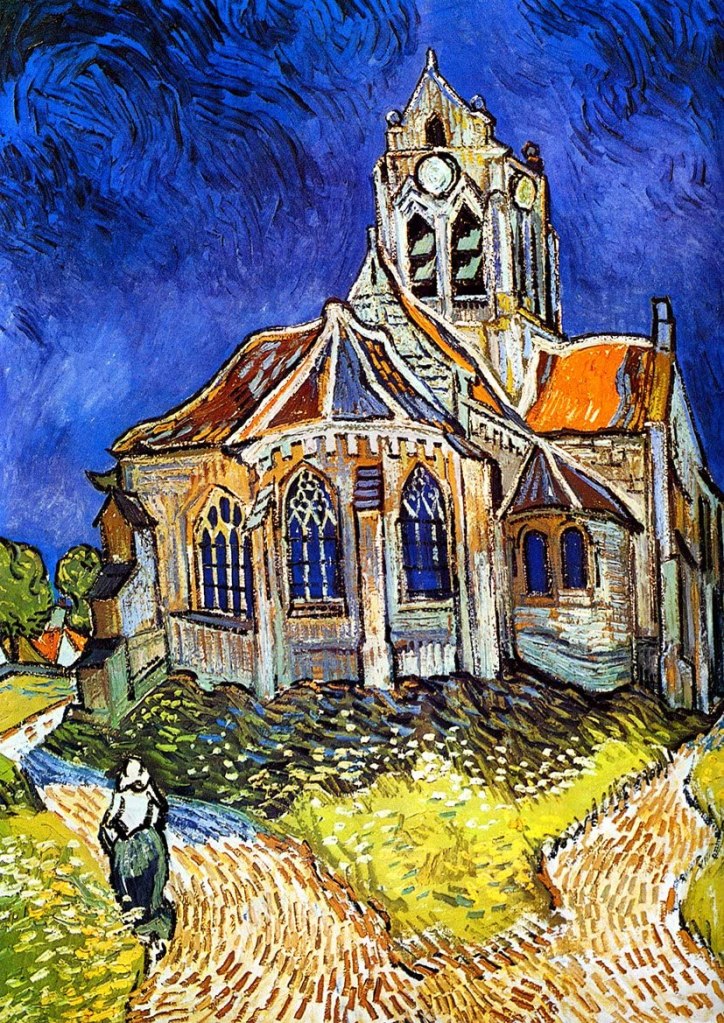
I’ve already posted one of Van Gogh’s paintings in the ABC Wednesday series – I for Irises.  Another painting of his that appeals to me is Church at Auvers-sur-Oise.

What I like about it are the colours and the contrast between the deep blue of the sky, the violet and orange roof of the church and the pastel colours of the divided path and grass in the foreground. I love the perspective, so wonky and wavy, and the details of the church.

This painting featured in the Doctor Who episode Vincent and the Doctor, in which the Doctor discovers a strange and malevolent figure in the painting peering out from one of the church window’s.  An interesting link, I thought – maybe Van Gogh’s depression had a supernatural cause!

ABC Wednesday – S is for …

… Alfred Sisley (1839 – 1899)

Sisley was an English Impressionist landscape artist, born in France where he lived for most of his life.

This is one of his paintings that particularly appeals to me – Small Meadows in Spring (c.1881)

This shows ‘le Chemin des Petits Prés‘, an oil painting of a riverside path which ran along the left bank of the Seine, connecting the villages of Veneux and By. The path has now been replaced by a paved walkway. The village visible on the opposite bank is Champagne.

R is for Renoir: La Loge

Pierre-Auguste Renoir (1841 – 1919), French Impressionist Artist

I’m spoilt for choice, but on reflection I think La Loge (1874) is my favourite painting by Renoir.

The ‘loge’ is a box at the theatre nearest the stage. This painting is my favourite Renoir because of its fine detail within an Impressionist painting. I love the precise depiction of the lady’s face and jewellery, the soft fabric of her dress, its flimsy lace bodice and cuffs and the splashes of red against the black and white. She is the focus of the painting with the gentleman behind her in the background, but my eyes are also drawn to him with the light glinting on his opera glasses.

This is a painting that draws our attention to where the people are looking – the gentleman is looking up at other people and the lady has put down her opera glasses and is maybe showing  herself to the audience. There is an ambiguity about this painting, which always has me wondering just what is going on.

There is a detailed description of this painting on The Courtauld Gallery’s website, where the painting is held. I was disappointed it wasn’t on display when I visited a couple of years ago.

An ABC Wednesday post.