ABC Wednesday: P is for …

… Peter Rabbit and Beatrix Potter

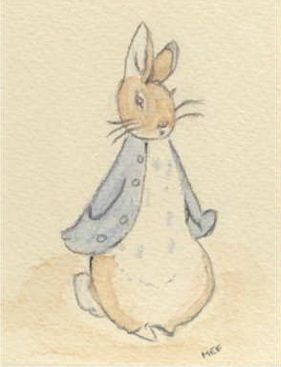
Peter Rabbit first made his appearance in 1902 in Beatrix Potter’s The Tale of Peter Rabbit.

Peter was a very naughty rabbit, who disobeyed his mother, despite being told the terrible fate of his father who had had an accident in Mr McGregor’s garden and was put into a pie by Mrs McGregor. He squeezed under the gate into the garden, ate lots of vegetables and then came face to face with Mr McGregor and escaped by the skin of his teeth.

Helen Beatrix Potter (28 July 1866 – 22 December 1943) was an English author, illustrator, mycologist and conservationist best known for children’s books featuring anthropomorphic characters such as in The Tale of Peter Rabbit which celebrated the British landscape and rural lifestyle. (From Wikipedia)

Her original watercolour paintings and sketches are in the Beatrix Potter Gallery at Hawkshead, Cumbria. Hill Top, the house which she bought with the proceeds from sales of her books and which she used as an artistic retreat from London, is in Near Sawrey, near Hawkshead. She left it to the National Trust. It is open to the public and it remains just as it was when Beatrix lived there.

I love the watercolours in her books and this is my attempt at painting Peter Rabbit, copied from The Tale of Peter Rabbit.

Peter Rabbit 002

An ABC Wednesday post.

ABC Wednesday – O is for On the Balcony by Berthe Morisot

I only ‘discovered’ Berthe Morisot a couple of years ago, but I really like her paintings, especially this one,  On the Balcony, which is of her sister and niece on a balcony in the Passy suburb of Paris, looking out at the city – shown in the distance. It’s a small painting in oil, 1871 – 1872, now held in the Ittleson Collection in New York.

She was one of the French Impressionists and was married to Edouard Manet’s brother, Eugene. Her paintings are often studies of women, either out of doors, as in this one, or in a domestic setting.

An ABC Wednesday post.

The Nun’s Prayer

ABC Wednesday – N is for …

this Nun’s Prayer on how to age gracefully. It’s said to date from the 17th Century but it seems quite modern to me and I don’t think that matters*:

Lord, Thou knowest better than I know myself that I am growing older and will someday be old. Keep me from the fatal habit of thinking I must say something on every subject and on every occasion. Release me from craving to straighten out everybody’s affairs. Make me thoughtful but not moody: helpful but not bossy. With my vast store of wisdom, it seems a pity not to use it all but Thou knowest Lord that I want a few friends at the end.

Keep my mind free from the recital of endless details; give me wings to get to the point. Seal my lips on my aches and pains. They are increasing and love of rehearsing them is becoming sweeter as the years go by. I dare not ask for grace enough to enjoy the tales of others’ pains, but help me to endure them with patience.

I dare not ask for improved memory, but for a growing humility and a lessening cocksureness when my memory seems to clash with the memories of others. Teach me the glorious lesson that occasionally I may be mistaken.

Keep me reasonably sweet; I do not want to be a Saint – some of them are so hard to live with – but a sour old person is one of the crowning works of the devil. Give me the ability to see good things in unexpected places, and talents in unexpected people. And, give me, Lord, the grace to tell them so.

*On second thoughts I think it does matter – but only because I’d like to know the source and I don’t like fabrications – things being made to seem what they are not.

ABC Wednesday – M is for Manet

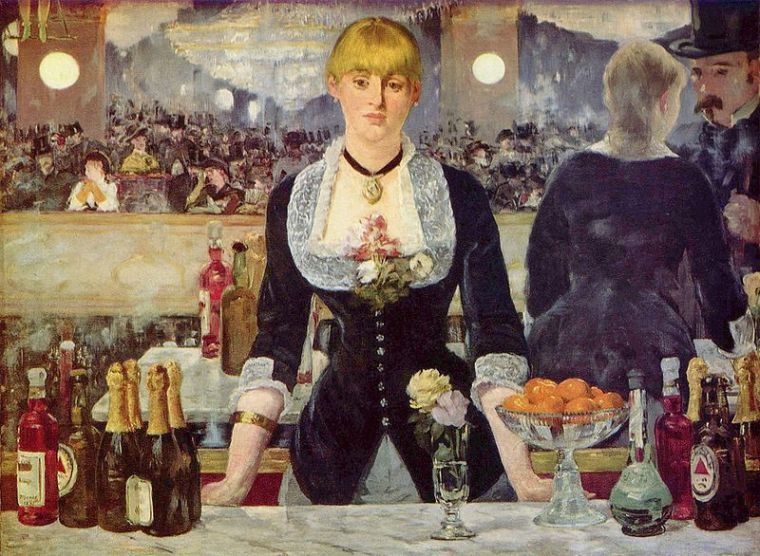
I love the paintings of Edouard Manet, one of the French Impressionists. It is so hard to pick just one painting to show his work, but I’ve chosen A Bar at the Folies Bergère, which to my mind is just marvellous.

I’ve seen this in the flesh, as it were, at the Courtauld Institute at Somerset House on The Strand in London. It’s a lot smaller than I imagined it would be. It’s an ambiguous painting as some see the barmaid as not just selling her wares but as a prostitute and the man reflected in the mirror as a potential client. It’s also intriguing because it’s difficult to tell if the scene in the background is a mirror reflecting what is in front of the barmaid, but then her reflection is not in the right place, nor are the bottles matched up.

I love all the details and colours of this painting as well as the overall effect. I love the atmosphere it creates , with the barmaid isolated, lost in her own thoughts in a crowded room. She is the still point in a busy, noisy place.

Manet A Bar at the Folies Bergeres

Manet painted this in 1882, oil on canvas.

An ABC Wednesday post.

L is for L S Lowry

L S Lowry was an English painter well known for his urban paintings of industrial towns like Salford in Lancashire, scenes peopled by his ‘matchstalk men and his matchstalk cats and dogs‘ (I always thought it was ‘Matchstick’ not ‘Matchstalk’, until I checked the song lyrics today!)

What is less well known (at least to me) was that he also painted many scenes of Berwick-upon-Tweed a seaside town he regularly visited from the 1930s until a couple of years before his death in 1976.

There is a Lowry Trail around the town and here are some photos of one of the locations:

This is ‘On the Sands‘, oil on canvas 1959 (click on the photo to enlarge), showing his matchstick figures. The shelter became dilapidated and was restored in 2001. This is how it looks today:

There is actually a little beach behind this scene:

This is my contribution to ABC Wednesday L is for …

ABC Wednesday – K is for …

… Kingsolver

For my ABC Wednesday posts I’ve been highlighting either authors or artists whose work I enjoy. This week it’s the letter K and there was no doubt about who that brought to mind – Barbara Kingsolver, who is the author of one of my very favourite books – The Poisonwood Bible.

I bought this book in an airport bookshop just before boarding a plane to go on holiday to Cyprus; that gave me plenty of time to read a good chunk of the book before we landed. I remember being very amused by the description of how the Price family got round the forty-four pound per person luggage limit on their flight to the Congo. I’d just struggled to get our luggage allowance down to the required limit for our holiday, but I hadn’t thought of doing what they did – each of them wearing multiple layers of clothing and other goods, such as tools and cake-mix boxes tucked out of sight in their pockets and under their waistbands. Cake-mixes were an essential item as Mrs Price said, ‘they won’t have Betty Crocker in the Congo.’

I soon read the rest of the book by the side of the pool, my hands covered in sun cream removing the gold lettering of Barbara Kingsolver’s name.

This is the book’s description from the back cover:

Told by the wife and four daughters of Nathan Price, a fierce evangelical Baptist who takes his family and mission to the Belgian Congo in 1959, The Poisonwood Bible is the story of one family’s tragic undoing and remarkable reconstruction over the course of three decades in postcolonial Africa. They carry with them all they believe they will need from home, but soon find that all of it – from garden seeds to Scripture – is calamitously transformed on African soil.

It is a brilliant book – one that I’ve read at least twice and would eagerly read again. The setting and historical figures and events are real, even though the characters and story are fictional. Barbara Kingsolver writes in her author’s introduction to the book that she relied on her memory, travel in other parts of Africa and many people’s accounts of the natural, cultural and social history of the Congo/Zaire to write the novel.

She wrote that her parents, who were different in every way from the parents in the book, were

… medical and public-health workers, whose compassion and curiosity led then to the Congo. They brought me to a place of wonders, taught me to pay attention, and set me early on a path of exploring the great, shifting terrain between righteousness and what’s right. (page x)

It’s a book that has stuck long in my memory, maybe because it paints such a remarkable picture based on reality and truth.

I’ve read some of her other books, namely The Bean Trees, Homeland and Other Stories, and Prodigal Summer,and whilst I enjoyed them, none of them were, I thought, as good as The Poisonwood Bible. I have The Lacuna, waiting to be read.

For more information see Barbara Kingsolver’s own website.