The Drowning by Camilla Lackberg: Book Notes

You can’t like every book you read and if I find I’m not enjoying a book I stop reading it. But it’s not always so straight forward because a book can begin well and hook you into the story, get your attention then begin to irritate because it takes so long to get there, and you read on. Then when you get to the end you heave a sigh of relief that you have finished it. It was just about OK.
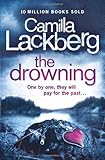
The Drowning by Camilla Lackberg is such a book. It began well – I wrote about the opening paragraphs in this post. They made me want to read on but I had some reservations because of the blurb on the back cover €“ €˜Expert at mixing scenes of domestic cosiness with blood-curdling horror’. Well, there is a lot of domestic cosiness and not really any blood-curdling horror. There are a few nasty scenes, but nothing that made me want to skim read, nothing in fact that I couldn’t read.

Synopsis from the back cover:

Christian Thydell’s dream has come true: his debut novel, The Mermaid, is published to rave reviews. So why is he as distant and unhappy as ever? When crime writer Erica Falck, who discovered Christian’s talents, learns he has been receiving anonymous threats, she investigates not just the messages but also the author’s mysterious past€¦

Meanwhile, one of Christian’s closest friends is missing. Erica’s husband, Detective Patrik Hedström, has his worst suspicions confirmed as the mind-games aimed at Christian and those around him become a disturbing reality.

But, with the victims themselves concealing evidence, the investigation is going nowhere. Is their silence driven by fear or guilt? And what is the secret they would rather die to protect than live to see revealed?

My view:

  • This is the sixth book in Camilla Lackberg’s  Fjällbacka series, so maybe I should have begun with the first book. However, I didn’t feel that I’d jumped into a series without understanding how the characters interacted, or that there were back stories that I should know, so I think it does work as a stand-alone book.
  • It’s written from several perspectives and has a second narrative interspersed with the main one. It’s not clear at first how these are related but it soon becomes apparent.
  • None of the characters came alive for me, apart from Erica  and Patrik and there was little I could visualise from the description of the location – it’s in Sweden, it’s cold and there is snow on the ground.
  • It’s unevenly paced, disjointed with snippets of information being passed between the characters and not shared with the reader, presumably to increase the suspense and tension, which it didn’t achieve for me. As a page-turner it just didn’t work, and I sighed mentally each time it came up.
  • The  description in places reminded me of an exercise I did on a training course in which you had to describe in detail how to make a cup of tea – decide to make a cup, pick up the kettle, take it to the tap etc. I am exaggerating, but you get the picture.
  • It’s predictable – I knew quite early on who the culprit was. That doesn’t necessarily mean it spoils a book, but in this instance it did because I kept on thinking, it’s … I couldn’t see why Erica and the police couldn’t see it either.
  • The ending was so irritating – a cliff hanger, aimed at getting you to read the next book??

I doubt I’ll read any of the other books in the series.

First Chapter First Paragraph Tuesday Intros

Every Tuesday Diane at  Bibliophile by the Sea hosts First Chapter First Paragraph Tuesday Intros, sharing the first paragraph or (a few) of a book she’s reading or thinking about reading soon.

Today I’m in the mood for reading short fiction and picked this book off my to-be-read shelves. It’s Tamburlaine Must Die by Louise Welsh, set in 1593 it tells the story of playwright, Christopher Marlowe’s last days, weaving together fact and fiction. It’s only 140 pages.

It begins:

I have four candles and one evening in which to write this account. Tomorrow I will lodge these papers with my last true friend. If I survive the day, they will light our pipes. But should I not return, he has instructions to secrete this chronicle where it will lie undiscovered for a long span, in the hope that when these pages are found, the age will be different and my words may be judged by honest eyes.

When I read the first four words I immediately thought of the Ronnie Barker and Ronnie Corbett sketch from years ago in the Two RonniesThe Four Candles. I don’t suppose that is the response Louise Welsh would have expected, but there it is, that’s what came to my mind. But this is not a comedy as this summary from Amazon reveals:

London, 1593. A city on edge. Under threat from plague and war, strangers are unwelcome, suspicion is wholesale, severed heads grin from the spikes on Tower Bridge. Playwright, poet and spy, Christopher Marlowe walks the city’s mean streets with just three days to find the murderous Tamburlaine, a killer escaped from the pages of his most violent play. Tamburlaine Must Die is the searing adventure of a man who dares to defy both God and the state and whose murder remains a taunting mystery to the present day.

What do you think? Would you keep reading?

Falling Angels by Tracy Chevalier

I really enjoyed reading Falling Angels by Tracy Chevalier. It’s been sitting unread for several years on the to-be read shelves and I’ve been meaning to read it for ages after reading her earlier book, Girl with a Pearl Earring. I should have got round to it sooner.

It begins:

I woke this morning with a stranger in my bed. The head of blond hair beside me was decidedly not my husband’s. I did not know whether to be shocked or amused.

Well, I thought, here’s a novel way to begin the new century.

It is 1901, the day after Queen Victoria’s death and the ‘I’ in this opening is Kitty Coleman, one of several narrators in this novel set in Edwardian England.

Synopsis from Tracy Chevalier’s website:

Two families visit neighboring graves in a fashionable London cemetery. One is decorated with a sentimental angel, the other an elaborate urn. The Waterhouses revere the late Queen and cling to Victorian traditions; the Colemans look forward to a more modern society. To their mutual distaste, the families are inextricably linked when their daughters become friends behind the tombstones. And worse, befriend the gravedigger’s son.

As the girls grow up and the new century finds its feet, as cars replace horses and electricity outshines gas lighting, Britain emerges from the shadows of oppressive Victorian values to a golden Edwardian summer. It is then that the beautiful, frustrated Mrs Coleman makes a bid for greater personal freedom, with disastrous consequences, and the lives of the Colemans and the Waterhouses are changed forever.

A poignant tale of two families brought reluctantly together, Falling Angels is an intimate story of childhood friendships, sexual awakening and human frailty. Yet its epic sweep takes in the changing of a nation, the fight for women’s suffrage and the questioning of steadfast beliefs.

My view:

This book covers the years from 1901 – 1908 when the world was on the cusp of change just before the outbreak of the First World War, and I found myself wondering what my grandmothers, who would have been much the same age as Kitty Coleman and Gertrude Waterhouse, had thought about it all. What would they have thought about the suffragettes for example? I suspect it would have been similar to one of the characters, Jenny Whitby, the Colemans’ maid servant, as they too were domestic servants. Jenny is horrified when she listens to the suffragettes, whilst she served them with scones at Kitty Coleman’s ‘At Home’:

What I heard made me want to spit. They talked about helping women but it turns out they are choosy about who exactly gets the help. They ain’t fighting for my vote – only for women who own property or went to university. (pages 227 – 228)

Maybe my great aunt who never married and became a matron at a public school would have had more sympathy and agreed with the suffragettes that all women would not get the vote all at once and they had to start somewhere. These are the early years of the suffragette movement culminating in the book in June 1908 with the Women’s March in Hyde Park to demand Votes for Women.

The change between Victorian and Edwardian England was a gradual one, as attitudes to life and death were transformed and the middle-class Colemans and the Waterhouses reflect these changing attitudes with the Colemans looking forward to the modern era, whilst the Waterhouses still value the Victorian traditions. I was interested in the discussion about cremation/burial, with Kitty favouring cremation  in opposition to her mother-in-law as they visited the columbarium (a place for keeping cinerary remains, ie ashes) that had recently been opened at the cemetery. Their discussion with Mr Jackson, the superintendent of the cemetery was a theological one in which he ends the discussion of how God could reunite the body and soul if the body has been burnt by saying:

Surely there is no difference between the decomposed remains of a buried body and the ashes of a burned one. … I would simply say that God is capable of all things, and nothing we do with our remains will stop Him if he wishes to reunite our souls with our bodies. (pages 37 – 38)

I liked the multiple first person narrator structure of the book, giving an all round view of events and the characters’ views and thoughts. It was easy to distinguish between them all, the two daughters, Maude Coleman and Lavinia Waterhouse in particular are very well depicted. The setting too is so well described that I could imagine myself wandering round the cemetery with all its gothic symbology, and see the suffragettes’ march with their banners ‘Deeds not Words’ and hear their cries of ‘Votes for Women’.

It’s an easy to read book that still manages to contain depth both of characterisation and of themes – family relationships, in particular that of mother and daughter, attitudes towards death and mourning, the change in social codes, the perils of being an unmarried mother and the beginnings of the women’s movement. I was fascinated by it!

This page on Tracy Chevalier’s website lists her books – I have one more of hers – The Lady and the Unicorn, I mustn’t wait too long before I read it!

Although I didn’t read this to take part in any challenges I realise that it fits in with several I’ve signed up to do – the Mount TBR Challenge, the Historical Fiction Reading Challenge and the What’s in a Name Challenge (in the category of book with the word ‘down’ or an equivalent in the title).

Sixes: a Selection from the last Six Months of Reading

Jo at The Book Jotter started this meme last year to summarise six months of reading, sorting the books into six categories and she’s done it again this year. Here is my version for 2013, with links to my posts on the books where appropriate:

Six books I have enjoyed, not including Crime Fiction:

Wild Swans etc

  1. Wild Swans: Three Daughters of China by Jung Chang (non-fiction)
  2. The Hand That First Held Mine by Maggie O’Farrell
  3. The Hobbit by J R R Tolkien
  4. After Flodden by Rosemary Goring
  5. Sarah Thornhill by Kate Grenville
  6. The Owl Killers by Karen Maitland

Six Crime Fiction books I’ve enjoyed:

Redemption etc

  1. The Redemption of Alexander Seaton by Shona MacLean
  2. Dead Water by Ann Cleeves
  3. The Glass Room by Ann Cleeves
  4. The Frozen Shroud by Martin Edwards
  5. Cards on the Table by Agatha Christie
  6. Kissing the Gunner’s Daughter by Ruth Rendell

Six authors new to me:

  1.  Roger Deakin – 
  2. Carola Dunn
  3. Julia Stuart
  4. Peter May
  5. Julius Falconer
  6. Patrick Leigh Fermor

Six authors I have read before:

  1. David Lodge
  2. Agatha Christie
  3. J T R R Tolkien
  4. Charles Dickens
  5. Erle Stanley Garner
  6. Kate Morton

Six Books ongoing reading or books on hold, which I’ll be getting back to €¦


  1. Charles Dickens: Life by Claire Tomalin
  2. Agatha Christie: an English Mystery by Laura Thompson
  3. Between the Woods and the Water by Patrick Leigh Fermor
  4. The Drowning by Camilla Lackberg
  5. Parade’s End by Ford Madox Ford
  6. Mary Queen of Scots by Antonia Fraser

Six books that were not as good as I’d expected:

  1. The Lacuna by Barbara Kingsolver
  2. Airs and Graces by Erica James
  3. Small Kindnesses by Fiona Robyn
  4. The Daughters of Fire by Barbara Erskine
  5. The Lollipop Shoes by Joanne Harris
  6. Peaches for Monsieur Le Curé by Joanne Harris

Saturday Snapshots

Today’s Saturday Snapshots are from our visit last week to Polkommet Country Park, West Lothian in Scotland. The Park has some lovely woodland walks alongside the River Almond:

River Almond P1080925Our granddaughter couldn’t resist getting her feet wet:

E & River Almond P1080937 For more Saturday Snapshots see Melinda’s blog West Metro Mommy Reads.

Searching for The Secret River: a Book Beginnings Post

Book Beginnings ButtonGilion at Rose City Reader hosts Book Beginnings on Friday in which you share the first sentence (or so) of the book you are reading, along with your initial thoughts about the sentence, impressions of the book, or anything else the opener inspires.

I’m currently reading Searching for The Secret River by Kate Grenville. It begins:

In the puritan Australia of my childhood, you could only get a drink on a Sunday if you were a ‘bona fide traveller’. That meant you had to have travelled fifty miles or more. Around Sydney a ring of townships at exactly the fifty-mile mark filled with cheerful people every Sunday. One of them was a little place called Wiseman’s Ferry.

I loved Kate Grenville’s book The Secret River, so when I discovered that she had written a book about how she came to write it I just had to get a copy. Her interest began with her great-great-great grandfather, Solomon Wiseman,the original ferryman at Wiseman’s Ferry. Her mother had told her stories about him, but she wanted to know more about, what he was like and what he might have done when he first encountered Aboriginal people … she needed to know.

I haven’t finished the book yet, but it is fascinating – seeing how she went about her research into family history and how she imagined his life from facts gleaned from the records and the places he had lived.