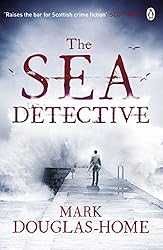
The Sea Detective by Mark Douglas-Home

Lovereading.co.uk  sent me a copy of  The Sea Detective by Mark Douglas-Home for review in advance of the publication of the third title in the series The Malice of Waves on 19 May and I’m glad to say that I thoroughly enjoyed it.

It’s one of those books that grabbed my attention right from the start when two young teenage girls from India are sold into the sex trafficking trade, completely unaware of the dangers and terror that awaits them. Then, Edinburgh-based oceanographer, Cal McGill is caught on camera planting a rare wild flower in the garden of the Scottish Environment Minister in a campaign to make politicians aware of the dangers of climate change. Detective Inspector Ryan wants to charge him with vandalism but the minister’s wife wants to keep the plant!

From then on the story gets complicated. It’s more of an investigative story than crime fiction, with several strands to the story, but it’s so well told that I had no difficulty in following all of them: a story of unsolved mysteries both from the present day and from the Second World War, and of two Indian girls, sold into the sex trafficking trade. It’s set mainly in Scotland with a strong sense of place throughout.

The main characters are all fully rounded and complex – Cal McGill works for environmental organisations tracking oil spills using wind speeds and data on ocean currents; DI David Ryan and DC Helen Jamieson are investigating the appearance of severed feet in trainers that had been washed on shore on islands miles apart – tests had revealed that they belonged to the same body; and Basanti, one of the Indian girls, whose resourcefulness saved her life. I especially liked Helen Jamieson, the overweight policewoman, whose boss, Ryan mistakenly thinks is stupid, and the way she deals with him.

The strand that interested me most concerns Cal’s grandfather, from the (fictional) island of Eilean Iasgaich. He had died during the Second World War, washed overboard during a storm, whilst their trawler was patrolling the sea around Norway, one of seven men who had died ‘“ and yet his name had not been included in the island’s war memorial. Cal eventually discovers the truth about what actually happened and how his grandfather met his death.

It’s a gripping and emotional story. I loved it.

The Sea Detective is Mark Douglas-Home’s first book. Before writing books he was the editor of Scotland’s leading daily newspaper, The Herald, and The Sunday Times Scotland. He is the nephew of the late Sir Alec Douglas-Home who was Prime Minister of the UK from October 1963 to October 1964. He lives in Edinburgh.

I’m looking forward to reading his second book, The Woman who Walked into the Sea as well as his third, The Malice of Waves.

Reading Challenges: Read Scotland 2016 – by a Scottish author and set in Scotland.
My Week in Books: 27 April 2016

This Week in Books is a weekly round-up hosted by Lypsyy Lost & Found, about what I’ve been reading Now, Then & Next.

IMG_1384-0

A similar meme,  WWW Wednesday is run by Taking on a World of Words.

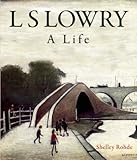
Now: I’m still reading L S Lowry: A Life by Shelley Rohde. Lowry is one of my favourite artists, well known for his urban paintings of industrial towns but his work covers a wide range of themes and subjects, from landscapes and seascapes to portraits.

I’m also reading The Voyage Out by Virginia Woolf, her first novel.
Blurb: Rachel Vinrace is on board her father’s ship, the Euphrosyne, on a voyage to South America. Despite being accompanied by her father and her aunt and uncle, Helen and Ridley Ambrose, the passage leads to Rachel’s awakening, both as a woman and as an individual. As the ship is wracked by storms, she finds herself romantically entangled with Richard Dalloway, an encounter that leaves her troubled and confused. Upon arrival in Santa Marina, Rachel strikes off alone to contemplate her identity, and finds herself with the aspiring novelist Terence Hewet. As the emerging romance between the two is complicated by their disagreements about gender and art, another storm, and tragedy, appear on the horizon.

Then: I’ve recently finished The Sea Detective by Mark Douglas-Home, a crime fiction novel with a difference and a book I thoroughly enjoyed. This is the first in an unusual crime series.

Blurb: Cal McGill is an Edinburgh-based oceanographer, environmentalist and one-of-a-kind investigator. Using his knowledge of the waves – ocean currents, prevailing winds, shipping records – McGill can track where objects have come from, or where they’ve gone. It’s a unique skill that can help solve all sorts of mysteries. Such as when two severed feet wash up miles apart on two different islands off the coast of Scotland. Most strangely, forensic tests reveal that the feet belong to the same body.

As Cal McGill investigates, he unravels a web of corruption, exploitation and violence, which threatens many lives across the globe – very soon including his own…

My review is to follow.

Next: this is always a step into the unknown and at the moment I’m wondering whether to read one of my TBR books, such as Poirot Investigates a collection of short stories by Agatha Christie, first published in 1924.
Blurb: First there was the mystery of the film star and the diamond’¦ then came the ‘˜suicide’ that was murder’¦ the mystery of the absurdly cheap flat’¦ a suspicious death in a locked gun-room’¦ a million dollar bond robbery’¦ the curse of a Pharaoh’s tomb’¦ a jewel robbery by the sea’¦ the abduction of a Prime Minister’¦ the disappearance of a banker’¦ a phone call from a dying man’¦ and, finally, the mystery of the missing will.

What links these fascinating cases? Only the brilliant deductive powers of Hercule Poirot!

It’s probably about time I read some more of Agatha Christie’s short stories!

First Chapter, First Paragraph

First chapterEvery Tuesday Diane at Bibliophile by the Sea hosts First Chapter First Paragraph Tuesday Intros, where you can share the first paragraph, or a few, of a book you are reading or thinking about reading soon.

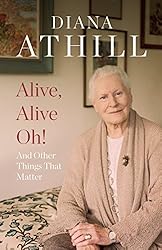
One of the books I’ll be reading soon is Alive, Alive Oh! And Other Things That Matter by Diana Athill OBE. From what I’ve read so far it promises to be very interesting. Born in 1917 Diana Athill helped Andre Deutsch establish his publishing company and worked as a literary editor for many years. She is also a novelist and has published several memoirs.

Alive, Alive Oh! And Other Things That Matter begins:

‘Sometimes I sits and thinks and sometimes I just sits’: I have forgotten who it is who is supposed to have said that, but it is a good description of a state quite often observed in a retirement home, and considered pitiable. Disconcertingly, I recently realized that I myself (not very often, just now and then) might say those very words if somebody asked me what I was doing. It is not a welcome thought, but less dreadful than it might be because I now know from experience that the state is not necessarily pitiable at all. It is even pleasant – or it can be. That probably depends on the nature of the person sitting. To me it has been, because the thinking turns out to be about events in the past which were enjoyable, and when the mind relaxes itself it is those same events which float in and out of it.

Blurb:

What matters in the end? In the final years of life, which memories stand out? Writing from her retirement home in Highgate, London, as she approaches her 100th year, Diana Athill reflects on what it is like to be in her nineties, and on the moments in her life which have risen to the surface and sustain her in her later years.

She recalls in sparkling detail the exact layout of the garden of her childhood, a vast and beautiful park attached to a large house, and writes with humour, clarity and honesty about her experiences of the First and Second World Wars, and her trips to Europe as a young woman. In the remarkable title chapter, Athill describes her pregnancy at the age of forty-three, losing the baby and almost losing her life, and her gratitude on discovering that she had survived.

With vivid memories of the past mingled with candid, wise and often very funny reflections on the experience of being very old, Alive, Alive Oh! reminds us of the joy and richness to be found at every stage of life.

Teaser Tuesday newTeaser Tuesday is a weekly bookish meme, hosted by MizB of Books and a Beat. ! Just do the following:

‘¢ Grab your current read
‘¢ Open to a random page
‘¢ Share two (2) ‘teaser’sentences from somewhere on that page

My teaser is from page 29:

It annoys me when someone describes this country in the late 1940s and 1950s as being dreary, an opinion usually based on the continuation of rationing for some years after the war’s end. People who see it like that can’t have lived through the war. Those of us still alive who did so see it differently.

It’s a short book – just 168 pages – but she seems to have packed so much into it.

My Reginald Hill Reading Project

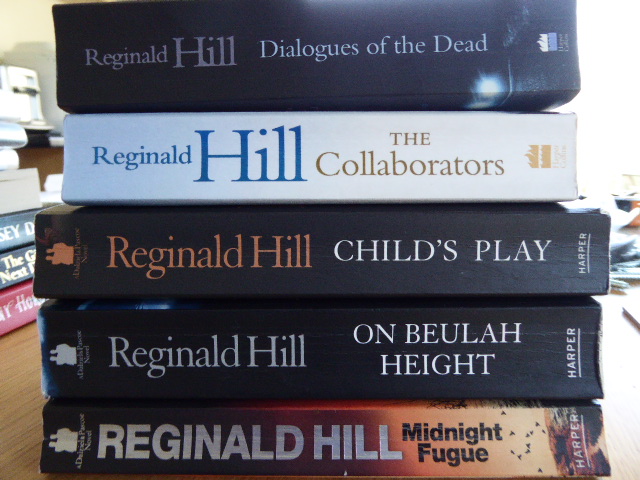
Inspired by reading Reginald Hill’s Bones and Silence recently I decided I want to read more of his books and I’ve made a page to record my progress. When I visited two secondhand bookshops this last week I stocked up on as many of his books that were on the shelves that I haven’t read:

P1010900

They are all Dalziel and Pascoe novels, apart from The Collaborators, which is a standalone novel set in 1945 in Paris. From the top down they are (synopses from Amazon, essentially the blurbs on the back covers) :

  • Dialogues of the Dead: A man drowns. Another dies in a motorbike crash. Two accidents ‘ – yet in a pair of so-called Dialogues sent to the Mid-Yorkshire Gazette as entries in a short story competition, someone seems to be taking responsibility for the deaths.In Mid-Yorkshire CID these claims are greeted with disbelief. But when the story is leaked to television and a third indisputable murder takes place, Dalziel and Pascoe find themselves playing a game no one knows the rules of against an opponent known only as the Wordman.
  • The Collaborators:Paris, 1945. In the aftermath of the French liberation, Janine Simonian stands accused of passing secret information to the Nazis.She is dragged from her cell before jeering crowds, to face a jury of former Resistance members who are out for her blood. Standing bravely in court, Janine pleads guilty to all charges.Why did Janine betray, not just her country, but her own husband? Why did so many French men and women collaborate with the Nazis, while others gave their lives in resistance?What follows is a story of conscience and sacrifice that portrays the impossible choice between personal and national loyalty during the Nazi occupation.
  • Child’s Play:When Geraldine Lomas dies, her huge fortune is left to an animal rights organization, a fascist front and a services benevolent fund. But at her funeral a middle-aged man steps forward, claiming to be her long-lost son and rightful heir. He is later found shot dead in the police car park, leaving behind a multitude of suspects. And Superintendent Dalziel and Peter Pascoe find themselves plunged into an investigation that makes most of their previous cases look like child’s play’¦
  • On Beulah HeightFifteen years ago they moved everyone out of Dendale. They needed a new reservoir and an old community seemed a cheap price to pay. But four inhabitants of the valley could not be moved, for nobody knew where they were: three little girls who had gone missing, and the prime suspect in their disappearance, Benny Lightfoot. This was Andy Dalziel’s worst case and now he looks set to relive it. Another child goes missing in the next valley, and old fears arise as someone sprays the deadly message on Danby bridge: BENNY’S BACK!
  • Midnight FugueGina Wolfe is searching for her missing husband, believed dead, and hopes Superintendent Andy Dalziel can help. What neither realize is that there are others on the same trail. A tabloid hack with some awkward enquiries about an ambitious MP’s father. The politician’s secretary who shares his suspicions. The ruthless entrepreneur in question ‘and the two henchmen out to make sure the past stays in the past.Four stories, two mismatched detectives trying to figure it all out, and 24 hours in which to do it: Dalziel and Pascoe are about to learn the hard way exactly how much difference a day makes’.

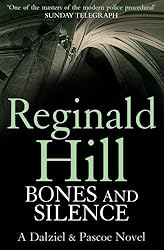
Bones and Silence by Reginald Hill

I found a lot to enjoy in Bones and Silence, Reginald Hill’s 11th book in his Dalziel and Pascoe series, first published in 1990.

Blurb (from the back cover):

When Detective Superintendent Andy Dalziel witnesses a bizarre murder across the street from his own back garden, he is quite sure who the culprit is. After all, he’s got to believe in what he sees with his own eyes. But what exactly does he see? And is he mistaken? Peter Pascoe thinks so.

Dalziel senses the doubters around him, which only strengthens his resolve. To make matters worse, he’s being pestered by an anonymous letter-writer threatening suicide. Worse still, Pascoe seems intent on reminding him of the fact.

Meanwhile the effervescent Eileen Chung is directing the Mystery Plays. And who does she have in mind for God? Dalziel of course. He shouldn’t have too much difficulty in acting the part …

My thoughts:

I liked all the complications of plot and sub-plots in this book and the interplay of the characters. It’s full of interesting characters and humour, but it is the plot that takes precedence. It is so tricky, with numerous red herrings and plot twists. Dalziel is positive that he saw Philip Swain shoot his wife; shooting her at close range, destroying much of her face and removing the top of her head. But Swain insists it was an accident – he was trying to stop her from killing herself and the gun went off. The only other witness, Greg Waterson, backs up Swain’s story – and then disappears.

My image of Dalziel comes from Warren Clark’s portrayal of him in the TV series because I watched the programmes before I read any of Hill’s books. To me Warren Clarke is Dalziel, just as David Suchet is Poirot. Dalziel is a larger than life character, speaks his mind and is never politically correct. He is is positive in his belief in Swain’s guilt even when everyone else thinks his wife’s death was an accident:

Andrew Dalziel, despite what his friends said, was no paranoiac. He did not believe himself to be infallibly perfect or unjustly persecuted. His great strength was that he walked away from his mistakes like a horse from its droppings, and as he himself once remarked, if you leave crap on people’s carpets, you’ve got to expect a bit of persecution.

But when he believed himself right, he did not readily accept evidence that he might be wrong, not while there was any stone left unturned. (page 242)

But it doesn’t help that Swain has been cast in the role of the devil opposite Dalziel’s God in the mystery play and the two are constantly sparring. The whole sub-plot of the mystery play is brilliant. Each Part of the book is headed by a quotation from the York Cycle of Mystery Plays, each one relevant to the events that follow. And the vision of Dalziel as God is so funny, especially when the fat man has to climb a narrow ladder up the back of a triple decker stage mounted on a flat car. Dalziel has to sit on a tiny platform over the upper deck, perched above polystyrene clouds.

Pascoe has recently returned to work after a period of sick leave, following an accident and, impatient to find evidence against Swain, Dalziel delegates the anonymous letters to Pascoe to discover who has been sending them. This sub-plot about the identity of the letter writer is the only part of the book that I’m not sure about. I had several thoughts about who it could be, but I was wrong and in the end when the author was revealed I wasn’t completely convinced that that character could have known all the information given in the letters. Still, it makes a dramatic conclusion to the book and came as a complete surprise to me.

Although Bones and Silence is a long book (524 pages) I read it quite quickly, completely absorbed in its mysteries and impressed both with the ingenuity of the plot and the quality of the writing. I really mustn’t leave it very long before I read some more of Reginald Hill’s books.

  • Paperback: 528 pages
  • Publisher: Harper (25 Jun. 2009)
  • Language: English
  • ISBN-10: 0007313128
  • ISBN-13: 978-0007313129
  • Source: I bought the book

Reginald Charles Hill FRSL (3 April 1936 ‘“ 12 January 2012) was an English crime writer, and the winner in 1995 of the Crime Writers’ Association Cartier Diamond Dagger for Lifetime Achievement.

Reading Challenges: Mount TBR Reading Challenge 2016 – a book I’ve owned for four years.

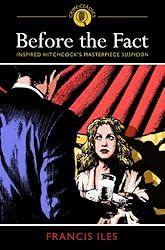
Before the Fact by Francis Iles

On the face of it Before the Fact is a straight forward story. It tells the tale of wealthy, intelligent but plain Lina McLaidlaw whose family are against her marriage to the handsome, charming and fascinating Johnnie Aysgarth; Lina’s father tells her Johnnie is a ‘rotter’. But right from the opening paragraph it’s obvious that Lina’s father is right. In fact Johnnie is much worse than her father realised:

Some women give birth to murderers, some go to bed with them, and some marry them. Lina Aysgarth had lived with her husband for nearly eight years before she realized that she was married to a murderer.

First published in 1932 by Francis Iles (* see below*), Before the Fact is a Golden Age crime fiction novel that is a psychological character study of its two main characters, Lina and Johnnie. It’s cleverly written. Lina slowly realises Johnnie’s true nature – that of a compulsive liar and gambler, a manipulative scoundrel who thinks nothing of being unfaithful, even of arranging a murder, or two.  But still she stays with him, trying to control and change him, believing his lies until she has to accept him for what he is, with disastrous consequences.

As Lina’s eyes are slowly opened I became exasperated at her naiveté, her acceptance of what she she has discovered about Johnnie. She comes across as a fool besotted by him and desperate for his love and attention, and even though her suspicions are aroused she still deliberately ignored all the warning signs, descending from panic, terror, horror and despair into passivity. She is maddening, a born victim and I began to wonder how it could possibly end. It was even more chilling than I had imagined.

*About the Author (copied from the publishers):

Frances Iles was a pseudonym of Anthony Berkeley Cox, who was born in 1893 in Watford. After serving in the army during the First World War, Berkeley worked as a journalist for many years before his first foray into the crime genre with The Layton Court Mystery (1925).

His two primary non-de-plumes were Francis Iles and Anthony Berkeley. As the former, he was a master of the psychological suspense genre, always with a wry humorous tenor to his writing; as the latter he acted as a trailblazer in the classic ‘Golden Age’ of crime and detective novels.

An intensely private man who always shunned publicity, Berkeley died in 1971.

As I read I marked a few passages that although not directly connected with the story I found interesting:

About artistic criticism – in particular female criticism:

If one did not happen to like a certain book, picture, or piece of music, one took it for granted that the book, picture, or piece of music was just bad; and the people who thought it was good, were, quite simply and plainly, mistaken. It never occurred to any female critic that a book might possibly be above her own level of intelligence (the men of course read only detective stories). (page 42)

on artists:

‘Aren’t artists intelligent?’ Lina asked innocently.

‘Of course they’re not. Most of them haven’t got the brains of a mouse. They just have this odd knack of being able to put things on canvas, and that’s all. They are the dullest of all the creators. Musicians are the nicest: you never hear a musician talk about himself at all. Then the really good authors. They don’t thrust their work down one’s throat; they’ve no need to. Then the second-rate authors, who do, and have. And then the painters, a long way bottom.’ (page 125)

I wonder who he was referring to?

And on murder:

When you incite a person to do something which both of you know will probably kill him – is that legally murder or not? (page 177)

Lina discusses this point with Isobel Sedbusk (based on Dorothy L Sayers), a writer of detective stories, thinking that it wasn’t ‘real murder, like giving the man poison, or shooting him, or anything like that.’ Isobel replies:

‘No, I’m inclined to doubt whether it would be murder, from the legal point of view. The legal definition of murder is ‘to kill with malice aforethought’. Still, you’ve got the malice aforethought all right. And if he knowingly incited the man to commit an act which would result in his death …’

Malice Aforethought – another novel by Francis Iles (published in 1931) begins with revealing the identity of the murderer. I shall have to read that one soon.

Reading Challenges: