It’s time again for Six Degrees of Separation, a monthly link-up hosted by Kate at Books Are My Favourite and Best. Each month a book is chosen as a starting point and linked to six other books to form a chain. A book doesn’t need to be connected to all the other books on the list, only to the one next to it in the chain.
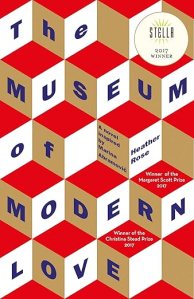
This month starts with The Museum of Modern Love by by Heather Rose (Kate’s pick was inspired by Sue’s recent post about writers and artists). I haven’t read this, but I would like to. This is the description on Amazon UK:
Arky Levin, a film composer in New York, has promised his wife that he will not visit her in hospital, where she is suffering in the final stages of a terminal illness. She wants to spare him a burden that would curtail his creativity, but the promise is tearing him apart. One day he finds his way to MOMA and sees Mariana Abramovic in The Artist is Present. The performance continues for seventy-five days and, as it unfolds, so does Arky. As he watches and meets other people drawn to the exhibit, he slowly starts to understand what might be missing in his life and what he must do.
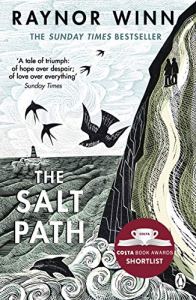
My first link is via a terminal illness to The Salt Path, Raynor Winn’s memoir about walking the South Coast Path when Moth her husband was diagnosed with a terminal illness. They were homeless, with no means of income except for £48 pounds a week. They had lost their home, business and livelihood, after investing in one of a friend’s companies that had failed. It is about the determination to live life, about overcoming pain and hardship, and the healing power of nature. It is about homelessness and the different reactions and attitudes of the people they met when they told them they were homeless.
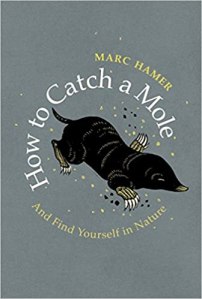
My second link is How to Catch a Mole by Marc Hamer, part memoir, part a nature study of the British countryside, part poetry, and, of course, about moles. After leaving school Marc Hamer was homeless for a while. He has worked in art galleries, marketing, graphic design and taught creative writing in a prison before becoming a gardener. And before writing this book he had been a traditional molecatcher for years.
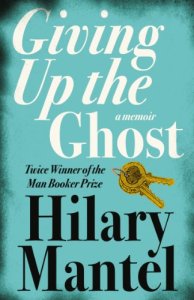
My third link is Hilary Mantel’s Giving Up the Ghost, a remarkable memoir. It came across to me as being clear, honest and very moving. She thought it was because of her that her parents were not happy and that without her they would have had a chance in life. It didn’t get any better when her father left home and she was left to live with two younger brothers, their mother and her mother’s lover. Home was a place where secrets were kept and opinions were not voiced. Her experience of ghosts at the age of 7 was horrifying as she felt as though something came inside her, ‘some formless, borderless evil’.
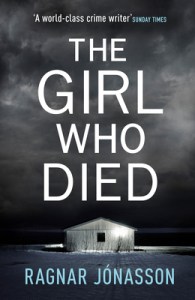
My fourth link is The Girl Who Died by Ragnar Jonasson, Icelandic noir, a mix of horror and psychological thriller, with a strong sense of place. Skálar is a close-knit community that doesn’t welcome newcomers, keeping its secrets well hidden. The only person who welcomes Una, to the village is Salka, the mother of Edda, one of the two girls Una is to teach. Her house is said to be haunted by the ghost of a young girl who had died fifty years earlier,
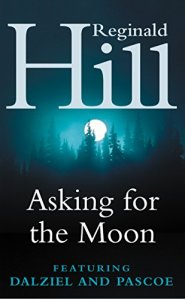
My fifth link is Asking for the Moon by Reginald Kill, a collection of four novellas. Two of them feature ghosts, Pascoe’s Ghost and Dalziel’s Ghost. But I think that the best one is the first story, The Last National Service Man which tells how Dalziel and Pascoe first met. Neither of them are impressed by the other. Dalziel thinks Pascoe is everything he dislikes – a graduate, well spoken, and a Southerner from south of Sheffield. Pascoe thinks Dalziel is an archetypical bruiser who got results by kicking down doors and beating out questions in Morse code on a suspect’s head.
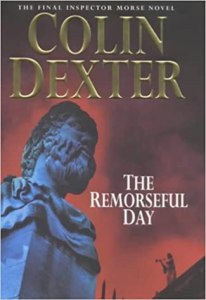
My final link is to the final Inspector Morse novel, The Remorseful Day by Colin Dexter. The plot is detailed, complex and as usual, with Morse, a puzzle type murder mystery with plenty of challenging clues. Sergeant Lewis is left to investigate the murder of nurse Yvonne Harrison that had remained unsolved for a year. When Morse phones to say he is feeling unwell Lewis is most concerned – Morse seldom mentioned his health, what is wrong with him?
The main focus of the book is on Morse and how he copes with his illness and his drinking habits. It becomes obvious just how alone he is in the world and how devastating his situation is to Lewis.
The first three books in my chain are memoirs and the other three are crime fiction/psychological thriller novels. Beginning in America it travels to the UK, then to Iceland, before ending back in the UK.
Next month (September 7, 2024), we’ll start with After Story by Larissa Behrendt.


Nice chain. I especially like that first link.
LikeLiked by 1 person
Thanks Cathy.
LikeLiked by 1 person
Always nice to see Hilary Mantel’s Giving Up the Ghost mentioned. I read it some time ago but the passage you refer to has stayed with me. Very powerful and quite chilling.
LikeLiked by 1 person
Hilary Mantel was such a great storyteller. Very sad there will be no more books by her.
LikeLiked by 1 person
You’ve got a terrific chain here, Margaret, The Remorseful Day has stayed with me since I read it. And I’d actually like to read The Museum of Modern Love. I’ve heard good things about it.
LikeLiked by 1 person
I had put off reading The Remorseful Day because it was the last of the Morse books.
LikeLiked by 1 person
Interesting chain. I am kind of glad I didn’t go the illness route, but you did a lovely job with it.
LikeLiked by 1 person
Thank you, Davida.
LikeLiked by 1 person
I like your turn from art to nature, I very much enjoyed The Salt Path, and must read her sequel to it one day soon.
LikeLiked by 1 person
Thanks Annabel. I can’t think why but your comment had gone into the Spam and it was only this morning that I found it and fished it out!
LikeLike
I haven’t read any of these, but I would like to read the Hilary Mantel memoir. How to Catch a Mole sounds unusual!
LikeLiked by 1 person
How to Catch a Mole, is well worth reading. I knew very about moles before and found it fascinating.
LikeLike
Very good chain. I forgot to do it!
LikeLiked by 1 person
Thanks, Hope.
LikeLike
Thanks for the link Margaret! I enjoyed your chain. I haven’t read any of your books, but my reading group is going to do Raynor Winn’s memoir this year! And, I like your link from that to another English nature-theme memoir.
Oh, and I’m going to look for a Colin Dexter novel for my husband as he likes Morse but has never read one of his novels. I think I should get the first one though.
LikeLiked by 1 person
LikeLiked by 1 person
I’ve been reading the Morse books out of order, but it’s a good idea to read them from the beginning. The films and TV adaptations are mostly faithful to the books.
LikeLike
That’s interesting to know – about their being faithful to the books. I’m assuming Endeavour is not Colin Dexter?
LikeLike
Endeavour is young Morse in the TV series.
LikeLike
Oh yes, I know. My question was are there any Colin Dexter books about the young Morse or are the Endeavour stories made just for TV?
LikeLiked by 1 person
Oh, I see. I haven’t found any Endeavour books, just DVDs of the TV series.
LikeLike
The stories were created by Russell Lewis.
LikeLike
Thanks Margaret …
LikeLike
Unusually for me, I’ve read four of the books you mention, and not just the crime novels, but also the Hilary Mantel. Feeling quite pleased with myself about that. Lovely chain, as usual, Margaret.
LikeLiked by 1 person
Thank you
LikeLike
How to Catch A Mole and Hilary Mantel’s Memoir both sound really intriguing! I enjoyed your chain a lot :)
My #6Degrees .
LikeLiked by 1 person
That’s a very nice chain. Reminded me that I do really need to get to Salt Path–been planning to for a little too long now. How to Catch a Mole sounds very much up my alley too!
LikeLike