Top Ten Tuesday: Most Anticipated Releases of the Second Half of 2019

top-ten-tuesday-new

Top Ten Tuesday is a weekly meme created by The Broke and the Bookish and now hosted by Jana at That Artsy Reader Girl. For the rules see her blog.

This week’s topic: Most Anticipated Releases of the Second Half of 2019. 

Beneath the Surface by Fiona Neill – 11 July

After a chaotic childhood, Grace Vermuyden is determined her own daughters will fulfil the dreams denied to her. Lilly is everyone’s golden girl, the popular, clever daughter she never had to worry about. So when she mysteriously collapses in class, Grace’s carefully ordered world begins to unravel.

The Bear Pit by S G MacLean – 11 July

The 4th book in the Seeker series, set in London in 1656, Captain Seeker is back in the city, on the trail of an assassin preparing to strike at the heart of Oliver Cromwell’s Republic.

The Sleepwalker by Joseph Knox – 11 July

The third book in the DC Aidan Waits series, set in Manchester. As a series of rolling blackouts plunge the city into darkness, Waits sits on an abandoned hospital ward, watching a mass murderer slowly die. Transferred from his usual night shift duties and onto protective custody, he has just one job … to extract the location of Martin Wick’s final victim before the notorious mass murderer passes away.

Ask Again, Yes by Mary Beth Keane – 8 August

A gripping and compassionate family drama set between neighbours in suburban New York – Gillam, upstate New York: a town of ordinary, big-lawned suburban houses. The Gleesons have recently moved there and soon welcome the Stanhopes as their new neighbours. Lonely Lena Gleeson wants a friend but Anne Stanhope – cold, elegant, unstable – wants to be left alone.

The Family Upstairs by Lisa Jewell – 8 August

In a large house in London’s fashionable Chelsea, a baby is awake in her cot. Well-fed and cared for, she is happily waiting for someone to pick her up. In the kitchen lie three decomposing corpses. Close to them is a hastily scrawled note. They’ve been dead for several days. Who has been looking after the baby? And where did they go?

Tidelands by Philippa Gregory – 20 August

Midsummer’s Eve, 1648, and England is in the grip of civil war between renegade King and rebellious Parliament.  The struggle reaches every corner of the kingdom, even to the remote Tidelands – the marshy landscape of the south coast.

Alinor, a descendant of wise women, crushed by poverty and superstition, waits in the graveyard under the full moon for a ghost who will declare her free from her abusive husband.  Instead she meets James, a young man on the run, and shows him the secret ways across the treacherous marsh, not knowing that she is leading disaster into the heart of her life.

This Poison Will Remain by Fred Vargas – 20 August

This is the 9th in the Commissaire Adamsberg seriesWhen three elderly men are poisoned by spider venom, everyone assumes that the deaths are tragic accidents. But at police headquarters in Paris, Inspector Adamsberg begins to suspect that the case is far more complex than first appears.

The Art of Dying by Ambrose Parry – 29 August

Edinburgh, 1850. Despite being at the forefront of modern medicine, hordes of patients are dying all across the city, with doctors finding their remedies powerless. But it is not just the deaths that dismay the esteemed Dr James Simpson – a whispering campaign seeks to blame him for the death of a patient in suspicious circumstances.

The Second Sleep by Robert Harris – 5 September

1468. A young priest, Christopher Fairfax, arrives in a remote Exmoor village to conduct the funeral of his predecessor. The land around is strewn with ancient artefacts – coins, fragments of glass, human bones – which the old parson used to collect. Did his obsession with the past lead to his death?

The Institute by Stephen King – 10 September

Deep in the woods of Maine, there is a dark state facility where kids, abducted from across the United States, are incarcerated. In the Institute they are subjected to a series of tests and procedures meant to combine their exceptional gifts – telepathy, telekinesis – for concentrated effect.

Luke Ellis is the latest recruit. He’s just a regular 12-year-old, except he’s not just smart, he’s super-smart. And he has another gift which the Institute wants to use…
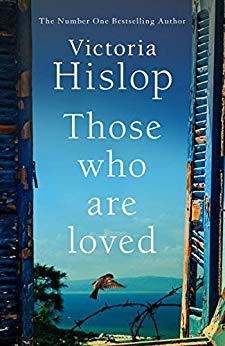
Those Who Are Loved by Victoria Hislop

Those who are loved

Headline Review|30 May 2019|496 pages|Review e-book copy|4.5*

Those Who Are Loved by Victoria Hislop is one of the most moving novels I’ve read for a long time. But it begins slowly and it was only at about the halfway stage that it really took off for me. And now I’ve come to write about it I’m finding it difficult to put into words just how exceptional I think it is. Whatever I write will not do it justice – it really is ‘an epic tale of an ordinary woman compelled to live an extraordinary life‘.

It is historical fiction ‘set against the backdrop of the German occupation of Greece, the subsequent civil war and a military dictatorship, all of which left deep scars.’

The main character is Themis Koralis/Stravidis (in Greek mythology Themis is the personification of fairness and natural law). In 2016 she is a great grandmother and realising that her grandchildren knew very little about Greek history she decided to tell them her life story, beginning from when she was a small child in the 1930s, through the German occupation of Greece during the Second World War, the civil war that followed, then the oppressive rule of the military junta and the abolition of the Greek monarchy, up to the present day.

As she grew up she and her brothers and sister had many disagreements, holding differing political opinions, which came to a head when the Germans invaded Athens in 1941.  Themis and her brother Panos joined the communist party in their fight against the Germans, whilst her other brother Thanasis and her sister Margarita opposed them, hating the communists’ views and believing that Germany was a friend of Greece, not a foe.

During the civil war Themis was imprisoned on the islands of exile, Makronisos and then Trikeri. Her experiences were horrific, but only strengthened her determination to survive. On Makronisos she met Aliki, also a member of the communist party, and when Aliki is condemned to death, Themis promises to find and raise Aliki’s son, Nikos as her own.

During the early part of the book I felt it was rather like reading a history book. But then, the book sprang to life, the pace increased, and I was totally gripped and moved as history and fiction came together dramatically in glorious technicolor, telling the story of the characters personal lives and their parts in the action.

I have only skimmed the surface of this book – there is so much more to the story than I can mention here. But after the slow start I loved it, even though it is not a book I can say I ‘enjoyed’. It is a powerful and shocking story of remarkable characters faced with brutal and traumatic events. It has a completely convincing and vivid sense of location. I knew next to nothing about this period in Greek history before and I was astounded by what I learnt. 

On a personal note, the earthquake in Athens on 7 September 1999 plays a part in the story. We were there then on holiday. We had been out at sea on that day and travelled back to our hotel through Athens, seeing some of the destruction and terror it caused. The earthquake had been felt at our hotel in Marathon – people had been thrown out of the swimming pool and later that evening we could still feel the aftershocks.

Many thanks to the publishers, Headline Review, for my review copy via NetGalley.

Library Book Reservations

Liby Bks June 2019

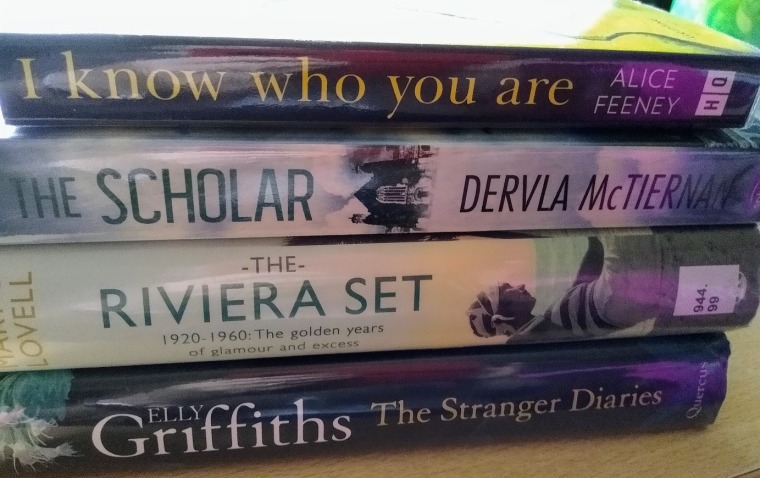
Why is it that when I reserved these four books at separate times over a period of months they all arrive within one week? And I now have only until the beginning of July in which to read them?  I have a feeling I won’t make it, so I hope no one else has reserved them …

I think I’d better start with I Know Who You Are or The Stranger Diaries, as I suspect other library members will have also reserved them.

 I want to read I Know Who You Are by Alice Feeney as I loved her debut novel, Sometimes I Lie.

When Aimee comes home and discovers her husband is missing, she doesn’t seem to know what to do or how to act. The police think she’s hiding something and they’re right, she is – but perhaps not what they thought. Aimee has a secret she’s never shared, and yet, she suspects that someone knows.

The Stranger Diaries by Elly Griffiths is a standalone gothic thriller. Although I began by loving her Ruth Galloway books I’ve not read all of them, finding her use of the present tense jarring, but I’ve loved her Stephens and Mephisto books. I’m hoping The Stranger Diaries will be just as good.

Clare Cassidy is no stranger to murder. As a literature teacher specialising in the gothic writer RM Holland, she teaches a short course on it every year. Then Clare’s life and work collide tragically when one of her colleagues is found dead, a line from an RM Holland story by her body. The investigating police detective is convinced the writer’s works somehow hold the key to the case. Not knowing who to trust, and afraid that the killer is someone she knows, Clare confides her darkest suspicions and fears about the case to her journal. Then one day she notices some other writing in the diary – writing that isn’t hers.

I’m hoping I’ll be able to renew The Scholar by Dervla McTiernan and The Riviera Set by Mary S Lovell.

I reserved The Scholar after I finished reading The Ruin as I wanted to know more about Detective Cormac Reilly and his girlfriend, Emma.

When Emma stumbles across the victim of a hit and run early one morning, Cormac is first on the scene of a murder that would otherwise never have been assigned to him. The dead girl is carrying an ID, that of Carline Darcy, heir apparent to Darcy Therapeutics, Ireland’s most successful pharmaceutical company. Darcy Therapeutics has a finger in every pie, from sponsoring university research facilities to funding political parties to philanthropy – it has funded Emma’s own ground-breaking research. The investigation into Carline’s death promises to be high profile and high pressure. As Cormac investigates, evidence mounts that the death is linked to a Darcy laboratory and, increasingly, to Emma herself.

When I read Cath’s review of The Riviera Set: 1920 – 1960: The Golden Years of Glamour and Excess on her blog Read Warbler I thought it sounded fascinating, not really expecting it to be such a hefty tome. The library copy is a hardback and it weighs a ton!  It’s social history and I’m hoping it’ll be a nice change from crime fiction.

The Riviera Set is the story of the group of people who lived, partied, bed-hopped and politicked at the Château de l’Horizon near Cannes, over the course of forty years from the time when Coco Chanel made southern French tans fashionable in the twenties to the death of the playboy Prince Aly Khan in 1960. At the heart of this was the amazing Maxine Elliott, the daughter of a fisherman from Connecticut, who built the beautiful art deco Château and brought together the likes of Noel Coward, the Aga Khan, the Windsors and two very saucy courtesans, Doris Castlerosse and Daisy Fellowes, who set out to be dangerous distractions to Winston Churchill as he worked on his journalism and biographies during his ‘wilderness years’ in the thirties.

After the War the story continued as the Château changed hands and Prince Aly Khan used it to entertain the Hollywood set, as well as launch his seduction of and eventual marriage to Rita Hayworth.

At least I’m not going to run out of anything to read now …

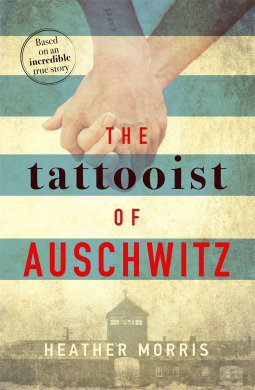
The Tattooist of Auschwitz by Heather Morris

‘a story of two ordinary people, living in an extraordinary time, deprived not only of their freedom but their dignity, their names and their identities.’

The Tattooist of Auschwitz

Zaffre|4 Oct. 2018|320 pages|Paperback|3*

Yesterday when I finished reading The Tattooist of Auschwitz, I didn’t want to write about it, but I kept thinking about it and in the end I decided I needed to record a few of my thoughts about it. It is not a book I can say that I ‘enjoyed’, because I didn’t – the subject matter is too painful, how can you enjoy a book that describes the horrors of one person’s experience of his time in the concentration camp of Auschwitz-Birkenau*!

It is ‘based on the true story of Lale Sokolov’.  He was born Ludwig Eisenberg on 28 October 1916 in Krompachy, Slovakia and transported to Auschwitz on 23 April 1942. He was given the job of tattooing the prisoners marked for survival. He met and fell in love with Gita, a fellow prisoner and he was determined that they would be survivors. The story Heather Morris tells is simply devastating and I could hardly bear to read the horrors of life in the concentration camps; it is appalling as it reveals the brutality, hatred and evil side of human nature. But is also about love, determination, compassion, and the strength of human nature. 

It is simply told in a straight forward, childlike style and in the present tense. It is certainly a most unsettling and depressing book, despite the fact that I knew that Lale and Gita would survive their horrific experience.

Heather Morris wrote the book after meeting Lale and hearing his story. In her Author’s Note she tells how she spent three years listening to him as

he told his story piecemeal, sometimes slowly, sometimes at bullet-pace and without clear connections between the many, many episodes. … Lale’s memories were on the whole, remarkably clear and precise.

The epilogue describes what happened to Lale and Gita after the end of the war. They married, moved to Bratislava, and, after travelling to Paris, eventually moved to Melbourne. There are photos at the end of the book of Lale and Gita in Australia with Gary their son and an Afterword by Gary about their family life and how their years in the camp affected them both.

But the line between fiction and fact can be blurred in a novel and there are claims that ‘the book contains numerous errors and information inconsistent with the facts, as well as exaggerations, misinterpretations and understatements‘. I have read the article pointing out the errors etc. It concludes that the book should be seen as an ‘impression devoid of documentary value on the topic of Auschwitz, only inspired by authentic events … Given the number of factual errors, therefore, this book cannot be recommended as a valuable title for persons who want to explore and understand the history of KL Auschwitz.’

It seems to me that it is a novel that clearly conveys what Lale experienced during the three years he spent in Auschwitz, as he remembered it many years later. Despite the errors that have been pointed out, I think it is a story of man’s inhumanity to man and a tribute to the strength of the human spirit for survival.

KL Auschwitz-Birkenau 

The first and oldest was the so-called “main camp,” later also known as “Auschwitz I” (the number of prisoners fluctuated around 15,000, sometimes rising above 20,000), which was established on the grounds and in the buildings of prewar Polish barracks;

The second part was the Birkenau camp (which held over 90,000 prisoners in 1944), also known as “Auschwitz II” This was the largest part of the Auschwitz complex. The Nazis began building it in 1941 on the site of the village of Brzezinka, three kilometers from Oswiecim. The Polish civilian population was evicted and their houses confiscated and demolished. The greater part of the apparatus of mass extermination was built in Birkenau and the majority of the victims were murdered here;’ (extract from the history page of the Auschwitz-Birkenau Memorial and Museum)

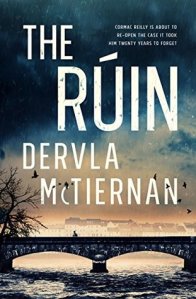
The Ruin by Dervla McTiernan

In Irish, Rúin means something hidden, a mystery, or a secret, but the word also has a long history as a term of endearment

Ruin

I liked The Rúin by Dervla McTiernan, the first in the detective Cormac Reilly series set in Ireland. It has a powerful opening in 1993 in Galway when Garda Cormac Reilly, new to the job, finds 15-year-old Maude and her little brother, Jack, who’s only five, alone in an old, decaying Georgian house, whilst their mother Hilaria Blake lies dead of an overdose.

Move forward twenty years and Cormac is now a DI. He has left an elite squad responsible for counter-terrorism and armed responses to serious incidents in Dublin and moved back to Galway, where Emma, his partner, has just started a new job. Although Galway is his home town he feels an outsider in the police department, largely shunned by the other officers, apart from Danny who had trained with him.  Despite his experience of running complex and high-profile cases he is assigned mainly to cold cases, which he thinks is an inappropriate use of his time. And he suspects the squad of corruption.

When Jack’s body is found in the River Corrib the police tell his girlfriend, Aisling Conroy, that he committed suicide. But when his sister, Maude arrives on the scene, having spent the last twenty years in Australia, she persuades Aisling to work with her to prove Jack’s death was murder. However, the police refuse to believe her and instead arrest her for the murder of her mother twenty years earlier. Meanwhile Cormac  realising there is a link between the deaths of Hilaria and Jack works to uncover the truth about both cases, despite the obstacles his fellow officers put in his way.

I found it rather confusing at first working out who was who and their relationships. There are quite a lot of minor characters who muddied the waters for me and I think the plot is over-complicated, needing the final chapters to explain the details. But I thought the main characters were convincing, in particular Cormac, and I was impressed by the description of Aisling grappling with her grief. There is also a strong sense of place. I was keen to find out the truth and once I had the characters clear in my head I just didn’t want to put it down until I finished it – it’s a real page-turner. I enjoyed it so much that I immediately reserved the next one in the series, The Scholar, at the library. I collected it on Thursday and will be reading it very soon.

  • Format: Kindle Edition
  • File Size: 1053 KB
  • Print Length: 402 pages
  • Publisher: Sphere (8 Mar. 2018)
  • Source: I bought it
  • My rating: 4*

A Glimpse of my TBRs

This post was inspired by FictionFan’s Stroll Around her TBR:

The definition…

My TBR is made up of books I own, both paper and e-books, but haven’t yet read, no matter when I acquired them, whereas the books I record for Bev’s Mount TBR Reading Challenge are books that I have owned prior to January 1 2019.

The current total…

I don’t have an accurate figure of the total. I have 387 books currently listed on LibraryThing as TBRs, but that’s not counting the many e-books I have unread on my Kindle!

The target…

I like having books waiting to be read, having books to choose from, so I’m happy to have some TBRs, but just not as many as at present. The difficulty is that I’m adding books more quickly than I’m reading them – the numbers are going up rather than down.  Maybe I should go through them and decide whether to keep them – or not, always hard when I’ve bought them – but maybe those free e-books could go ….

The breakdown…

It’s a mix of mainly fiction with some non-fiction. I like to vary my reading so it’s a mix of genres too. My records aren’t detailed enough to break the numbers down into genres.

The oldest book…

There are two books listed on my LibraryThing catalogue that I’ve owned since 4 February 2007 – A Dead Language by Peter Rushforth and Thomas Hardy: The Time-torn Man by Claire Tomalin. I did start to read both of them years ago, but put them aside for a while – and that’s where they both are.

I bought the Rushforth book as I’d loved his first book, Pinkerton’s Sister, but A Dead Language doesn’t have the same appeal, although I can’t bring myself to the point of actually abandoning it. Whereas I really want to read the Hardy biography …

The newest book…

The Good Daughter by Karen Slaughter

Good Daughter

I haven’t read any of Karin Slaughter’s books, but have wondered if I would like them. After reading Jules’ review of her latest novel, The Last Widow on her blog onemoreword  I decided to try one of her standalone books and bought The Good Daughter. 

The review copies…

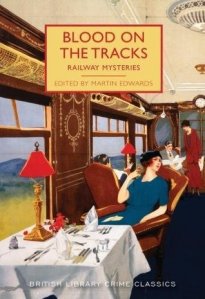
Currently standing at 18. The oldest review copy is Blood on the Tracks by Martin Edwards which I acquired from NetGalley on 10 April 2018. It’s a collection of short stories subtitled Railway Mysteries. I’ll be reading it soon as I have included it in my 20 Books of Summer list.

Blood on the tracks

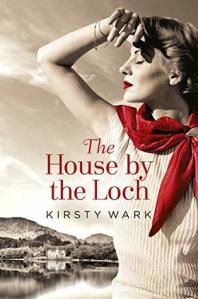
The newest review copy, also from NetGalley, is The House by the Loch by Kristy Wark, due to be published 13 June. It’s a family drama set in Scotland on remote Loch Doon.

House by the loch

The 200th book on the list…

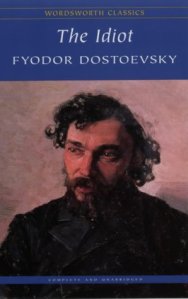
According to LibraryThing that is The Idiot by Fyodor Dostoevsky, a book I thought I’d like to read after reading The Brothers Karamazov years ago. I don’t know when I’ll get round to reading it though as it’s nearly 600 pages of small font – an e-book might be more manageable.

The Idiot Wordsworth Classic

Blurb from the back cover:

Prince Myshkin returns to Russia from an asylum in Switzerland. As he becomes embroiled in the frantic amatory and financial intrigues which centre around a cast of brilliantly realised characters and which ultimately lead to tragedy, he emerges as a unique combination of the Christian ideal of perfection and Dostoevsky’s own views, afflictions and manners. His serene selflessness is contrasted with the worldly qualities of every other character in the novel. Dostoevsky supplies a harsh indictment of the Russian ruling class of his day who have created a world which cannot accommodate the goodness of this idiot.

A Selection of the books I most want to read and can’t understand why I don’t just do it…

In no particular order:

(not counting the books on my 20 Books of Summer list or my NetGalley review books)


I’d love to look around your TBRs if you fancy having a go too.