My Week in Books: 28 February 2018

This Week in Books is a weekly round-up hosted by Lypsyy Lost & Found, about what I’ve been reading Now, Then & Next.

IMG_1384-0

A similar meme,  WWW Wednesday is run by Taking on a World of Words.

Now:

51IBFwYPBfLMunich by Robert Harris, set in 1938, beginning in September as Hitler is determined to start a war and Chamberlain is desperate to preserve the peace. I’ve read about half the book and am finding it fascinating.

Blurb

As Chamberlain’s plane judders over the Channel and the Führer’s train steams relentlessly south from Berlin, two young men travel with secrets of their own. 

Hugh Legat is one of Chamberlain’s private secretaries; Paul Hartmann a German diplomat and member of the anti-Hitler resistance. Great friends at Oxford before Hitler came to power, they haven’t seen one another since they were last in Munich six years earlier. Now, as the future of Europe hangs in the balance, their paths are destined to cross again. 

When the stakes are this high, who are you willing to betray? Your friends, your family, your country or your conscience?

Bookworm: A Memoir of Childhood Reading by Lucy Mangan, due to be published tomorrow, 1 March 2018. This is a delightful book taking me back to the books of my childhood as Lucy Mangan describes the books she loved. I’ve nearly finished it, so I’ll post my review soon.

Blurb

The Cat in the Hat? Barbar? The Very Hungry Caterpillar? Whoever it was for you, it’s very hard to forget the vivid intensity of your first encounter with a book.

As a bespectacled young bookworm, Lucy Mangan devoured books: from early picture books, to Swallows and Amazons, Enid Blyton to Little Women, and from trashy teen romances to her first proper ‘grown-up’ novels. In Bookworm, she revisits this early enthusiasm; celebrating the enduring classics, and disinterring some forgotten treasures.

This is a love letter to the joys of childhood reading, full of enthusiasm and wit, telling the colourful story of our best-loved children’s books, the extraordinary people who created them, and the thousand subtle ways they shape our lives. It also comes packed with brilliant recommendations to inspire the next generation of bookworms and set them on their way.

This impassioned book will bring the unforgettable characters of our collective childhoods back to life – prompting endless re-readings, rediscoveries, and, inevitably, fierce debate. It will also act as an invaluable guide to anyone looking to build a children’s library and wondering where to start, or where to go next.

Then:

The last book I finished is Dry Bones in the Valley by Tom Bouman. This book has won several awards: Los Angeles Times Book Prize for Mystery/Thriller (2014), Edgar Award for Best First Novel (2015), Strand Critics Award Nominee for Best First Novel (2014). I really enjoyed it. My review will be up soon.

Blurb

When an elderly recluse discovers a corpse on his land, Officer Henry Farrell follows the investigation to strange places in the countryside, and into the depths of his own frayed soul.

In Wild Thyme, Pennsylvania, secrets and feuds go back generations. The lone policeman in a small township on the sparse northern border, Henry Farrell expected to spend his mornings hunting and fishing, his evenings playing old-time music. Instead, he has watched the dual encroachment of fracking companies and drug dealers bring money and troubles to the area. As a second body turns up, Henry’s search for the killer opens old wounds and dredges up ancient crimes which some people desperately want to keep hidden.

With vivid characters and flawless pacing, Tom Bouman immerses readers in this changing landscape. In these derelict woods, full of whitetail deer and history, the hunt is on…

Next:
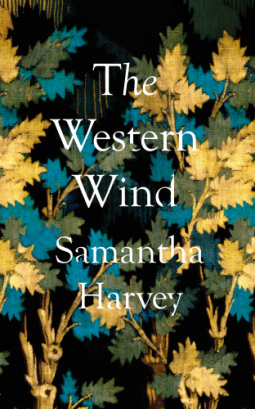
The Western Wind by Samantha Harvey, also due to be published tomorrow, 1 March 2018.

Blurb (Amazon):

15th century Oakham, in Somerset; a tiny village cut off by a big river with no bridge. When a man is swept away by the river in the early hours of Shrove Saturday, an explanation has to be found: accident, suicide or murder? The village priest, John Reve, is privy to many secrets in his role as confessor. But will he be able to unravel what happened to the victim, Thomas Newman, the wealthiest, most capable and industrious man in the village? And what will happen if he can’t?

Moving back in time towards the moment of Thomas Newman’s death, the story is related by Reve – an extraordinary creation, a patient shepherd to his wayward flock, and a man with secrets of his own to keep. Through his eyes, and his indelible voice, Harvey creates a medieval world entirely tangible in its immediacy.

Have you read any of these books?  Do any of them tempt you? 
First Chapter First Paragraph: The Ghost of the Mary Celeste by Valerie Martin

Every Tuesday First Chapter, First Paragraph/Intros is hosted by Vicky of I’d Rather Be at the Beach sharing the first paragraph or two of a book she’s reading or plans to read soon.

My first paragraph this week is from The Ghost of the Mary Celeste by Valerie Martin, which is one of my latest acquisitions.

The Ghost of the Mary Celeste


It begins:

The Brig Early Dawn, Off the Coast of Cape Fear, 1859

The captain and his wife were asleep in each other’s arms. She, new to the watery world, slept lightly; her husband, seasoned and driven to exhaustion the last two days and nights by the perils of a gale that shipped sea after sea over the bow of his heavily loaded vessel, had plunged into a slumber as profound as the now tranquil ocean beneath him. As his wife turned in her sleep, wrapping her arms loosely about his waist and resting her cheek against the warm flesh of his shoulder, in some half-conscious chamber of her dreaming brain she heard the ship’s clock strike six bells. The cook would be stirring, the night watch rubbing their eyes and turning their noses towards the forecastle, testing the air for the first scent of their morning coffee.

Blurb

A mystery unsolved to this day
A mystic who confounds the cynics
A writer looking for the story that will make his name

A ghost ship appears in the mist. To the struggling author Arthur Conan Doyle, it is an inspiration. To Violet Petra, the gifted American psychic, it is a cruel reminder. To the death-obsessed Victorian public, it is a fascinating distraction. And to one family, tied to the sea for generations, it is a tragedy.

In salons and on rough seas, at séances and in the imagination of a genius, these stories converge in unexpected ways as the mystery of the ghost ship deepens. But will the sea yield its secrets, and to whom?

∼ ∼ 

This is the Mary Celeste, so I know the basics – the ship was discovered adrift off the coast of Spain. Her cargo was intact and there was no sign of struggle, but the crew was gone. They were never found. I’m intrigued … what will this novel reveal?

What do you think – would you read on?

New-to-Me Books from Barter Books

On Tuesday it was time for another visit to my favourite bookshop Barter Books, one of the largest secondhand bookshops in Britain. We were early getting there just after it had opened for the day, so there was space to park right outside the entrance.

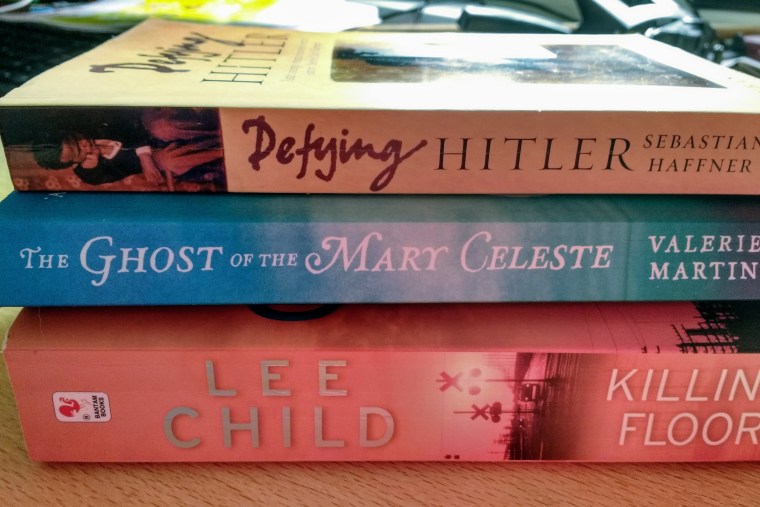
I was quite restrained and only brought three books home, with me. But at least I’ve made some room on my bookshelves as I’d brought in six books. These are the books I brought home:

IMG_20180222_095337630_HDR.jpg

Killing Floor by Lee Child,the first in his Jack Reacher series. I’m keen to read this because I’ve recently read the 22nd book in the series and want to know more about Reacher, an ex-military cop of no fixed abode.

The Ghost of the Mary Celeste by Valerie Martin. I’ve read some of Valerie Martin’s books before and enjoyed them. This one weaves fact and fiction concerning the mystery surrounding the Mary Celeste, looking at it from different viewpoints including those of a psychic and Arthur Conan Doyle, who was inspired by it to write a short story, J. Habakuk Jephson’s Statement

Defying Hitler: a Memoir by Sebastian Haffner, a memoir of life in Germany during the Nazi rise to power. It was written in 1939 during Haffner’s exile in England. I’ve been reading novels about the Second World War period, so I think it would be good to know more about  the Wiemar Republic, particularly from a German who lived through those times.

What do you think? Have you read any of these? Do they tempt you too?

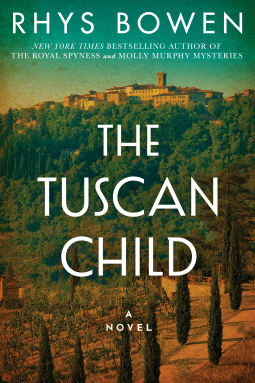
The Tuscan Child by Rhys Bowen

Lake Union| 20 February 2018|352 p|Review copy|3*

In 1944, British bomber pilot Hugo Langley parachuted from his stricken plane into the verdant fields of German-occupied Tuscany. Badly wounded, he found refuge in a ruined monastery and in the arms of Sofia Bartoli. But the love that kindled between them was shaken by an irreversible betrayal.

Nearly thirty years later, Hugo’s estranged daughter, Joanna, has returned home to the English countryside to arrange her father’s funeral. Among his personal effects is an unopened letter addressed to Sofia. In it is a startling revelation.

Still dealing with the emotional wounds of her own personal trauma, Joanna embarks on a healing journey to Tuscany to understand her father’s history—and maybe come to understand herself as well. Joanna soon discovers that some would prefer the past be left undisturbed, but she has come too far to let go of her father’s secrets now… 

I enjoyed The Tuscan Child up to a point. I liked the historical setting of 1944 and the descriptions of Tuscany and Italian food are beautiful. It’s easy reading and the dialogue gives a good impression of people speaking in a foreign language in which they are not fluent. Although I love Italian food I did begin to groan when yet another meal was being prepared and described in detail.

But the split narrative between Hugo and Joanna didn’t work too well for me. I liked Hugo’s story more than Joanna’s and I wanted to know what happened to him which kept me reading. But I thought the book was more of a romance than a historical mystery. And I thought the mystery element wasn’t too difficult to work out with rather too many convenient events that revealed what had happened to Hugo.

My thanks to Lake Union for a review copy via NetGalley.

Amazon UK link
Amazon US link

The Midnight Line by Lee Child

A quest for justice

The Midnight Line (Jack Reacher, #22)

Bantam Press| 7 Nov 2017|391 p|Hardcover|4*

I wasn’t sure when I began reading The Midnight Line that it was my sort of book. It’s the 22nd book in Lee Child’s Jack Reacher series and I haven’t read any of the earlier books. See this post for the first paragraph – what struck me was Lee Child’s straight forward style of writing and the short, staccato sentences.

Jack Reacher, a former military policeman, is looking for the owner of a West Point class ring from 2005. It’s a small ring, a woman cadet’s graduation present to herself, engraved with the initials S.R.S and Reacher wonders what she went through to get it and why it ended up in a pawn shop. He tracks the ring back to its owner in a search that takes him to the deserted wilds of Wyoming.

After a slow start containing too much description of fighting for my liking and too many short sentences I began to find that Child’s writing grew on me. It’s not all short sentences, and I liked the way that every now and then Reacher recaps where the search is taking him. I began to feel it was a book about a quest – reminiscent of tales of heroes or knights of old on a mission to rescue a damsel in distress, or of a ring-bearer returning the ring to its rightful owner – in a very modern setting.

I like the characters, particularly Reacher, a huge guy variously described as Bigfoot or the Incredible Hulk and I like the description of the landscape of the West with its vast open spaces – at least 20 miles between neighbours – long straight and dusty roads, rocky tracks and unmarked trails. Reacher doesn’t drive, but hitch hikes, or takes a bus, walking when he has to. He’s a loner, with no home, no belongings, just buying new clothes as he needs them, always on the move, a tough guy who uses a whole bar of soap when he showers.

The hunt first takes Reacher to Rapid City, South Dakota to find Arthur Scorpio, a laundromat owner, who tells him the ring came in from a guy in Wyoming in a place called Mule Crossing, a ‘wide spot’ on the road to Laramie. Whilst in Rapid City he meets Detective Gloria Nakamura, keeping Scorpio under surveillance and Terry Bramhall, a private detective, also watching Scorpio and looking for the same woman as Reacher. Reacher and Bramhall meet again at Mule Crossing and join forces.

It turns out that this is more than a search for the owner of the ring. As Reacher gets nearer to finding her he comes across the trail of a drug smuggling circle and I learned a lot about the history of heroin and pain relief and the terrible issues facing US veterans. Reacher finds out exactly what did happen to S.R.S., the owner of the ring, and it’s not pretty! This book is dedicated to the nearly two million recipients of the Purple Hearts awards.

I finished the book delighted that it was so much better than I thought it would be and was just as pleased when I went to Barter Books yesterday (more about that visit soon) and found the first book introducing Jack Reacher – Killing Floor – so that after reading the 22nd book I can start at the beginning.

About Lee Child

Lee Child (James ‘Jim’ Grant, known by his pen name Lee Child) is not American (as I thought) but British, born in Coventry.   He went to law school in Sheffield, England, and after part-time work in the theatre he joined Granada Television in Manchester for what turned out to be an eighteen-year career as a presentation director during British TV’s “golden age.” During his tenure his company made Brideshead RevisitedThe Jewel in the CrownPrime Suspect, and Cracker. He now lives in New York.

He has received many awards. The most recent is the CWA’s Diamond Dagger for a writer of an outstanding body of crime fiction, the International Thriller Writers’ ThrillerMaster, and the Theakston Old Peculiar Outstanding Contribution to Crime Fiction Award.

Many thanks to my husband for buying me this book as a surprise Christmas present.

I’m choosing this book in this year’s What’s In A Name Challenge in the category of a book with a shape in the title.

Amazon UK link
Amazon US link

My Tuesday Post: Munich by Robert Harris

Every Tuesday First Chapter, First Paragraph/Intros is hosted by Vicky of I’d Rather Be at the Beach sharing the first paragraph or two of a book she’s reading or plans to read soon.

Teaser Tuesdays is hosted by The Purple Booker. Post two sentences from somewhere in a book you’re reading. No spoilers, please! List the author and book title too.

My first paragraph this week is from Munich by Robert Harris, which I’m currently reading.

Munich


It begins:

Shortly before one o’clock on the afternoon of Tuesday 27 September 1938, Mr Hugh Legat of His Majesty’s Diplomatic Service was shown to his table beside one of the floor-to-ceiling windows of the Ritz restaurant in London, ordered a half-bottle of 1921 Dom Perignon that he could not afford, folded his copy of The Times to page seventeen and began to read for the third time the speech that had been delivered the night before in Berlin’s Sportpalast by Adolf Hitler.

Here is a teaser from page 99. 

The Prime Minister, Neville Chamberlain is talking to Legat about the suffering endured through the last war (the First World War):

… Afterwards, whenever I saw a war memorial, or visited one of those vast cemeteries in France where so many dear friends are buried, I always vowed that if ever I was in a position to prevent such a catastrophe from happening again, I would do anything – sacrifice anything – to maintain peace. You understand that?’

Blurb:

September 1938. Hitler is determined to start a war. Chamberlain is desperate to preserve the peace. The issue is to be decided in a city that will forever afterwards be notorious for what takes place there. Munich. 

As Chamberlain’s plane judders over the Channel and the Fürher’s train steams relentlessly south from Berlin, two young men travel with secrets of their own.

Hugh Legat is one of Chamberlain’s private secretaries, Paul Hartmann a German diplomat and member of the anti-Hitler resistance. Great friends at Oxford before Hitler came to power, they haven’t seen one another since they were last in Munich six years earlier. Now their paths are destined to cross again as the future of Europe hangs in the balance.

When the stakes are this high, who are you willing to betray? Your friends, your family, your country or your conscience?

I’ve read just a few pages on from my teaser and am firmly fixed in the pre-war years and hoping, futilely I know, that Chamberlain would succeed in preventing the coming war. I also want to know more about him. As Harris has portrayed him so far in this book he seems a man out of his time – a Victorian figure – and a man who like Hitler was egocentric, a man who ‘always conflated the national interest with himself.‘ (page 37)