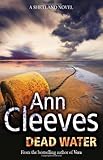
Ann Cleeves and Dead Water

I loved Ann Cleeves’s Shetland QuartetRaven Black, White Nights, Red Bones and Blue Lightning, so I was delighted to read her latest book, Dead Water, which takes the Quartet one step further. Actually, it’s the first book in a new Shetland Quartet, in which each book will be named after the four elements –  earth, air, fire and water. Each of the Shetland books reads well as stand-alones, but I think it’s better to read them in order as you can then follow the development of the main characters. And Dark Water does refer to events in earlier books.

In Dead Water Rhona Laing, the Fiscal, finds journalist Jerry Markham lying dead, drifting in a yoal, a traditional Shetland boat in Aith marina. Markham, a Shetlander visiting his parents, was apparently working on a story for a national newspaper – maybe about the development of renewable energy proposed for Shetland, or maybe his reason was more personal? Detective Inspector Jimmy Perez is not the man he once was, since the death of his fiancée and at first he takes a back seat in the investigations, led by Detective Inspector Willow Reeves (originally from the Hebrides) who is drafted in from the Inverness team to head up the investigation. But eventually his natural curiosity takes over and he decides to help the inquiry, and his knowledge of the local community is vital in catching the killer.

I really enjoyed Dead Water, a mixture of mystery and the creation of  totally believable characters, set in Shetland Mainland.  The book is well paced, with the tension steadily building and Ann Cleeves writes with clarity, so that you can easily picture the people and the places she describes. She gives just the right amount of detail for the reader to feel immersed not only in the story but also in the life of the islands – the history and traditions, and the changes brought about the development of sustainable energy.

Last Tuesday evening D and I went to Main Street Trading bookshop where Ann Cleeves gave a talk about how she first went to Shetland and came to know and love the islands. She also talked about her decision to write crime fiction based in Shetland, and how she first pictured a scene in the snow  which eventually became the first book, Raven Black, after hearing stories of the islands from an old Shetlander.

She also spoke about the new BBC TV Shetland series, which she told us is being broadcast in March, beginning with an adaptation of Red Bones. Admittedly Douglas Henshall, playing the part of Perez, is not her vision of Jimmy Perez, after all, Perez has long dark hair with Spanish ancestry in his blood, whereas Douglas Henshall is  redheaded Scot, but she is happy both with him in the role and with the alterations that have been made. As she explained, once she has finished writing a book it passes out of her hands and each reader has their own individual interpretation. She cannot see what is in the minds of readers, but she can see the director’s interpretation in the TV version of her book! I’ve seen the trailer and it does look good.

Ann Cleeves is an excellent speaker, just as she is an excellent writer. On her website you read about her books and the forthcoming series and also download a leaflet Discover the Mystery of Shetland which has a map, beautiful colour photos and a commentary from Ann about the real and fictitious locations in her books. It’s very good – I was given a copy last Tuesday.

Saturday Snapshots – on Sunday

A few years ago we had a holiday in Gloucestershire – in Painswick. I’ve posted some photos in the past but not these of a walk in Frith Wood, which is on a ridge between Slad and Painswick. It’s a beautiful, magical wood of magnificent beech trees, with a mix of oak, ash and sycamore and it’s a Site of Special Scientific Interest.

Frith Wood

Frith Wood DSC_0106

Frith Wood DSC_0100 Frith Wood DSC_0109For more Saturday Snapshots see Alyce’s blog At Home With Books.

Caramel Squares/Millionaire's Shortbread

Anything made of caramel is always tempting, especially millionaire’s shortbread. It’s that combination of shortbread, caramel and chocolate that I find so irresistible.

I’ve tried making it a few times and this last batch I made is the best, so far. It could be better, the shortbread could be shorter and the chocolate a bit thicker to reach perfection, but the caramel part was scrumptious.

Millionaire's shortbreadI used a mix of recipes:

Home Baking Cookbook 001The shortbread is made with:

  • 115g butter
  • 60g soft light brown sugar
  • 225g plain flour

I rubbed the butter into the flour, added the sugar and worked it together to form a firm dough. Then I pressed  the mixture into a 23cm square cake tin, pricked it all over with a fork and baked it in the oven at 190° for 20 minutes. I left it to cool and then –

For the caramel, I used the recipe on a tin of condensed milk:

  • 120g butter
  • 75g brown sugar
  • 2 tablespoons of honey
  • 397g can condensed milk

It all went into a saucepan and I cooked it over a moderate heat and stirred until the sugar melted and the ingredients were combined. Then I brought it to the boil and lowered the heat and simmered for 3 to 4 minutes until thickened, and then poured it over the shortbread and left it to set.

For the topping I melted some milk chocolate in a bowl over a pan of barely simmering water and poured it over the caramel. I’d have preferred plain chocolate, but milk chocolate was all we had in the house.

See Beth Fish Reads for more Weekend Cooking posts.

The Redemption of Alexander Seaton by Shona MacLean

There are some books that have the power to transport me to another time and place and The Redemption of Alexander Seaton is one such book. I think it’s one of the best novels I’ve read recently. It’s quite long and detailed but each time I put it down I wanted to get back to it as quickly as possible. It’s a fantastic book, historical crime fiction, full of atmosphere and well-drawn characters.

It’s set in 17th century Scotland, mainly in the town of Banff, where on a stormy night Patrick Davidson, the local apothecary’s assistant collapses in the street. The next morning he is found dead in the school house of Alexander Seaton, a failed minister, now a schoolteacher. Davidson was poisoned and when Charles Thom, one of Alexander’s few friends in the town is arrested for the murder, he sets out to prove his innocence. It’s not an easy task, and Alexander finds himself embroiled in an apparent Spanish Catholic plot to invade Scotland, and bigoted prejudices that result in a witch hunt.

As the story unfolds details of Alexander’s history are gradually revealed, his family background, friends and education and the disgrace that prevented him from becoming a minister. The religious conflict between Catholics and Protestants during the reign of Charles I is slotted into the plot seamlessly, explaining the beliefs and prejudices that struck fear into many hearts. It’s a story of murder and cruelty, but also of love and the power of good over evil. For Alexander it’s a trial that eventually sees him beginning to regain his faith in God.

I found the book totally absorbing, convinced I was back in Scotland in the 17th century, eager to find out who the murderer was and the motivation for killing Patrick Davidson. Alexander Seaton is an engaging character and I’m keen to read more about him as there are other books in the series.

The author originally wrote under her name – Shona Maclean, but now her books are published under the truncated name, S G MacLean. She explained in an interview in Shots magazine that ‘the thinking was that my name was too soft and feminine and men wouldn’t buy my books.’ She has an M.A. and Ph.D. in History from the University of Aberdeen. Her Alexander Seaton books are:

1. The Redemption of Alexander Seaton (2008)
2. A Game of Sorrows (2010)
3. Crucible of Secrets (2011)
4. The Devil’s Recruit (2013)

Note: The cover shown above is from the 2009 paperback edition published by Quercus, which I borrowed from my local library.

Sunday Selection

Newbooks magazine arrived yesterday, with articles about James, Naughtie, Deborah Moggach and Jodie Picoult amongst others – all interesting reading. There’s also a recipe for Parsnip Cake with Walnuts and Raisins that I may try.

Now I’m wondering whether to send off for one (or more) of these books, offered for just the cost of p&p. I haven’t read anything by any of these authors, so have no knowledge of their writing. Newbooks gives extracts from the opening of the books and articles about the authors.

newbooks March 13

  • Jasmine Nights by Julia Gregson – described as a love story set against the backdrop of the Second World War in Egypt and Turkey, in which Saba Tarcan enlists in ENSA to entertain the troops, but also is drafted as a spy. I have Julia Grigson’s first book The Water Horse, but haven’t read it yet. It looks very interesting and well located – Julia Grigson travelled to both Egypt and Turkey to get the settings right. Although the book is not about her parents, their experiences during the War were the springboard into writing the book. 
  • Among Others by Jo Walton – set in Wales in 1979, this is a story about a 15 year-old girl and her twin sister who commune with fairies. When her sister is killed, she is crippled and sent away to a boarding school. It’s a fantasy and science fiction novel and centres on books and their importance.  Jo Walton is well-known (if not by me) as a science fiction/fantasy writer. She is a Welsh-born author, living in Canada.
  • The Forbidden Queen by Anne O’Brien – historical fiction about Katherine de Valois, who married Henry V. Anne O’Brien has made use of the historic outline of Katherine’s life and incorporated the romantic myths of her love for Owen Tudor and her liaison with Edmund Beaufort. Not a political history for this is a coming-of-age novel – a tragic love story.
  • The Masque of the Red Death by Bethany Griffin – a version of Edgar Allan Poe’s tale, a dark, gothic dystopian story of the plague and apocalypse. It’s targeted at young adults/teenagers. I don’t think this book is for me.
  • The Passage by Justin Cronin and The Twelve by Justin Cronin. These are the first two books in Justin Cronin’s post-apocalyptic trilogy, more dystopian fiction. I’m not interested in reading books featuring vampires (apart from Dracula, which to my surprise, I liked), even bio-engineered vampires. Justin Cronin is a multi-award-winning writer, a Professor of English at Rice University, who lives with his family in Houston, Texas.

At the moment I’m veering towards sending off for Jasmine Nights, or The Forbidden Queen.