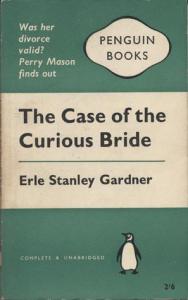
The Case of the Curious Bride by Erle Stanley Gardner

First published in 1935 The Case of the Curious Bride is the 5th Perry Mason book by Erle Stanley Gardner.

Synopsis extracted from the back cover:

An attractive young woman calls at Perry Mason’s office to inquire if a friend can marry again without getting a divorce as her husband had been presumed killed in an air accident seven years previously. Mason sees sinister implications and as a result of his investigations – helped by his secretary Della Street – dramatic developments lead to a court case in which the tables are turned on the police.

My view:

There are plenty of twists and turns in this mystery surrounding Rhoda Montaine, who is accused of murder and it certainly looks as though she is guilty.  I found it very puzzling. I also thought it was unsatisfactory as Perry Mason resorts to trickery, fooling everyone. At times I was at a complete loss to understand what he was doing and why. It all becomes clear at the end, but I found it far-fetched.

  • Paperback: 208 pages
  • Penguin Books 1960 (first published by Cassell 1935)
  • Source: I bought the book
  • My Rating 2/5
  • Challenges: Mount TBR, What’s in a Name 6 (a book with an emotion in the title)

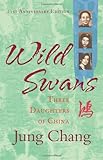
Wild Swans by Jung Chang

It’s taken me a couple of months to read Wild Swans: Three Daughters of China (first published in 1991), Jung Chang’s book about her grandmother, her mother and herself, telling of their lives in China up to and during the years of the violent Cultural Revolution. Her family suffered atrociously, her father and grandmother both dying painful deaths and both her mother and father were imprisoned and tortured.

Needless to say that this is a harrowing book to read, but it’s also an eye-opener (for me at any rate) about what happened in China under Mao.

Jung Chang was born in Yibin, Sichuan Province, China, in 1952. She was briefly a Red Guard at the age of fourteen, and then a peasant, a ‘barefoot doctor’, a steelworker and an electrician. She came to Britain in 1978, and in 1982 became the first person from the People’s Republic of China to receive a doctorate from a British university. Wild Swans  won the 1992 NCR Book Award and the 1993 British Book of the Year. She lives in London.

In Wild Swans she casts light on why and how Mao was able to exercise such paralysing control over the Chinese people. His magnetism and power was so strong and coupled with his immense skill at manipulation and his ability to inspire fear, it proved enough to subdue the spirit of most of the population; not to mention the absolute cruelty, torture and hardships they had to endure.

I wondered how she knew so much about what happened to her mother and grandmother (I don’t know nearly as much about mine) but in the Introduction she explains that when her mother came to visit her in London they talked every day for months. She talked about their eventful lives – her grandmother had been a concubine of a warlord general and her mother had joined the Communist underground at the age of 15. She also recorded sixty hours of her memories.

I wrote a bit about the book in a Book Beginnings post at the end of last November, when I’d just started to read it. It’s a personal story, reflecting the twentieth century history of China. A remarkable book, full of courage and spirit.

  • Paperback: 720 pages
  • Publisher: HarperPress; New edition edition (1 Mar 2012)
  • Language: English
  • ISBN-10: 0007463405
  • ISBN-13: 978-0007463404
  • Source: borrowed from a friend

Tolkien, The Hobbit and Middle-Earth

The Hobbit
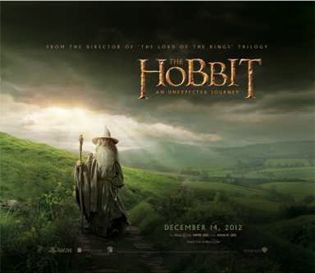
Last Wednesday we went to see The Hobbit: an Unexpected Journey. Whereas I’ve read The Lord of the Rings several times, I’ve never read The Hobbit, so the story was new to me. It meant that I could watch the film, totally unbothered by any changes from the book. And no doubt there are differences, as the book has been transformed into three films.

I enjoyed the film immensely, although, as I expected, there was too much fighting for my liking, which made my eyes glaze over. (This is my normal reaction to fighting scenes.) The hobbit, Bilbo Baggins, Gandalf and a party of dwarves, led by their king, Thorin Oakenshield go on a quest to recover the lost Dwarf Kingdom of Erebor and its long-lost treasure, guarded by Smaug, the dragon. Their journey takes them into great danger through lands occupied by orcs, goblins, wargs and sorcerers and sees the first meeting of Bilbo and Gollum (Andy Serkis) in which Bilbo gains possession of the precious Ring.

Martin Freeman was perfect as Bilbo Baggins, as was Ian McKellen as Gandalf, and Richard Armitage as Thorin Oakenshield. It was Ken Stott’s voice (and his mouth) that made me realise he was taking the part of Balin the dwarf, but I completely failed to see that the Goblin King was played by Barry Humphries. The rest of the cast was also excellent and the scenery was magical.

There are many books now about Tolkien and his writings – I have just two books of reference on Tolkien’s works, both from pre-movie days:The Tolkien and Middle Earth Handbook by Colin Duriez, which is a mine of information about Tolkien’s life, thoughts and writings. It’s an A-Z of people, places and things of importance in Tolkien’s books as well as containing details of Tolkien’s friends, colleagues, writers and thinkers who influenced his work.

Tolkien is now so well known, not only through his books, but also through Peter Jackson’s films, that it’s hard to believe that at one time his publishers thought the The Lord of the Rings could make a financial loss for them. Duriez writes:

In those unenlightened days, the learned Professor could mutter the word ‘Orc’ at uncouth behaviour, or exclaim ‘Mordor in our midst’ at an ugly example of modern life, without its meaning being known to the general public.

I think this book is a good source to discover information not only about the characters, but also the back-stories of Tolkien’s invented mythology. It is, of course, selective and certainly doesn’t aim to be comprehensive, because of the sheer volume and breadth of Tolkien’s works, but it’s certainly a good starting place.

The other book I have is A Tolkien Bestiary by David Day. A bestiary is an illustrated book about beasts, popular in the Middle Ages and this one includes Tolkien’s fantastical beasts and monsters, together with the races, flora and fauna that inhabit Middle-Earth and the Undying Lands. There are colour and black and white illustrations, maps, time charts and genealogical tables, plus a useful index. A mine of information from before Peter Jackson’s movies were made. Here, for example is the illustration of Gandalf (very similar to Ian McKellan’s portrayal, I think!) and of Gandalf and some of the dwarves making their way to Bilbo’s house in the Shire:
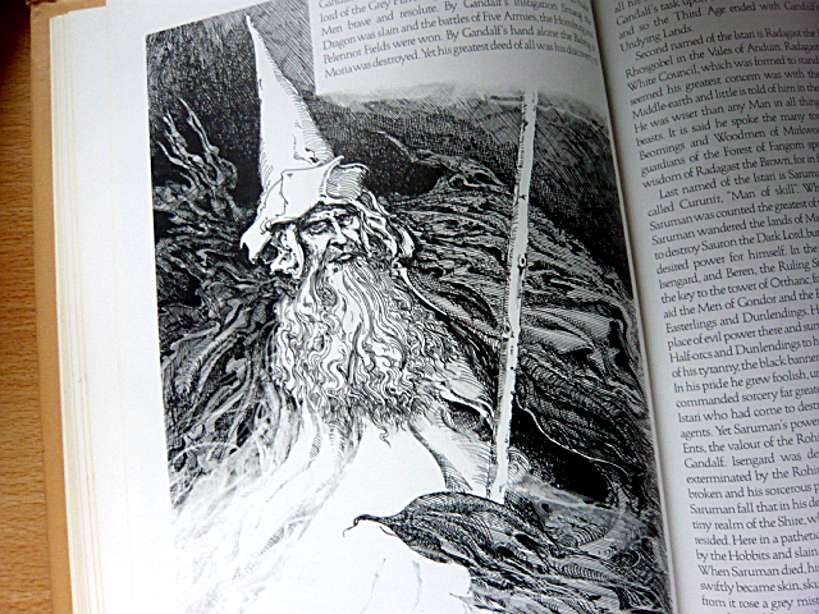
Tolkien Bestiary Gandalf

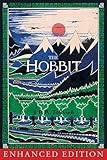
Since seeing the film I’ve downloaded an Enhanced Edition of The Hobbit. This has illustrations and audio/video content available for iPads, iPhones, and iPod Touch devices, including J R R Tolkien singing and reading from his book.

It also includes illustrations by Tolkien and one of the manuscript pages of his original draft of the first chapter. In the Foreword, Christopher Tolkien, Tolkien’s son reveals that his father had a clear recollection of writing the opening sentence of The Hobbit. It was whilst he was sitting correcting School Certificate papers and on a blank piece of paper he scrawled: ‘In a hole in the ground there lived a hobbit.’ He did not know then and later why that came into his head, but years later it became The Hobbit. And he couldn’t remember when. But his sons think it must have been around 1929. During the years that followed Tolkien wrote more of the book and became engrossed in The Silmarillion, the myths and legends of his invented world.

Now I just need to read the book itself! And then I may have to re-read The Lord of the Rings, and find a biography of Tolkien too. There are so many books about Tolkien – can anyone recommend any of them?
This Isn't Fiction Reading Challenge

Last year I read just 12 non fiction books, a very small percentage of all the books I read. So, this year I’m aiming to read more widely, perhaps cutting back on reading crime fiction, which made up more than half my reading last year. When I saw that Birgit is hosting a non fiction challenge I thought that it would give me a push in that direction.

All non fiction genres are allowed!

Books must be at least 100 pages long (excluding appendix and annotations)!

Books must be read in their entirety and not just in part (which consequently excludes encyclopedias, then again who in their right mind would want to read one of those from beginning to end)!

No picture heavy books – you’re supposed to read not just look at pretty photos (that said, books should have a 75:25 text/picture ratio – if it’s a big tome with 300 or more pages, then it may be a 50:50 ratio)!

ARCs and re-reads are allowed!

So, what’s it going to be for you?
  • 5 Books – Kindergarden
  • 10 Books – Elementary School
  • 15 Books – High School
  • 20 or more Books – College

After looking at my list of unread non fiction on my LibraryThing catalogue I found that I have 30+ books, so I should find plenty of choice to go for the High School  level and maybe even for the College level. Most of them are autobiographies/biographies, with some history and a touch of philosophy and travel.

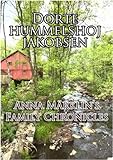
Anna Märklin's Family Chronicles by Dorte Hummelshoj Jakobsen

This is the second book by Dorte Hummelshoj Jakobsen that I’ve read. I liked the first one The Cosy Knave, but I liked her latest book, Anna Märklin’s Family Chronicles even more. The Cosy Knave, as the title suggests, is humorous and rather quirky, whereas Anna Märklin’s Family Chronicles is a psychological mystery and not at all cosy.

Set in Denmark in the present day with flashbacks to Sweden (where her father’s family came from) during the early part of at the beginning of the twentieth century, Anna Storm finds herself with beset with problems. Her father is seriously ill and strangely secretive about his family background:

There were so many things her father did not want to talk about. Illness and death, war and accidents. Things did not change for the better because you talked about them  he claimed.

Anna longs to know more and when she finds her grandmother’s journal she is enthralled. But digging into the past can reveal secrets that you might not want to know.

At the same time she is concerned about Karin, her best friend and neighbour, whose life is under threat for reasons Karin doesn’t divulge. When Anna can’t contact Karin, either by phone or at home, she eventually uses Karin’s spare key to enter her flat and finds her lying dead on the kitchen floor. it looks as though she slipped and hit her head – but was it really an accident?

Anna Märklin’s Family Chronicles has depth both in mystery and in characterisation and the setting is superb. I was transported in time and place as I read and fearful for Anna’s safety as she dug deeper into the mysteries surrounding her. I really enjoyed this book and hope that Dorte Jakobsen will write more in this vein.

  • Format: Kindle Edition
  • File Size: 439 KB
  • Publisher: Candied Crime (18 Dec 2012)
  • Sold by: Amazon Media EU S.à r.l.
  • Language: English
  • ASIN: B00AQIGSVQ
  • Source: my copy supplied by the author
  • My Rating: 4/5

Dorte Hummelshoj Jakobsen is a teacher from Denmark, teaching English at upper secondary level. In her spare time she reads and writes crime fiction in English and Danish, and in 2010 she sold her first flash stories to American magazines or publishers. One story appeared in Discount Noir (edited by Ste Weddle & Patricia Abbott).

Since then she has published two collections of flash fiction, “Candied Crime” (humour) and “Liquorice Twists” (a bit darker). Her bestsellers are the romantic ghost story “Heather Farm” (suspense plus romance in the Dunes near the Danish west coast) and the cosy novel “The Cosy Knave” (European title: “Murder deLight”).

For an interview with Dorte see Linda Rae Blair’s website.