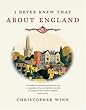
I Never Knew That About England by Christopher Winn

I came across I Never Knew That About England by Christopher Winn, soon after I decided to read my way around Britain in my Britain in Books project. This book is a collection of stories ‘that have England as their backdrop’.

It’s arranged alphabetically by the 39 traditional counties of England, so it fits in very well with my project. Winn writes in his preface that he has made every effort to get the facts right, but notes that many of the stories

are not eternal truths but have been handed down through time, sometimes by word of mouth only. Details can vary according to different sources, but the essential substance and essence remains. (page 7)

The book is a miscellany of stories, anecdotes and a ‘smattering of fascinating facts and figures.’  I’m going to dip into it every now and then and post little snippets as they appeal to me, starting with my home county of Cheshire.

Cheshire - click on image to enlarge

Cheshire is in the north-west of England, bordering Wales. Readers of Mrs Gaskell know that Cranford is based on the town of Knutsford, but what I never knew is that the village of Mobberley, near Knutsford, where one of my aunties lived, is the birthplace of George Mallory (1886 – 1924), the mountaineer who died attempting to climb Mount Everest. His father was the Rev. Herbert Leigh Mallory, the rector of Mobberley and it is said that he practised climbing up the church tower. I found this article in the Knutsford Guardian about the family home, Hobcroft House.

When asked why he wanted to climb Everest, Mallory replied: ‘Because it’s there’. It’s never been discovered whether Mallory did reach the summit. The camera Mallory and his companion Sandy Irvine took with them as they set out to make it to the top has never been found. Irvine’s body too has never been discovered, but in 1999 Mallory’s body was found on the North Face, 1,000 feet below the summit. There is a memorial window in the St Wilfrid’s Church dedicated to Mallory, inscribed:

lost to human sight between earth and heaven

Saturday Snapshot – A Walk Along the River Till

On Wednesday we walked alongside the River Till in Northumberland, England to its junction with the River Tweed, in Scotland.We started at the medieval Twizel Bridge – the bridge crossed by the English Army  on their way to the battle at Flodden in 1513. The bridge is now a pedestrian route, the traffic speeding along a new main road. Both bridges across the River Till are shown in my photo below. (The medieval bridge is in front of the new bridge) :

Here is a closer look at the medieval bridge:

As we went along the river bank the salmon were leaping out of the water, but no matter how quick I tried to be with the camera I couldn’t snap a fish as it leapt out of water. This is the closest I got:

The nearer circle is where the fish jumped out and the further one where it went back into the river!

We carried on down the river bank to Twizel Viaduct. This stands 90 feet over the Till and used to carry the Tweedmouth to Kelso railway line. It was built by the York Newcastle & Berwick Railway between 1846-9. This line closed in 1965:

The autumn trees still have most of their copper leaves:

But when we got to the junction of the Till and Tweed there were these leafless trees on the opposite side of the river. The angle of the trunks is just amazing:

We weren’t the only people out enjoying the autumn sunshine – the fishermen were there too.

There is a ruined castle on the ridge overlooking the Till, but more about that in a later post.

Saturday Snapshot post, hosted by Alyce, At Home with Books.

A Classics Challenge 2012

It’s that time of year when ‘challenges’ for next year keep appearing on book blogs. Each year I think I won’t join in and each year I do attempt a few. Here’s one that appeals to me, but not as a ‘challenge’ (see my previous post for my views about ‘challenges’). This one promises to be more interactive:

It’s A Classics Challenge, devised by Katherine Cox of November’s Autumn. It involves reading seven works of Classic Literature in 2012, but only three of the seven may be re-reads.

But, instead of writing a review as you finish each book (of course, you can do that too), visit November’s Autumn on the 4th of each month from January 2012 – December 2012, where you will find a prompt, it will be general enough that no matter which Classic you’re reading or how far into it, you will be able to answer. There will be a form for everyone to link to their post.

I like the idea.

My Reading List

I have quite a lot of unread classics on my bookshelves and even more loaded onto my Kindle, so I have plenty to choose from. At present I think I’ll start with these seven books (but the titles could most likely be substituted for others when I actually get down to reading!)

  • Emma by Jane Austen – a re-read. I first read this many years ago. Recently I read Sebastian Faulks’s view of Emma as a snob in his book Faulks on Fiction and decided it was time to re-read the book.
  • The Woman in White by Wilkie Collins. I read The Moonstone earlier this year and liked it very much, which spurred me on to get The Woman in White.
  • Three Men in a Boat by Jerome K Jerome – a book that I’ve known about for ages, but have never read. It’s a humorous story of a boating expedition on the River Thames. I’m looking forward to some comedy.
  • Wives and Daughters by Elizabeth Gaskell. The only Gaskell book I’ve read is Cranford – time to remedy that with this tale of the mid-19th century England pre the Industrial Revolution.
  • Kidnapped by Robert Louis Stevenson. I’m re-living my youth with this book, which I first read at school, when I was about 13 or 14. I can’t remember much about it, except that I thoroughly enjoyed it at the time. It’s historical fiction set in 18th century Scotland, based on real people.
  • Our Mutual Friend by Charles Dickens. This is a mammoth book (nearly 900 pages) with many characters. I hope I don’t get bogged down in it – it looks as though I’ll need to concentrate.
  • The Voyage Out by Virginia Woolf. I began to read this (Woolf’s first novel) a few years ago. I love Mrs Dalloway and To the Lighthouse, but the opening of this didn’t grab my attention as much and I got distracted by other books. I’ll have to start it again.

Writing this has made me keen to read them all – but which one to pick first?

Agatha Christie Reading Challenge – Update

The Agatha Christie Reading Challenge is run by Kerrie at Mysteries in Paradise. It’s an open-ended challenge to read all of Agatha Christie’s books. I’m not attempting to read them in order (as Kerrie is doing) but reading them as I find them.

Actually I don’t think of this as a ‘challenge’. To me a challenge should be just that – something that tests my ability to achieve a goal under difficult circumstances, something that needs effort and determination to achieve. Reading Agatha Christie’s books is pleasure, the only effort needed is finding the books and even that isn’t difficult these days. I’ve bought some and borrowed others from the library, although I still haven’t read some of the earlier books, I’m managing to fill in the gaps.

So far I have read her Autobiography, 30 of her full length books and 2 of the collections of her short stories:

Progress in publication date order (the links are to my posts on the books):

  1. 1920 The Mysterious Affair At Styles
  2. 1922 The Secret Adversary
  3. 1924 The Man in the Brown Suit
  4. 1926 The Murder of Roger Ackroyd
  5. 1928 The Mystery of the Blue Train
  6. 1929 The Seven Dials Mystery
  7. 1932 Peril At End House
  8. 1934 Murder on the Orient Express
  9. 1934 Why Didn’t They Ask Evans? (Aka The Boomerang Clue)
  10. 1936 The A.B.C. Murders
  11. 1937  Dumb Witness
  12. 1937 Death on the Nile
  13. 1938 Hercule Poirot’s Christmas
  14. 1939 Murder is Easy
  15. 1941 Evil Under the Sun
  16. 1942 The Body in the Library
  17. 1946 The Hollow
  18. 1848 Taken at the Flood
  19. 1949 Crooked House
  20. 1951 They Came to Baghdad
  21. 1953 A Pocket Full of Rye
  22. 1956 Dead Man’s Folly
  23. 1957 4.50 from Paddington
  24. 1961 The Pale Horse
  25. 1962 The Mirror Crack’d from Side to Side
  26. 1964 A Caribbean Mystery
  27. 1968 By the Pricking of My Thumbs
  28. 1970 Passenger to Frankfurt
  29. 1972 Elephants Can Remember
  30. 1975 Curtain: Poirot’s Last Case (written in the 1940s)

Short Stories:

  1. 1932 The Thirteen Problems
  2. 1933 The Hound of Death

Autobiography/Biography

Agatha Christie: An Autobiography

I’ll be reading these books in the coming months (linked to Amazon UK):

Short Stories:

Biography:

White Nights by Ann Cleeves: a Book Review

White Nights (Shetland Island, #2)

White Nights by Ann Cleeves is the second in her Shetland Quartet, featuring Detective Jimmy Perez. The first book is Raven Black, which I read and wrote about last year. I enjoyed this one just as much as the first and, although I think it stands well on its own, I think it best to read them in order as some of the characters appear in both and you can follow the development of their relationships.

White Nights is set mainly in Biddista, a fictional village of a few houses, a shop, an art gallery and restaurant called the Herring House, and an old Manse. Kenny Thomson finds a man’s body hanging in the hut where the boat owners of the village of Biddista keep their lines and pots. Perez recognises the dead man – he’s the mystery man who had caused a scene the previous evening at the opening of Bella Sinclair’s and Fran Hunter’s art exhibition. At first it looks as though the man, his face covered by a clown’s mask, has committed suicide, but he’d been dead before he was strung up and the murder team from Inverness, headed up by Roy Taylor, are called in. It takes quite some time before they can identify the dead man and even longer before the motive for killing him is revealed. And that is only after more deaths have occurred.

This is a most satisfying book for me. It’s not only full of believable characters, each one an individual in their own right, it also has a nicely complicated plot and a great sense of location. As well as the mystery of who killed the man in the clown mask and why, there is also the disappearance 15 years earlier of Kenny’s older brother Lawrence. It was thought that he left the island after Bella had broken his heart. Kenny hadn’t heard from him since and at first thought the dead man could be him.

It’s the place, itself, that for me conveyed the most powerful aspects of the book. The ‘white nights’ are the summer nights when the sun never really goes down. They call it the ‘summer dim’, the dusk lasts all night, and in contrast to the bleak, black winters, fills people with ‘a kind of frenzy‘. The landscape and the climate certainly play a great part in people’s lives.Taylor feels very much an outsider, almost too impatient to cope with what he thinks is Perez’s hesitant approach, until it occurred to him that

here in this bizarre, bleak, treeless community, Perez’s strange methods might actually get results. (page 263)

I could see the landscape and the sea, and I could hear the birds, the kittiwakes on the cliffs, the puffins and skuas. The Shetland Islands are part of theBritish Isles, but are so far north of the mainland that they are on about the same latitude as the southern point of Greenland.

However, I did think that the ending came rather suddenly after the careful build up to the mystery. The tension just gradually faded away as it became obvious who the culprit was. But I still think it’s a very good book, that held my interest, one that made me want to get back to it each time I had to put it down.

  • Paperback: 340 pages
  • Publisher: Pan (5 Jun 2009)
  • Language English
  • ISBN-10: 0330448250
  • ISBN-13: 978-0330448253
  • Source: Library Book
  • My Rating: 4/5