All Bones and Lies by Anne Fine: Book Review

Sometimes a book starts off well, only to peter out and other times the beginning doesn’t look at all promising and later the book  improves. Then there are books like All Bones and Lies by Anne Fine that don’t seem attractive at the beginning and carries on in the same vein throughout, despite hints in the writing that it will get better. I didn’t really enjoy this book and only finished it because it’s my Book Club choice for discussion and I think it’s better to read all of it before I say anything about it.

I had high hopes I would like it and that it would be a funny book – Anne Fine has won Awards for her children’s books and the film, Mrs Doubtfire, starring Robin Williams, is based on her book Madame Doubtfire. Although I didn’t enjoy the story, I did find it an indictment of how old age is looked upon by some people – an angry, unsettling and cruel look at our society.

Colin, works for the council and visits his aged mother, Norah. Norah is a grumbler, completely self-absorbed and constantly belittling Colin who can never please her. She had

… spent the larger part of her life making malice an art form. Small wonder that she’d had so little time for jobs or hobbies. She’d put her heart and energies into this business of growing grievances and fomenting ill-will. (page 252)

Colin is at a loss about how to deal with her:

All over Britain people his age were watching clocks in stuffy rooms, nodding along in unfeigned sympathy with their own grizzled back numbers about what tough luck it was that they could no longer get to the shops, what with their shocking bunions. Then they’d go home, pick up the newspaper and find themselves reading about some even more ancient geezer who’d lost both legs in the war and had done his first parachute jump. The world was full of dutiful sons and daughters who had revamped their whole Saturday to cheer some seventy-year-old through a drab birthday only to find that the reason the Social Club was closed in the first place was because all the Over-Eighties had gone off on safari. (pages 135 -6)

Much of the narrative is what goes on inside Colin’s head as he imagines what he will say and do and never quite manages to stand up for himself. His twin sister, Dilys is estranged from her mother and leaves it all to Colin. He worries about everything, particularly the house insurance his mother is arranging. He fantasises quite a lot too, in the garden shed at the bottom of the garden, and also imagines that Tammy, the daughter of an ex-circus trapeze artiste, is his own child.

At times I found it confusing, just what was real and what was in his imagination and how the book hung together. Of course, everything goes wrong as events spiral out of Colin’s control. As I read I hoped above all that I would never turn into Norah.

Agatha Christie on Individuality

This morning I was reading more of Agatha Christie’s Autobiography. It feels as though I’m listening to her as she recalls her life and in this morning’s chapter she was talking about individuality and writing. She said that even though you admire certain writers and may wish to write like them, you know you can’t:

If I could write like Elizabeth Bowen, Muriel Spark or Graham Greene, I should jump to high heaven with delight, but I know that I can’t, and it would never occur to me to attempt to copy them. I have learnt that I am me, that I can do the things, that as one might put it, me can do, but I cannot do the things that me would like to do. As the Bible says, ‘Who by taking thought can add one cubit to his stature?’ (page 422)

So it’s no good me wanting  to write like she did!

She went on to list the things she couldn’t do:

  • she was never good at games
  • she was not a conversationalist
  • she couldn’t draw or paint
  • she couldn’t model or do any kind of sculpture
  • she couldn’t hurry without getting rattled
  • she couldn’t say what she meant easily – she could write it better

and then the things she could do:

  • she could write
  • she could be a reasonable musician, but not a professional one
  • she could improvise when in difficulties

and things she didn’t like:

  • crowds
  • being jammed up against people
  • loud voices
  • noise
  • protracted talking
  • parties, especially cocktail parties
  • cigarette smoke and smoking generally
  • any kind of drink except in cooking
  • marmalade
  • oysters
  • lukewarm food
  • grey skies
  • the feet of birds, or the feel of birds altogether
  • and most of all – the taste and smell of hot milk

finally, things she did like:

  • sunshine
  • apples
  • almost any kind of music
  • railway trains
  • numerical puzzles and anything to do with numbers
  • going to the sea
  • bathing and swimming
  • silence
  • sleeping
  • dreaming
  • eating
  • the smell of coffee
  • lilies of the valley
  • most dogs
  • going to the theatre

Apart from a few exceptions we like and dislike most of the same things – I do like a glass of wine for example, I’m useless at numerical puzzles, can’t do sudoku (I bet she’d have liked that), I’m not fond of swimming, and I like cats as well as dogs.

Weekend Cookery – Blondies

I haven’t done a Weekend Cookery post for a few weeks, so I thought it was about time I did.

My husband likes to cook and often cooks dinner, but he doesn’t bake. He’s a fan of Nigella and and also of Blondie. So, he couldn’t resist making Nigella’s recipe in the pullout in the Radio Times of Nigella’s Simple Treats.

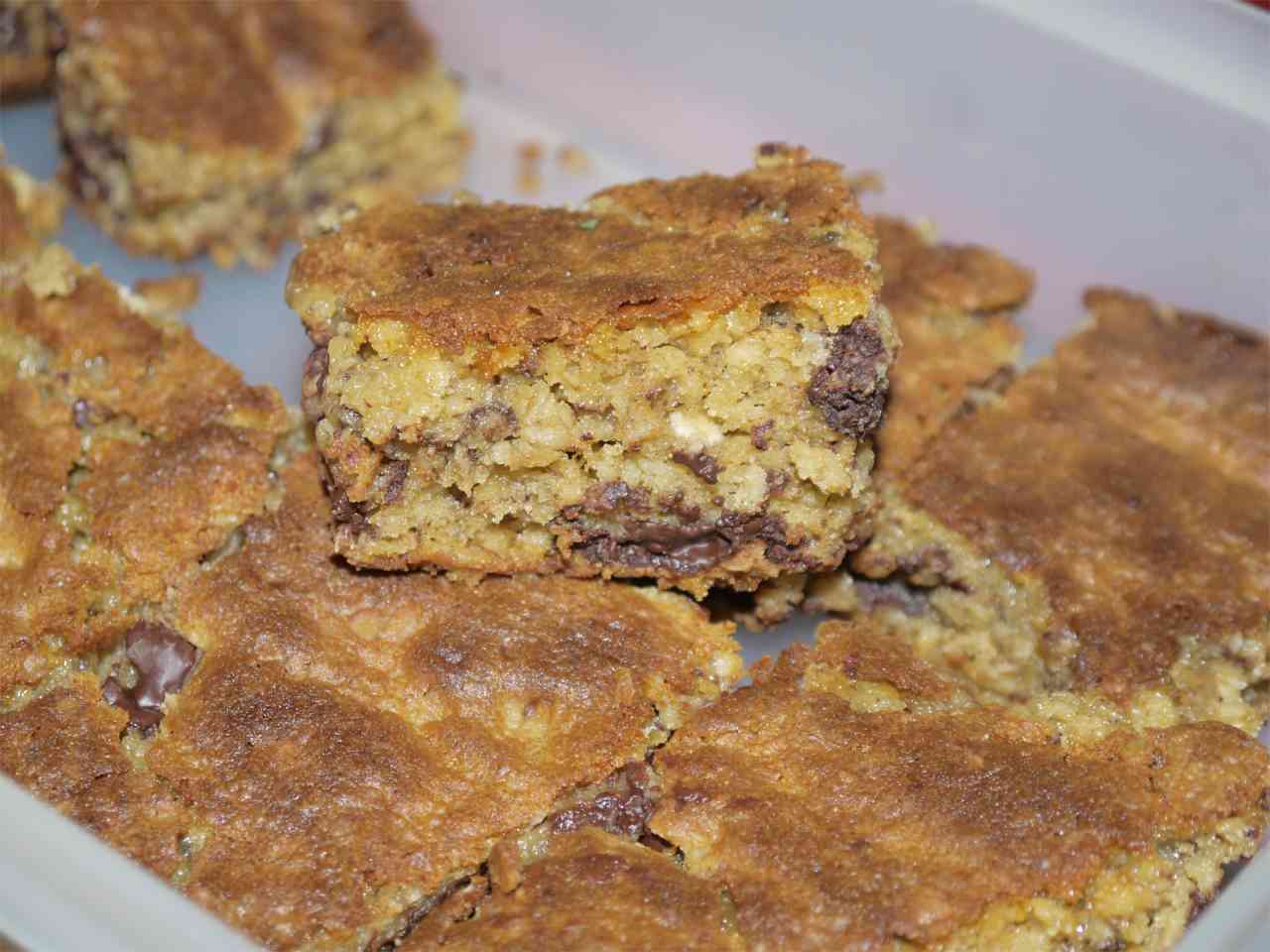
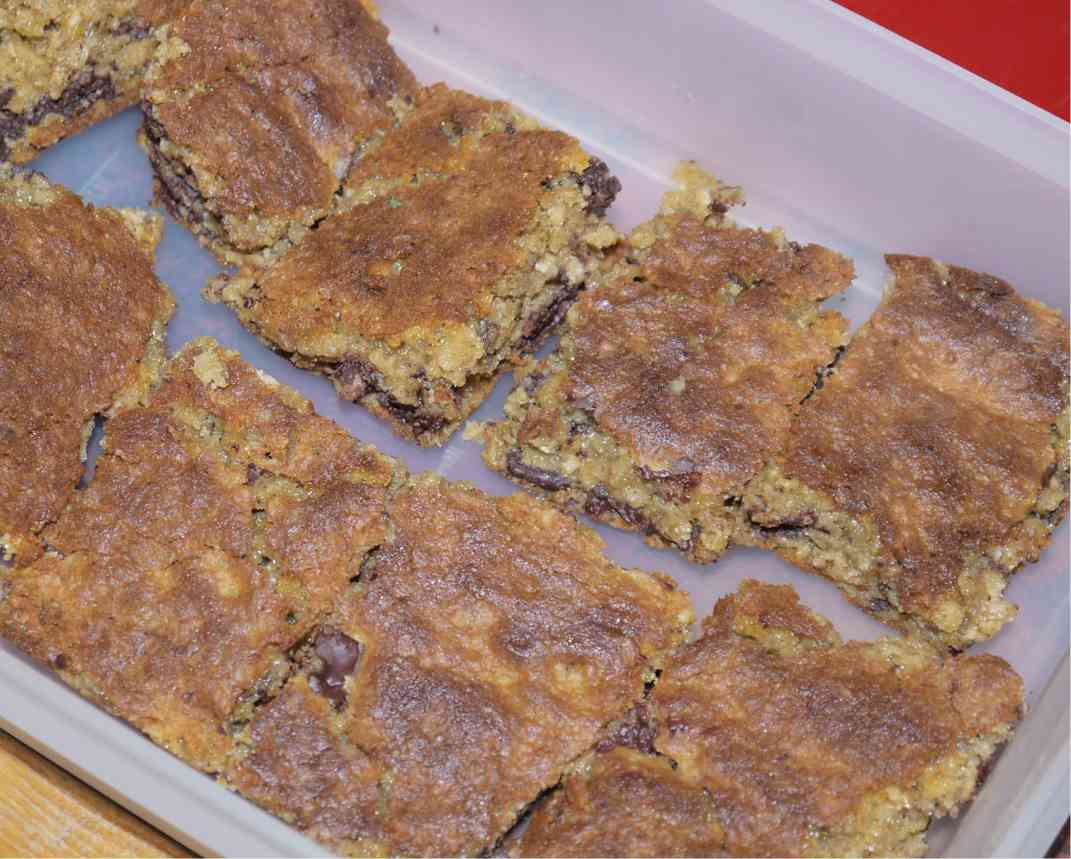
Here are Dave’s Blondies – they are absolutely delicious.

He made them by combining 200g porridge oats, 100g plain flour, and ½ teaspoon bicarbonate of soda in a bowl. In another bowl he beat together 150g soft unsalted butter and 100g light muscovado sugar until pale and then stirred in 1 can (397g) condensed milk, then add in the oats mixture. When this was well mixed he added in 1 egg and 170g of dark chocolate, chopped into small pieces.

He then put the lumpy mixture into a 9in square cake tin and baked it in a preheated oven at 180°for about 35 minutes. As Nigella describes it, it was ‘quite a pronounced dark gold around the edges and coming away from the tin’ and was still  ‘frighteningly squidgy, not to say wibbly.’

He let it firm up in the tin and then cut it into pieces. You can see in the photo below that they are a lovely consistency and the chocolate pieces are softly melted into the  chewy oaty mixture.

D's Blondies1

weekend cooking

Weekend Cookery is a weekly event hosted by Beth Fish Reads, where you’ll find more cookery related posts.

Edited 28 August 2021: The recipe is in Nigella Lawson’s book, Kitchen: Recipes from the Heart of the Home page 314.

Book Notes

These are notes on a couple of books I’ve read recently. They didn’t send me rushing to the computer to write about them, but they were good enough to finish.

I wrote a bit about Solar by Ian McEwan in a Teaser Tuesday post, whilst I was still reading it.

Opinion on Amazon is pretty much spread across the board, almost as many people  giving it five stars as those giving it one star. I thought it was OK, not as good as Atonement or Enduring Love both of which I loved.

It’s a story of greed, self-deception as well as climate science, global warming and photovoltaics.  The book is in three sections, 2000, 2005 and 2009 following the life of Michael Beard, a Nobel Prize winning physicist whose fifth marriage has failed.  His previous marriages had all ended due to his womanising,  but this time it’s his wife who has an affair and he can’t stand it. Beard is an unlikeable character, bemoaning his weight, overeating and drinking to excess, lecturing and lechering, stealing his colleagues research and setting up his wife’s lover for murder:

He was self-sufficient, self-absorbed, his mind a cluster of appetites and dreamy thoughts. Like many clever men who prize objectivity, he was a solipsist at heart , and in his heart was a nugget of ice … (page 169)

There are some interesting and some not so interesting parts to this book, some of it great and some not so great. It seemed as though it was really three episodes rather than one story.

The Turning of the Tide by Reginald Hill was originally published under the pseudonym of Patrick Ruell in 1971 as The Castle of the Demon. It’s described on the book jacket as an ‘intricately plotted thriller’. Emily has left her husband, the enigmatic Sterne Follett and is staying in Skinburness, a coastal town on the Solway Firth. At first the reasons for her doing this are not revealed. A sequence of sinister events unfolds, a body is found and Emily realises that her husband is involved – just how or why she has yet to discover.

Emily is staying in a house facing the long spit of land called the Grune, a sandy raised shingle beach. She suspects someone has been in the house, moving her things, she sees a green face looking in the window at her, an American staying at the local hotel goes missing, there are two archaeologists digging in a patch of furze and gorse. Then she is attacked whilst walking back from the hotel. She doesn’t know who to trust.

I wasn’t totally convinced by the plot, although there is plenty of tension. There was no way I would have guessed the outcome which I thought was a bit far-fetched. The descriptions of the location, however are very good:

They walked along the shore in a silence which became almost companionable after a couple of minutes. The sun was quite low now, shooting a line of varnished brightness up the Solway, laying a golden boundary between England and Scotland. The line of the tide running down to the Irish Sea was obscured by light. Her mind played with the phrase for a moment, then let it be washed away by the gentle lap of the ebbing water which, with their own footsteps, was the only sound. It seemed to merge with the silence rather than break it, just as the buildings that were now in sight seemed to lie flat against the frieze of grass, sea and sky rather than intrude into it. (page 12)

I borrowed both books from the library.