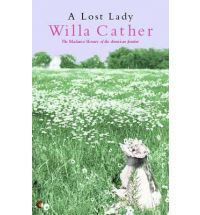
 I was very impressed with A Lost Lady by Willa Cather and now I want to read more of her books. I read it through in one sitting, which is most unusual for me, but having started it I just had to finish it. Not that there’s any mystery to solve, but just because I was enjoying the story, the writing and the scenes it conjured up in my mind.
A Lost Lady is about Mrs Forrester, a beautiful woman married to an older man, an elderly railroad pioneer living in a house on a hill at Sweet Water in the Nebraska plains along the Burlington railroad. She’s a well-loved, beautiful “lady-like” woman and the house, well known for Mrs Forrester’s hospitality and welcome, is in an idyllic setting. The story is told mainly through the eyes of Judge Pommeroy’s nephew, Niel Herbert, aged 12 at the beginning of the book.
There is an episode near the beginning of the book that completely shocked me, involving boys and a woodpecker. Even the boys watching who were not especially sensitive were “indignant and uncomfortable, not knowing what to do.” This episode signals the end of an idyllic life style. Captain Forrester looks back with nostalgia at his early days in the West, a time when
One day was like another, and all were glorious: good hunting, plenty of antelope and buffalo, boundless sunny sky, boundless plains of waving grass, long fresh water lagoons yellow with lagoon flowers, where the bison in their periodic migrations stopped to drink and bathe and wallow. “An ideal life for a young man,” the Captain pronounced. (page 48)
His working life was ended by a railroad accident, and it’s now a time when life is changing. He is aging and helpless, and with the failure of the bank in Denver his dreams have ended. Mrs Forrester who adapts to change also symbolises the end of a past age. Niel has idolised her but as she begins to drink and takes a lover he is shattered, disllusioned:
In that instant between stooping to the window-sill and rising, he had lost one of the most beautiful things in his life. Before the dew dried, the morning had been wrecked for him; and all subsequent mornings, he told himself bitterly. This day saw the end of that admiration and loyalty that had been like a bloom on his esixtence. He could never recapture it. It was gone, like the morning freshness of the flowers. (pages 83-4)
Mrs Forrester is indeed “lost”, no longer the woman she was, not only “lost” to Niel, but “lost” to the values of the times. Other themes explored in A Lost Lady are the rise of materialism, a longing for the past seen as a golden age, the spoiling of the countryside in the name of progress and the changing role of women in society. There is also an emphasis on the need to adapt and to accept the possiblity of loss. I can see some similarities to Madame Bovary, in Mrs Forrester’s adultery (the book has been called “the Madame Bovary of the American frontier”), but there aren’t many similarities between the two woman other than that. Madame Bovary reads romantic fiction, is dissatified with her husband and commits suicide, whereas Mrs Forrester carries on with her life, is practical and does not give in to despair.
A Lost Lady is a complex novel, written in 1922 and published in 1923, and although it deals with the passing of the old order it still seems relevant today. Perhaps every age is the end of one period and the start of another.

 For Teaser Tuesday quote two or three sentences from the book you’re currently reading – without giving away any spoilers. This weekly event is hosted by Mizb.











 BooksPlease