In Open Book today at 4.00pm on BBC Radio 4 Mariella Frostrup talks to Hilary Mantel about her latest novel Wolf Hall about Henry VIII’s notorious minister Thomas Cromwell.
Month: April 2009
Sunday Salon

It’s been a good week for reading. I finished:
- The Private Lives of the Impressionists by Sue Roe
- Ferney by James Long
- We Have Always Lived in the Castle by Shirley Jackson – review to follow later
It has taken me weeks to read Sue Roe’s book, as I took it slowly, savouring the detail. Whereas both Ferney and We Have Always Lived in the Castle are the type of books that demand to be read and it was impossible to read them slowly.
I’ve started reading three very different books:
- Remember Me by Melvyn Bragg – a story of a tragic love affair.
- The Cat Who Could Read Backwards by Lilian Jackson Braun – Qwilleran and Koko, the Siamese cat investigate an art gallery murder.
- After the Victorians: the World Our Parents Knew by A N Wilson – popular history covering the period 1901 -1953.
I’ve only just started each one, but in their different genres they all promise well. I won’t be finishing them all this week as Melvyn Bragg’s book is 551 pages and A N Wilson’s is 624 pages!
Ferney by James Long: a Book Review
 Whether you believe in reincarnation or not Ferney by James Long is a most enjoyable read. It’s difficult to write about it without giving away too much. I liked the balance between historical fact and imagination as the story of Ferney and Gally unfolds.
When Gally and her husband Mike buy a derelict cottage in Penselwood in Somerset they meet Ferney, an old man of 80 who knows the history of the cottage. When they first see the cottage
It was not much more than a shell, and a green wet-looking shell at that, though the roof was still on. Long and low, the jumbled lines of its random stonework told of many changes and additions over all the busy years. The roof-line took a little step downwards towards the far end. Stone lintels topped window holes filled only by ivy and from the middle of the house a buckled, wooden lattice-work porch jutted out, tilting down on to its knees from the weight of the creeper that had massed on it, sensing an easy opponent.
Gally thinks it is perfect. Despite his misgivings Mike agrees to buy and renovate the cottage because after Gally’s miscarriage he wants to keep her on an even keel and this promised to bring her “more peace and happiness than he had seen since they first met.” At this point in the book Gally is very fragile, tormented by nightmares and mentally unbalanced (or so I thought).
But right from their first meeting with Ferney he startles them both. Gally sees him as “a philospher king with a sword in one hand and a book of verse in the other.” And as the bond grows between Gally and Ferney, Mike is upset immediately feeling on the defensive, irritated, and pushed out. And he is quite right to feel like that. Mike is a historian but he finds it hard to believe Ferney’s stories of the past and insists on having proof. The contrast between the two men is a focal point with Gally torn between the two of them.
I loved the way the narrative slips effortlessly from the past to the present as time slips for Gally and she finds herself reliving scenes from long ago. Just what effect does the cottage and the Bag Stone that stands outside have on their lives? And how will the relationship between Gally and Ferney be resolved? I just had to read on and on to find out.
This is the 12th library book I’ve read this year.
Garden Scene

Symbolism – Booking Through Thursday

Question suggested by Barbara H:
My husband is not an avid reader, and he used to get very frustrated in college when teachers would insist discussing symbolism in a literary work when there didn’t seem to him to be any. He felt that writers often just wrote the story for the story’s sake and other people read symbolism into it.
It does seem like modern fiction just ‘tells the story’ without much symbolism. Is symbolism an older literary device, like excessive description, that is not used much any more? Do you think there was as much symbolism as English teachers seemed to think? What are some examples of symbolism from your reading?
I sympathise with Barbara’s husband and remember thinking at school that my teacher was trying to extract more from the text than was actually there, and getting really tired of analysing every sentence almost when I wanted to get on with reading. That I think was the problem -sometimes I just wanted to know what happened and was not very interested in going any further.
 But later I took a course in “Literature” and was fascinated by how much more you can find in a text than on first reading. I read The Waste Land by T S Eliot which is crammed to the brim with symbolism. Without understanding the symbolism and literary allusions much of the poem is meaningless and baffling.
The dictionary definition of “symbol” is that it represents something else such as an idea or a quality by analogy or association for example a rose can represent or symbolise beauty and a serpent may stand for evil. Using symbolism means that a variety of meanings and interpretations are possible and I think they enrich the text. Any object or scene or episode can be symbolic giving depth of meaning and achieving a mysterious suggestiveness.
These days I like to vary my reading and sometimes I’m happy reading books that can be read quickly without thinking too deeply about what is happening, but at other times I want a more complex book, where there are themes working on several different levels that stimulate my imagination. I don’t think the use of symbolism is an older literary device, although my example of The Waste Land is not exactly “modern”.
Wordless Wednesday – The Dark Tower

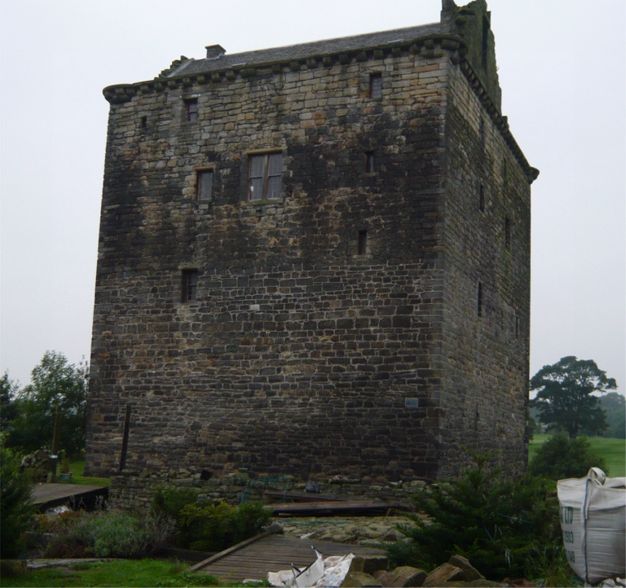
- Niddry Castle, near Winchburgh, West Lothian
Well, nearly wordless.
Niddry Castle, a Tower House built around 1500, about 11 miles west of Edinburgh. Mary Queen of Scots stayed here in May 1568 after her escape from captivity in Loch Leven Castle. We visited it on an open day last September. The entrance is up a narrow stone stairway and I was amazed to see a grand piano in the living room way up in the tower.
 BooksPlease