Worse? – Booking Through Thursday

btt button

Which is worse?

Finding a book you love and then hating everything else you try by that author, or

Reading a completely disappointing book by an author that you love?

Today Deb’s Booking Through Thursday question is a hard one. I had to think for a while before coming up with this not too inspired answer!

  • Finding a book you love and then hating everything else you try by that author:

I don’t think I’ve had this experience – certainly not hating subsequent books. I may have thought other books were not so good and then not bothered reading any more by that author.

  • Reading a completely disappointing book by an author that you love?

Again I’ve not read one that was completely disappointing, maybe some books weren’t quite as good as others I’d read by a particular author, which is disappointing. But then there is always the hope that the next one would be better. Oh, dear, I suppose I could say the same about the first question.

I just don’t know the answer – both are disappointing.

What is most disappointing is finding that you’ve come to the end of a loved author’s books and there are no more to read. But I can always re-read them – eg Jane Austen’s books – I still have one more of hers to read The Watsons – I do hope I won’t be disappointed!

Non-Fiction Five Challenge

nonfictionsmall

Another Challenge! This is the Non-Fiction Five Challenge, starting on Friday 1 May. For more information on this challenge hosted by Trish at Trish’s Reading Nook click on the Rules below.

The Rules

1. Read 5 non-fiction books during the months of May – September, 2009

2. Read at least one non-fiction book that is different from your other choices (i.e.: 4 memoirs and 1 self-help)

You don’t have to post a list of the books you intend to read and can change them at any time, but I decided to do it anyway. So for the time being I’m planning to read:

  • After the Victorians by A N Wilson. I have started reading this one already and it will probably take me until September to finish it.
  • Russia by Jonathan Dimbleby
  • 1599: A Year in the Life of William Shakespeare by James Shapiro
  • Eden’s Outcasts by John Matteson
  • The Snow Geese by William Fiennes

Book Review:The Cat Who Could Read Backwards

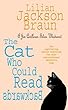
The Cat Who Could Read Backwards by Lilian Jackson Braun was on display in my local library. It caught my eye both by its title and its cover. I hadn’t come across any of the “Cat” books before, although I’ve since discovered that there are a lot of them. I like “whodunnits” and cats so I thought it might be entertaining.

Then I read that Zetor had found it “disappointing”, which put me off a bit. I can see what she means. It is rather slow – nearly halfway through the book before the murder – and no the cat can’t read and is as she says pretty average for a feline. But I liked it.

Briefly the book is about Joe Qwilleran, a newspaper reporter assigned to be an art writer, even though he knows little about art. There is a feud between the paper’s art critic, George Bonifield Mountclemens III, and local artists and when Earl Lambreth, who runs the art gallery is found murdered there are plenty of suspects. Qwilleran who used to be a crime reporter gets involved.

 I liked the slowness of it, the humour and above all Koko, the Siamese cat. The cover disappointingly shows a black cat not the beautiful Siamese with a “voice like an ambulance siren” and when Qwilleran first meets him he sees him  in bright daylight which

… emphasized the luster of the pale fur, the richness of the dark brown face and ears, the uncanny blue of the eyes. Long brown legs, straight and slender, were deflected at the ends to make dainty feet, and the bold whiskers glinted with the prismatic colors of the rainbow.

Later on in the book, when Koko is frolicking on the staircase his

… slender legs and tiny feet looking like long-stemmed musical notes were playing tunes up and down the red-carpeted stairs.

I found the art snobbery amusing. For example, an exhibition of a local artist’s watercolours of sailboats is described by Mountclemens by detailing the fine craftsmanship of the picture frames, and dismissing the paintings by saying that they “do not  detract from the excellence of the moldings.”

What I didn’t like was the ending, with the introduction of a new character at such a late stage; most disappointing. Will I read any more of The Cat Who … books? Maybe, if I find them in the library, but I won’t be buying them.

Book Review: Tangled Roots by Sue Guiney

tangled-roots001I should have received Tangled Roots from LibraryThing’s Early Reviewers programme but as it never arrived the author, Sue Guiney kindly sent me a copy. It’s written from two perspectives – John, a professor of Theoretical Physics and his mother, Grace, moving backwards and forwards in time and set in Boston, London and Moscow and as the title indicates is about how their lives intertwine and interact.

It took me several chapters before I really became interested in Tangled Roots. I was a bit lost in the description of the characters’ thoughts and inner soul searching. However, as I read on the characters began to come to life, particularly Grace.  Grace is looking back over her life, how her marriage and pregnancy brought her career to a halt, how she coped with her husband’s infidelity and the death of her second child, her sister’s cancer and how she struggled with depression. Overall, Grace is the more convincing character.

John is unhappy, seemingly going through a mid-life crisis. He hasn’t got over his mother’s death, has a failed marriage, succombs to an affair with a student, and it looks as though his and his Russian colleague’s research will be pipped at the post by the “South American team”. I’m hazy about the actual details of the research. It all seemed a bit vague and something to do with holography, but that maybe because I don’t know much about science and certainly nothing about theoretical physics. I wasn’t really convinced about this part of the book. I wanted to get back to find out more about Grace.

Tangled Roots is about family relationships and relationships between friends and colleagues. It’s about communication, understanding or lack of it, and about dealing with life’s catastrophes. It’s also about illness and depression. There is quite a lot of scientific information interspersed, some of which I found enlightening and there is a glossary of terms at the end of the book to help the scientifiically challenged like me. Entropy, which is the “measurement of the amount of disorder in a physical system”, serves as a simile with the characters’ lives as events spiral rapidly into disorder and chaos.

Non-Fiction – Musing Mondays

monday-musingToday’s MUSING MONDAYS post is about reading non-fiction€¦

Do you read non-fiction regularly? Do you read it in a different way or place than you read fiction? (question courtesy of Diane).

I don’t read a lot of non-fiction, but I do read it regularly. I like to have at least one that I’m reading in between reading fiction. I read mainly biographies, books on history, religion, art, travel and cookery.

I don’t read them differently from fiction, apart from the travel and cookery books, which I use as reference books – dipping into sections rather than reading them straight through. I do like looking at cookery books for inspiration and at travel books to get an idea of what places look like. I suppose I read cookery books mainly in the kitchen, but really I read books wherever I am (including cookery books).

I think the one main difference when I’m reading non-fiction is that it’s usually for information and I don’t often make notes of what I’m reading as I do with fiction. The indexes help and sometimes I wish fiction had indexes too. 

Click on the graphic above to read more Monday Musings.