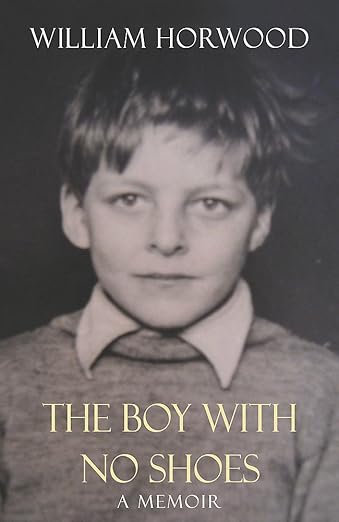
The Boy With No Shoes: a Memoir by William Horwood

Headline Book Publishing| 2004| Hardback edition| 440 pages| 5*

Five-year-old Jimmy Rova is the unwanted child of a mother who rejects him, and whose other children bully him. The one thing he can call his own is a pair of shoes, a present from the only person he feels has ever loved him. When they are cruelly taken away, Jimmy spirals down into a state of loneliness and terrible loss from which there seems no recovery.

This triumphant story of a boy’s struggle with early trauma and his remarkable journey into adulthood is based on William Horwood’s own remarkable childhood in south-east England after the Second World War. Using all the skills that went into the creation of his modern classics, Horwood has written an inspiring story of a journey from a past too painful to imagine to the future every child deserves. (Amazon)

William Horwood is an English novelist. He grew up on the East Kent coast, primarily in Deal. His first novel, Duncton Wood, an allegorical tale about a community of moles, was published in 1980. It was followed by two sequels, forming The Duncton Chronicles, and also a second trilogy, The Book of Silence. William Horwood has also written two stand-alone novels intertwining the lives of humans and of eagles, The Stonor Eagles and Callanish , and The Wolves of Time duology. Skallagrigg, his 1987 novel about disability, love, and trust, was made into a BBC film in 1994. In addition, he has written a number of sequels to The Wind in the Willows by Kenneth Grahame.

When I saw The Boy With No Shoes on the secondhand bookshelves in my local village hall I thought I’d like to read it. It was a great choice as I think it’s one of the best books I’ve read this year. It’s important to read the Author’s Note carefully before you read the book, and not dive straight into it. I had to re-read it after I’d read a few chapters as I was beginning to wonder if this was really fictional. I also wasted time searching on maps to find where he lived growing up.

In his Author’s Note at the front of the book he explained why he wrote about himself as Jimmy Rova:

When I was thirty-four and had been iller than I knew for two long years, my recovery began in the strangest and most magical dream of ways. |I woke one day from dreaming and saw myself when very young, as clearly as in a black and white Kodak photograph. I saw how desperately the little boy I once was had needed someone to talk to in a world where no one wanted to listen. I decided there and then to travel back in time and let myself as adult be listener to the child. This book and my final healing is the result of that imaginative listening, over very many years.

Because the boy seemed other than himself he gave him a different name and changed the name of his home town. By so doing he was able to fill in gaps, paper over the cracks and visit distant places of emotion that he would never have reached.

It is a long and detailed book that took me nearly a month to read. It is beautifully written and as he tells the story of his very early life there are many times when it moved me to tears. His writing is so clear that the places and people he describes spring to life as you read. All the characters have depth and are believable as people.

He is just as good at portraying Jimmy’s feelings and emotions. I could feel his depth of despair, fear and confusion as he describes his first memory about the man in a time long ago who bought him a pair of shoes. That day entered his heart and stayed there forever. He called him The Man Who Was, the man who left him standing in the rain, holding his Ma’s hand, full of fear that he would not be there to keep him safe from Ma, who treated him appallingly, and he would be all alone. All that was left to him were the shoes. So, imagine how awful it was when the shoes disappeared, cruelly taken from him.

But life for Jimmy did eventually get better, especially when Granny came to live with them, but even she could not protect completely from his abusive Ma. I loved all the details of Granny’s time in Africa with ‘The African Gentleman’, who wore a funny hat on his grey and grizzled hair, and his clothes were striped black and yellow. In his hand he carried a wand like a magician. Also unforgettable is his first love, Harriet, and how his mother ended their affair.

There were others too who were kind to him. I loved his description of a new English teacher at the Grammar School, who in contrast to the Head and other teachers believed in the boys. He inspired Jimmy and transformed his life by showing him how to believe he could succeed and how to prepare for his O levels.

There were others too, His Uncle Max who took him hiking in Snowdonia. Moel Saibod was the first mountain he climbed and then others, including Snowdon, the tallest mountain in Wales and England. Then, Mr Boys who taught him to read, Mr Bubbles, a fisherman and his wife, who lived along the shore and taught him all about fishing. I could go on and on, but really if this interests you the best thing is to read the book for yourself. It is a wonderful book, that captures what life was like in the 1950s and even though my childhood was nothing like his, it brought back memories of growing up. I too, as a young woman) climbed Snowdon – Welsh name, Yr Wyddfa (I did not take the Snowdon Mountain Railway either up or down) and also Moel Saibod.

The Boy With No Shoes by William Horwood: Book Beginnings on Friday & The Friday 56

Every Friday Book Beginnings on Friday is hosted by Gillion at Rose City Reader where you can share the first sentence (or so) of the book you are reading. You can also share from a book you want to highlight just because it caught your fancy.

I’m featuring The Boy With No Shoes by William Horwood, a memoir I started to read today. William Horwood is an English novelist. His first novel, Duncton Wood, an allegorical tale about a community of moles, was published in 1980. It was followed by two sequels, forming The Duncton Chronicles, and also a second trilogy, The Book of Silence. William Horwood has also written two stand-alone novels intertwining the lives of humans and of eagles, The Stonor Eagles and Callanish , and The Wolves of Time duology. Skallagrigg, his 1987 novel about disability, love, and trust, was made into a BBC film in 1994. In addition, he has written a number of sequels to The Wind in the Willows by Kenneth Grahame.

In 2007, he collaborated with historian Helen Rappaport to produce Dark Hearts of Chicago, a historical mystery and thriller set in nineteenth-century Chicago. It was republished in 2008 as City of Dark Hearts with some significant revisions and cuts under the pen name James Conan.

The book begins with the Author’s Note:

When I was thirty-four and had been iller than I knew for two long years, my recovery began in the strangest and most magical of ways. I woke one day from dreaming and saw myself when very young, as clearly as in a black -and-white Kodak photograph. I saw how desperately the little boy I once was had needed someone to talk to in a world where no one wanted to listen.

From the Prologue:

My name is Jimmy and there was a man in my time long ago, before the Boy and the Girl, before my Darktime, before Granny came to help me; and the man held my hand and took me out of our cold house into the sun and then along a street to a great big place with a sign outside

From Chapter 1 Running:

The park keeper in his uniform and hat shouted at me and grabbed one of my ears and pulled me towards him.

‘KEEP OFF THE GRASS!’ he yelled, so close it made my eardrums ache.

Also every Friday there is The Friday 56, hosted by Freda at Freda’s Voice, but she is taking a break and Anne at My Head is Full of Books has taken on hosting duties in her absence. You grab a book and turn to page 56 (or 56% of an eBook), find one or more interesting sentences (no spoilers), and post them.

On page 56 the characters are talking about the day that Edmund Hillary from New Zealand and Sherpa Tensing from Tibet had climbed the highest mountain in the world. No one in the whole history of the world had stood on top of it before.

Uncle Max said, ‘This is a great day for England and the monarchy.’

Granny said, ‘It seems to me that it is a great day for New Zealand and for Tibet, and a bad day for Mount Everest. It is nothing to do with England at all, let alone the Queen.

Description from Goodreads:

Five-year-old Jimmy Rova is the unwanted child of a mother who rejects him, and whose other children bully him. The one thing he can call his own is a pair of shoes, a present from the only person he feels has ever loved him. When they are cruelly taken away, Jimmy spirals down into a state of loneliness and terrible loss from which there seems no recovery. This triumphant story of a boy’s struggle with early trauma and his remarkable journey into adulthood is based on William Horwood’s own remarkable childhood in south-east England after the Second World War. Using all the skills that went into the creation of his modern classics, Horwood has written an inspiring story of a journey from a past too painful to imagine to the future every child deserves.