
Spell the Month in Books is a linkup hosted by Jana on Reviews From the Stacks on the first Saturday of each month. The goal is to spell the current month with the first letter of book titles, excluding articles such as ‘the’ and ‘a’ as needed. That’s all there is to it! Some months there are optional theme challenges, such as “books with an orange cover” or books of a particular genre, but for the most part, any book you want to use is fair game!
This option this month is Animal on the Cover or in the Title, which I found much easier to do than some of the previous options. These are all books I’ve read, apart from Inchworm.
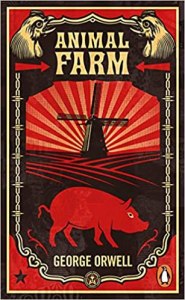
A is for Animal Farm by George Orwell is an allegorical novella, of the Russian Revolution and the rise of the Soviet Union. It tells the story of a farm where the animals rebel against the farmer, Mr Jones, and throw him off the land. They hope to create a society where they are all equal, free and happy. Ultimately, the farm ends up in a state that is as bad, if not worse than it was before, under the dictatorship of a pig named Napoleon. It begins as the old boar Major tells the animals about his dream of overthrowing the human race when the produce of their labour would then be their own and he incites them to rebel. In the story that follows the Major is based on Marx, Farmer Jones on the Tsar, the pigs Napoleon and Snowball are based on Stalin and Trotsky respectively. Their revolution began by declaring that all animals are equal and ended with the added phrase but some animals are more equal than others.
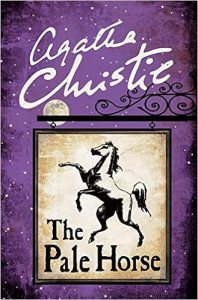
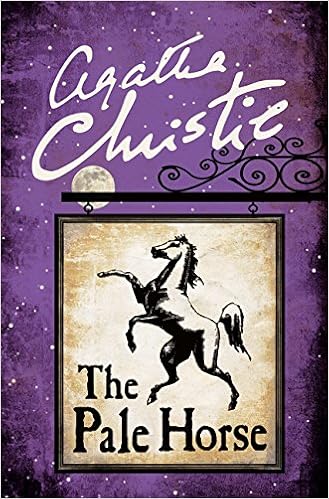
P is for The Pale Horse by Agatha Christie. Neither Hercule Poirot, nor Miss Marple feature in this novel and Mrs Ariadne Oliver has only a small part. Detective Inspector Lejeune is in charge of the investigation into the murder of Father Gorman who was killed one night on his way home. A list of names is found on Father Gorman’s body, seemingly unconnected in any way. The title, a reference from the Book of Revelation to a pale horse ridden by Death suggested to me from the beginning that what they had in common was death.
The Pale Horse is an old house which was formerly an inn in the village and is now the home of three weird women, thought by the locals to be witches. The Pale Horse is also the name of a sinister organisation that arranges murders based on black magic. It’s a fascinating book conveying a feeling of real menace.
R is for The Raven’s Head by Karen Maitland. Set in 1224 in France and England this is a dark book. I found parts of it very uncomfortable and disturbing to read and yet also very compelling. Life in the medieval world was cruel and brutal and The Raven’s Head describes that world in minute detail, evoking the superstitious fear of the period.
The story is told from the three main characters point of view – Vincent, Wilky, a young boy taken from his family to live in a monastery in Norfolk where unspeakable terrors await him and the other young boys, and Gisa also living in Norfolk, working in her uncle’s apothecary’s shop. Their lives are connected through Lord Sylvain who is trying to find a way to bring the dead back to life and the abbot, trying to find the elixir of life – both experimenting with alchemy.
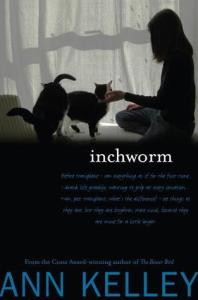
I is for Inchworm by Ann Kelly. Gussie is a twelve year old girl from St. Ives in Cornwall. She is passionate about learning, wildlife, poetry, literature, and she wants to be a photographer when she grows up. But her dreams were put on hold as she struggled with a serious heart condition. Now she has got what she needed: a heart and lung transplant. But it isn’t working out quite the way she thought. Firstly she has to leave her beloved Cornwall to live in London and in the months following her operation she is unable to do very much except read and adopt a stray kitten, but she could do that when she was sick. She craves adventure and experience beyond her four walls, until, that is, she hits upon a plan – she is going to get her divorced parents to fall in love again. It’s not going to be easy, her mum is still dating her doctor boyfriend and despises Gussie’s father, who happens to be living with his new girlfriend – the Snow Queen. But Gussie is a determined girl and there is only one thing that could stop her now.

L is for Lion by Conn Iggluden. This is the first book in Conn Iggulden’s Golden Age series set in Amcient Greece in the 5th century BCE. I thoroughly enjoyed it which surprised me as generally speaking I’m not keen on reading battle scenes and the book starts and ends with battles. But I had no problem with following the action of the battles between the Greeks and the Persians, and was able to visualise what was going on without any difficulty. The characters’ names took me a little while to get clear in my mind but I soon got used to them. The two main characters are both young men, Cimon the older of the two has more authority than Pericles, the younger man. Lion is the story of their early careers.
The next link up will be on May 3, 2025 when the theme will be: Freebie
 BooksPlease