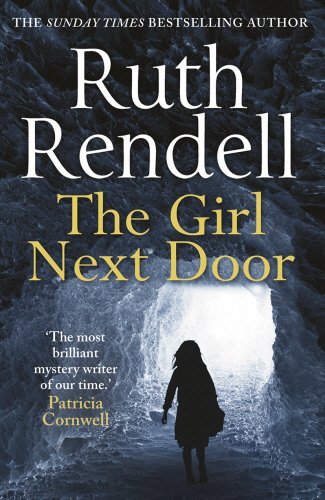
The Girl Next Door by Ruth Rendell

Rating: 5 out of 5.

Ruth Rendell, Lady Rendell of Babergh, also known as Barbara Vine, who died aged 85 in 2015, was a literary phenomenon. From 1964, when Inspector Reginald Wexford first appeared in From Doon With Death, she wrote more than sixty novels, including police procedurals, standalone and psychological mysteries plus numerous books of short stories. Many of them were adapted for television or made into feature films.

The Girl Next Door by Ruth Rendell, is one of my TBRs, a book that’s been sitting on my bookshelves since 2016. It’s one of her later novels, a stand-alone book, first published in 2014, a year before her death.

Description from Amazon UK

Beneath the green meadows of Loughton, Essex, a dark network of tunnels has been dug. A group of children discover them. They play there. It becomes their place.

Seventy years on, the world has changed. Developers have altered the rural landscape. Friends from a half-remembered world have married, died, grown sick, moved – or disappeared.

Work on a new house called Warlock uncovers a long buried grisly secret: the bones of two severed hands are discovered in a box, and an investigation into a long-buried crime of passion begins.

The friends, who played together as children, begin to question their past. And a weary detective, more concerned with current crimes, must investigate a case of murder.

The book begins just before the second world war when Woody killed his wife and her lover when he discovered they were having an affair. He then cut off their hands, a right hand and a left that they had held together, and put them in a biscuit tin, which he buried in a tunnel, where the local children played.

Time moves on to 1944. Ruth Rendell describes a garden where the neighbourhood children play:

The garden was not beautiful. It had no flowering trees, no roses, no perfumed herbs. Tunnels they called it at first. The word ‘qanat’, an impossible word, was found by Daphne Jones and adopted by the rest of them. It meant, apparently, a subterranean passage for carrying water, in some oriental language. They liked it because it started with a q without a u. Their schoolteachers had taught them that no word could ever start with q unless followed by u, so Daphne’s idea appealed to them and the tunnels became qanats. (pages 13 – 14)

Time moves on again and we meet up with the children as adults in their seventies, when the skeletal hands have been discovered. The qanats were actually the foundations of a house called Warlock in Loughton, twelve miles north of London and most of the children, are now still living in the area. When they read the newspaper report about the discovery of the hands they get together and reminisce about their childhood and playing in the tunnels, wondering whose hands had been buried.

This is when the book expands into a study of ageing as well as murder mystery:

As you get older, you forget names: those you studied with, lived next door to, the people who came to your wedding, your doctor, your accountant and those who cleaned your house. Of these people’s names you forget perhaps half, perhaps three quarters. Then whose names do you never forget, because they are incised on the rock of your memory? Your lovers (unless you have been promiscuous and there are too many) and the children you went to your first school with. You remember their names unless senility steps in to scrape them off the rock face. (page 17)

It’s quite a long book, nearly 350 pages in a small font in my copy and Ruth Rendell takes time to describe these old friends’ lives and reveals their relationships, their loves and losses and those of their own children and grandchildren as well as their regrets, and bereavements. I felt I really got to know them as real people. Long buried secrets rise to the surface, and old passions are reignited.

From the beginning we know the identity of the murderer, Woody and that of his wife Anita, but not that of the man, whose hand had held Anita’s. At times I thought I’d worked out who it was but when his identity was revealed it wasn’t who I thought it was – it was more complicated than I’d realised. And who is ‘the girl next door‘? I did work that out correctly. It is in some places a bleak novel, and all the characters’ lives have changed by the end of the book. It’s a book that really gripped me and drew me on to find out more. And I really enjoyed how it shows the changes that have taken place in society from the 1930s onward.

I’ve read several of Ruth Rendell’s standalone books and I think this is one of her best. I’ve also read some of her Inspector Wexford books and those she wrote under the name of Barbara Vine.
The Girl Next Door by Ruth Rendell: Book Beginnings & The Friday 56

Every Friday Book Beginnings on Friday is hosted by Gillion at Rose City Reader where you can share the first sentence (or so) of the book you are reading. You can also share from a book you want to highlight just because it caught your fancy.

I’m featuring The Girl Next Door by Ruth Rendell, one of my TBRs, a book that’s been sitting on my bookshelves since 2016. It’s one of her later novels, a stand-alone book.

Chapter One:

He was a handsome man. A handsome boy, his mother called him, because she started praising his looks when he was five.

Also every Friday there is The Friday 56, hosted by Freda at Freda’s Voice, but she is taking a break and Anne at My Head is Full of Books has taken on hosting duties in her absence. You grab a book and turn to page 56 (or 56% of an eBook), find one or more interesting sentences (no spoilers), and post them.

Unlike other users of Baldwin’s Hill, who were afraid of pregnancy or, in the case of the girls, of not being virgins when they were married, he and Daphne went ‘all the way’, as the phrase had it. She didn’t get pregnant, though he had done nothing to prevent it.

Description from Amazon UK

Beneath the green meadows of Loughton, Essex, a dark network of tunnels has been dug. A group of children discover them. They play there. It becomes their place.

Seventy years on, the world has changed. Developers have altered the rural landscape. Friends from a half-remembered world have married, died, grown sick, moved – or disappeared.

Work on a new house called Warlock uncovers a long buried grisly secret: the bones of two severed hands are discovered in a box, and an investigation into a long-buried crime of passion begins.

The friends, who played together as children, begin to question their past. And a weary detective, more concerned with current crimes, must investigate a case of murder.

A – Z of TBRs: G, H and I

I have been neglecting my TBRs this year and have been reading mainly new books and library books.So here is the third instalment of my A – Z of TBRs, a series of posts in which I take a fresh look at some of my TBRs to inspire me to read more of them by the end of the year. These TBRs are all physical books – I’ve not included e-books.

I’m enjoying searching my shelves – finding books I’d forgotten were there (the disadvantage of shelving books behind others).

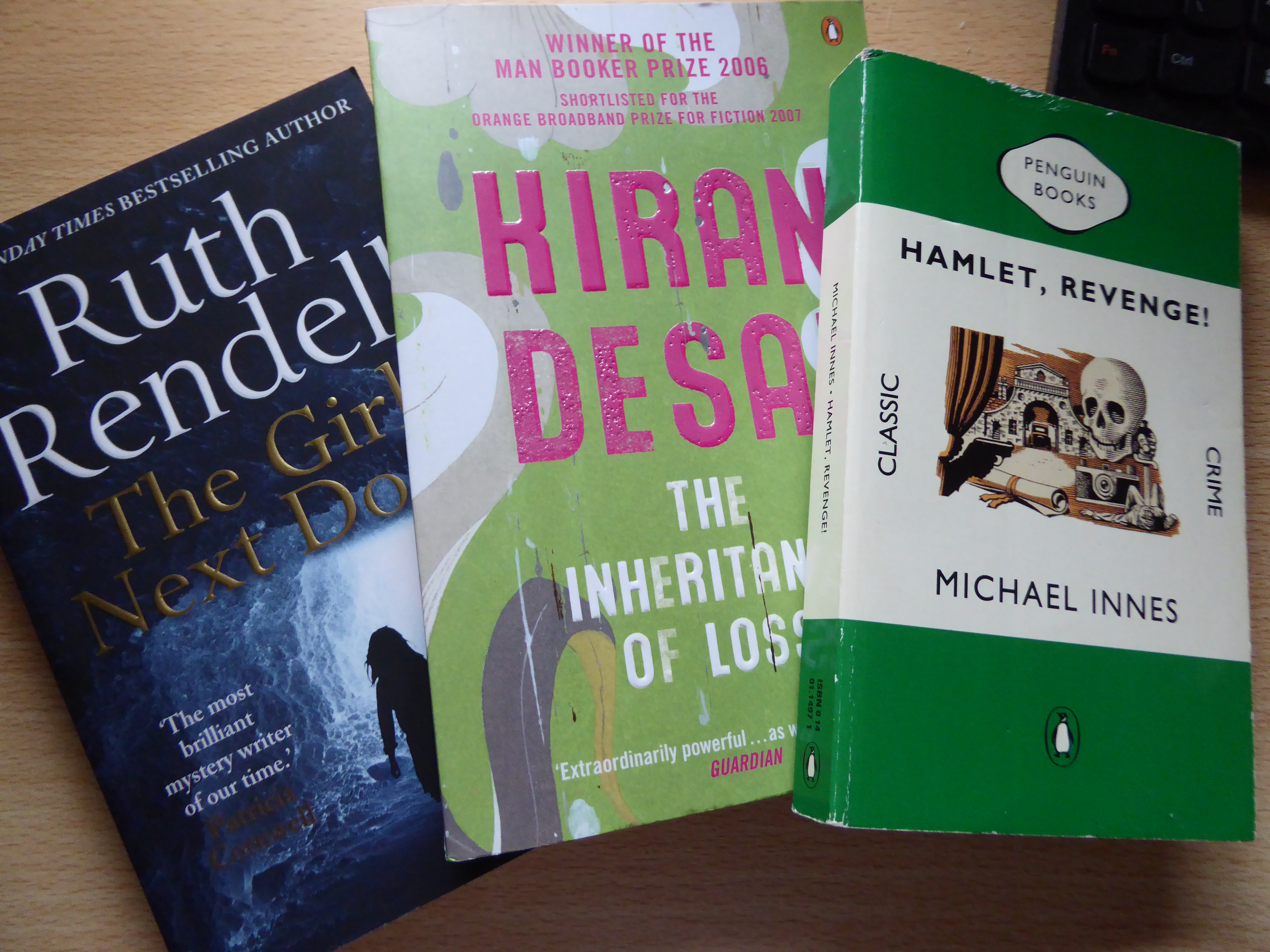
a-z tbrs ghi P1020304


G is for The Girl Next Door by Ruth Rendella book I’ve had for just over a year. When a new house is being built a long buried secret is uncovered – a tin box is found in an earthen tunnel. It contained two skeletal hands, one male and one female.

Their garden was not beautiful. It had no flowering trees, no roses, no perfumed herbs. Tunnels, they called it at first. The word ‘qanat’, an impossible word, was found by Daphne Jones and adopted by the rest of them. It meant, apparently, a subterranean passage for carrying water in some oriental language. They liked it because it started with a q without a u. Their scholteachers had taught them that no word could ever start with a q unless it was followed by u, so Daphne’s idea appealed to them and the tunnels became qanats. In time to come the qanats became their secret garden. (pages 14 -15)

HHamlet, Revenge! by Michael Innes (on my TBR shelves since May 2015). This is a green Vintage Penguin, first published in 1937, and in this edition in 1961, about a murder planned to take place in the middle of a private performance of Hamlet.

It had begun as a family frolic. And now, although it would not be publicly reported, the dramatic critics were coming down as if to an important festival. Professors were coming to shake learned respectable bald heads over a fellow-scholar’s conception of an Elizabethan stage. Aged royalty  was coming to be politely bewildered. Most alarming of all, ‘everybody’ was coming – for the purpose no doubt, of being where ‘everybody’ was. And even if it was a select and serious everybody – a known set before whom a Lord Chancellor might mime without misgiving – it was still a crowd, and its actions were unpredictable. (page 28)

IThe Inheritance of Loss by Kiran Desai, a book I’ve had for just over 10 years! It won the Man Booker Prize in 2006. This is set in India, in a dilapidated mansion high in the Himalayas, the home of three people each dreaming of another time – a retired judge, Sai, his granddaughter and a cook.

In Kalimpong, high in the northeastern Himalayas where they lived – the retired judge and his cook, Sai and Mutt – there was a report of new dissatisfaction in the hills, gathering insurgency, men and guns. It was the Indian Nepalese this time, fed up with being treated like the minority in a place where they were the majority. They wanted their own country, or at least their own state, in which to manage their own affairs. Here, where India blurred into Bhutan and Sikkim, and the army did pull-ups and push-ups, maintaining the tanks with khaki paint in case the Chinese grew hungry for more territory than Tibet, it had always been a messy map. The papers sounded resigned. A great amount of warring, betraying, bartering had occurred; between Nepal, England, Tibet, India, Sikkim, Bhutan; Darjeeling stolen from here, Kalimpong plucked from there – despite, ah, despite the mist charging down like a dragon, dissolving, undoing, making ridiculous the drawing of border. (page 9)

What do you think? Do you fancy any of them? 

One reason I haven’t read these books yet is that they’re all in such a small font!