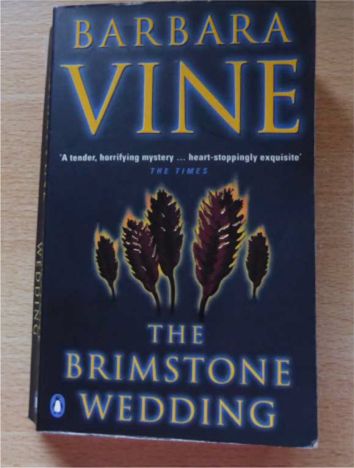
The Brimstone Wedding by Barbara Vine

I’ve had The Brimstone Wedding by Barbara Vine sitting on my unread shelves for a while and when the R.I.P. IX Challenge came up I thought it would be a good book to include in the challenge, because the cover blurbs describe it as a ‘horrifying mystery’, ‘chilling’ and with a ‘horrible climax’.

Brimstone wedding

My copy is a second-hand paperback, which is no longer in print, but The Brimstone Wedding is available as an e-book.

Jenny Warner is a carer at a retirement home, Middleton Hall where she meets Stella Newland, who is dying of lung cancer. At first Stella never mentions her husband or her past life, but gradually she confides in Jenny, telling her things she has never said to her son and daughter – things about her life she doesn’t want them to know. 

Their stories intertwine, some narrated by Jenny and some by Stella as she records events in her life on a tape recorder which she leaves to Jenny.  They have more in common than Jenny initially thought and as Stella slowly reveals her past the tension in the book begins to mount.

The atmosphere is mysterious, a house isolated in the fens, seems to hold the key to the past. The description of the house is superb, set in an overgrown garden, with clothes still hanging in the wardrobe, food and champagne still sitting in the fridge and a red Ford Anglia locked in the garage. It’s all very subtle at first with tantalising hints about what had really happened in Stella’s past, but the full horror is left to the end, which by that time I was itching to find out if it was what I suspected it was. I was not disappointed; it’s not horrific in the overblown graphic sense, but in a sinister, psychological way that really is ‘chilling’ and inexpressibly sad.

Ruth Rendell, writing as Barbara Vine, writes beautifully and powerfully yet in a controlled manner, nothing is left out but there are no superfluous characters or sub-plots. Everything ties in well and the subtle horror of what I was reading gripped me. It is indeed a ‘chilling’ book. It’s about love, hate and indifference, about relationships between couples and families, and about obsession, deceit and betrayal.

Here are just a few quotations that I noted as I read. The opening sentences, set the scene and illustrate Jenny’s superstitious nature. Throughout the book there are numerous examples of her beliefs:

The clothes of the dead don’t wear long. They fret for the person who owned them. Stella laughed when I said that. She threw back her head and laughed in the surprisingly girlish way she had. I was telling her Edith Webster had died in the night and left cupboards full of clothes behind her, and she laughed and said she’d never known anyone as superstitious as me. (page 3)

and

When you deceive people you make fools of them. You make them act stupidly, act as if things which are aren’t and things which aren’t are. And that’s what fools do or people who are mentally disturbed and we look down on them for it or if we’re unkind we laugh at them. (page 17)

She is also aware of ill omens – a bird dying in your hand means your hands will shake for ever, it also means a death in the family and red and white flowers mixed are the worst possible omen at a funeral meaning there will be another death. I was wondering what significance the title has: Jenny has been married for thirteen years, which according to her mother is a ‘Brimstone Wedding’ anniversary. Jenny thinks:

Maybe because it’s explosive or because it’s hard and dark like a burning stone, which is what brimstone means. (page 231)

I think The Brimstone Wedding is one of the best of Barbara Vine’s books that I’ve read – nearly as good as A Dark-Adapted Eye and writing under her real name, Ruth Rendell, A Judgement in Stone. It certainly qualifies not only for the R.I.P. Challenge, but also for the Mount TBR Challenge 2014 and the My Kind of Mystery Challenge.

Put On By Cunning by Ruth Rendell

Put On By Cunning, aka in America as Death Notes is another book off my to-be-read shelves, an enjoyable read. It was first published in 1981.

The epigraph indicates just what is to follow:

So shall you hear
Of deaths put on by cunning and forc’d cause;
Fall’n on th’inventors’ heads all this can I
Truly deliver.

Hamlet

It is a tale of great complexity, a tale of murder and conspiracy to murder. A wealthy old man, Sir Manuel Camargue, one of greatest flautists of his time is found dead. Ankle deep in snow he had lost his footing in the dark and slipped into an icy lake and became trapped. His heiress, his daughter Natalie, had only recently been reunited with him after an absence of nineteen years. Although it seems a straight forward death, Camargue’s much younger fiancée puts doubts in Chief Inspector Wexford’s mind when she tells him that Camargue had said that the woman who presented herself as Natalie was an imposter.

As is Wexford’s way he becomes obsessed with finding the truth and wonders if Camargue’s death was actually murder, despite the Chief Constable’s insistence that he forgets about it as the evidence all points to his death being an accident. Indeed, the verdict of the inquest is ‘Misadventure’. Wexford, however, is persistent in his doubts and convinced Natalie is an imposter, he is determined to investigate, which leads him to both California and France.

There is much I enjoyed in this, the eleventh Wexford book. It begins well, Ruth Rendell sets an excellent scene, and I could easily visualise the locations and characters, with beautiful descriptive passages. Inevitably, as both Wexford and Inspector Burden, begin to unravel the mystery more and more characters are implicated, until it really does seem a complex case becoming even more complicated, with too many coincidences and characters.

I thought that Wexford was keeping far too much to himself – leaving both Burden and me too much in the dark. The ending came as somewhat of an anti-climax as Wexford explained what had really happened and revealed all the false leads. Still, it kept me guessing to the end and I wondered (as I often do) just what clues I had missed along the way.

And now I’m wondering if I could attempt a ‘Ruth Rendell/Barbara Vine Reading Challenge’, along the lines of the ‘Agatha  Christie Reading Challenge’, ie to read all her books. I’ve read several already.

Book Beginning: A Sight for Sore Eyes by Ruth Rendell

The library van came round this week and I borrowed another Ruth Rendell book: A Sight for Sore Eyes, first published in 1998. I don’t really check what the book is about when it’s one by Ruth Rendell, as I usually enjoy her books. This one begins:

They were to hold hands and look at one another. Deeply, into each other’s eyes.

‘It’s not a sitting,’ she said, ‘it’s a standing. Why can’t I sit on his knee?’

He laughed. Everything she said amused him or delighted him, everything about her captivated him from her dark-red curly hair to her small white feet. The painter’s instructions were that he should look at her as if in love and she at him as if enthralled. This was easy, this was to act naturally.

This could be the opening to a love story, but this is a Ruth Rendell book and I’m expecting it to be something darker and more mysterious. Indeed, the information on the back cover warns that this is ‘Masterfully spooky. Don’t read this alone.’

For more Book Beginnings see Gilion’s blog Rose City Reader.

The Saint Zita Society by Ruth Rendell

When I began to read The Saint Zita Society I could not remember all the characters, so many were introduced one after the other. So, I wrote them all down together with where they lived. In the first 30 pages I counted 28 characters. It helped to write their names down, and eventually their relationships and characteristics became familiar to me. There were just a few of the initial characters who did not play a large part later in the book.

I’d borrowed the book from the library and had totally missed the fact that the book’s endpapers contain a plan of Hexham Place with the names of the people who live at each house! It was partly my own fault that I missed this, not looking properly and skipping over straight away to the first chapter, but it was also because the library had covered up the front endpaper with labels and had sealed the book jacket to both the front and back endpapers! It would really have helped if I’d seen this when I started to read the book!

This is not a who-done-it, nor a why-done-it, but is really a character study of the people who live and work at Hexham Place in Pimlico and a ‘will-they get away with it’ mystery. To that extent I found it entertaining, if predictable. As usual with Ruth Rendell’s books the characters are a mix of odd personalities, with even the most ‘normal’ ones, revealing their idiosyncrasies – a reflection of real society, I suppose!

The Saint Zita Society is the brainchild of June (78 years old and the paid companion of the wealthy Princess Susan Hapsburg, 82 years old) who lives at No. 6 Hexham Place, along with Gussie the dog). As June explains Saint Zita is the patron saint of domestic servants, who gave food and clothes to the poor. The Society doesn’t function well, mainly because the members (cleaners, drivers, gardeners, and home helps – a nanny and an au pair) use it to air their grievances with little hope of resolving them. On the fringes of the Society is Dex, a strange man who keeps to himself, sees evil spirits and talks to Peach, his ‘god’, on his mobile. The others are uneasy around Dex, especially when they’re told that he had  tried to kill his mother and had spent time in a place for the criminally insane, but he is now cured and working as a gardener for Dr Jefferson at No.3 Hexham Place

After about a third of the book there is a death and an attempt to cover it up. And from that point on the action spirals to its predictable conclusion and even what I think was meant as an unexpected twist near the end was also rather obvious.

Overall, not a taxing mystery, but a look at the interaction between a group of disparate characters. I enjoyed it even though it lacked suspense and it ends rather abruptly (a bit like this post!). Just be careful next time you’re out shopping in a crowd or are out jogging on your own!

Kissing the Gunner's Daughter by Ruth Rendell

I’ve read only a few of Ruth Rendell’s Detective Chief Inspector Wexford books, although I must have watched all the TV dramatisations, with George Baker playing the part of Wexford. The books are set in Kingsmarkham, a fictional English town. The first of these, From Doon with Death, is also her first novel and was published in 1964. The full list of her books is on Fantastic Fiction.

Kissing the Gunner's Daughter

Kissing the Gunner’s Daughter (first published in 1992) is the fifteenth book in the series. It begins with the shooting of Sergeant Martin of Kingsmarkham CID whilst he was standing in a queue at the local bank. This seemed to trigger a chain of more murders as a few months later Wexford and Burden are faced with solving the brutal murders of author Davina Flory, her husband and daughter, shot dead at Tancred House. Only Daisy, her granddaughter survived, and wounded in the shoulder she had crawled to the phone to call for help. Her account of what happened is understandably confused. They had all been eating their dinner when they heard noises of someone upstairs. She only saw one of the intruders:

‘He came in …’ Her voice went dead, automatic machine tones. ‘Davina was still sitting there. She never got up, she just sat there but with her head turned towards the door. He shot her in the head, I think. He shot my mother. I don’t know what I did. It was so terrible, it was like nothing you could imagine, madness, horror, it wasn’t real, only it was – oh, I don’t know … I tried to get on to the floor. I heard the other one getting a car started outside. The one in there, the one with the gun, he shot me and I don’t know, I don’t remember … (page 70)

I had my suspicions quite early on in the book about the murder, but it was only intuition – I couldn’t put my finger on the reason for my thoughts. As I read on I thought I was wrong, as Ruth Rendell added more and more detail, and I was lost in all the red herrings she introduced. But then I began to suspect that I might have been right after all.This is an excellent book, both for the mystery element and for the characterisation, even the lesser characters stand out as real people.

I like Wexford, a detective with a happy marriage, although his relationship with his daughters, especially the younger daughter, Sheila is not so good. He hates her fiancé, author Augustine Casey, and this forms an interesting sub plot in which Rendell expresses her views on literary scene poseurs and post-modernist literature. Casey is an ‘extreme post-modernist‘ who ‘had already written at least one work of fiction without characters.‘ (page 97) Dora says that Casey is a very clever man, perhaps a genius and Wexford responds:

God help us if you’re going to call everyone who was shortlisted for the Booker prize a genius. (page 95)

I did not want to put this book down and just wish that it hadn’t sat unread on my bookshelves for about 20 years (including being hidden away for a few years due to being double shelved). But then I wouldn’t have had the pleasure of reading it now – I think it’s much better than some of Ruth Rendell/Barbara Vine’s later books.

A note on the title:

Kissing the Gunner’s Daughter’ is a phrase derived from a tradition in the Royal Navy, as Wexford explains:

It means being flogged. When they were going to flog a man in the Royal Navy they first tied him to a cannon on deck. Kissing the gunner’s daughter was therefore a dangerous enterprise. (page 340)

A dangerous enterprise indeed not only for the victims but also for the culprits, one of whom took enormous risks. (And my intuition proved partly right in the end.)

The Crocodile Bird by Ruth Rendell: a Book Review

I posted the opening sentences of The Crocodile Birdlast Friday. It really grabbed my attention and got me wondering what had caused Liza’s world fall apart. The cause is revealed when Eve, Liza’s mother tells her she has to leave home because Eve is liable to be booked for murder in the morning. Liza is nearly seventeen but has been brought up with practically no knowledge of the world outside the little gatehouse to Shrove House, where she has lived in seclusion, never having been on a bus or train or having any contact with other children. As Liza explained, Eve had wanted to protect her:

The world had treated her so badly, it was so awful out there, that I wasn’t to be allowed to go through any of that. I was to be sheltered from the world, hence no school and no visits to town, no meeting other people, other people kept down to a minimum, a totally protected childhood and youth. (page 116)

Liza, however, has a secret lover, Sean and when she leaves home she to goes to live with him in his caravan. She tells him the story of her life in a series of tales each night, just like Scheherazade in One Thousand and One Nights, culminating in how her mother is now on trial for murder. It seems, moreover, that she has killed more than once. Eve’s passion and obsession is for Shrove House, owned by Jonathan Tobias. Eve and Jonathan had grown up together and she had once thought they would marry and Shrove House would be hers. She would do anything to stay there.

This really a psychological study, rather than a straightforward crime fiction novel. It’s written in a simple style matching Liza’s childlike naivety.  To some extent, I thought that reduced the tension, although as Liza’s eyes were opened and she realised the meaning of events she had witnessed as a child, the tension mounted. It seemed that she might be following in her mother’s murderous footsteps!

The Crocodile Bird is an easy book to read and one that I enjoyed. The title intrigued me for most of the book, as I wondered where the bird comes into the story. The explanation is as Liza explains to Sean that just as the crocodile bird is able to feed safely from the mouth of a crocodile, so whatever Eve did to others (and she did some terrible things) Liza, like the bird, was always safe with her.

  • Paperback: 368 pages
  • Publisher: Arrow; New edition edition (29 Sep 1994)
  • Language English
  • ISBN-10: 0099303787
  • ISBN-13: 978-0099303787
  • Source: I bought the book
  • My Rating: 3.5/5