Top Ten Tuesday: Books that Feature Travel

Top Ten Tuesday is a weekly meme created by The Broke and the Bookish and now hosted by Jana at That Artsy Reader Girl. For the rules see her blog.

The topic today is Books that Feature Travel and the books I’ve chosen feature different types of travelling in a variety of countries – on a bicycle, on boats and ocean liners, as well as on foot. I’ve read all of them except for Sea Change, which is still sat on my bookshelves.
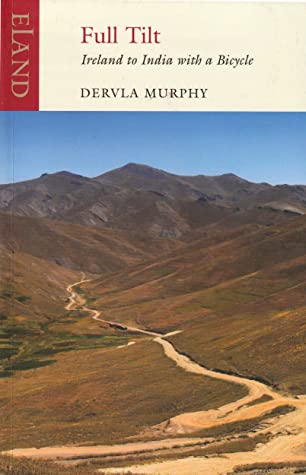
  1. Full Tilt: Dunkirk to Delhi on a Bicycle, first published in 1965  by Dervla Murphy this is an account of her journey in 1963, which took her through Europe, Persia (Iran), Afghanistan, over the Himalayas to Pakistan and into India.
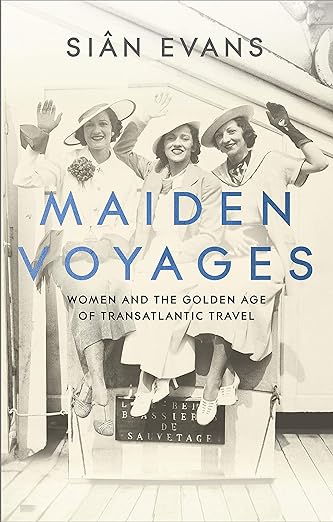
  2. Maiden Voyages by Siân Evans – transatlantic travel between the two World Wars on magnificent ocean liners undertaken by many women. Some travelled for leisure, some for work; others to find a new life, marriage, to reinvent themselves or find new opportunities. 
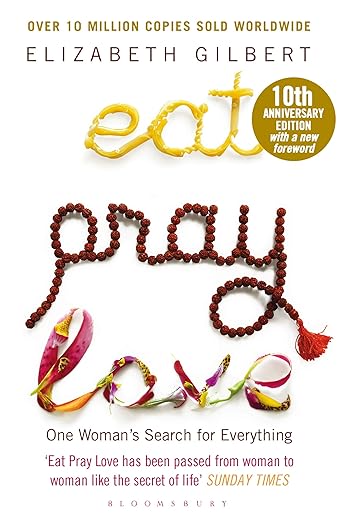
  3. Eat, Pray, Love by Elizabeth Gilbert. She travelled to Italy (Eat), India (Pray) and Indonesia (Love) spending four months in each place, searching for pleasure in Italy, mainly through food, God in India at an ashram, and balance in Indonesia.
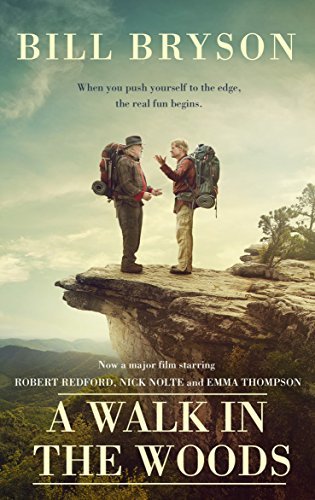
  4. A Walk in the Woods by Bill Bryson about his hike along the Appalachian Trail, the longest continuous footpath in the world.
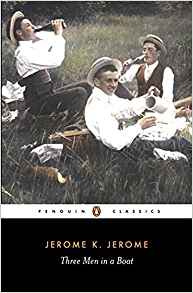
  5. Three Men in a Boat by Jerome K Jerome, first published in 1889. He intended it to be a serious travel book about the Thames, its scenery and history, but, as he wrote it turned into a funny book. It’s a story of a journey, comparing their trip to Stanley’s expedition to Africa searching for Dr Livingstone. 
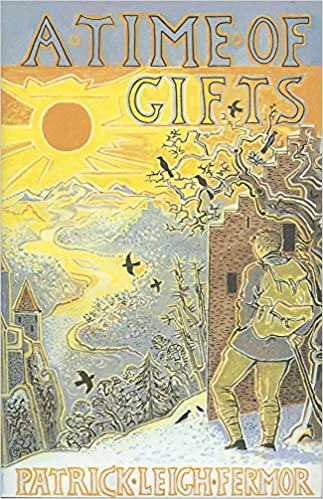
  6. A Time of Gifts by Patrick Leigh Fermor in which he describes his travels on foot in 1933 from the Hook of Holland through Germany, to Austria, Slovakia and Hungary, on his way to Constantinople.
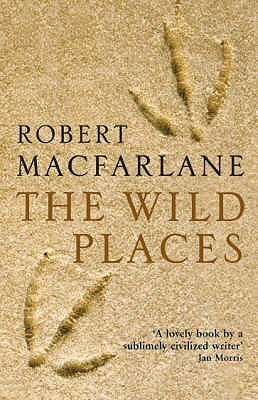
  7. The Wild Places by Robert Macfarlane, with a map showing the places he visited from the cliffs of Cape Wrath, to the holloways of Dorset, the storm-beaches of Norfolk, the saltmarshes and estuaries of Essex, and the moors of Rannoch and the Pennines.
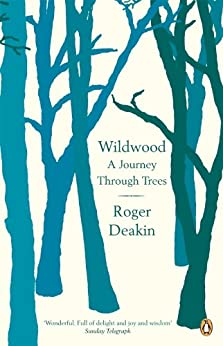
  8. Wildwood: a Journey Through Trees by Roger Deakin about his journeys through a wide variety of trees and woods in various parts of the world. It’s a memoir, a travelogue and also it’s about the interdependence of human beings and trees
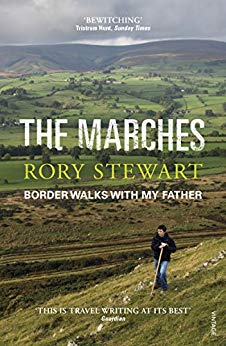
  9. The Marches Border Walks With My Father by Rory Stewart walking in the borderlands between England and Scotland, along Hadrian’s Wall and his coast to coast walk from Cunbria Cumbria to Berwick-upon-Tweed.
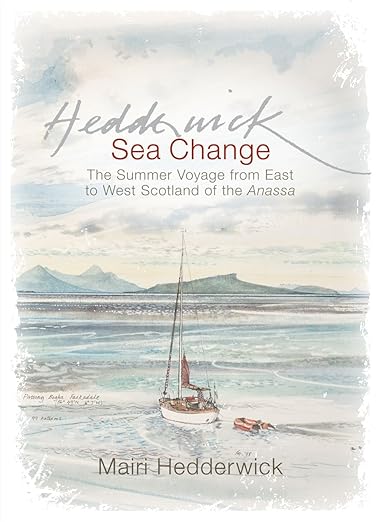
  10. Sea Change: The Summer Voyage from East to West Scotland of the Anassa by Mairi Hedderwick, describing her journey in an antiquated 26-foot long yacht through the Caledonian Canal to the fjords of the west: Lochs Linnhe, Etive, Ailort, Moidart, Nevis and Leven.
Stacking the Shelves: 12 April 2025

It’s Saturday and time for Stacking the Shelves, hosted by Marlene at Reading Reality and the details are on her blog, as well as a huge amount of book reviews. Why not visit her blog if you haven’t already found it? The gorgeous graphic is also used courtesy of the site.

The idea is to share the books you are adding to your shelves, may they be physical or virtual. This means you can include books you buy in physical stores or online, books you borrow from friends or the library, review books, gifts and of course e-books!

These are e-books I’ve either bought or acquired for free this month:

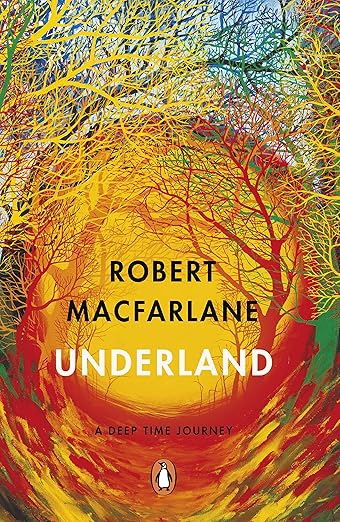
Underland: A Deep Time Journey by Robert Macfarlane, a 99p offer.

In Underland, Robert Macfarlane takes us on a journey into the worlds beneath our feet. From the ice-blue depths of Greenland’s glaciers, to the underground networks by which trees communicate, from Bronze Age burial chambers to the rock art of remote Arctic sea-caves, this is a deep-time voyage into the planet’s past and future. Global in its geography, gripping in its voice and haunting in its implications, Underland is a work of huge range and power, and a remarkable new chapter in Macfarlane’s long-term exploration of landscape and the human heart.

The One That Got Away by Mike Gayle.This was free – a bonus short story from Amazon Prime this month.

Reuben thought he’d spend the rest of his life with Beth, until she broke his heart six months ago. He’s not even remotely over her, so he’s devastated to hear she’s getting married—this weekend. Now he’s faced with the ultimate question: what should he do on the day of the wedding? Grieve? Disrupt the ceremony? Or do everything in his power to pretend it’s not happening? Enlisting the help of his friends, Reuben is all set to mark the occasion with distraction on a grand scale: Ferraris, champagne, and a VIP box at the races. But on the morning of the Big Day, Reuben gets a phone call that not only derails his elaborate itinerary: it may well change his life completely…

The Boy from Tiger Bay: A True Story of Murder, Betrayal, and a Fight for Justice by Ceri Jackson. A free book from Amazon Prime this month.

A brutal murder. A blighted investigation. The true story of five men damned by a crime they didn’t commit.

On Valentine’s Day 1988, twenty-year-old Lynette White was brutally murdered in a dark corner of Cardiff’s world-famous, and infamous, Tiger Bay. Stigmatised by a bad reputation, the area was on the brink of major redevelopment which would change the historic community forever.

South Wales Police launched its biggest murder hunt to date, and within weeks detectives released a photofit of a prime suspect seen outside the murder scene, his hands covered in blood. A white man. But as the months passed by and no arrest was made, the police came under inevitable pressure.

Everyone knew John Actie. But he didn’t know Lynette White. Yet, almost a year after her death, he and four other innocent men were charged with killing her. None matched the description, and none were white. But they became the scapegoats in what some saw as a desperate attempt to close the case.

Told predominantly through John Actie’s eyes, The Boy from Tiger Bay is an explosive true-crime narrative that exposes one of the UK’s most infamous murder investigations—a story of racial injustice and the enduring fight to bring the truth to light.

I’ve received one ARC this week from NetGalley

The Death of Shame (A Raven and Fisher Mystery Book 5) by Ambrose Parry, publication date, 5 June 2025.

1854, Edinburgh.
Respectable faces hide private sins.

Apprentice Sarah Fisher is helping to fund Dr Will Raven’s emerging medical practice in exchange for being secretly trained as a medic, should the rules barring women ever change. Sarah needs no instruction in the inequalities that beset her gender, but even she has her eyes opened to a darker reality when a relative seeks her help in searching for her missing daughter. Annabel Banks was promised a situation in a prestigious household, but there has been no word from her since she left home, and the agency that arranged her position says she never appeared.

Sarah’s inquiries lead her to reforming campaigners trying to publicise the plight of the hundreds of girls ensnared in Edinburgh’s houses of assignation. Sarah learns how young women are lured, deceived, trafficked and raped, leaving them ruined in the eyes of a society obsessed with moral purity, and where virginity is prized as a lucrative commodity.

Drawing upon real historical events, The Death of Shame takes Raven and Sarah into a treacherous labyrinth of exploitation, corruption, and immorality.

The Wild Places by Robert Macfarlane


I read The Wild Places by Robert Macfarlane at the end of December. I didn’t enjoy it as much as I thought I would from reading the blurb:

The Wild Places is both an intellectual and a physical journey, and Macfarlane travels in time as well as space. Guided by monks, questers, scientists, philosophers, poets and artists, both living and dead, he explores our changing ideas of the wild. From the cliffs of Cape Wrath, to the holloways of Dorset, the storm-beaches of Norfolk, the saltmarshes and estuaries of Essex, and the moors of Rannoch and the Pennines, his journeys become the conductors of people and cultures, past and present, who have had intense relationships with these places.Certain birds, animals, trees and objects – snow-hares, falcons, beeches, crows, suns, white stones – recur, and as it progresses this densely patterned book begins to bind tighter and tighter. At once a wonder voyage, an adventure story, an exercise in visionary cartography, and a work of natural history, it is written in a style and a form as unusual as the places with which it is concerned. It also tells the story of a friendship, and of a loss. It mixes history, memory and landscape in a strange and beautiful evocation of wildness and its vital importance.

I have mixed feelings about it. It does do all those things described above and maybe that was the problem for me -it tries to do too much. It is beautifully written, sometimes overwritten and it is also repetitive. There is a map showing the places he visited that helped me  to a certain extent – vague enough if you don’t want to pinpoint the precise locations. It is a book to read in small sections, to dip into rather than to read straight through as I did. I think I would have enjoyed it more if I had taken more time to read it – but during the times I did put it down I was in no hurry to get back to it.

I was intrigued by the places where he slept out and flabbergasted by the risks he took.

For example, he went on a night walk alone in the Cumbrian mountains. By the time he reached the mountains it was late afternoon and when he reached the ridge at over 2,000 feet the snow had thickened to a blizzard and it was hard to stand up in the wind. He decided to sleep on the surface of a frozen tarn that lay between two small crags giving some shelter from the wind. First he tested it by jumping gently on its centre; it didn’t creak, so he slept there in his sleeping and bivouac bags whilst it hailed and snowed. He began

to feel cold, deep down, as though ice were forming inside me, floes of it cruising my core, pressure ridges riding up through my arms and legs, white sheaths forming around my bones. (page 198)

When he woke he did a little dance on the tarn to warm himself and then saw that where he had been lying on the tarn,

the ice had melted, so that there was a shallow indent, shaped like a sarcophagus, shadowed out by the moonlight. (page 199)

However, I did enjoy the experience of reading The Wild Places, and  I’ve decided to read Macfarlane’s The Old Ways:  a Journey on Foot, particularly as a friend told me she had enjoyed it more than The Wild Places. Macfarlane describes how he set off from his Cambridge home to follow ancient tracks, holloways, drove roads and sea paths that criss-cross the British landscape.

Robert Macfarlane  is a Reader in Literature and the Geohumanities in the Faculty of English at Cambridge University. He is well-known as a writer about landscape, nature, memory, language and travel.

  • Paperback: 352 pages
  • Publisher: Granta Books (7 July 2008)
  • Language: English
  • ISBN-10: 1847080189
  • ISBN-13: 978-1847080189
  • Source: I bought my copy