Mini Reviews

I’ve been reading almost non-stop and not pausing long enough to write proper reviews, so it’s time for a brief look at some of the books I’ve read. These notes are not as detailed as I usually write, but when you read quickly this is the result!

Friend of the Devil by Peter Robinson, the 17th DCI Banks book 4*

Inspector Alan Banks and his team, the Western Area Major Crimes Squad, investigate the murder of 19-year-old Hayley Daniels who was found raped and strangled in the Maze, a tangle of narrow alleys behind Eastvale’s market square, after a drunken night on the town with a group of friends. There are plenty of suspects and it’s a matter of looking at who was where and when to find the murderer. It wasn’t who I thought it was.

DI Annie Cabbot, on loan to the Eastern area, is assigned to look into the murder of Karen Drew, a quadriplegic, who was found dead in her wheelchair on a seaside cliff. It’s only when Annie discovers the real identity of Karen Drew, that the question of why anyone would want to murder a quadriplegic, becomes clear. But who could have done it? Annie has to revisit an earlier case to find the culprit.

Although this can be read as a stand-alone novel, part of the enjoyment in reading the series in order is that you see the development of the main characters and their relationships over the years. The books are basically police procedurals but along the way there’s a lot about Alan and Annie as people rather than police officers. I have become fond of the regular characters in these books.

Watching the Dark by Peter Robinson, the 20th DCI Banks book 4.5*

This is the description on Goodreads: DCI Alan Banks reluctantly investigates DI Bill Quinn with Inspector Joanna Passero. Quinn, convalescing at St Peter’s Police Treatment Centre, was killed by a crossbow on the tranquil grounds, and left compromising photos. Quinn may be disreputable, linked to a vicious crime in Yorkshire and to a cold case – English Rachel Hewitt 19 vanished in Estonia six years ago.

Banks is not happy about this investigation, not only at the murder of one of their own officers, but because of the involvement of Joanna Passero who seems to him to be determined to prove that Quinn was a corrupt cop.

The team’s investigations lead them to a group smuggling illegal immigrants from Eastern Europe into the UK, taking Banks and Passero to Tallin in Estonia, whilst Annie heads the investigation in the UK. It’s remarkably complex. It’s also long, with many twists and turns, and it became too repetitive in the middle of the book, which is why I haven’t given it 5 stars. But I did enjoy it more than Friend of the Devil, especially the setting in Estonia. Robinson’s books are all definitely grounded in their settings, whether they’re in Yorkshire, Estonia, or elsewhere.

I have now read 20 of the 28 DCI Banks books.

I think the setting in Estonia means I can add Watching the Dark to the Wanderlust Bingo card in Central/Eastern Europe square.

Mini Reviews

This year has been a good time for reading books, but not a good time as far as writing reviews goes and I am way behind. So before I forget about them here are some notes about four of the backlog:

On the Beach by Nevil Shute 5*

I read this because I loved A Town Like Alice. It’s described on Goodreads as follows:

After the war is over, a radioactive cloud begins to sweep southwards on the winds, gradually poisoning everything in its path. An American submarine captain is among the survivors left sheltering in Australia, preparing with the locals for the inevitable. Despite his memories of his wife, he becomes close to a young woman struggling to accept the harsh realities of their situation. Then a faint Morse code signal is picked up, transmitting from the United States and the submarine must set sail through the bleak ocean to search for signs of life. On the Beach is Nevil Shute’s most powerful novel. Both gripping and intensely moving, its impact is unforgettable.

I think this is a terrifying and incredibly sad book, and yet it all seems low key. People go about their everyday lives but set against the background that the world is about to end. It was first published in 1957 and is set sometime in the early 1960s about a group of people living in Melbourne and on the USS submarine, Scorpion, as they await the arrival of deadly radiation spreading towards them from the Northern Hemisphere, following a nuclear war the previous year. It is slow moving, focusing on the individual characters and on the differing ways they deny or accept what is happening. How will they live the remaining few months ahead of them and how will they face the end of their lives? It’s a powerful book, well written and full of fascinating characters.

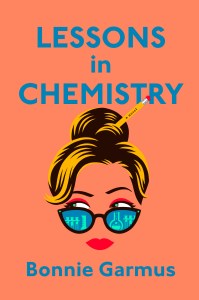
Lessons in Chemistry by Bonnie Garmus 4*

I enjoyed this book but not as much as I’d expected. It’s described on Goodreads as ‘Laugh-out-loud funny, shrewdly observant, and studded with a dazzling cast of supporting characters‘. But although I found parts of it amusing I didn’t laugh out loud. It’s about Elizabeth Zott, covering her life from the early 1950s through to the 1960s. She is a scientist, an independent single mother, who having lost her job, found herself as ‘the star of America’s most beloved cooking show Supper at Six. Elizabeth’s unusual approach to cooking (“combine one tablespoon acetic acid with a pinch of sodium chloride”) proves revolutionary. But as her following grows, not everyone is happy. Because as it turns out, Elizabeth Zott isn’t just teaching women to cook. She’s daring them to change the status quo.

I found Elizabeth quite an unlike able character and couldn’t warm to her. The book is full of exaggeration and hyperbole – examples are Elizabeth’s daughter Madeleine who at the age of four could read Nabakov and Six Thirty, the dog who was so clever and kind, worrying about Elizabeth and Madeleine. I don’t think we’re meant to take this as realistic – it’s a larger-than-life world with a semi-magic-realist strand and all just that bit over the top. In a complete contrast to the whimsy there’s a brutal rape, the death of Calvin, Elizabeth’s husband, abuse, abandonment, bullying and sexism thrown into the mix. Then there’s Elizabeth’s TV cookery show – I enjoyed the details of this more than the rest of the book. The ending is a bit of a let down and a bit rushed.

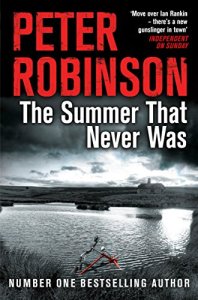
The Summer That Never Was by Peter Robinson 4*

This is crime fiction, the 13th Inspector Banks book. I’m gradually reading through the whole series. This is Goodread’s description:

A skeleton has been unearthed. Soon the body is identified, and the horrific discovery hits the headlines . . .

Fourteen-year-old Graham Marshall went missing during his paper round in 1965. The police found no trace of him. His disappearance left his family shattered, and his best friend, Alan Banks, full of guilt . . .

That friend has now become Chief Inspector Alan Banks, and he is determined to bring justice for Graham. But he soon realises that in this case, the boundary between victim and perpetrator, between law-guardian and law-breaker, is becoming more and more blurred . . .

What I particularly liked about this one is that it gives an insight into Banks’s childhood, as he investigates the murder of his childhood friend. The book alternates between this case and that of a present day case, that of the disappearance of another schoolboy, Luke Armitage, the son of an ex-football player. DI Annie Cabbot is in charge of that investigation. Although this can be read as a stand-alone novel, part of the enjoyment in reading the series in order is that you see the development of the main characters and their relationships over the years. There are now 27 books in the series with the 28th, Standing in the Shadows, due to be published in June 2023.

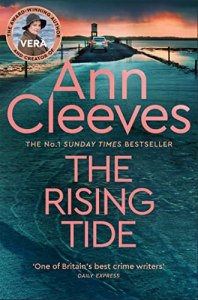
The Rising Tide by Ann Cleeves 5*

More crime fiction, this is the 10th Vera Stanhope mystery novel. I love the Vera books and this one is no exception. Ann Cleeves is a superb storyteller. Her books are deceptively easy to read,  moving swiftly along as the tension rises. They are layered, cleverly plotted and above all convincing.

The Rising Tide is set on the Holy Island of Lindisfarne, a tidal island just off the coast of Northumberland, only accessible across a causeway when the tide is out. Ann Cleeves explains whilst the background to the novel is real any specific places on the island or the nearby coast are fictional. I’ve visited the island several times and know just how fast the tide comes in over the causeway. If you’ve watched the TV series it shows Vera crossing the causeway in her Land Rover in the opening titles.

It has a complex plot and plenty of twists and turns as DCI Vera Stanhope and her team investigate the death of Rick Kelsall who was discovered hanged from the rafters of his small bedroom on Holy Island. He is one of a group of friends who have met for a reunion each year on the island for the past fifty years. It appears to be suicide but Vera is convinced that it is murder and that the clue to his death lies in the past. I was kept guessing almost to the end as the secrets from the past are revealed.

These notes don’t do just justice to the books but I enjoyed all of them, even Lessons in Chemistry. My favourite though is The Rising Tide and I wish I’d written more detail about it just after I read it!

Book Beginnings & The Friday 56: The Summer That Never Was by Peter Robinson

Every Friday Book Beginnings on Friday is hosted by Gillion at Rose City Reader where you can share the first sentence (or so) of the book you are reading. You can also share from a book you want to highlight just because it caught your fancy.

One of the books I’m currently reading is The Summer That Never Was by Peter Robinson, the 13th Inspector Banks book, following on from Aftermath. I am really enjoying it, so far, which is a relief as I really disliked Aftermath.

My Book Beginning:

Trevor Dickinson was hung over and bad-tempered when he turned up for work on Monday morning

Also every Friday there is The Friday 56, hosted by Freda at Freda’s Voice, where you grab a book and turn to page 56 (or 56% of an eBook), find one or more interesting sentences (no spoilers), and post them.

Page 56:

‘Did he have many friends?’

‘He made quite a few around here,’ Joan answered. She looked at her mother. ‘Who was there Mum?’

‘Let me remember. There was the Banks lad, of course, they were very close, and David Grenfell and Paul Major. And Steven Hill.’

Blurb

A skeleton has been unearthed. Soon the body is identified, and the horrific discovery hits the headlines.

Fourteen-year-old Graham Marshall went missing during his paper round in 1965. The police found no trace of him. His disappearance left his family shattered, and his best friend, Alan Banks, full of guilt.

That friend has now become Detective Chief Inspector Alan Banks, and he is determined to bring justice for Graham. But he soon realizes that in this case, the boundary between victim and perpetrator, between law-guardian and law-breaker, is becoming more and more blurred.

What do you think, does it appeal to you? What are you currently reading?

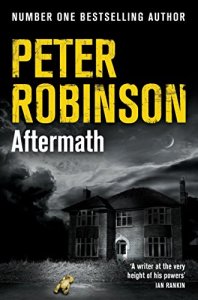
Aftermath by Peter Robinson – a brief review

A house of horror. A despicable serial killer. Banks’s darkest case.

When a concerned neighbour calls the police to number 35 The Hill after a domestic disturbance, the two constables are led to a truly horrific scene. They unwittingly uncover an elusive serial killer known as the Chameleon. With the killer finally in custody it appears the nightmare is over.

Not for Banks though. Too many questions remain unanswered at the house of horrors. And then they discover there are more bodies than victims. Is the Chameleon killer just one monster of many? Banks must solve his darkest case yet

Aftermath is the 12th book in Peter Robinson’s Inspector Banks series. The synopsis does not indicate the real nature of this book. There is much more to it than ‘truly horrific’. I agree that it is Banks’ darkest case in the series so far, but it is more than that. I didn’t like it right from the start; there is too much violence and graphic detail for me. It is harrowing and deeply disturbing with some scenes of physical abuse, child abuse, and rape. However the characters are well written and the story is gripping and despite hating it I read all 512 pages.

I’ve read some of the later books in the series and don’t remember that any of them were as dark and disturbing as this one, so I’m hoping the next book in the series, The Summer That Never Was, is not like Aftermath.

  • ASIN ‏ : ‎ B003DWC6NQ
  • Publisher ‏ : ‎ Pan; New Edit/Cover edition (4 Sept. 2008
  • Print length ‏ : ‎ 512 pages
  • My Rating: 3* not for the storyline but for the writing
  • Source: I bought the e-book

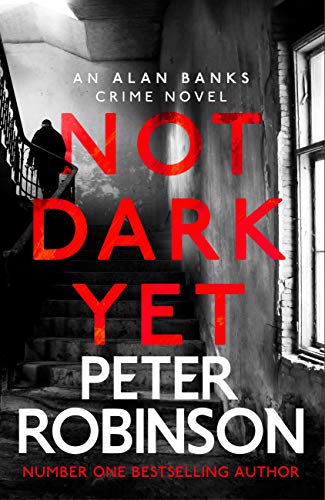
My Friday Post: Not Dark Yet by Peter Robinson

Yesterday Peter Robinson’s latest Inspector Banks book, Not Dark Yet was published and once I’d read the opening pages I decided to abandon any plans I had for what to read next and started to read it properly. So this is my choice this week for Book Beginnings on Friday and the Friday 56.

Every Friday Book Beginnings on Friday is hosted by Gillion at Rose City Reader where you can share the first sentence (or so) of the book you are reading, along with your initial thoughts about the sentence, impressions of the book, or anything else the opener inspires.

The book begins in Moldova:

Zelda hadn’t visited Chișinău since she had been abducted outside the orphanage at the age of seventeen. And now she was back. She wasn’t sure how she was going to find the man she wanted – she had no contacts in the city – but she did have one or two vague ideas where to begin.

Also every Friday there is The Friday 56, hosted by Freda at Freda’s Voice.

  1. Grab a book, any book.
  2. Turn to page 56, or 56% on your eReader. If you have to improvise, that is okay.
  3. Find any sentence (or a few, just don’t spoil it) that grabs you.
  4. Post it.
  5. Add the URL to your post in the link on Freda’s most recent Friday 56 post.

Page 56:

Banks found himself with a lot to think about as he made his way back to Vauxhall Underground station. He had originally intended to do some shopping while he was in London, check out the big Waterstones in Piccadilly, visit FOPP in Cambridge Circus, but decided he couldn’t face it. Like everyone else, he did most of his shopping online these days. London was too hot and too crowded today; he just wanted to go home.

My thoughts exactly each time I’ve been to London – I can’t stand crowds.

This is the 27th Inspector Banks books and I’ve read I’ve several of them, totally out of order, which doesn’t seem to matter – they work well as stand alone books. I’ve also watched the TV series, which I enjoy even though they are different from the books and my vision of Banks is nothing like Stephen Tompkinson who plays him. In fact, the characters are clearly meant to be different versions of the same person; they look different, have different personalities and meet different fates in different worlds.

Catching Up with Inspector Banks

Last month I read A Necessary End and Past Reason Hated by Peter Robinson, books 3 and 5 in his Inspector Banks series. I’ve read a few of his books out of order and I’m now filling in the gaps in my reading.

In A Necessary End a policeman is killed at an anti-nuclear demonstration in Eastvale. With over a hundred people at the demonstration at first there are plenty of suspects, but it soon becomes apparent that the main suspects are the organisers of the demonstration and the people living at Maggie’s Farm, an old Dales farmhouse set on the moors above the dales, the home of Seth Cotton.

To complicate matters Banks’ friend, Jenny Fuller is in a relationship with Dennis Osmond, a social worker and one of the main organisers of the demonstration. Jenny can’t believe that Dennis could be the culprit as he’d told he the last thing they had wanted was a violent confrontation.

This is the first book to introduce Detective Superintendent Richard ‘Dirty Dick’ Burgess, a troubleshooter from London called in to help with the investigations. Banks had worked with him a couple of times when was working in London and is not happy to see him. Because of this Banks works independently of Burgess and eventually gets to the bottom of the mystery.

Past Reason Hated is set just before Christmas when Caroline Hartley is found brutally murdered in her home she shared with Veronica Shildon. Three people had been seen visiting the house separately that evening. Nobody could describe them clearly – it had been dark and snowing and the street was not well lit and the investigation into her death centres on identifying them.

There are a number of suspects, among them is Charles Ivers, Caroline’s ex-husband, whom she had left to live with Veronica. There are also the members of the Eastvale amateur dramatic society who are rehearsing for a performance of Twelfth Night at the community centre. Caroline had a small part. But Banks is also interested in the music that was playing  when Caroline was found – the Laudate pueri – and in identifying the woman whose photo was found in Caroline’s belongings.

Both of these books are enjoyable but I preferred Past Reason Hated, because it has so many strands, which of course all interlinked and because of Robinson’s descriptions of the scenery in a snowy December. I also liked the focus on Susan Gay, newly promoted to Detective Constable as she stumbles to find her way in the team.

I am now addicted to the Banks books, which I enjoy more than the TV series. Both these books are from my TBRs.