Top Ten Tuesday is a weekly meme created by The Broke and the Bookish and now hosted by Jana at That Artsy Reader Girl. For the rules see her blog.
The topic this week is Authors (or books by authors) Who Live In My State/Country. I live in the UK. I’ve chosen authors who live/have lived in two Counties of the UK – Northumberland, where I now live and Buckinghamshire, where I used to live. The titles marked with * are linked to my reviews and the rest to Goodreads.
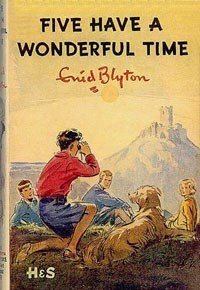
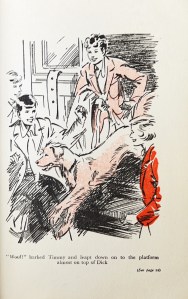
The Famous Five are having a brilliant time – on holiday in horse-drawn caravans – and they’ve discovered a ruined castle nearby! The castle looked deserted from a distance – but is that a face at the window? Or is it a trick of the light? The Famous Five just have to find out! Just who is hiding in the castle?
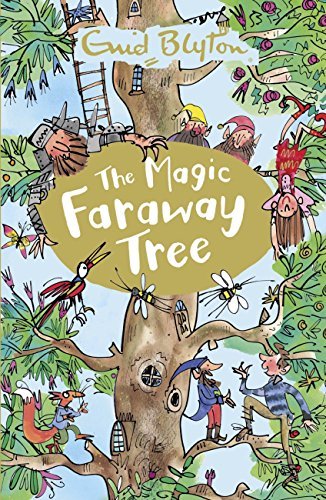
I had a wonderful time as a child reading Enid Blyton’s books. Her books gave me so much pleasure as a child going right back to her Noddy and the Magic Faraway Tree books. Her Malory Towers books were my favourites, but I also enjoyed the Favourite Five, The Secret Seven and the Adventure and Mystery series too.
The Five are Julian, Dick and Anne, their cousin, George (real name Georgina, but not call her that), and Timmy, George’s dog. Their ages aren’t mentioned in this book but according to Enid Blyton.net, Julian was twelve in Five on a Treasure Island, the first in the series, Dick and George were eleven, and Anne was ten. In the next book, Five Run Away Together, they were all a year older since their last adventure on Kirrin Island, a year before. After that in the later books, it seems that their ages were frozen in time (like Agatha Christie’s Poirot) — otherwise they would have been well into their twenties before the end of the series.
It’s the summer holidays and George is waiting impatiently at home recovering from a cold, whilst the rest of the Five are staying in a couple of old-fashioned gypsy caravans in a field near the village of Faynights, opposite the ruins of Faynights Castle. There’s news that two famous scientists have disappeared, with plans to go abroad and sell their secrets to another country. Julian is worried one of them might be his Uncle Quentin, George’s father. He isn’t and knows the two men, and insists that Derek Terry-Kane, in particular, would never be a traitor.
When George arrives they all go to the village shop to buy ice creams and the shop woman tells them some ‘fair folk’ are coming who usually camp in the field where the children are staying. She says it’s not a fair nor a circus, but a sort of mixed-up show with a fire-eater, a man with snakes, an India-Rubber man, and a man who can get himself free, no matter how tightly he’s tied up with ropes. When they arrive they insist the children have to leave the field, saying ‘No kids are allowed in our field’ and make life very unpleasant for them. Then their caravans disappeared whilst the children were out – the fair people had towed them into the next field. This is only resolved when Jo, a gypsy girl turns up, whose uncle is the fire-eater. She insists that they are her best friends and makes them bring the caravans back.
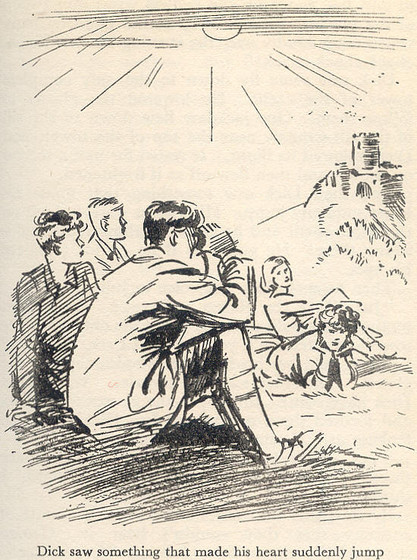
Julian though, isn’t happy and wants them to leave. But he changes his mind when Dick spots a face in a window-slot at the top of the only complete tower at the top of the castle. He thinks it’s a man’s face with bushy eyebrows. George remembers that Terry-Kane has thick black eyebrows. They decide they can’t leave without exploring the castle and find an explanation for the face – is Terry-Kane in the castle? So the next day they do just that and find themselves in the middle of a very dangerous mystery. It’s only with Jo’s help and the fairground entertainers with their amazing skills that it all ends well.
This really is a book that reflects the lives and attitudes of the 1950s. The children go exploring on their own much more so than they are allowed to do today, playing outdoors, exploring where they lived in the woods and fields, riding bikes with friends, and going swimming. And as a child of the 1950s that’s what my childhood was like, but not to the same extent as the Famous Five! Boys were encouraged to be strong and independent, whilst girls tended to be domesticated. Anne, for example, does the shopping, tidies the caravans and does the cooking, whereas the boys get the water and collect wood for the camp fire. George, a tomboy is the exception – she has short hair, scorns skirts and dresses in shorts and wants to do what the boys do.
Yesterday’s Britain, published by the Reader’s Digest describes the period 1950 – 1959 as a ‘golden age for some people‘, with ‘Britons better off as material prosperity swept away the last vestiges of austerity. “Most of our people have never had it so good,” declared Harold Macmillan.
Public figures were automatically respected, authority was deferred to inside as well as outside the home, and children grew up with an unquestioning sense of security.
It’s a pity that we can’t say the same for today!
About Enid Blyton
She wrote around 760 books during her fifty-year writing career! The 1950s was her most productive period, often publishing more than fifty books a year. However, her books have been criticised over the years, saying they are mediocre material, formulaic books with fantastical plots, xenophobic and ‘reflected negative stereotypes regarding gender, race, and class.’ Her books are very much of their time – she was born in 1897 and died in 1968. She began writing in the 1920s, with most of her series dating from the 1940s, when lives and attitudes were very different from those of today. I think they are books that provided comfort reading during and after the Second World War. Some of Blyton’s books have been ‘updated’ over recent years to remove or alter potentially offensive language and imagery, in an attempt to make them appeal more to modern children.
I thoroughly enjoyed them, finding them fun to read and completely unaware at the time that there was so much criticism when I read her books. She wrote about children whose lives were very different from mine and that was one reason I liked them. I loved the fact that her books took me to magical places, places of adventure where children could solve mysteries, thwart criminals, be independent of adults and have great fun, a world of mysterious castles and islands, exploring secret passages and hidden chambers and finding buried treasure.
I seem to be going back to my childhood with my ABC Wednesday posts, but I make no apologies for writing about Enid Blyton, whose books gave me so much pleasure as a child going right back to her Noddy and the Magic Faraway Tree books. I also had a few of the little magazines she wrote called Sunny Stories. I could never decide which of her books I liked the most:
The Naughtiest Girl series
The Famous Five
The Secret Seven
Malory Towers
The St Clares books
The Five Find-Outers
The Adventure series
I thought they were all marvellous.
Later when I worked in a library I discovered that not everyone thought like me and that some libraries banned her books – not the one I worked in though! The Wikipedia article on Enid Blyton also relates how her work was also banned by the BBC, criticising her work as being ‘stilted and longwinded’. I have to say at the time I was reading them I certainly didn’t find them so. Other criticisms are that the books are formulaic, xenophobic and ‘reflected negative stereotypes regarding gender, race, and class.’ Her books are very much of their time – she was born in 1897, died in 1968, her books dating from the 1920s, most of the series dating from the 1940s, when lives and attitudes were very different from those of today. I never noticed any class, racial or sexist prejudices when I read her books. I haven’t read her books for many years but I dare say I could very well do so now.
She wrote about children whose lives were very different from mine and that was one reason I liked them. I loved the fact that her books took me to magical places, places of adventure where children could solve mysteries, thwart criminals, be independent of adults and have great fun, a world of mysterious castles and islands, exploring secret passages and hidden chambers and finding buried treasure.
There are a number of websites with information about Enid Blyton – the Enid Blyton Society and Enid Blyton.net to name but two. By all accounts her life was not always a happy one – as the 2009 TV film about her portrayed. Enid with Helena Bonham Carter as Enid, shows her as a mother who ignored her own daughters, an arrogant, selfish and insecure woman. Sometimes it’s not a good thing to know too much about an author’s personal life. I’d rather just enjoy her books.
I don’t have a photo of the real Green Hedges in Beaconsfield, Buckinghamshire the house where Enid Blyton lived for many years, but the Bekonscot Model Village in Beaconsfield includes a model of the house complete with Noddy in his little car parked at the front.
This week’s Weekly Geeks is about examining a book (or books) which were published in your birth decade. Tell us about a book that came out in the decade you were born which you either loved or hated. Is it relevant to today? Is it a classic, or could it be? Give us a mini-review, or start a discussion about the book or books.
The first author I thought of who had written books in the 1940s was Enid Blyton and one of the books she published in 1946, my birth year isThe First Term at Malory Towers. The Malory Towers books (she published 6 between 1946 and 1951) were amongst my favourite Enid Blyton books.
I read all of them avidly! The lives of these girls at boarding school were so different from mine. It sounded wonderful, by the sea, at a school that looked like a castle with towers built on the cliffs in Cornwall.
This is boarding school fiction written well before J K Rowling was born. I loved all the books about Darrell Rivers’ adventures at Malory Towers from the age of twelve, when she first went there. It’s been years since I read them but I still remember wishing I could go to a school like that. There is more information on this book and other Enid Blyton books at The Enid Blyton Society. I had started to write this post and stopped to watch Country Tracks and amazingly part of the programme was about Dorset where Enid Blyton once lived. Even though she located Malory Towers in Cornwall she was actually describing the landscape of Dorset. Ben Fogle was looking at places connected to Enid including the swimming pool cut out of the rocks that features in Malory Towers. The real pool was dug out of the rocks in the 1930s when a headmaster wanted to stop his boys from jumping into the sea from the rocks.
I no longer have my copy, but I do have two of the series – In the Fifth at Malory Towers and Last Term at Malory Towers, in which Darrell is the headgirl of the whole school. I’m tempted to read them again, but maybe I won’t enjoy them as much now as I did before and I’ll find them terribly dated.
The next book I first read when I was in my teens and it is Titus Groan by Mervyn Peake, the first in his Gormenghast series. I found this book in the library, attracted to it by the unusual title. I thought it was brilliantly fantastic and read all three of the series. A few years ago I bought all three books.
This is from the back cover of Titus Groan:
Titus Groan, heir to Lord Sepulchrave, has just been born. A Groan of the strict lineage, Titus is seventy-seventh, he will inherit the miles of rambling stone and mortar that form Gormenghast Castle, and its surrounding kingdom. His world will be predetermined by complex ritual, the origins of which are lost in time; it will be peopled by the dark characters who inhabit the half-lit corridors. Lord Sepulchrave, a figment of melancholy, and his red-haired Countess; Swelter the chef and his bony enemy, Flay; Prunesqallor, castle physician, and his etiolated sister, Irma, and Steerpike, the Machiavellian youth.
This is a strange world and I loved it. I think it has stood the test of time, mainly because it is timeless, set in its own world. And, of course, I’m keen to read them again too.
My third choice is one I read only this year –The Hollow by Agatha Christie. I think this is one of the best Christie books. It is a country-house mystery with plenty of characters who could be the murderer and it kept me guessing, almost to the end. I wrote about it in February. This is also a book I’d love to re-read.

 … Enid Blyton


 BooksPlease