Top 5:Books on my TBR that intimidate me

Top 5 Tuesday was created by Shanah at Bionic Book Worm, and it is now being hosted by Meeghan at Meeghan Reads. For details of all of the latest prompts for October to December, see Meeghan’s post here.

Do you have a pile of books on your TBR that you were “going to read soon” but now it’s been like 5 years and you don’t know how to start that book any more? Maybe it’s 600 pages long. Or maybe you’ve seen some not-so-great reviews that pushed it down a bit. What books on your TBR intimidate you?

These are books I want to read but each time that I look at them I think ‘not now’ because they are so long AND as these are all either hardbacks or paperbacks they’re heavy, unwieldy and in small print!

Nicholas Nickleby by Charles Dickens (860 pages) – Nicholas Nickleby, is left penniless after his father’s death and forced to make his own way in the world. There’s an extraordinary gallery of rogues and eccentrics: Wackford Squeers, the tyrannical headmaster of Dotheboys Hall; the tragic orphan Smike, rescued by Nicholas; and the gloriously theatrical Mr and Mrs Crummle and their daughter, the ‘infant phenomenon’. Nicholas Nickleby is characterized by Dickens’s outrage at social injustice, but it also reveals his comic genius at its most unerring.

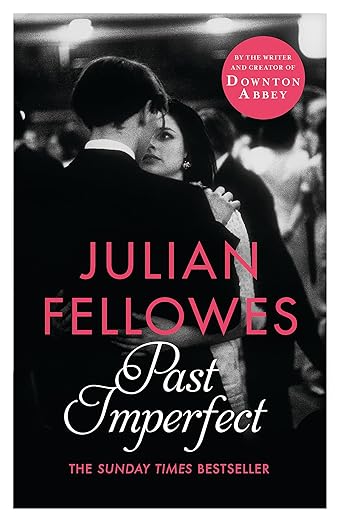
Past Imperfect by Julian Fellowship (528 pages) described on the back cover as a story that takes us back to the Debutante Season of 1968 – ‘Poignant, funny, fascinating and moving’ . Wishing to track down a past girlfriend who claims he had fathered her child, the rich and dying Damian Baxter contacts an old friend from his days at Cambridge. The search takes the narrator back to 1960s London, where everything is changing–just not always quite as expected.

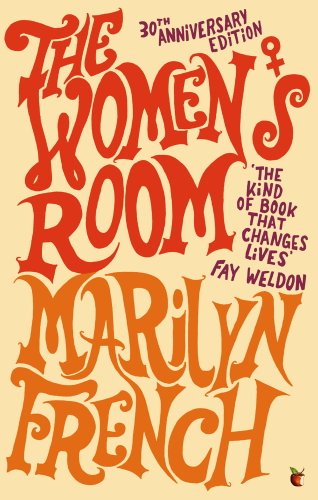
The Women’s Room by Marilyn French (544 pages), described as ‘one of the most influential novels of the modern feminist movement.’ It was first published in 1977 to a barrage of criticism. This is the story of Mira Ward, a wife of the Fifties who becomes a woman of the Seventies. From the shallow excitements of suburban cocktail parties and casual affairs through the varied nightmares of rape, madness and loneliness to the dawning awareness of the exhilaration of liberation, the experiences of Mira and her friends crystallize those of a generation of modern women.

The Wine of Angels by Phil Rickman (623 pages) – the first Merrily Watkins novel, in which the Rev Merrily Watkins tries to be accepted as the vicar (or priest-in-charge as she insists she ought to be called) in the country parish of Ledwardine in Herefordshire, steeped as it is in cider and secrets and echoes of the poet Thomas Traherne who was once based in the area.

This Thing of Darkness by Harry Thompson (750 pages) – In 1831 Charles Darwin set off in HMS Beagle under the command of Captain Robert Fitzroy on a voyage that would change the world. This is the story of a deep friendship between two men, and the twin obsessions that tear them apart, leading one to triumph, and the other to disaster.
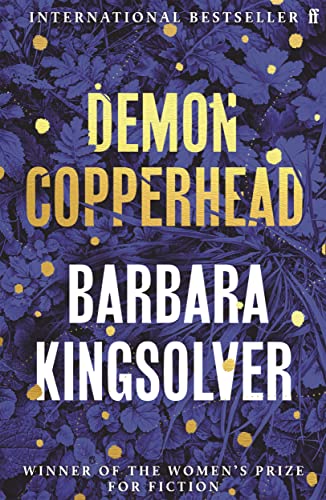
Book Beginnings & The Friday 56: Demon Copperhead by Barbara Kingsolver

Every Friday Book Beginnings on Friday is hosted by Gillion at Rose City Reader where you can share the first sentence (or so) of the book you are reading. You can also share from a book you want to highlight just because it caught your fancy.

I’ve borrowed Demon Copperhead from the library and I’ve started reading it – even though I’m currently in the middle of two other books. As it’s had such good reviews, I’m a bit worried that it won’t live up to all the hype for me. It’s a retelling of David Copperfield, which I read earlier this year.

My Book Beginning:

First, I got myself born. A decent crowd was on hand to watch, and they’ve always given me that much: the worst of the job was up to me, my mother being let’s just say out of it.

Also every Friday there is The Friday 56, hosted by Freda at Freda’s Voice, where you grab a book and turn to page 56 (or 56% of an eBook), find one or more interesting sentences (no spoilers), and post them.

Page 56:

Finally Miss Barks turned round with her elbow on the back of the seat and said let’s talk about where we are going. I’d be staying with a gentleman named Mr Crickson that took kids for short-term only. He had boys there now. The Cricksons had been regular fosters until his wife passed away, and now he just took in the odd hardship case.

So, I’m guessing Miss Barks and Mr Crickson are the equivalent characters of Mr Barkis and Mr Creakle in David Copperfield. I have a feeling I should not approach this book as a retelling of David Copperfield, or I’ll be forever comparing the two and not really reading it as a book in its own right, as it were.

Synopsis:

Demon’s story begins with his traumatic birth to a single mother in a single-wide trailer, looking ‘like a little blue prizefighter.’ For the life ahead of him he would need all of that fighting spirit, along with buckets of charm, a quick wit, and some unexpected talents, legal and otherwise.

In the southern Appalachian Mountains of Virginia, poverty isn’t an idea, it’s as natural as the grass grows. For a generation growing up in this world, at the heart of the modern opioid crisis, addiction isn’t an abstraction, it’s neighbours, parents, and friends. ‘Family’ could mean love, or reluctant foster care. For Demon, born on the wrong side of luck, the affection and safety he craves is as remote as the ocean he dreams of seeing one day. The wonder is in how far he’s willing to travel to try and get there.

Suffused with truth, anger and compassion, Demon Copperhead is an epic tale of love, loss and everything in between.

~~~

What do you think? Have you read it, or are you going to read it? Do you like books that retell classics?

Martin Chuzzlewit by Charles Dickens: a Brief Overview

The Life and Adventures of Martin Chuzzlewit is my last book to review on my first Classics Club list. I read this in December 2017 and didn’t write a post, mainly because it was during the Christmas/New Year period, a busy time. All I recorded was this: ‘It is long, starts very slowly and then gets more interesting, with great characters and some comic and satirical episodes. It’s a study of selfishness and hypocrisy.’

From the back cover of my paperback copy:

Moving from the sunniest farcicality to the grimmest reaches of criminal psychology, Martin Chuzzlewit is a brilliant study in selfishness and hypocrisy.

The story of an inheritance, it relates the contrasting destinies of the two descendants of the brothers Chuzzlewit, both born and bred to the same heritage of selfishness, showing how one, Martin, by good fortune escapes and how the other, Jonas, does not – only to reap a fatal harvest. Peopled with Dickens immortals as Mrs Gamp, Poll Sweedlepipe, Montague Tiggs, Chevy Slime, it is one of Dickens’ great comic masterpieces.

It was Dickens’ sixth novel, serially published in 1843-44, and was something of a flop, with a dramatic decline in sales, compared to his early books. I can understand that because it’s not one of my favourites of his books. It is too long – over 900 pages in my Penguin Classics edition. I stuck with it as I had previously enjoyed watching the 1994 TV Mini Series with an excellent cast including Paul Schofield, Keith Allen, Julia Sawalha, Ben Walden, and Lynda Bellingham amongst others.

In this case I think the TV adaptation scores over the novel, which dragged in parts for me. It is a satire, a black comedy, a romance of the sickly sentimentality sort, a story of blackmail and murder, that involves hypocrisy, greed and selfishness.

I thought the section set in America where young Martin went to seek his fortune was overdone and it became tedious. It seems that Dickens had not enjoyed his own visit to America in 1842 as in this section he mocks what he disliked about America – the corrupt newspapers, slavery, the violence, obsession with business and money and so on and so forth. I was glad when young Martin returned to England.

But I enjoyed the comic characters – the drunken nurse of sorts, Mrs Gamp and her invisible friend, Mrs Harris, and Sam Pecksmith, the scheming architect. The Pecksmith family’s visit to London is hilarious. These characters saved the book for me. Mrs Gamp is one of the most bizarre characters with her mispronunciations and monologues recounting her conversations with her imaginary friend Mrs Harris. Her speciality lies in the polar extremities of life, birth and death:the lying in and the laying out.

  • Publisher ‏ : ‎ Penguin Classics; Reissue edition (30 Jan. 1986)
  • Language ‏ : ‎ English
  • Paperback ‏ : ‎ 944 pages
  • Source: my own copy
  • My Rating: 3*

David Copperfield by Charles Dickens

4*

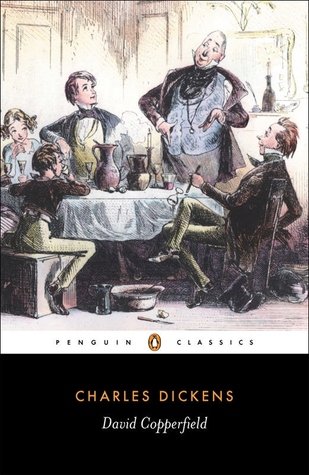
All I knew about David Copperfield: The Personal History, Adventures, Experience and Observation of David Copperfield the Younger of Blunderstone Rookery (Which He Never Meant to Publish on Any Account) by Charles Dickens is that it is said to be his most autobiographical novel. I think I must have watched a TV serialisation years ago but I remember very little about it. It was first published as a serial in 1849 and 1850, and then as a book in 1850.

It’s a long novel with a multitude of characters, including David’s cruel stepfather, Mr Murdstone, the family housekeeper Peggotty, his school friends Steerforth, who he mistakenly idolises and, my favourite character, Tommy Traddles, who has a heart of gold, and a remarkable upstanding head of hair. Then there’s another favourite character, David’s great aunt Betsey Trotwood, who wages war against marriage and donkeys and her companion, the simple-minded Mr Dick; Mr Micawber, always in debt and in and out of the debtor’s prison, and the odious and nauseating Uriah Heep are both memorable characters.

I was totally immersed in their world, enjoying the sights, sounds and smells of Victorian England, the living conditions of the poor contrasting with the decadent wealth of the rich, and the dramatic intensity of episodes such as the terrible storm at sea off Yarmouth. There’s drama, comedy and tragedy, melodrama and pathos as the story follows David’s life from his birth to his adulthood, covering his childhood, early schooldays, his time as a young boy working in a factory, then as a student in Canterbury where he lodged with the lawyer Mr Wickfield and his daughter, Agnes.

Betsey later established him in London where he worked in the Doctor’s Commons, under the tutelage of Mr Spenlow, whose daughter, the beautiful, frivolous and to my eyes, the utterly pathetic Dora totally captivated him. The sections of the book involving Dora are rather too sentimental for my liking. Then there’s Pegotty’s family – her brother Daniel, a fisherman, their nephew Ham and niece, Little Em’ly who is David’s childhood friend and sweetheart. They live in a converted boat on the beach at Yarmouth. And not forgetting Barkis, who marries Pegotty, after telling David to tell her, ‘Barkis is willing‘. Their sections of the book are the ones I enjoyed the most. I could go on and on, not forgetting David himself as describes the misfortunes and obstacles he met and the friends he makes.

I enjoyed reading David Copperfield, which was Dickens’ own personal favourite of all his novels, but it is not mine – it’s a bit too long for me. I think my favourite is Bleak House, which I read after seeing the TV adaptation in 2005 with Anna Maxwell Martin, Gillian Anderson, Denis Lawson, and Charles Dance. Maybe I’ll read it again to see what I think of it now. These days I prefer shorter books and Bleak House, like David Copperfield is long with many characters and sub-plots.

Little Dorrit by Charles Dickens

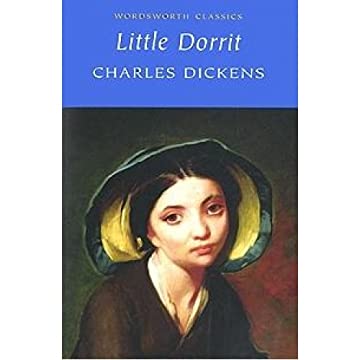
I read the Wordsworth Classic edition of Little Dorrit with Illustrations by Hablot K. Browne (Phiz) and an Introduction and Notes by Peter Preston, University of Nottingham. As always, I read the Introduction after I’d read the novel. I finished reading it in June and started writing this review. But it is only today that I realised I hadn’t finished it, so, this post is not as detailed as I would like it to be.

Summary from the back cover:

Little Dorrit is a classic tale of imprisonment, both literal and metaphorical, while Dickens’ working title for the novel, Nobody’s Fault, highlights its concern with personal responsibility in private and public life. Dickens’ childhood experiences inform the vivid scenes in Marshalsea debtor’s prison, while his adult perceptions of governmental failures shape his satirical picture of the Circumlocution Office. The novel’s range of characters – the honest, the crooked, the selfish and the self-denying – offers a portrait of society about whose values Dickens had profound doubts.

Little Dorrit, Charles Dickens’ eleventh book, was published serially from 1855 to 1857 and in book form in 1857. The novel attacks the injustices of the contemporary English legal system, particularly the institution of debtors’ prison. I found it hard going in parts, ponderous, sombre and serious. But as it’s a long book other parts are more lively, comic and far more enjoyable. That said it is also long-winded, far too wordy, melodramatic with a multitude of characters and a long-drawn out and convoluted plot. It is a great sprawling epic of a novel.

It is satire and Dickens spares no one, but it is those sections that hold up the flow of the novel. I found the first rant at the corruption and workings of the government Circumlocution Office, explaining that its purpose is ‘How Not to Get Things Done’, entertaining at first, but eventually repetitive and increasingly incredible. The account of the Barnacle family going round and round in circles, producing nothing but red tape, became excruciatingly boring.

I can’t say that I particularly liked any of the characters, and some of them are merely caricatures. rather than characters. Little Dorrit is so meek and self-effacing and far too good for her own good. Her father, known as the Father of the Marshalsea, is a most annoying character. He is the prison’s longest inhabitant, the longest debtor, the one to whom the other prisoners pay homage which makes him pompous and full of his self-importance. So much so that he fails to realise he is exploiting Little Dorrit.

But it is Dickens’ description of life in the Marshalsea, a debtors’ prison, that fascinated me, based on Dickens own father’s imprisonment there. The families could live with the debtors and were free to come and go, until the prison gates were locked at night. It was a separate society that worked on a system of hierarchy, run by the prisoners who had access to a pub, The Snuggery, and a shop, for those who had money. But it carried a terrible stigma of shame and corrupted them all – even Little Dorrit lied to herself about her father’s true situation. Once you were imprisoned there was practically no way you could be freed, unless your debts were paid and that was impossible when you couldn’t earn any money.

There are so many characters and so many sub-plots that I’m not going to attempt to write about them, other than to say at times I was amused and bemused, caught up in the stories, and dismayed at its length and complexity. Although I’ve been critical of some of the novel in this post and I think it could be my least favourite of all of Dickens’ books that I’ve read, overall I did enjoy it enough to give it 3.5 stars on Goodreads.

Throwback Thursday: 5 August 2021

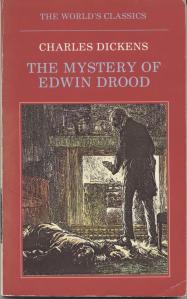
This month I’m looking back at my review of The Mystery of Edwin Drood by Charles Dickens which I first posted on 20 September 2010.

Here’s the first paragraph:

It’s been a few weeks now since I finished reading The Mystery of Edwin Drood by Charles Dickens, his last and unfinished book. I was surprised that it took so long before the mystery actually began to emerge and that it’s more the story of Edwin Drood’s uncle, John Jasper, than it is of Drood himself.   I was also surprised that much of it is written in the present tense, a style that I’m not too keen on. I haven’t read a Dickens novel for a few years and found the difference in style between this and modern mystery novels interesting. The build up to the mystery is so much more leisurely and descriptive than in modern novels, and I had to tone down my impatience for something mysterious to happen. Once I’d passed these hurdles I enjoyed the book immensely, even though I knew that the mystery is left open.

Click here to read my full review

The next Throwback Thursday post is scheduled for 2 September 2021.