Agatha Christie Reading Challenge Carnival

The July edition of the Agatha Christie Reading Carnival is available here.

This month there are 10 contributors providing 16 blog posts with reviews of Agatha Christie’s books and posts about her.

You can join the Carnival too, sign up, then read at your own pace, write a review on your blog then go to the Carnival collecting space, and put in your URL, your details and a comment about the post.

Murder on the Orient Express by Agatha Christie

Murder on the Orient Express must be one of Agatha Christie’s most well known books. It was first published in 1934 and it was first filmed in 1974, starring Albert Finney as Hercule Poirot, and most recently in 2010 with David Suchet as Poirot. I’ve seen both films and so knew the plot, but I’d never read the book until now.

Poirot is on the Orient Express, on a three-days journey across Europe. But after midnight the train comes to a halt, stuck in a snowdrift. In the morning the millionaire Simon Ratchett is found dead in his compartment his body stabbed a dozen times and his door locked from the inside. It is obvious from the lack of tracks in the snow that no-one has left the train and by a process of elimination Poirot establishes that one of the passengers in the Athens to Paris coach is the murderer.

Poirot interviews the passengers and the Wagon Lit conductors, none of whom appear to have a motive for killing Ratchett or to have any connection with him or each other. Poirot decides that this

… is a crime very carefully planned and staged. It is a far-sighted, long-headed crime. It is not – how shall I express it? – a Latin crime. It is a crime that shows traces of a cool, resourceful, deliberate brain – I think an Anglo-Saxon brain. (page 193)

Having interviewed all the suspects Poirot draws up a list of questions about things that need explaining. This leads him to speculation and re-interviewing some of the suspects and eventually he arrives at the truth. It’s hard to know whether I would have arrived at the same conclusion if I hadn’t seen the films, but watching the first one it did become obvious before the denouement.

I liked this book enormously. I like the way Agatha Christie divided it into three sections – The Facts, the Evidence and Hercule Poirot Sits Back and Thinks. I liked the characterisation and all the, now so non-pc, comments about nationalities, highlighting class and racial prejudice. I like the problem-solving and ingenuity of the plot.

  • Paperback: 240 pages
  • Publisher: Harper; Masterpiece edition (Reissue) edition (3 Sep 2007)
  • Language English
  • ISBN-10: 0007119313
  • ISBN-13: 978-0007119318
  • Source: Library book because I can’t find my own copy!
Agatha Christie Reading Challenge Update

The Agatha Christie Reading Challenge is run by Kerrie at Mysteries in Paradise. It’s an open-ended challenge to read all of Agatha Christie’s books. I’m not attempting to read them in order (as Kerrie is doing) but reading them as I find them. So far I have read her Autobiography, 25 of her full length books and 2 of the collections of her short stories:

Progress in publication date order (the links are to my posts on the books):

  1. 1920 The Mysterious Affair At Styles
  2. 1922 The Secret Adversary
  3. 1924 The Man in the Brown Suit
  4. 1926 The Murder of Roger Ackroyd
  5. 1928 The Mystery of the Blue Train
  6. 1929 The Seven Dials Mystery
  7. 1932 Peril At End House
  8. 1934 Why Didn’t They Ask Evans? (Aka The Boomerang Clue)
  9. 1936 The A.B.C. Murders
  10. 1937 Death on the Nile
  11. 1938 Hercule Poirot’s Christmas
  12. 1939 Murder is Easy
  13. 1941 The Body in the Library
  14. 1946 The Hollow
  15. 1949 Crooked House
  16. 1953 A Pocket Full of Rye
  17. 1956 Dead Man’s Folly
  18. 1957 4.50 from Paddington
  19. 1961 The Pale Horse
  20. 1962 The Mirror Crack’d from Side to Side
  21. 1964 A Caribbean Mystery
  22. 1968 By the Pricking of My Thumbs
  23. 1970 Passenger to Frankfurt
  24. 1972 Elephants Can Remember
  25. 1975 Curtain: Poirot’s Last Case (written in the 1940s)

Short Stories:

  1. 1932 The Thirteen Problems
  2. 1933 The Hound of Death

Autobiography/Biography

Agatha Christie: An Autobiography

I own a few more of her books, which I’ll be reading next:

  • Murder on the Orient Express (1934)
  • Dumb Witness (1937)
  • The Moving Finger (1942)
  • Taken at the Flood (1948)
  • They Do It With Mirrors (1952)
  • A Murder is Announced (1950)
  • They Came to Baghdad (1951)
  • The Golden Ball and Other Stories (1971)
  • Nemesis (1971)

I also have:

  • The Complete Parker Pyne: Private Eye,  which brings together the 14 stories featuring Mr Parker Pyne.
  • Miss Marple and Mystery: the Complete Short Stories.

Murder is Easy by Agatha Christie: Book Review

Murder is Easy, Agatha Christie’s 25th book was first published in 1939.

Publisher’s summary:

Luke Fitzwilliam could not believe Miss Pinkerton’s wild allegation that a multiple murderer was at work in the quiet English village of Wychwood — or her speculation that the local doctor was next in line. But within hours, Miss Pinkerton had been killed in a hit-and-run car accident. Mere coincidence? Luke was inclined to think so — until he read in The Times of the unexpected demise of Wychwood’s Dr Humbleby …

My view

This has stood the test of time very well. It’s another one of Agatha Christie’s easily read crime mysteries, with plenty of plot twists and unexpected revelations. This time the detective is Luke Fitzwilliam, a retired policeman recently returned to England from the East. He was wondering what to do with himself when he met Miss Pinkerton quite by chance. She tells him of her suspicions about a number of murders in her village and when he tells her that it’s rather hard to do a lot of murders and get away with it, she replies:

No, no, my dear boy, that’s where you’re quite wrong. It’s very easy to kill – so long as no one suspects you. And you see, the person in question is just the last person anyone would suspect! (page 22)

Wychwood-under-Ashe is a picturesque village with a Manor House, a village green and a duck pond. In other words a quintessentially English village just like Miss Marple’s St Mary Mead. But instead of Miss Marple, the person who helps Luke with his investigations is Bridget Conway, a beautiful young woman who immediately entrances Luke. His cover story is that he is writing a book on folklore and needs to talk to the locals gathering tales and legends.

I had no idea about the killer’s identity and neither really did Luke, until just near the end of the book. Superintendent Battle appears but does nothing towards solving the mystery and denies that he could have done any better than Luke explaining that

… nothing’s impossible in crime.

… Anyone may be a criminal, sir, that’s what I meant. (page 317)

Murder is Easy – one of Agatha Christie’s best mysteries:

  • Paperback: 400 pages
  • Publisher: Harper; Masterpiece edition (Reissue) edition (3 Sep 2007)
  • Language English
  • ISBN-10: 000713682X
  • ISBN-13: 978-0007136827
  • Source: I bought it

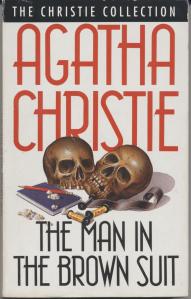
The Man in the Brown Suit by Agatha Christie: Book Review

The Man in the Brown Suit 001Agatha Christie wrote The Man in the Brown Suit whilst on a world tour with Archie Christie, her first husband, in 1922 and it was first published as a serial in The Evening News in 1923 in 50 instalments under the title of Anna the Adventurous. I think that’s an apt title as Anne Beddingfield, one of the two narrators of this book, longs for adventure, enjoying the cinema films of The Perils of Pauline. Agatha Christie, though thought it was ‘as silly a title as I had ever heard‘. But as The Evening News were prepared to pay her £500 for the serial rights she said nothing and bought a Morris Cowley with the proceeds.

She had the idea for the story from Major Belcher, a friend of Archie’s who had invited him to go with him on a grand tour of the British Empire to organise an Empire Exhibition. The Christies dined with Belcher at his house, the Mill House at Dorney and he had urged Agatha to write a detective story about it. He suggested the title The Mystery of the Mill House and wanted her to put him in it.

Agatha sketched the plot whilst she was in South Africa when there was a revolutionary crisis and decided that the book was to be more of a thriller than a detective story, with the heroine as ‘a gay, adventurous, young woman, an orphan, who started out to seek adventure.‘ But she found it hard to make the character she had chosen based on Belcher to come alive, until she hit upon the idea of writing it in the first person and making the Belcher character (Sir Eustace Pedler), Anne’s co-narrator.

I found this information in Agatha Christie’s An Autobiography, but I haven’t added the details she also added that give away who the murderer is (for of course there is a murder) – maybe she thought anyone reading her autobiography would have read all her books.

Anne’s adventure begins when she sees a man fall to his death on the live rails at Hyde Park tube station. He had a terrified look on his face and turning round Anne sees a man in a brown suit, who quickly becomes The Man in the Brown Suit both to her and the newspapers. He announced he was a medical man and that the man was dead, and as he left the station he dropped a piece of paper with some figures and words scrawled on it in pencil, which Anne picked up. A second death follows, this time a young woman is found strangled at Mill House, the home of Sir Eustace Pedler, MP. She was thought to be a foreigner. Anne decides to investigate and the trail takes her on board the Kilmorden Castle sailing to Cape Town.

The action takes place mainly on board ship and in South Africa which Agatha Christie describes so well from her own experiences.  Like Agatha, Anne suffers terribly from sea-sickness; both stayed in their cabins for three days until the ship reached Madeira and like Agatha, Anne just wanted to go ashore and be a parlourmaid. At that point in her life, Agatha had told Archie: ‘I would quite like to be a parlourmaid’. (An Autobiography page 300)

This book features the first appearance of Colonel Race, who appears in three more of Agatha Christie’s books. Anne describes him as ‘one of the strong, silent men of Rhodesia‘ and was very taken with him – ‘easily the best-looking man on board.‘ (page 54)

The novel is a mix of murder mystery and international crime organised by an arch-villain known as ‘the Colonel’, involving violence (but not graphic) and suspense. As usual there are a number of suspects and Anne has to work out who she can trust and who to believe. I found it a bit too drawn out for my liking, too many time lapses and coincidences to convince me of the plot’s credibility, but it held my interest to the end even though I knew the culprit’s identity.

Crime Fiction Alphabet – Letter N

This week we’ve reached the letter N in Kerrie’s Crime Fiction Alphabet. My choice is a medley of ‘N‘s.

  • I had thought I would review Peter James’s Not Dead Enough, and I started it a while back but put it down to read other books. Not because I didn’t like it, but it’s a very long book – 610 pages of very small font, which is difficult for me to read, especially late at night when my eyes get tired quickly. From the back cover:

On the night Brian Bishop murdered his wife he was sixty miles away, asleep in bed at the time. At least that’s the way it looks to Detective Superintendent Roy Grace, who is called to investigate the kinky slaying of beautiful young Brighton socialite, Katie Bishop.

  • Another choice for the letter N that I considered is A Necessary End, an Inspector Banks mystery by Peter Robinson but I haven’t finished that book either. From the back cover:

In the usually peaceful town of Eastvale, a simmering tension has now reached breaking point. An anti-nuclear demonstration has ended in violence, leaving one policeman stabbed to death. Fired by professional outrage, Superintendent ‘Dirty Dick’ Burgess descends with vengeful fury on the inhabitants of ‘Maggie’s Farm’, an isolated house high on the daleside.

  • My third choice is Not the End of the World by Christopher Brookmyre. I started reading this after enjoying Quite Ugly One Morning. The bookmark shows I’m up to page 30. I think I didn’t finish this book because I was expecting it to be set in Scotland like Quite Ugly One Morning and was put off by it being in Los Angeles – silly I know!


  • Then there is Agatha Christie’s Nemesis, which is the last Miss Marple mystery. I only bought it recently and I’m itching to read it soon. Mr Rafiel, an old acquaintance (see A Caribbean Mystery), has died and left Miss Marple instructions for her to investigate a crime after his death.


  • And finally the book I’m currently reading is Janet Neel’s Ticket to Ride, which so far is making very interesting reading. But I don’t want to write much about it before I’ve finished it. Ticket to Ride features Jules Carlisle a newly qualified solicitor. She takes on the case of Mirko Dragunoviç, an illegal immigrant who claims that one of the eight dead bodies, found on the beach west of King’s Lynn, is that of his brother.

Janet Neel is the nom de plume of Baroness Cohen of Pimlico who sits as a Labour peer in the House of Lords. She started out as a solicitor, then went to the Board of Trade and then to Charterhouse Bank. She has written several crime fiction novels. The first, Death’s Bright Angel won the John Creasey Prize and both Death of a Partner and Death Among the Dons were shortlisted for the CWA Gold Dagger.