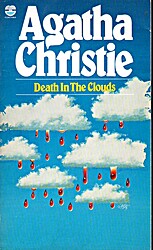
Death in the Clouds by Agatha Christie: a Book Review

Death in the Clouds is a kind of locked room mystery, only this time the ‘locked room’ is a plane on a flight from Paris to Croydon, in which Hercule Poirot is one of the passengers.

In mid-air, Madame Giselle, is found dead in her seat. It appears at first that she has died as a result of a wasp sting (a wasp was flying around in the cabin) but when Poirot discovers a thorn with a discoloured tip it seems that she was killed by a poisoned dart, aimed by a blowpipe.

At the inquest the jury’s verdict is that the murderer is Poirot! However the coroner refuses to accept this and finds that the cause of death was poison with insufficient evidence to show who had administered the poison. All the other passengers and flight attendants are suspects and Poirot together with Inspector Japp, studies the passenger list with details of their belongings. There is a helpful plan of the cabin at the front of the book showing who sat where, including a crime fiction writer, a flute-playing Harley Street doctor, two French archaeologists, a dentist, a hairdresser, a Countess (formerly an actress), a woman who is a compulsive gambler, a crime writer and a businessman . Despite all this I was quite unable to work out who did it.

The question is who could have acquired the rare poison and how could it have been shot at Madame Giselle without anyone noticing that happening. Why would anyone want to kill her, and how were any of the suspects connected with her? Even when Poirot details the clues, including the Clue of the Passenger’s Baggage (and I read through the list a few times), I still didn’t work it out.

Apart from the ingenious mystery, which the coroner describes as the most astonishing and incredible case he had ever dealt with, there were other things I enjoyed in reading this book. First of all the ‘psychological moments’  in which people don’t notice what is happening in front of them because their attention is diverted. Then there is the way Christie makes fun of crime fiction writers and readers, making Japp comment that:

I don’t think it healthy for a man always to be brooding over crime and detective stories, reading up all sorts of cases. It puts ideas into his head. (page 63)

Poirot’s denouement at the end of the book clears up all the confusion, detailing his impressions, precise ideas and methods in dealing with the case. Looking back through the book, all the clues were there, of course, but so cleverly concealed that in most cases I had overlooked them or not realised their significance. A most enjoyable book!

  • Paperback: 336 pages
  • Publisher: HarperCollins; Masterpiece edition (Reissue) edition (3 Mar 2008)
  • Language English
  • ISBN-10: 000711933X
  • ISBN-13: 978-0007119332
  • Source: I bought the book
  • My rating 4/5

Wondrous Words – Flapjack

Reading Agatha Christie’s books I sometimes come across words that I recognise, but know they cannot possibly mean what I understand them to mean. I found an example recently in Death in the Clouds.

A murder has taken place on a plane and Poirot has asked for a detailed list of the passengers’ belongings. In amongst those belongings three of the passengers have flapjacks in their bags. I thought that was quite strange, because to me a flapjack is a type of biscuit made of rolled oats, syrup and maybe pieces of fruit. They’re delicious. I wondered why these people would have flapjacks in their bags, along with cigarette holders, cigarette cases, keys, pencils and loose change, etc.

I was intrigued enough to look up the word. Wikipedia tells me that the word was not used to describe a food made of oats until 1935. Death in the Clouds was published in 1935, so it is just possible that Agatha Christie meant the flapjack that I know, but not very likely when I noticed that these three people were all women and also had lipstick and rouge in their bags and none of the men had flapjacks.

The answer is quite simple when I checked in my Chambers Dictionary:

A flapjack is a flat face-powder compact.

And this website adds that it was a term used in the 1930s and 1940s – voilà, the correct definition!

Nothing to do with the murder, though.

See more Wondrous Words at BermudaOnion’s Weblog.

Teaser Tuesday

Currently I’m reading Agatha Christie’s The Clocks, which incidentally, is on ITV on Boxing Day -one of the Agatha Christie’s Poirot series. Reading the preview it doesn’t sound as though they have stuck too closely to the plot, but never mind.

This description of a bookshop near the British Museum appealed to me:

Inside, it was clear that the books owned the shop rather than the other way about. Everywhere they had run wild and taken possession of their habitat, breeding and multiplying and clearly lacking any strong hand to keep them down. The distance between bookshelves was so narrow that you could only get along with great difficulty. There were piles of books perched on every shelf or table.

On a stool in a corner, hemmed in by books, was in a old man in a pork-pie hat with a large flat face like a stuffed fish. He had the air of one who has given up an unequal struggle. He had attempted to master the books, but the books had obviously succeeded in mastering him. He was a kind of King Canute of the book world, retreating before the advancing tide of books. (page 170)

I don’t suppose this will be included in the drama, but I hope it will.

I’m about halfway through the book and Poirot has yet to appear!

For more Teaser Tuesdays go to Should Be Reading.

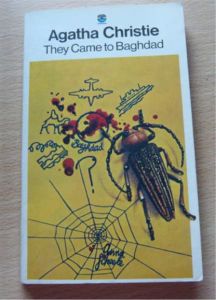
They Came to Baghdad by Agatha Christie: a Book Review

They came to Baghdad

I made copious notes as I read Agatha Christie’s They Came to Baghdad because it’s such a complex plot and there seemed to be so many significant events and people that I wanted to clarify what was happening. This is not one of Agatha Christie’s detective novels – no Miss Marple or Hercule Poirot,-  just Victoria Jones, a short-hand typist, a courageous girl with a ‘natural leaning towards adventure’ and a tendency to tell lies. Set in 1950 this is a story about international espionage and conspiracy. The heads of the ‘great powers‘ are secretly meeting in Baghdad, where if it all goes wrong ‘the balloon will go up with a vengeance.’ And an underground criminal organisation is out to make sure it does go wrong, aiming at ‘total war – total destruction. And then – the new Heaven and the new Earth.’

Victoria gets involved after one meeting with a young man, Edward, who is going out to Baghdad the following day to join an archaeological dig. She thinks he’s an incredibly good-looking man and considering herself an excellent judge of character is immediately attracted to him. As she has just been fired from her job, impulsively she decides to follow him to Baghdad, claiming to be the niece of Dr Pauncefoot Jones, Richard’s boss .

At the same time a British secret agent, Carmichael, is trying to get to Baghdad with important information, and is his life is in great danger. Will he get there? Anna Scheele, a mysterious character is also on her way to Baghdad and there are hints that she is at the centre of things. Just who is she and what side is she on?

Alongside the mystery, Agatha Christie’s descriptions of the locations, local people and of the archaeological dig are superb, no doubt taken from her experience of her own visits to Baghdad and Iraq. I enjoyed it for its entertaining plot, the authenticity of the background and its great characters, in particular I grew very fond of the amazing Victoria Jones.

  • First published in 1951 by William Collins & Co Ltd
  • My copy a secondhand paperback Fontana Books, 1980
  • My Rating: 4/5

Taken at the Flood by Agatha Christie: a Book Review

I enjoyed Agatha Christie’s Taken at the Flood, on several levels. There is the murder and mystery level, but also a great sense of the times, set in post-war Britain, reflecting the mood of the population, and, on top of all, that the characters stand out for the most part as well-rounded, convincing people. There are plenty of references to the changing social scene, to the attitude towards women and foreigners and to the difficulties  of war heroes adapting to civilian life.

It was published in 1948, when the aftermath of the war is felt by some people as a restless dissatisfaction with life,  feeling ‘rudderless’ just drifting along and by others, who had ‘come into their own’ during the war, benefiting from the need to plan and think and improvise for themselves.

Lynn Marchmont is one of the people feeling ill at ease and nervous; she was aware of ill will, ill feeling:

It’s everywhere. On railways and buses and in shops and amongst workers and clerks and even agricultural labourers. And I suppose worse in mines and factories. Ill will. But here it’s more than that. Here it’s particular. It’s meant! (page 65)

There is certainly ill will in her family after her uncle, Gordon Cloade had died, killed in an air raid, and left the rest of the family ‘out in the cold’. They had all relied on him to help them out financially and expected they would inherit his wealth on his death. But Gordon had married Rosaleen, a young woman, whose brother, David Hunter has no intention of letting any of them have any money. Rosaleen has a chequered past and when a tall, bronzed stranger arrives in the village calling himself Enoch Arden, the question of his identity becomes of great importance. I didn’t know the reference to Enoch Arden, but knew it must be of significance when it stirs some poetical memory in David’s mind, from a poem by Tennyson. Then Enoch Arden is found in his room at the local inn, The Stag:

‘Dead as a doornail,’ said Gladys, and added with a certain relish: ‘ ‘Is ‘ead’s bashed in!’ (page 161)

Poirot is called in to help solve the crime. Was Enoch Arden was Rosaleen’s first husband, Robert Underhay or had Robert died in Africa, as she said? Would the family fortune remain with the Cloades? Is Rosaleen’s life in danger, are the Cloades wishing her dead?

It’s a baffling case and Poirot tells Superintendent Spence that it’s an interesting case, because it’s all wrong – it’s not the ‘right shape.’ Eventually, of course, he works it out and it is complicated as Spence complains, protesting when Poirot quotes Shakespeare. Poirot, however, explains that it is very Shakespearian:

… there are here all the emotions – the human emotions – in which Shakespeare would have revelled – the jealousies, the hates – the swift passionate actions. And here, too, is successful opportunism. “There is a tide in the affairs of men which taken at its flood leads on to fortune …” Someone acted on that, Superintendent. To seize opportunity and turn it to one’s own ends – and that has been triumphantly accomplished – under your nose, so to speak!’ (page 319)

Agatha Christie’s Birthday – A Celebratory Post

So much has been written about Agatha Christie’s life, her books, her houses, and so on and so forth, that I wasn’t sure what to write about for this post to celebrate the 121st anniversary of her birth.  Last year I wrote an A – Z of facts about her taken from her autobiography and the year before I visited her grave and wrote a bit about that and Winterbrook House, her house at Wallingford.

Looking for inspiration I came across the Agatha Christie: Official Centenary Celebration 1890- 1990, which is a mine of information with articles about Agatha Christie to celebrate her life and work. Along with lists of her books, plays, films and TV adaptations (up to 1990) there are articles about her poetry, life before the First World War, her family life, the actors and actresses playing the roles of Poirot and Miss Marple, including many fascinating facts and photographs.

For example there is this “Confession” reproduced in Michael Parkinson’s Confession Album, 1973 in which famous people filled in a questionnaire about their likes and dislikes. The reproduction in the book is indistinct and I can’t make out some of the words but here are some of Agatha’s favourite things and her greatest misery:

  • My ideal value: Courage
  • My idea of beauty in nature: A Bank of Primroses in Spring
  • My favourite qualities in men: Integrity and Good Manners
  • My favourite qualities in women: Loving and Merry
  • My greatest happiness: Listening to Music
  • My greatest misery: Noise and Long Vehicles on Roads
  • My  favourite authors: Elizabeth Bowen Graham Greene
  • My favourite actors and plays: Alec Guinness  Murder in the Cathedral
  • My favourite quotation: Life is a pure flame and we live by an invisible sun within us – Sir Thomas Browne
  • My favourite state of mind: Peaceful

There is also an article by Mathew Pritchard – Agatha Christie – a Legend for a Grandmother, which reveals that

She was an intensely private kind of person, who listened more than she talked, who saw more that she was seen, and whose perception, humour and enjoyment of living was in many ways the opposite of what you might expect from the nature of her stories. Her family was what she prized most – I think she regarded our summers together as a reward in part for the completion of another Christie for Christmas which had usually taken place by May or June each year and partly as relaxation from the strenuous archaeological tours she undertook with her husband Max Mallowan most springs during the 1950s. We all looked forward to them, I as a schoolboy more than most.

Amongst other memories he  wrote about her plays in the West End, and her house in Wallingford where he took school friends, who were all impressed by her modesty, friendliness and the interest she took in what they were doing. He revealed that her greatest passion apart from reading and writing was music (see her greatest happiness, above) and remembered her singing  and their visits to the opera, visiting Bayreuth together to see a production of Wagner’s Parsifal.

One strand of Agatha Christie’s work that I’m not familiar with is the books she wrote under the pseudonym Mary Westmacott. Her daughter Rosalind Hicks explained how she had chosen the name – Mary was Agatha’s second name and Westmacott the name of some distant relatives. She managed to keep her identity as Mary Westmacott unknown for fifteen years. She wrote six books under this name:

  1. Giant’s Bread, published in 1930, a novel about Vernon Deyre and his obsession with music, in line with her love of the musical world. She had been trained as a singer and a concert pianist.
  2. Unfinished Portrait (1934), based on her own experiences and early life.
  3. Absent in the Spring (1944), which was for Agatha the most satisfying book she wrote, about a woman alone in the desert finally coming to recognise what she was really like.
  4. The Rose and the Yew Tree (1947), which Rosalind described as a favourite of both Agatha and herself.
  5. A Daughter’s a Daughter (1952) about the battle between a widowed woman and her grown-up daughter.
  6. The Burden (1956), the story of the weight of one person’s love on another.

Rosalind didn’t think it was fair to describe them as ‘romantic novels’, nor yet ‘love stories’, but books about ‘love in some of its most powerful and destructive forms.’ Definitely books I’m going to seek out.

See more celebratory birthday posts at the Agatha Christie Blog Challenge Celebration.