Six Degrees of Separation from Rapture to Persuasion

It’s time again for Six Degrees of Separation, a monthly link-up hosted by Kate at Books Are My Favourite and Best. Each month a book is chosen as a starting point and linked to six other books to form a chain. A book doesn’t need to be connected to all the other books on the list, only to the one next to it in the chain.
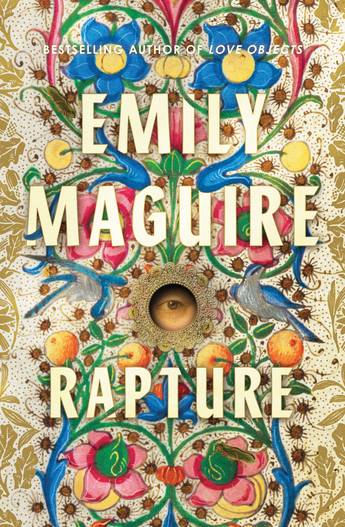
This month we start with Rapture by Emily Maguire. The motherless child of an English priest living in ninth-century Mainz, Agnes is a wild and brilliant girl with a deep, visceral love of God. At eighteen, to avoid a future as a wife or nun, Agnes enlists the help of a lovesick Benedictine monk to disguise herself as a man and secure a place at the revered Fulda monastery.

I haven’t read it and hadn’t heard of the author. According to a review in The Guardian she writes fiction and nonfiction and was shortlisted for the Stella prize, the Miles Franklin and book of the year at the Australian Book Industry awards for An Isolated Incident her 2016 novel. ‘In Rapture, her seventh novel, she turns her hand to historical fiction. Drawing inspiration from the life of Pope Joan, the woman who (according to legend) disguised herself as a man and served as pope for two years during the middle ages, Maguire examines questions of faith using the language of the body.’

I’ve had several false starts with this month’s chain, none of which I could complete. In the end I decided to start with another book about a pope, especially as the Roman Catholic Cardinals will start the procedure to elect a new pope on May 7.
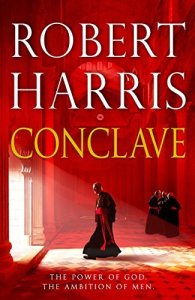
It’s Conclave by Robert Harris. I always learn a lot from reading Harris’s books. In this one he describes the procedure to elect a new pope. Cardinal Lomeli, the Dean of the College of Cardinals leads the 118 Cardinals through the voting stages. I felt as though I was a fly on the wall watching it throughout as the Cardinals are locked inside the Sistine Chapel, isolated from contact with the outside world. Harris has thoroughly researched the subject and seamlessly woven the facts into the novel. He visited the locations used during a Conclave that are permanently closed to the public and interviewed a number of prominent Catholics including a cardinal who had taken part in a Conclave, as well as consulting many reports and books.

The next book is another one by Robert Harris The Fear Index , a fast-paced story set in the world of high finance and computer technology, which is way out of my comfort zone. It’s about scientist Dr Alex Hoffman, who together with his partner Hugo Quarry, an investment banker, runs a hedge fund based in Geneva, that makes billions. Alex has developed a revolutionary form of artificial intelligence that tracks human emotions, enabling it to predict movements in the financial markets. It’s built around the standard measure of market volatility: the VIX or ‘Fear Index’. But I learnt a bit about hedge funds and how they operate, although I got lost in the computer technology details. 
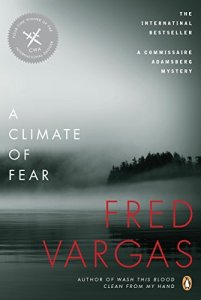
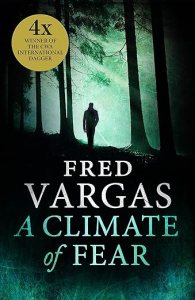
My third link is A Climate of Fear by Fred Vargas, 9th Commissaire Adamsberg book. I like Adamsberg; he’s original, a thinker, who doesn’t like to express his feelings, but mulls things over. He’s an expert at untangling mysteries, an invaluable skill in this, one of the most complicated and intricate mysteries I’ve read, involving a woman found bleeding to death in her bath, having apparently committed suicide, a strange symbol that appears at subsequent death scenes, and a secretive society studying and re-enacting scenes from the French Revolution.
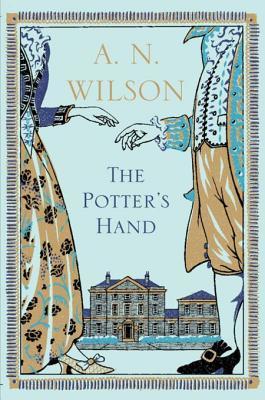
My fourth link is The Potter’s Hand by A N Wilson. it begins in 1768 and roughly follows the fortunes of the Wedgwood family until 1805, 10 years after the death of Josiah Wedgwood, an English potter and the founder of the Wedgwood company. For me it really did convey what it must have been like to live in that period – whilst the American War of Independence, and the French Revolution, were taking place. It’s full of ideas about colonialism, the abolition of slavery, working conditions, and women’s rights. There are many characters who come in and out of the narrative along the way, both fictional and historical, including Voltaire, George Stubbs (who painted the Wedgwood family portrait) and Samuel Taylor Coleridge.
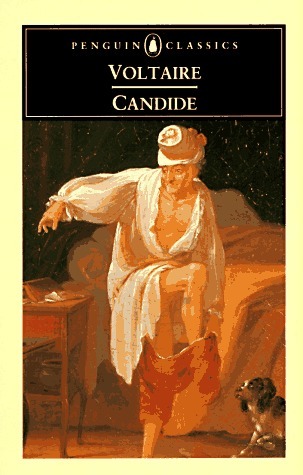
My fifth link is Voltaire’s Candide or Optimism, a small book I read many years ago. Candide was the most brilliant challenge to the idea endemic in Voltaire’s day, that ‘all is for the best in the best possible worlds‘.In Candide he whisks his young hero and friends through a ludicrious variety of tortures, tragedies and reversals of fortune, in the company of Pangloss, a ‘matapysico-theologo-cosmolo-nigologist’ of unflinching optimism. The result is one of the glories of the eighteenth-century satire. (Taken from the description on the back cover.)
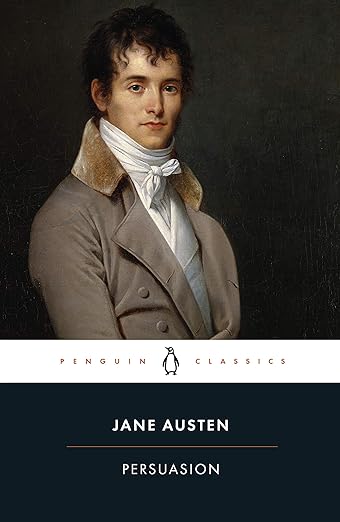
And my final link is Persuasion by Jane Austen. I read this first at school, when I was 17 for A Level GCE. It’s her last novel of missed opportunities and second chances centred on Anne Elliot, no longer young and with few romantic prospects. Eight years earlier, she was persuaded by others to break off her engagement to poor, handsome naval Captain Frederick Wentworth. ‘Set in the fashionable societies of Lyme Regis and Bath, Persuasion is a brilliant satire of vanity and pretension, and a mature, tender love story tinged with heartache.’ (Amazon) I’ll be re-reading it later in the year taking part with Brona at This Reading Life in her Austen 2025 project to reread her books, along with the Classics Club’s Sync Read (or readalong).

I certainly never thought I’d end my chain with Persuasion – but here it is! From Rapture to Persuasion in six moves. The links are the pope, books by Robert Harris, fear, the French Revolution, Voltaire and satire.

What is in your chain, I wonder?

Next month (June 7, 2025), we’ll start with Kate’s pick the 2025 Women’s Prize for Fiction All Fours by Miranda July.
Top Five Tuesday:Top 5 books with an emotion in the title

Top 5 Tuesday was created by Shanah at Bionic Book Worm, and it is now being hosted by Meeghan at Meeghan Reads. For details of all of the latest prompts for January to March, see Meeghan’s post here.

Today the topic is Top 5 books with an emotion in the title. Whether it’s happy or sad, anger or excitement, any emotion is fine!

These are all books I’ve read with links to my reviews.

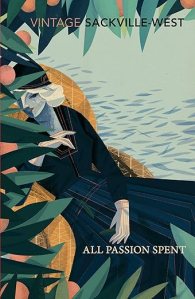
All Passion Spent by Vita Sackville-West. Lady Slane is an ageing British aristocrat. Her husband has recently died at the age of 94, leaving his family with the problem of ‘What was to be done about Mother?’ The family are four sons and two daughters. Lady Slane at 88 is still a beautiful woman and quickly but quietly asserts her independence. She ignores her children and decides to live, with her maid Genoux, in a house in Hampstead that she had first seen thirty years previously. This is a novel of contrasts, beautifully written, and expressing so many emotions in a quiet unassuming manner.

A Climate of Fear by Fred Vargas, a Commissaire Adamsberg murder mystery. I like Adamsberg; he’s original, a thinker, who doesn’t like to express his feelings, but mulls things over. He’s an expert at untangling mysteries, an invaluable skill in this, one of the most complicated and intricate mysteries I’ve read. He’d compared the investigation right from the start to a huge tangled knot of seaweed. A woman is found bleeding to death in her bath, having apparently committed suicide, there’s a secretive society studying and re-enacting scenes from the French Revolution, and two deaths ten years earlier on an isolated island off the coast of Iceland, where the afturganga, the demon who owns the island summons people to their death.

The Grapes of Wrath by John Steinbeck. Steinbeck’s writing conjures up such vivid pictures and together with his use of dialect I really felt I was there in America in the 1930s travelling with the Joad family on their epic journey from Oklahoma to California. What a long, hard journey with such high hopes of a better life and what a tragedy when they arrived to find their dreams were shattered, their illusions destroyed and their hopes denied. Throughout the book, Steinbeck shows the inhumanity of man to man and also the dignity and compassion, the essential goodness and perseverance of individuals against such appalling conditions and inhumane treatment. 

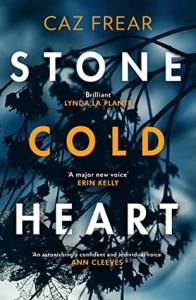
Stone Cold Heart by Caz Frear, a police procedural written in the first person present tense narrated by DC Cat Kinsella who is part of the Murder Investigation Team 4. Naomi Lockhart, a young Australian woman was murdered and at first it looked as though her flatmate had killed her. It’s a most convoluted and tangled tale, filled with secrets and lies, most of which are complete red herrings.  Alongside the murder mystery, the book follows the story of DC Cat Kinsella’s family and the mystery surrounding Maryanne Doyle that was told in Sweet Little Lies – you really do need to read that book first to understand what is going on in her family life in this book. Cat is a conflicted character to say the least and although other readers have found her a warm and likeable character I found her one of the most irritating fictional detectives in crime fiction.

Cruel Acts by Jane Casey. A year ago, Leo Stone was convicted of murdering two women and sentenced to life in prison. Now he’s been freed on a technicality, and he’s protesting his innocence. DS Maeve Kerrigan and DI Josh Derwent are determined to put Stone back behind bars where he belongs, but the more Maeve digs, the less convinced she is that he did it. Then another woman disappears in similar circumstances. Is there a copycat killer, or have they been wrong about Stone from the start?

A Climate of Fear by Fred Vargas

A Climate of Fear (Commissaire Adamsberg #10)

A Climate of Fear by Fred Vargas (see below*), translated from the French by Siân Reynolds, is her 9th Commissaire Adamsberg book.

I had high expectations for this book and I wasn’t disappointed. It’s as quirky and original as the other Commissaire Adamsberg books I’ve read (I’ve read five of them, including this one). I like Adamsberg; he’s original, a thinker, who doesn’t like to express his feelings, but mulls things over. He’s an expert at untangling mysteries, an invaluable skill in this, one of the most complicated and intricate mysteries I’ve read. He’d compared the investigation right from the start to a huge tangled knot of seaweed, and summed it up at the end:

… you can’t just plunge into a thing like that. We were pulling out tiny little broken fragments, and getting drawn into other traps. We had elements, clues, but they were floating, dozens of them, just under the surface without any apparent connection between them, in a sort of fog. The whole thing had been drowned in confusion by this twisted and determined killer. (pages 393-394)

The ‘tangled knot‘ is most confusing to begin with, made up of a woman found bleeding to death in her bath, having apparently committed suicide, a strange symbol that appears at subsequent death scenes, a secretive society studying and re-enacting scenes from the French Revolution, and two deaths ten years earlier on an isolated island off the coast of Iceland, where the afturganga, the demon who owns the island summons people to their death.

As in earlier books, Fred Vargas brings in elements of the supernatural, of folk tales, myths and legends, all of which is fascinating and intricately woven into the murder mystery. I loved all of it, especially the tense and fraught relationship that developed between Adamsberg and his team as they became increasingly unable to follow Adamsberg’s line of thought. I also enjoyed reading the details about Robespierre and the part he played in the French Revolution during the Reign of Terror, plus the little quirky details such as those about the cat who sleeps on the photocopier and the tame wild boar that guards one of the characters.

All in all, a brilliant book.

  • Hardcover: 416 pages
  • Publisher: Harvill Secker (14 July 2016)
  • Language: English
  • ISBN-10: 1910701386
  • ISBN-13: 978-1910701386
  • Source: I borrowed it from my local library
  • My Rating: 5*

These are the other books I’ve read by Fred Vargas:

* Fred Vargas is the pseudonym of the French historian, archaeologist and writer Frédérique Audoin-Rouzeau.

My Week in Books: 13 September 2017

This Week in Books is a weekly round-up hosted by Lypsyy Lost & Found, about what I’ve been reading Now, Then & Next.

IMG_1384-0

A similar meme,  WWW Wednesday is run by Taking on a World of Words.

Now: I’m currently reading The Taxidermist’s Daughter by Kate Mosse.

The Taxidermist's Daughter


Blurb:

The clock strikes twelve. Beneath the wind and the remorseless tolling of the bell, no one can hear the scream . . .

1912. A Sussex churchyard. Villagers gather on the night when the ghosts of those who will not survive the coming year are thought to walk. And in the shadows, a woman lies dead.

As the flood waters rise, Connie Gifford is marooned in a decaying house with her increasingly tormented father. He drinks to escape the past, but an accident has robbed her of her most significant childhood memories. Until the disturbance at the church awakens fragments of those vanished years . . .

Then: I’ve just finished reading A Climate of Fear by Fred Vargas which I really enjoyed. My review will follow soon.

A Climate of Fear (Commissaire Adamsberg #10)


Blurb:

A woman is found dead in her bath. The murder has been disguised as a suicide and a strange symbol is discovered at the scene.

Then the symbol is observed near a second victim, who ten years earlier had also taken part in a doomed expedition to Iceland.

How are these deaths, and rumours of an Icelandic demon, linked to a secretive local society? And what does the mysterious sign mean? Commissaire Adamsberg is about to find out.

Next: For once I know exactly what I’ll be reading next, The Poisonwood Bible by Barbara Kingsolver. This is a re-read of a book I first read and loved years ago:

The Poisonwood Bible

Blurb:

Told by the wife and four daughters of Nathan Price, a fierce evangelical Baptist who takes his family and mission to the Belgian congo in 1959, The Poisonwood Bible is the story of one family’s tragic undoing and remarkable reconstruction over the course of three decades in postcolonial Africa.

How about you? Have you read any of these books?  If so, what did you think of them? And what have you been reading this week?