Good Evening, Mrs Craven by Mollie Panter-Downes

good-eveningThere are 21 short stories in Good Evening Mrs Craven: the War-time Stories of Mollie Panter-Downes. These portray the lives of people on the Home Front, getting on with their lives set against the backdrop of war. They’re not stories of action but their subjects are psychological, emotional and social.  They offer a glimpse into what life was like then – the mood, the atmosphere, the tension and the fear, the hopes and the devastation, the loss and the loneliness, the stress and the tragi-comedy of life.

Mollie Panter-Downes’s style is fluent, a touch journalistic, sometimes subtly ironic and most pleasurable to read. There are stories of housewives, evacuees, billeted soldiers and Home Front volunteers, of the ladies in the Red Cross sewing party who met ‘twice a week to stitch pyjamas, drink a dish of tea, and talk about their menfolk’,  the effects of food rationing, of lovers separated by the war and of ‘The Woman Alone’.

Social changes are highlighted in stories such as ‘Cut Down the Trees’. Forty Canadian soldiers are billeted at Mrs Walsingham’s big house by the river. Her maid, Dossie is horrified by the changes. She mourns the passing of the old way of life, blaming the Canadians:

Of course it wasn’t precisely their fault they were there, but it made her sick to hear their big boots clattering up and down the stairs and to see their trucks standing in line along thelime avenue. (page 150)

She looks forward to the end of the war:

When peace came, sane existence would be immediately resumed. Dossie sincerely believed that the big house, quietly chipping and mouldering above its meadows, would be instantly repopulated, as though by a genie’s wand, with faceless figures in housemaid’s print dresses, in dark-blue livery and gardener’s baize aprons. She believed that the lawns would be velvet again, that visiting royalty would once more point a gracious umbrella towards Mrs Walsingham’s Himalayan poppies, that the gentry would know their places and sit over their claret in the dining room, where they belonged.

In contrast, Mrs Walsingham is more realistic and accepts the inevitable change. When the trees are cut down to make space for the soldiers’  ‘paraphernalia’ she thinks it is an improvement, letting in more air and light. She says

It’s altered the view from this side of the house, but what’s a view? Everything else is changing so fast I suppose we shouldn’t bother about trees and water staying the way they were. (page 153)

TBR – Booking Through Thursday

btt button

Follow-up to last week’s question:

Do you keep all your unread books together, like books in a waiting room? Or are they scattered throughout your shelves, mingling like party-goers waiting for the host to come along?

bookcase2I have a bookcase where a lot of my unread books are shelved – that’s the waiting room. I also have unread books in piles in various rooms because I don’t have enough shelves – these are on the waiting list for places to come available. But now I come to think of it the unread bookcase also holds books I’ve read as well because there’s nowhere else left to move the unread books to once I’ve read them. And I have a feeling that there are some unread books mingled in amongst the other bookcases too.

The only place I’ve found to keep them under some form of order is in LibraryThing. But now LT has a category of Books To Read I see that I have 285 books in that category, whereas I’ve tagged 275 of them as TBR.  I’m so inconsistent! Anyway that’s a lot of unread books.

The Gardens of the Dead by William Brodrick: Book Review

The Gardens Of The Dead

The Gardens of the Dead by William Brodrick is his second novel. Although this book is a page turner I felt it was rather disjointed in parts. I had to backtrack a few times to make sure I was following the plot and the timeline is occasionally confusing. But on the whole I thought the book was pretty good.

Elizabeth Glendenning QC dies of a weak heart at the start of the book. Ten years earlier she had successfully defended a guilty man, Graham Riley. Just before her death she devised a scheme to bring Graham Riley back to court and to implement this scheme she had enlisted the help of Father Anselm, the barrister turned monk and her son Nick. She left a safety deposit box key with Father Anselm along with instructions that he should open it in the event of her death. Once he does this a sequence of events is triggered as Father Anselm and Nick follow the trail laid out by Elizabeth.

Part of me, the cynical part, wondered why she did this – it would have been much simpler to simply leave a written account rather than set what turns out to be a puzzle to be solved. But another part of me enjoyed seeing the mystery unfold. There are several surprising and some not so surprising elements to this story of good and evil, of revenge, family loyalties, justice and morality.

I liked the character of Anselm. He is kind and patient, well versed in analysing information and questioning people from his work at the Bar and also a good listener. My favourite character though is Father Andrew, the Prior, who was fond of a saying from a Desert Father:

Don’t use wise words falsely.

So he didn’t talk much and was always cautious when he spoke, but throughout the book he has several conversations with Anselm which are always perceptive and wise.

I borrowed this book from the library and at the time I thought the author’s name was familiar to me but couldn’t remember reading anything by him or reading any reviews of his books. Later I realised that I have the first novel he wrote The Sixth Lamentation, languishing somewhere in my to-be-read piles. Now I really must dig it out to read more about Anselm.

Library Loot

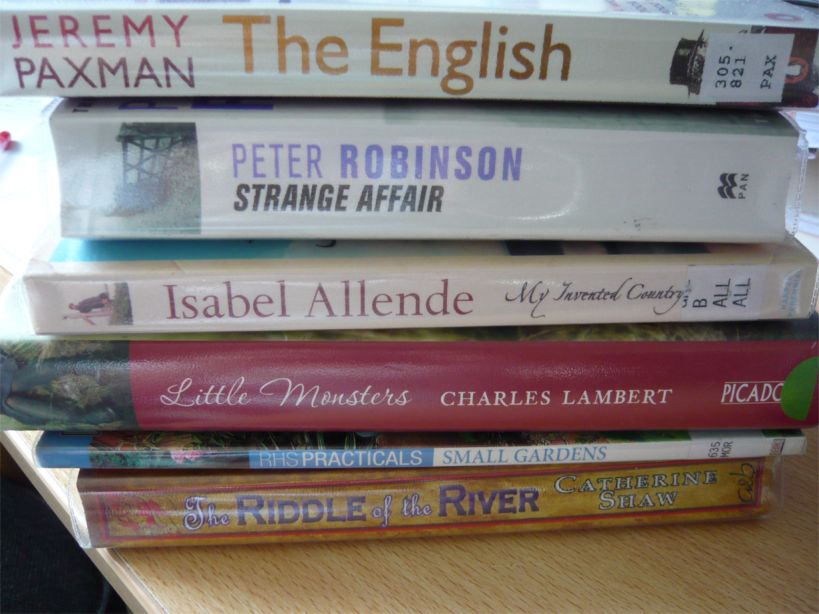
I came back from the library today with this pile of books.

library-loot-paxman

I’ve been thinking about how I choose books since writing my last Weekly Geeks post – am I influenced by the cover, just what is it about a book that makes me want to read it? Here are my reasons for choosing this pile:

  • The English: a Portrait of a People by Jeremy Paxman. I like to vary reading fiction with non-fiction, so I browsed in the non-fiction section and this caught my eye because of its title and author. I haven’t read anything by Jeremy Paxman but his TV programmes are always interesting and often controversial. I thought I’d like to find out how he defines Englishness. The chapter headings look interesting such as “The Land of the Lost Content”, “Funny Foreigners” and “The Ideal Englishman”. It also looks as though no one else has borrowed this book and it’s always nice reading a brand new book.
  • Strange Affair by Peter Robinson. I looked for a book by this author based on Roberta’s recommendations in her blog Books To the Ceiling.
  • My Invented Country by Isabel Allende. South America is largely unexplored by my reading and I have two of Allende’s books waiting to be read. She was on my mind since writing the Weekly Geeks post and so I looked in the Biography section and found this memoir. It promises to be a ‘highly personal tour through Chile.’
  • Little Monsters by Charles Lambert. I’ve not read anything at all about this book or its author. It’s from the New Books section and its cover was on full display. I don’t like the cover and I don’t like the title, but what attracted me initially is this quote from Beryl Bainbridge on the front cover: ‘Charles Lambert is a seriously good writer.’ I like her books, so I picked it up and on the back cover this quote from Griff Rhys Jones (why him, I wondered) made me curious enough to look further: ‘Sharp like sherbet, poignant and gripping.’ I opened the book and the first pages looked interesting.
  • Small Gardens – a Royal Horticultural Society Guide. This was in the library sale. We have a small garden, sadly not too flourishing, so I thought it would be useful.
  • The Riddle of the River by Catherine Shaw – another author I’ve never come across before and in this case it was the title on the spine that drew my eye.  The cover is OK, but it was the sub-title and the subject matter that made me decide to borrow the book – ‘Murder and mystery in Victorian Cambridge’. The book summary on the back helped plus the opening pages.

How do other people choose books? Do let me know.

Weekly Geeks – Reading Globally

weekly-geeksThis week’s Weekly Geeks is brought to us by Terri who asks us about our world travels through books.

Are you a global reader? How many countries have you “visited” in your reading? What are your favorite places or cultures to read about? Can you recommend particularly good books about certain regions, countries or continents? How do you find out about books from other countries? What countries would you like to read that you haven’t yet?

I’ve included books both set  in the country and by a native or resident of the country. I don’t have favourite places or cultures to read about – my choice of books is purely haphazard as far as location is concerned. Looking at the map there are large “white” areas indicating countries I’ve yet to visit. Brazil is the only country I’ve “visited” in South America through reading The Alchemist by Paulo Coelho, who is Brazilian. I’ll be reading more from South America with Isabel Allende’s City of the Beasts and The House of Spirits.


Create Your Own Map at The World 66 site

Some of my favourites are: