Teaser Tuesday – Coastliners

teaser-tuesdayTeaser Tuesdays is a weekly bookish meme, hosted by MizB of Should Be Reading.

Share a couple or more sentences from the book you’re currently reading. You also need to share the title of the book that you’re getting your ‘teaser’ from €¦ that way people can have some great book recommendations if they like the teaser you’ve given!

And please avoid spoilers!

coastlinersI’ve started to read Coastliners by Joanne Harris, a novel about life on the tiny Breton island of Le Devin. After the death of her mother Mado has returned to the island to her father’s house. It has been ten years since she lived there and she finds her home threatened both by the tides and a local entrepreneur.  Her father is not welcoming. She finds the house looking derelict and deserted. On entering she sees a photograph of her father, GrosJean, her sister Adrienne and herself:

My face had been cut out of the picture – clumsily with scissors – so that only GrosJean and Adrienne remained, she with her arm resting lightly on his. My father was smiling at her over the space where I had been.

My Last 20 Books

my-last-20-booksI’ve not been writing my blog or reading many others’ blogs whilst I’ve been away, so there is a lot to catch up with. I’m now behind again with writing about the books I’ve read, and I’ve bought more books whilst I was away – more about those another time. To get  me back in the swing of writing again I thought I’d start with this post – not too difficult and I thought it was interesting when I saw it on Cathy’s blog and then on Kerrie’s.

Cathy recently wrote about the last 20 books she read and identified their origins. Thanks go to Cathy for the image.

My books come from a number of sources, some I buy new either from bookshops or online and some are secondhand, either from secondhand bookshops, library sales, or charity shops for example. Some books come from Book Crossing, and some I borrow from family and friends. A few are review copies either direct from the publisher or author and some are via LibraryThing’s Early Reviewers’  Program.

I aim to write a review for every book that I read. Sometimes the review is brief, just notes, but I write whether or not it appealed to me and why. Most of my reviews are favourable because if I find a book doesn’t appeal I don’t finish it and I don’t think it’s fair to write about a book when I haven’t read it in full.

So, here are the last 20 books I’ve read, and where I acquired them. (Clicking on the highlighted titles takes you to my posts on the books).

1. A Lost Lady by Willa Cather –  library book

2. The Spare Room by Helen Garner – LibraryThing Early Reviewers’ Program

3. Knots and Crosses by Ian Rankin – borrowed from my son

4. Doctored Evidence by Donna Leon – library book

5.  Beachcombing by Maggie Dana – review copy from the author

6. Peril at End House by Agatha Christie – library book

7. A Judgement in Stone by Ruth Rendell – library book

8. The Birthday Present by Barbara Vine – library book

9. Jane Austen: a Life by Claire Tomalin – a “Giveaway” book from Of Books and Bicycles

10. When the Lights Went Out by Andy Beckett – LibraryThing Early Reviewers’ Program

11. Good Evening Mrs Craven by Mollie Panter-Downes – bought from Waterstones bookshop

12. The Thirteen Problems by Agatha Christie – library book

13. Angels and Demons by Dan Brown – bought but can’t remember where from

14. Company of Liars by Karen Maitland – bought from Waterstones Bookshop

15. The Gardens of the Dead by William Brodrick – library book

16. Hide & Seek by Ian Rankin – borrowed from my son

17. Turbulence by Giles Foden – LibraryThing Early Reviewers’ Program

18. The Sixth Wife by Suzannah Dunn – bought from Waterstones bookshop

19. Tooth and Nail by Ian Rankin – borrowed from my son

20. Strange Affair by Peter Robinson – library book

I was quite surprised to see so many review books in the last 20 I’ve read – this is unusual for me, but I did have a run of luck with “snagging” books on LibraryThing recently, which I don’t suppose will continue. The three books I borrowed from my son were in a omnibus volume of Ian Rankin’s early Rebus books. I’m aiming to read them in the order he wrote them.

Eight of the books are library books, which is about average for me. I like to read those along with my own books.

There are three books I’ve not yet written aboutone is Angels and Demons was a re-read as I recently saw the film and wanted to compare it with the book. I found there were many changes, some of which I remembered as I watched the film. The last two on the list I finished reading last week – reviews to follow soon (I hope).

Preferences

btt button

Today’s questions are:

Which do you prefer? (Quick answers€“we’ll do more detail at some later date)

  • Reading something frivolous? Or something serious?
  • Paperbacks? Or hardcovers?
  • Fiction? Or Nonfiction?
  • Poetry? Or Prose?
  • Biographies? Or Autobiographies?
  • History? Or Historical Fiction?
  • Series? Or Stand-alones?
  • Classics? Or best-sellers?
  • Lurid, fruity prose? Or straight-forward, basic prose?
  • Plots? Or Stream-of-Consciousness?
  • Long books? Or Short?
  • Illustrated? Or Non-illustrated?
  • Borrowed? Or Owned?
  • New? Or Used?

(Yes, I know, some of these we’ve touched on before, and some of these we might address in-depth in the future, but for today€“just quick answers!)

My very quick answers are that I can’t choose.  I read them all!

Company of Liars by Karen Maitland: Book Review

company-of-liarsCompany of Liars: a novel of the plague by Karen Maitland is a great yarn. Set in England in 1348 it tells the tale of a group of people fleeing across the country as the plague moves inland from the ports. The narrator is Camelot, a pedlar. A “camelot” in medieval times was a person who also carried news and had a reputation for trading in goods that were not always genuine. This Camelot is no exception, scarred and with only one eye, pedalling relics such as skeins of Mary Magdalene’s hair, “white milk of the Virgin Mary in tiny ampoules no bigger than her nipples” and “hair from the very ass that bore our blessed Lord into Jerusalem”.  Camelot is an unreliable narrator.

As you would expect from the title the members of the group, a conjuror, a one-armed storyteller, a musician and his apprentice, a young couple on the run, a mid-wife and a strange child who can read the runes are all liars, with secrets that gradually exposed as they journey on.  Some secrets are not that well hidden and I’d guessed them all before the end of the book.

They make their way from Kilmington on the south coast through Thornfalcon in Somerset (where incidentally we stayed last year in an old farmhouse) heading north to North Marston in Buckinghamshire seeking the shrine of Sir John Schorne. He was the rector of North Marston and had discovered a well, the waters of which were reputed to have miraculous healing powers. The shrine  had become a popular place of pilgrimage after Sir John Schorne’s death in 1313. Camelot thought they would be safe there as the pestilence would not reach it before the winter frosts came killing off the plague. However, they are thrown out of the pub where they were staying and forced to move on after trouble with the locals.

I also liked the storytelling in the novel – it’s not only Cygnus, the storyteller but each character has a tale to tell, some obviously tall stories, mingling magic and myth. Cygnus is a strange character with his left arm that wasn’t an arm but the pure white wing of  a swan. A sense of menace develops as it is not just the plague they are fleeing from – there is a hue and cry out for Cygnus believed to be the killer of a little girl and they are being followed by a wolf, howling in the night. Their safety is also threatened when Jofre, the young apprentice musician gets drunk  and is then found dead, presumably killed by a pack of wolves. But strangest of all is the white-haired child Narigorm who seems to be controlling events.

This is a memorable story, with a colourful cast of characters. It’s a long book (over 550 pages) and there are many other characters than the group of nine. Yet I had no difficulty keeping track of who was who and it was actually a quick read as I was keen to know what would happen next. It is full of suspense and drama.

I liked the fact that the places in this novel are real places and that the details of the plague, its causes and ways of dealing with it are based on fact. Thornfalcon is not the only location in this book that is familar to me. North Marston is not far from where we live and so we went to have a look at the shrine. It was renovated in 2005.

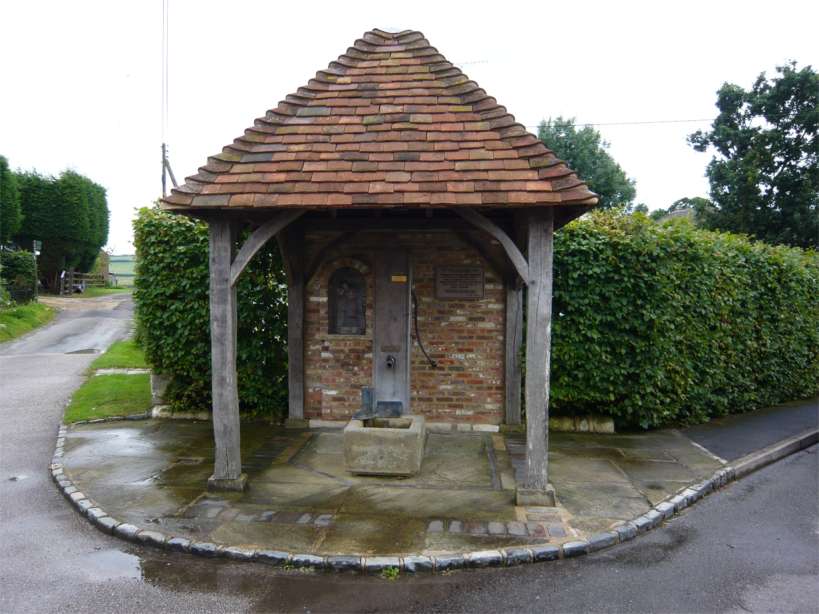
sir-john-schornes-well

Also in the shrine is a boot representing the boot in which the rector whilst exorcising a man suffering from gout is said to have captured the devil. Apparently the devil made himself as small as a beetle and flew away through one of the lace-holes.

sir-john-schornes-shrine-boot

This is how the well looked before it was renovated in 2005. For more photos see here.

sir-john-schornes-well-history1

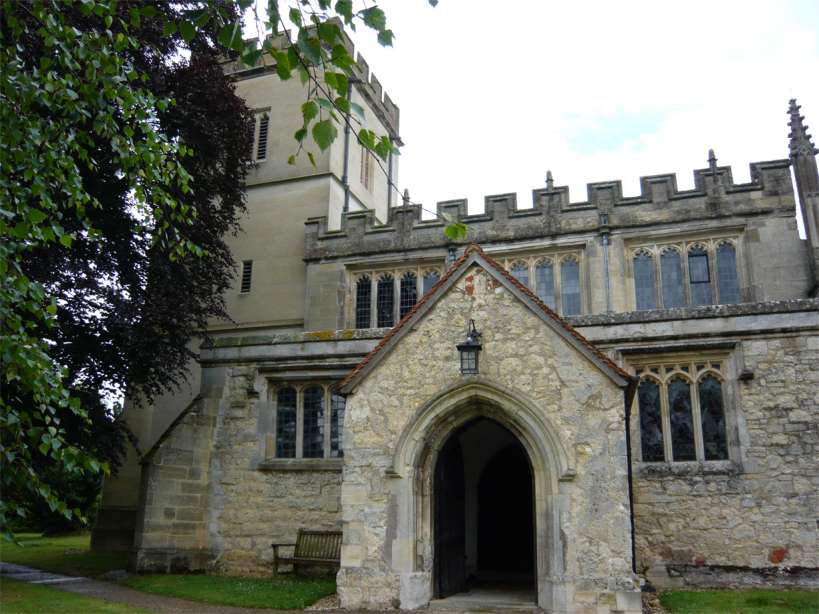
The shrine is near to the parish church, which dates back to the 12th century. The inner part of the tower is from the 15th century, whereas the stone in the outer walls were all replaced between 2002  and 2004.

north-marston-church

The Sixth Wife by Suzannah Dunn

In my last Sunday Salon post I wrote that I was glad I’d got round to reading The Sixth Wife by Suzannah Dunn and was having difficulty  putting it down.  However, on reading further on my enthusiasm for this book waned and then crashed down almost to zero.  I should know better than to write about a book before I’ve finished reading it. But people often say you can tell if you’re going to like a book after about 50 pages and the first part of this book did grab my attention, so it was all very promising.

My problem with it is that the dialogue is too modern, too colloquial. It’s not that I want ‘thees’ and ‘thous’ and ‘prithree’ this and that, but the conversations in this book come from the 21st century, not the 16th. And although I was fore warned from the description on the back cover that Catherine, the Duchess of Suffolk, Katherine Parr’s “best friend” has her own tale to tell I didn’t expect it to be the main part of the book. The Sixth Wife is not really about Katherine Parr, but about Catherine’s relationship with Thomas Seymour – which Dunn explains in the epilogue is from her own imagination.  I don’t expect historical fiction to be a mere recounting of facts,  but I do expect it to have some basis in fact, and not be mainly a story of a woman sleeping with her best friend’s husband. This book is more fiction than history and for me it doesn’t compare with, say Phillippa Gregory’s historical fiction for example.

The plus side, however is that reading this book has spurred me on to read more in the period. This list is taken from Wikipedia:

  • My Lady Suffolk: A Portrait of Catherine Willoughby, Duchess of Suffolk by Evelyn Read (1963) ASIN B000JE85OK
  • Queen Katherine Parr by Anthony Martienssen, McGraw-Hill Book Company, New York 1973
  • Women, Reform and Community in Early Modern England: Katherine Willoughby, Duchess of Suffolk, and Lincolnshire’s Godly Aristocracy, 1519-1580: 19 (Studies in Modern British Religious History) by Melissa Franklin Harkrider
  • Catherine Parr: Henry VII’s Last Love by Susan James (2008). Gloucestershire: The History Press. ISBN o75244591X

Tuesday Teaser – Tooth and Nail

teaser-tuesday

It‘s Tuesday again. Teaser Tuesdays is a weekly bookish meme, hosted by MizB of Should Be Reading.

Share a couple or more sentences from the book you’re currently reading. You also need to share the title of the book that you’re getting your ‘teaser’ from €¦ that way people can have some great book recommendations if they like the teaser you’ve given!

And please avoid spoilers!

rebus-early-yearsToday’s teaser is from Tooth and Nail by Ian Rankin, which I’ve just started to read. Rebus is on his way to London to investigate four murders that had happened in the space of three months:

He was a busy little man this killer they had named the Wolfman and then they had sent word to Rebus’s boss. Lend us your man, they had said. Let’s see what he can do. (page 396 in the omnibus Rebus the Early Years)