Sunday Salon – The Case for God by Karen Armstrong

tssbadge1Just as we’ve been all over the place physically – up and down England with occasional forays into Scotland, so my mind and reading has wandered around and I now find that I’ve started several books at once. Some of them are listed on the sidebar over on the right. I’m going to leave them there as a reminder of what I’ve begun, but I’ve decided to concentrate on just reading two books at a time – one non-fiction (Karen Armstrong’s The Case for God;What Religion Really Means) and one fiction (probably Among the Mad by Jacqueline Winspear as I’ve read more of that than the others and it’s a library book that should be returned soon).

Karen Armstrong’s books always impress me – so much detail and words that I have to look up the meaning. I feel rather inadequate when it comes to writing about The Case for God. The book jacket tells me she ‘is one of the world’s leading commentators on religious affairs’ and in the introduction she writes

We are talking far too much about God these days and what we say is often facile. In our democratic society, we think the concept of God should be easy and that religion ought to be readily accessible to anybody. ‘That book was really hard!’ readers have told me reproachfully, shaking their heads in faint reproof. ‘Of course it was!’ I want to reply. ‘It was about God.’ (page 1)

So I knew from the beginning I should concentrate and make notes as I read. I’m now about a third of the way into the book and have several pages of notes of points that particularly interest me. I like this type of book which is balanced and objective, based on extensive  research and knowledge.

Fortunately Karen Armstrong has included a glossary of such words as ‘apophatic’, that I had no idea of  their  meaning (it means ‘speechless’; wordless; silent – referring to theology that defines God in negative terms “God is not …”) and words that I thought I did know such as ‘faith’.  Translated from the Greek ‘pistis; this meant ‘trust, loyalty, commitment’ and did not mean the acceptance of orthodox theology of belief. So when Jesus was berating his disciples for their lack of faith he was not asking them to believe in him but was asking for their commitment to his mission to feed the hungry etc (page 90).

She states that ‘our religious thinking is sometimes remarkably undeveloped, even primitive’ (page 1) and that religion was ‘not primarily something that people thought but something they did.’ (page 4)

This book does not attack anyone’s beliefs – Armstrong states that quarrelling about religion is counterproductive and aims to show how people in the pre-modern world thought about God, throwing light on some problematic issues such as creation, miracles, revelation, faith, belief and mystery. She then traces the rise of the ‘modern God’ (page 9).

I’m reading The Case for God quite slowly and not reading it at night, when I often fall asleep with a book in my hands which means that when I next continue reading I have no idea of what the previous pages were about and have to read them again. So it’s daytime reading with a pen and notebook at hand.
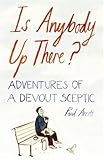
Is Anybody Up There? by Paul Arnott

Subtitled Adventures of  a Devout Sceptic I thought Is Anybody Up There? was an interesting book, although it is more a biography or memoir than an exploration of why Paul Arnott calls himself a sceptic. At times he seemed to me to be advocating most of the world’s religions. He describes how as a child he believed in fairies, leprechauns and Father Christmas, his introduction to Christianity, atheism and his growing interest in Buddhism, Hindusim and Islam.

In fact it’s only with Richard Dawkins that he has any real issues, thinking that “his extrapolations into altruism and faith [in The Selfish Gene] were too deterministic, rich in some answers and impoverished in others.” (page 5)

Writing about Dawkins’s The God Delusion he says

To my mind, it was if he had written a book about football and only focused on the hooligans, corruption in the boardroom, and the few bent referees, ignoring the fantastic skills of both male and female players on the ball and the communal wonder which comes with the scoring of a goal. Dawkins railed against easy targets one after the other, without recognising that every religious person, other than the lunatic fringe he was tilting at, agreed with him wholly about life at the extremes of faith. (page 5)

Arnott’s difficulty is that he just isn’t sure. He explored different faiths, but the “more [he] read and reread, the more any spiritual truth eluded [him].” (page 174) He admits that he “likes religions” (page 211), he commends a “laissez-faire approach” and believes in a “devout acceptance of the beliefs of others” (page 226).  And yes, he does believe there is “somebody” “up there”, whatever that is. His reasons are rather vague -“because of how much is going on out there down here” and because “most people throughout the ages have found it makes more sense to have an idea of divinity than not.”(page 205)

It’s easy reading, with information about a number of religious beliefs, but it’s not very enlightening. Still, I enjoyed reading it.

Awards

i-keep-coming-back-for-moreThis summer I received two awards, which I haven’t acknowledged on this blog (my excuse is house-hunting, we may be near the end of that now, but I mustn’t say too much in case it all falls through).

Cathy of Kittling Books gave me the I Keep Coming Back for More Award. In her words:

The I Keep Coming Back for More! Award is for a blog you just can’t stay away from. If you’ve been busier than a one-armed paperhanger with the hives and your Google reader is over 1,000 unread posts, these are the blogs that you single out to read. These are the ones that are never victims to the dreaded Mark All As Read. There may be many different reasons why you can’t stay away: a taste in books that mirrors your own, the same sense of humor, always knowing the latest in the book world… for whatever the reason, these blogs are flat out addictive and you have no wish to be cured!

I like this award – thank you very much, Cathy, yours is a blog I keep coming back to! I also like your rules:

  • Enjoy the award. If you don’t want to put it on your blog, don’t. Just get the warm, fuzzy feeling that I’m sending your way!
  • You don’t have to reveal any deep, dark secrets about yourself or answer any sort of questions. You’ve already earned it!
  • You don’t have to link back to me.
  • You don’t have to give it to anyone else.

Simple, huh? Now, if you do want to give this award to someone else, that’s a whole ‘nuther kettle of fish.
If you do want to pass it along to some of those addictive book blogs in your reader, just follow the same four rules I outlined above. This is a pay-it-forward award. Nothing is to be expected in return!

As I ‘ve been away a lot recently my Google Reader is overflowing, full to bursting in fact with so many posts to read. Actually I very rarely mark all the blogs in my Reader as read, although I do scroll down them when there are a lot. I wouldn’t want to miss a good post! I regularly click over to the blogs rather than reading them in the reader. I’m passing on this award to:

Thinking about it, I’m also passing it on to all the bloggers in my blogroll as they all write blogs I read and enjoy.superior scribbler award

Then Jane of Reading, Writing, Working Playing gave me the Superior Scribbler Award. I love this image and the idea that someone thinks I’m a “superior scribbler” tickles me pink! Thank you so much Jane.

Again if you’re on my blogroll I’m passing this award on to you.

Would You Lie? Booking Through Thursday

btt button

Suggested by Monibo:

Saw this article (from March) and thought it would make a good BTT confessional question:

Two-thirds of Brits have lied about reading books they haven’t. Have you? Why? What book?

I don’t remember ever claiming to have read a book when I haven’t.  There are books I think I’ve read but when I look at them I realise I haven’t – I just know the story either from a film or TV programme, just as there are books I don’t think I’ve read and then when I start reading I realise that I have! It’s bad enough not being able to remember all the books I have read without having to remember which books I’ve lied about reading as well!!

According to this article 1984, War and Peace, and Ulysses come high up on the list of books people lie about having read and the main reason given was to impress the person they were speaking to. (1984 is a book I think I’ve read but maybe I haven’t, I’m not sure.)

It wouldn’t impress me at all if someone claimed to have read a book and then it was obvious they knew next to nothing about it. But then it doesn’t impress me what anyone reads – I’m just happy they read at all, as so many people don’t!

Teaser Tuesday – The Girl on the Landing

teaser-tuesday

Teaser Tuesday is hosted by MizB at Should Be Reading.

Grab your current read.
Let the book fall open to a random page.
Share with us two (2) ‘teaser’ sentences from that page.

Currently I’m in the middle of The Girl on the Landing by Paul Torday – today’s Teaser is three sentences from pages 67 – 68:

The sensation of being watched was now so powerful that I could scarcely prevent myself from breaking into a run. A prickle of sweat broke out on my forehead. All of a sudden I was seized by a feeling of horror as if something from outside had come into the world.