It’s All About Me – Booking Through Thursday

btt button

Deb’s question today is: Which do you prefer? Biographies written about someone? Or Autobiographies written by the actual person (and/or ghost-writer)?

I’m not sure I can decide which I prefer.

I read both biographies and autobiographies and they both have their pros and cons. Both can be biased and written to present a certain portrait, either flattering or otherwise. Biographers are trying to reconstruct a person’s life from different sources, including letters, diaries, and personal accounts. The end result may seem as if it is factual, but it is an interpretation and quasi-fictional. I don’t like biographies that make general assumptions about a person’s thoughts and motives based on speculation and the author’s own views and impressions.

Inevitably neither a biography nor an autobiography can retell the whole of a person’s life so there has to be a selection and the skill is deciding what to include and what to leave out. This does of course mean that secrets/events a person doesn’t want reveal may be revealed by a biographer with a particular axe to grind or be left out to paint a more flattering portrait.

A good example of a biography is Jane Austen: a Life by Claire Tomalin. It’s well researched, detailed, based on documentary evidence such as diaries and Jane Austen’s own letters.

Memoirs are what a person remembers about their life. Generally they’re more about a particular part of a life rather than the whole. I’ve recently read Somewhere Towards the End by Diana Athill, which is a good example of an autobiography/memoir. It won the Costa Biography Award in 2008 and I think the judges comment sums up what makes a good autobiography/biography:

A perfect memoir of old age – candid, detailed, charming, totally lacking in self-pity or sentimentality and, above all, beautifully, beautifully written.


Nocturnes: Five Stories of Music and Nightfall by Kazuo Ishiguro

Nocturnes by Kazuo Ishiguro is a quintet of stories exploring the themes of love, music and the passing of time. All have narrators who are musicians. As I wrote in an earlier post I’m not a great fan of short stories but these are better than most as they do flesh out the characters in more detail, although some of them just seem to stop rather than ending, leaving me wanting more. There’s nothing dramatic here, rather they are gentle stories with a touch of nostalgia and a sense of loss for what has gone or what could have been.

The first story is The Crooner set in Venice. A young Hungarian musician playing in a cafe meets his mother’s favourite singer, the ageing Tony Gardner. Tony enlists the musician’s help in seranading his wife, Lindy from a gondola.  He reminisces, looking back with nostalgia over the 27 years he and Lindy have been married. They rehearse the songs he’s going to sing to her, all the while going round in circles passing the same palazzo several times. By the end of the story I was left feeling sad – things were not what they initally seemed.

I wasn’t quite sure what to make of Come Rain or Shine. Ray goes to stay with his friends Emily and Charlie. Their marriage is obviously going through a bad patch and when he is left alone in their flat bored with reading Mansfield Park and browsing their CD collection he can’t stop himself from reading Emily’s diary. What follows is farcical as in his attempts to hide the fact he read the diary he ends up wrecking the room and pretends that it was the neighbour’s dog.

The Malvern Hills, is another sad story about a young musician who’s struggling to make his way in the rock world. He retreats to the Malvern Hills to compose love songs. There he meets an older couple, Swiss folk singers Sonja and Tilo, whose lives are on the point of change.

Noctune, the title story again features Lindy some years later. She and a saxophonist are neighbours, convalescing in a luxury hotel after they’ve both had plastic surgery. A sad bittersweet story as they listen to CDs and then go on a nocturnal walk around the hotel in the early hours of the morning. But their lives have not lived up to their dreams and a plastic surgeon can’t fix that.

The last story Cellists completes the cycle – back in the same cafe in a piazza in Venice seven years later. Tibor, one of the cellists, meets and falls under the spell of Eloise, an American who is apparently a distinguished musician. Their encounter changes his life for the worse.

These stories are full of longing and regret, something which I think Ishiguro does well.

What’s the Buzz!

tuesdaythingersThis week on Tuesday Thingers Wendi writes: we are looking at Buzz! That’s right! Library Thing has a page to share what people are saying about Library Thing. The best part? They have areas for quotes from sites (including Wendi’s Book Corner and a few others I’ll bet you’ll recognize), What Librarians are Saying, Prizes and Awards, Should It Be Illegal?, quotes from mainstream media, and even Tweets! So, take a peek and see what people are saying. :)

Questions: Were you aware that Library Thing had a Buzz page? Were you surprised by anything you saw or read on the Buzz page?

My answer: I had no idea this was on LibraryThing. I don’t find it the easiest site to find things on – except for of course cataloguing my books and finding book reviews, which are the two things I do most on the site. I tried to find it on my own but failed and had to get there from the link on Wendi’s blog.

Lo and behold there is a quote from me on there!

“I like being able to have an image of the book and other members’ listings and reviews. You can find photos of authors and suggestions for more reading. It’s easy to add in books as LibraryThing does all the work for you using data imported from booksellers and a long list of libraries.”

BooksPlease: Ramblings of a Book Worm

It’s about a third of the way down the page the last entry in a blue centre column called “Librarians say”, which is amazing – I’m not a librarian any more, although I used to be one! The link is to a Booking Through Thursday post on cataloguing I wrote nearly two years ago on my old blog on Blogger. I’m thrilled!

Teaser Tuesday – All the Colours of Darkness

teaser-tuesdayTeaser Tuesday is hosted by MizB at Should Be Reading.

I haven’t finished reading All the Colours of Darkness by Peter Robinson but I thought I’d quote a few sentences from it as a “teaser”. Robinson is a “new to me author”, but by no means a new author. He’s written many books and received numerous awards, all listed on his website.

All the Colours of Darkness is the eighteenth book in his Inspector Banks series. Banks and DI Annie Cabbot are investigating the deaths of Mark Hardcastle, found hanging from an oak tree in Hindswell Woods, and his partner Laurence Silbert found battered to death in his house in the Heights, the ‘posh’ part of Eastvale (a fictional Yorkshire town).

It looks like a textbook case of murder-suicide, a crime of passion. But somehow I have my doubts as this is set out in the first few chapters. This seems to be confirmed in the chapter I’m currently reading when Banks is interviewing Laurence’s mother Edwina, now in her eighties, the owner of the enormously successful Viva boutique chain in the 60s:

‘Edwina’, Banks said in exasperation. You’re keeping something from me. I can tell. You were doing it last night and now you’re doing it again. What on earth is it? What are you holding back?’

Edwina paused and sighed.’Oh, very well. It is naughty of me, isn’t it? I suppose you’d find out sooner or later, anyway.’ She stubbed out her cigarette and looked Banks in the eye. ‘He was a spy, Mr Banks. My son, Laurence Silbert. He was a spook.’ (pages133-4)

There are theatrical references as Mark was a set and costume designer for a production of Othello at the Eastvale Theatre and the epigraphs at the beginning of the book are from Shakepeare’s Othello and Puccini’s Tosca. So it’s promising to be a mix of different elements – jealousy, murder, revenge, envy and ambition.

Crime Fiction Alphabet: Featuring the Letter ‘E’

crime_fiction_alphabetInstead of concentrating on one book or one author I’ve picked a mixture of books and authors for this week’s featured letter E in Kerrie’s Crime Fiction Alphabet Community Meme.

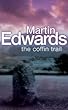
First up is Martin Edwards, who is one of my favourite authors and bloggers (click on the links to go to his website and blog). I  ‘discovered’ him when he commented on one of my posts. I’m so glad he did.  He’s written several novels, short stories and non-fiction books as well as edited a number of anthologies. Click on the titles to see my posts on his Lake District series:

Another author who used to be a great favourite of mine is Ed McBain. I haven’t read anything of his for many years.  He was born Salvatore Albert Lombino in 1926 and changed his name to Evan Hunter, writing under the pseudonym Ed McBain from 1956. He died in 2005. He wrote an enormous number of books – from 1958 until his death he wrote one or two books a year as Ed McBain. The first one in his 87th precinct series is Cop Hater. You can read the beginning of chapter one on the Ed McBain website. Writing under his own name Evan Hunter, he wrote the screenplay for Alfred Hitchcock’s film The Birds, based on Daphne Du Maurier’s short story (which is very different from the film). I think it’s time to re-read some Ed McBain books!

Then there is Ellery Queen – who was actually two people writing pseudonymously. They were  cousins Daniel (David) Nathan, alias Frederic Dannay and Manford (Emanuel) Lepofsky, alias Manfred Bennington Lee. They also used the pen name Barnaby Ross. Ellery Queen was also the chief character of their novels. A list of their books can be found on the Fantastic Fiction website. I first read Ellery Queen and Ed McBain as a teenager when I found them on my parents’ bookshelves and devoured them after I’d read all the Agatha Christie books I could find.

Umberto Eco wrote one of my favourite books The Name of the Rose. I read this when I was working in the Archives of the local County Council. It was recommended by one of the archivists and we spent many happy tea breaks discussing this novel. It is set in the Middle Ages in Italy, in which Brother William a Franciscan monk, aided by Adso a novice,  investigates several strange deaths. It’s a wonderful mix of detective fiction, historical fiction and religious history rolled into one, involving solving cryptic clues, secret codes and puzzles. 

Finally some books beginning with the letter E:

And on that note I shall end this look at the letter E in crime fiction.