A Question of Blood by Ian Rankin: Book Review

I’ve recently finished reading Ian Rankin’s A Question of Blood, the 14th Inspector Rebus book, only three more left to read now!

Lee Herdman, is an ex-SAS loner who shoots and kills two teenagers, injuring another at a private school in South Queensferry near Edinburgh, before killing himself. Rebus, also ex-Army and a loner is the ideal man to investigate and he becomes obsessed with discovering what drove Herdman to do it.

But the book begins with Rebus in hospital having scalded his hands by tripping into his bath, or so he says. With his hands in bandages, DS Siobhan Clarke helps him out by being his driver. She is also becoming more and more like Rebus, a loner who has no life outside her job, and drinks alone. She has panic attacks as a result of being stalked by Marty Fairstone, a housebreaker with several convictions for assault. When Fairstone is found burned to death in his house, after a late night drinking session with Rebus, Rebus is the number one suspect for his murder.

Rebus is forced to think of his family,  because one of the dead teenagers is a relation – Derek Renshaw, his cousin’s son. Family ties are highlighted in this book, not only through Rebus, but also through the relationship between the surviving teenager, James Bell and his father, the disreputable MSP Jack Bell, and also the Cotter family – the Goth teenager, Myss Teri, her parents and her brother who died in a car crash involving Derek Renshaw.

Rebus is his usual tormented self, but it is Siobhan who comes just as much into focus as Rebus and by the end of the book the relationship between them is strengthened:

He’d been thinking about families: not just his own, but all those connected to the case. Lee Herdman, walking away from his family; James and Jack Bell, seemingly with nothing to connect them but blood; Teri Cotter and her mother … And Rebus himself, replacing his own family with colleagues like Siobhan and Andy Callis, producing ties that oftentimes seemed stronger than blood. (pages 437-8)

I don’t think this is the best Rebus book Rankin has written, for me it dragged a bit in the middle and I think it could have been a bit less drawn out, but it’s still a good read, addressing more issues than just the crimes.

Musing Mondays – Currently Reading

Monday Musings is hosted by Should Be Reading.

This week’s question is:

What are you currently reading? Would you recommend it to others? Is it part of a series (if so, which one)? What are you thinking about it? What book(s) would you compare it to, if any?

Currently I’m reading A Dark Adapted Eye by Barbara Vine. I think it’s the first one Ruth Rendell wrote under the pseudonym Barbara Vine. I’m still in the opening chapters and working out the relationships between the characters. It’s a psychological crime novel about a family with secrets. The blurb reads:

Brilliantly plotted. Vine is not afraid to walk down the mean streets of the mind and can build up an almost tangile atmosphere of menace and unease. (Daily Telegraph)

It’s not part of a series, although the Vine books are all psychological crime novels and from what I’ve read so far I would certainly recommend it if you like that sort of book.

I’m also reading Death on the Nile by Agatha Christie, featuring Hercule Poirot. I haven’t read this before, although I’ve seen the film with Peter Ustinov as Poirot and the TV version starring David Suchet, so as I’m reading it I’m remembering what happens and can visualise the setting in Egypt on the Nile alongside the Pyramids. I like the way Christie sets up so many possible suspects and then reveals how each one couldn’t be the murderer. I think I remember who did it, and how – but I could be wrong. As I like Agatha Christie I’d recommend any of her books, and this one is a classic.

I have a third book on the go, although at present it’s lagging behind as I’m enjoying the other two books so much. It’s Portrait of an Unknown Woman by Vanora Bennett, historical fiction set in Tudor England (Henry VIII) with Thomas More’s family. That’s not to say that I’m not enjoying this book, but it’s quite slow to get going – or rather I’m slow at reading it, because it is quite detailed and not a lot happens at first.

It covers the same period as Wolf Hall by Hilary Mantel, when Henry VIII wants a divorce from Katherine of Aragon to marry Anne Boleyn, but there is little comparison between these two books apart from that. I suppose I’d compare it to Philippa Gregory’s books. And if you like detailed and well-researched historical fiction, then it is for you.

Weekend Cooking – Watercress Soup

Weekend Cooking is open to anyone who has any kind of food-related post to share: Book (novel, nonfiction) reviews, cookbook reviews, movie reviews, recipes, random thoughts, gadgets, fabulous quotations, photographs. For more information, see the welcome post.

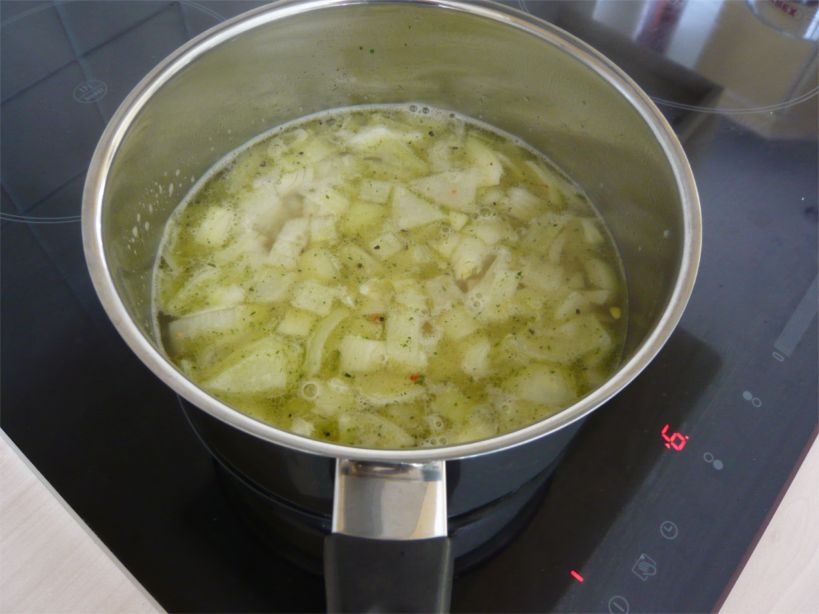
It’s been hot and sunny here all last week, but today it’s been raining on and off all morning. Just the right sort of weather to make watercress soup. This is my favourite soup to make because it’s so easy. The only preparation is peeling and chopping potatoes and onion, briefly sautéing them in oil, then simmering them for about 15 -20 minutes in vegetable stock until cooked. Then add the watercress and simmer very briefly before blitzing the soup with a hand blender in the pan – cooking the watercress like this means it keeps a fresh green colour.

Simmer chopped potatoes and onion in vegetable stock
Add watercress
Bowl of watercress soup

Best Books January to June

Kerrie at Mysteries in Paradise recently asked what are your favourite crime fictionbooks so far this year, which got me to thinking about my favourite books as a whole (not just crime fiction). About half the books I read are crime fiction and the other half is a mixture of fiction (of many genres) with a smattering of non fiction.

After much thought I’ve decided on these ten books as my favourite reads so far. I’ve only included one book from Ian Rankin and Agatha Christie, although I’ve read several from each that I rate as highly as the ones I’ve chosen. Six of the books are crime fiction (marked *), there is one non fiction and one book of short stories. They are listed in the order that I read them.

I hope to vary my reading during the rest of 2010, maybe a few more non-fiction books as I have several biographies/autobiographies I’d love to read and more classics, but I expect crime fiction will still be high on my list of best books by the end of the year.

Paris in July

I’m not actually going to Paris this month, but BookBath and Thyme For Tea are hosting a blogging experience to celebrate all things French and Parisian running from the 1st – 31st July this year called “Paris In July“. 
The aim of the month is to celebrate our French experiences through reading, watching, listening to, observing, cooking and eating all things French!
There will be no rules or targets in terms of how much you need to do or complete in order to be a part of Paris In July – just blog about anything French and you can join in. Some ideas for the month might include;
  • Reading a French book – fiction or non-fiction
  • Watching a French movie
  • Listening to French music
  • Cooking French food
  • Experiencing French art, architecture or travel

This should give me the nudge to finish reading Irene Nemirovsky’s Suite Francaise, which I started last year. I’ve read half of it and right now I can’t imagine why I didn’t finish it because I was finding it so good! I’d also like to read The Gourmet by Muriel Barbery.

Although I doubt very much that I’ll be able to read these books this July there are also two other books I’ve been meaning to read for ages – The Hunchback of Notre Dame by Victor Hugo and The Count of Monte Cristo by Alexandre Dumas.

And I must get out my French cookery books too, in particular The Frenchwoman’s Kitchen by Brigitte Tilleray.

Disappointment: Booking Through Thursday

btt button

Today’s question from Deb is:

Name a book or author that you truly wanted to love but left you disappointed. (And, of course, explain why.)

One book that came to mind when I read this question is Haweswater by Sarah Hall. I read it in 2006 before I wrote about books on my blog so my notes on it are brief. It’s a novel about what happened when the Haweswater dam was constructed and the valley of Mardale in Cumbria was flooded. I read it because I was interested in the area and on the cover it said that it had won the Commonwealth Writers’ Prize for Best First Book in 2003, so I was expecting it to be good.  I think I’m obviously in the minority here because I thought that it was “Disappointing, verbose, overwritten and detached – characters not described with much empathy.”