Reading Indies 2024

Karen @ Kaggsy’s Bookish Ramblings and Lizzy @ Lizzy’s Literary Life are hosting #ReadIndies for the fourth time. This year’s badge has been populated with the 41 micro publishers (publishers with 5 employees or less) that have, under the aegis of Will Dady of Renard Press, gathered together to form the Indie Press Network.

Here are the two rules that apply to #ReadIndies: 

  • Reading material (whichever format, whichever language) must come from publishers who are currently operating as independents.
  • Self-published titles are not eligible.
This is my first time taking part and I’m concentrating on the Dean Street Press books. I have 11 books to choose from:

  1. Arrest the Bishop? by Winifred Peck
  2. The Draycott Murder Mystery by Molly Thynne
  3. Evenfield by Rachel Ferguson
  4. The Fledgeling by Frances Faviell
  5. A Harp in Lowndes Square by Rachel Ferguson
  6. A House on the Rhine by Francis Faviell
  7. The Other Side of the Moon: David Niven by Sheridon Morley
  8. The Red Lacquer Case by Patricia Wentworth
  9. Thalia by Francis Faviell
  10. There’s a Reason for Everything by E.R. Punshon
  11. Who Pays the Piper? by Patricia Wentworth

I think I’ll read The Fledgeling by Frances Faviell, first because I enjoyed The Dancing Bear recently.

Synopsis:

‘I can’t go back. I’d rather die—I’d rather be dead.’

Neil Collins is going AWOL from his National Service – for the third time. Twice he has served time for previous desertions and been sent back, despite being hopelessly unsuited to military life. This time, terrorized by a bullying fellow soldier determined to escape himself, Neil intends to make his escape a permanent one. He heads to London, to the dreary, claustrophobic rooms where his twin sister, Nonie, and their dying grandmother live, periodically invaded by prying neighbours, a little girl who has befriended Mrs Collins, a curious social worker, and other uninvited visitors.
The Fledgeling (1958) traces the single day following Neil’s desertion, and its impacts on Neil, Nonie, the tough-as-nails Mrs Collins, and others. Each of the characters comes vividly alive in Faviell’s sensitive and observant prose. At times containing all the tension of a thriller, at others a profound drama of familial turmoil, Faviell’s third and final novel is dramatic, compelling, and emotionally wrenching. This new edition features an afterword by Frances Faviell’s son, John Parker, and additional supplementary material.

Indefensible by James Woolf

Bloodhound Books| 5 January 2024| 413 pages| E-book review copy| 3*

Synopsis from Amazon UK

A lawyer crosses a dangerous line with a former client and discovers that some decisions are indefensible…

Daniel, a criminal barrister, is working all hours on a sensational trial, defending a client he believes is wrongfully accused of a grisly murder. Determined to keep Rod out of prison, he begins to neglect his wife—and soon suspects she’s having an affair.

After Daniel triumphs in court, the bond with his newly acquitted client grows even stronger. And when Rod offers Daniel a favour that he really shouldn’t accept, things take a catastrophic turn.

Daniel realises the lethal consequence of his actions and now his dream case threatens to become his worst nightmare…

My thoughts

I received a copy of Indefensible from the author, James Woolf for review. It’s his debut novel, although 30 of his short stories have appeared in magazines and books, including four in the longstanding arts magazine Ambit. James also writes stage plays (about 15 have been professionally produced) and has written radio plays for Radio 4 and LBC. He has worked in professional ethics within the law for 20 years, including taking calls from barristers when they have a question about their code of conduct. So his book explores the consequences of not following the code of conduct.

After a dramatic opening it took me a while to settle into this book. I couldn’t warm to Daniel at first, a barrister, recently appointed as a QC. He is a complex character who comes across as very needy, insecure and vulnerable, having left his wife on acrimonious terms. This has knocked his confidence and he finds personal relationships difficult. He is disappointed as his clerk is not getting him the cases he wants. But then he gets his first major case defending Rod, accused of a particularly grisly murder. During the course of the trial he meets Michaela, who is a crime reporter, and the two develop a relationship. I was never sure about the characters, were they telling the truth, and were they really what they seemed.

I enjoyed the setting – London in the 1990s with reference to real court cases, such as the trial of Fred and Rosemary West. For me the strength of this book is the court case, keeping me guessing about the outcome and eager to find out who was telling the truth. But as Daniel says the trial process is about testing the evidence – it’s the test that is important and not the truth. As the trial continued I began to fear the worst, that the truth was being obscured. What happened afterwards was not quite what I expected, as Daniel’s decisions and subsequent choices proved to be indefensible.

After a slow start I found this book compelling reading and I’ll be looking out for more books by James Woolf.

My thanks to James Woolf and Bloodhound Books, the publishers, for sending me the Kindle edition for review.

Six Degrees of Separation from The Hog’s Back Mystery to Maisie Dobbs

It’s time again for Six Degrees of Separation, a monthly link-up hosted by Kate at Books Are My Favourite and Best. Each month a book is chosen as a starting point and linked to six other books to form a chain. A book doesn’t need to be connected to all the other books on the list, only to the one next to it in the chain.

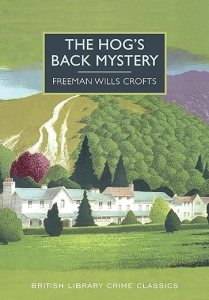
This month starts with the book that I ended my last Six Degrees chain with, which was The Hog’s Back Mystery by Freeman Wills Crofts. I’ve recently finished reading this British Library Crime Classic, first published in 1933, during the Golden Age of detective fiction between the two world wars. Dr James Earle and his wife live near the Hog’s Back, a ridge in the North Downs in the beautiful Surrey countryside. When Dr Earle disappears from his cottage, Inspector French of Scotland Yard is called in to investigate. At first he suspects a simple domestic intrigue – and begins to uncover a web of romantic entanglements beneath the couple’s peaceful rural life.

I’m starting my chain with High Rising by Angela Thirkell, another book first published in 1933. Set in the 1930s it’s an entertaining and witty social comedy, in the fictional county of Barsetshire, borrowed from Trollope. Laura Morland is a widow with four sons, who supports herself by writing novels, which she knows are not ‘in any sense of the word, literature‘ but which have appeal.

My second link is to Cards on the Table by Agatha Christie, in which one of the characters, Ariadne Oliver, also writes fiction. The victim is Mr Shaitana, a collector of snuff boxes, Egyptian antiquities and murderers.This story has just four suspects and any one of them ‘given the right circumstances‘ might have committed the crime. It’s also a book first published in the 1930s, that is 1936..

My third link is via ‘card’ to A Card from Angela Carter by Susannah Clapp. She and Angela had been friends for a number of years. This book uses the postcards Angela sent to her to form a sort of biography. Sent from various places around the world some have a full message, some only a few words, which Susannah uses to paint a picture of what Angela was like, a ‘great curser’, capable of the sharpest of remarks, clever, unpredictable, quirky, and funny.

My fourth link is to a book written by another author called Susannah, The Adventures of Maud West, Lady Detective by Susannah Stepleton, subtitled ‘Secrets and Lies in the Golden Age of Crime‘. This is narrative non-fiction. Was Maud West really who she said she was? Susannah Stapleton discovered that she really did exist and was indeed a private investigator with her own detective agency, based in London in the early part of the twentieth century, from 1905 onwards.

My fifth link is to crime fiction featuring a private investigator, The Big Sleep by Raymond Chandler, first published in 1939. Private Investigator Philip Marlow is hired by the paralysed millionaire General Stallwood, to deal with the blackmailer of one of his two troublesome daughters, and Marlowe finds himself involved with more than extortion. Kidnapping, pornography, seduction, and murder are just a few of the complications he gets caught up in.

And my final link is Maisie Dobbs, a book featuring yet another private investigator. This is the first in Jacqueline Winspear’s Maisie Dobbs series. In 1929 Maisie set herself up as a private investigator, having started as a maid to the London aristocracy, studied her way to Cambridge and served as a nurse in the Great War. I’ve read a few more of the series since I read this one.

My chain forms a circle beginning and ending with crime fiction. The other links are books with the word ‘card’ in the titles, books with authors named Susannah and books featuring private investigators. The first five books, like the beginning book, were all published in the 1930s.

Next month (2 March 2024), we will start with Tom Lake by Ann Patchett.

Top Ten Tuesday: New-to-Me Authors I Discovered in 2023

Top Ten Tuesday is a weekly meme created by The Broke and the Bookish and now hosted by Jana at That Artsy Reader Girl. For the rules see her blog.

The topic this week is New-to-Me Authors I Discovered in 2023. These are all books I read and reviewed in 2023. I enjoyed all of them, some more than others (marked with an asterisk*).


The Flower Arranger at All Saints by Lis Howell

The Flower Arranger at All Saints by Lis Howell was one of Prime Reader’s free books last year that I downloaded. I loved it! it’s my first 5* read of the year.

Synopsis

In quiet Tarnfield, local rivalries and parish feuds simmer under the genteel surface. It’s the sort of place where everyone knows each other’s business. And a new vicar wants to shake things up in the community. Then Phyllis the church flower arranger is found dead before the big Easter service.
With fingers pointing and tensions rising, the village is in turmoil.

Chaotic mum-of-two, Suzy Spencer, has just arrived in Tarnfield. She needs a fresh start after her husband betrayed her. Now she finds herself entangled in the mystery along with quiet widower, Robert Clark. The killer is set to strike again with another floral flourish. Despite their differences, can Suzy and Robert stop the murderer before anyone else suffers?

My thoughts

There is a lot to like in this book. The setting is Tarnfield, a fictional Cumbrian village. The setting is described so well that I could ‘see’ it all. It’s picturesque, quiet and secluded, where everyone knows everybody’s business. The church plays a huge part in village life, but traditions are being upended by the new vicar and his fondness for playing the guitar during sermons.

And the characters are so ‘real’. I believed in them and even though there are many of them they’re all easily distinguishable and I loved the biblical references and flower clues – they’re intriguing. The plot too kept me keen to carry on reading, wanting to know the identity of the murderer. As Suzy and Robert try to get to the bottom of the mystery many secrets are revealed – and it looks as though a relationship between the two of them is developing.There are more deaths and red herrings with several twists and turns before the culprit is found.

Why haven’t I come across this author before and her Suzy Spencer mysteries? The Flower Arranger at All Saints is the first in the series and luckily there are four more for me to read!

About the author

Lis Howell is from Liverpool, UK. She is the author of the Suzy Spencer cozy mysteries. They are set around the fictional town of Norbridge, Cumbria in the North of England. In her varied life, Lis has spent a short time running a post office in a Cumbrian village; and she lived for several years near Hadrian’s Wall between England and Scotland. Lis is an award-winning TV journalist based in London and is now an academic. Like Suzy, she’s a confused churchgoer, although she married a churchwarden! Anglican traditions feature in her books, along with modern media, family life and village intrigue.

I’m taking part in the  What’s In A Name Challenge? this year and this book fits into the category of a NFL team (New Orleans Saints).

Top Ten Tuesday: Books I Meant to Read in 2023 but Didn’t

Top Ten Tuesday is a weekly meme created by The Broke and the Bookish and now hosted by Jana at That Artsy Reader Girl. For the rules see her blog.

The topic this week is Books I Meant to Read in 2023 but Didn’t. I have an enormous pile of books I’d love to read this year.

These are just ten of them, books I was so keen to read when I first got them, but for one reason or another I just never got round to actually reading them. And simply saying that I will read a book this year almost guarantees that I won’t. They’re listed in no particular order, because if I try to prioritise them that would be fatal:

Strangers on a Train by Patricia Highsmith – Guy Haines and Charles Anthony Bruno meet on a train. Bruno manipulates Guy into swapping murders with him. “Some people are better off dead,” Bruno remarks, “like your wife and my father, for instance.” 

Recalled to Life by Reginald Hill – Set in 1963, Dalziel and Pascoe re-investigate a crime of passion in one of England’s great houses, an open-and-shut case. But thirty years later, when the convicted nanny is freed, then spirited off to America before she can talk, Dalzeil wonders did the wrong aristocrat hang?

How Green Was My Valley by Richard Llewellyn – a story of life in a mining community in rural South Wales as Huw Morgan is preparing to leave the valley where he had grown up. He tells of life before the First World War.

Here Be Dragons by Sharon Penman – set in 13th century Wales this is the story of Llewelyn, the Prince of North Wales, and his rise to power and fame and his love for Joanna, the illegitimate daughter of King John.

The Secret of Annexe 3 by Colin Dexter – Much too early on New Year’s Day, a grumpy Inspector Morse is summoned to investigate a murder at the Haworth Hotel. The victim is still wearing the Rastafarian costume that won him first prize at the hotel’s New Year’s Eve party; his female companion and the other guests in the annexe have vanished. It’s a mystery that’s a stretch even for Morse. But with pit-bull fervor he grabs the truth by the throat and shakes loose the bizarre secrets of a cold-blooded crime of passion. . . .

Gone Girl by Gillian Flynn – on the day of Nick and Amy’s fifth wedding anniversary, Amy suddenly disappears. The police suspect Nick. Amy’s friends reveal that she was afraid of him, that she kept secrets from him. He swears it isn’t true.

 Birthright by Nora Roberts – a novel about an archaeological dig when five-thousand-year-old human bones are found, this has a sense of death and misfortune combined with a mystery about the archaeologist Callie Dunbrook’s past. 

 Earth and Heaven by Sue Gee – In the aftermath of the First World War, a young painter Walter Cox and the wood-engraver Sarah Lewis meet at the Slade, then set up home and a studio together. With their newfound happiness, and the birth of Meredith, then Geoffrey, the grief of war recedes. But children are unpredictable and have their own inner lives: events on a summer afternoon change everything …

 Tangerine by Christine Mangan – Set in Morocco in the 1950s, this is described as a psychological literary thriller and the perfect read for fans of Daphne du Maurier and Patricia Highsmith. The last person Alice Shipley expected to see since arriving in Tangier with her new husband was Lucy Mason. After the horrific accident at Bennington, the two friends – once inseparable roommates – haven’t spoken in over a year. But Lucy is standing there, trying to make things right.

When Christ and His Saints Slept by Sharon Penman – the first book in the Eleanor of Aquitaine trilogy. Historical fiction about Stephen and his cousin, the Empress Maude, and the long fight to win the English throne.