Saturday Snapshot – another look at the family album

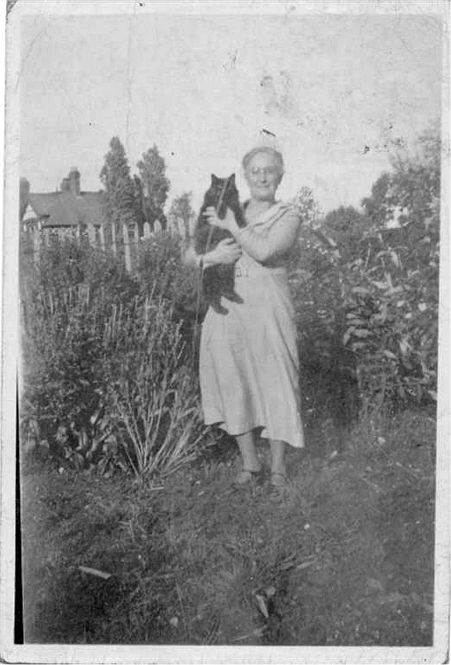
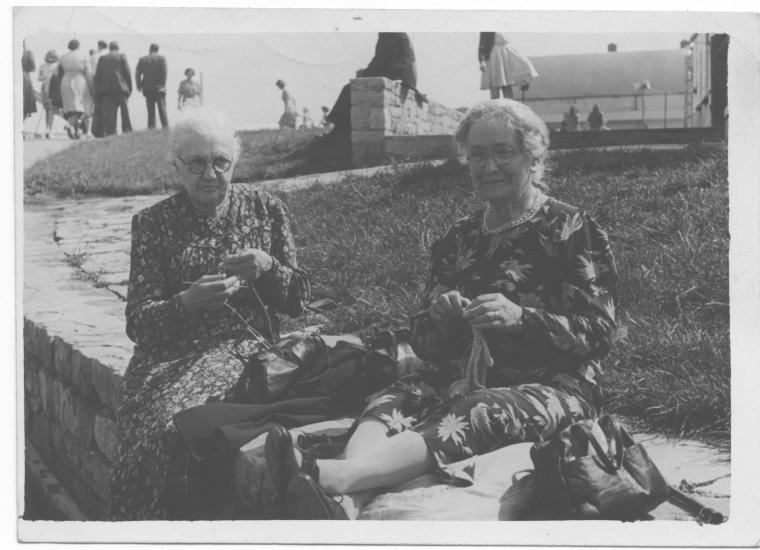
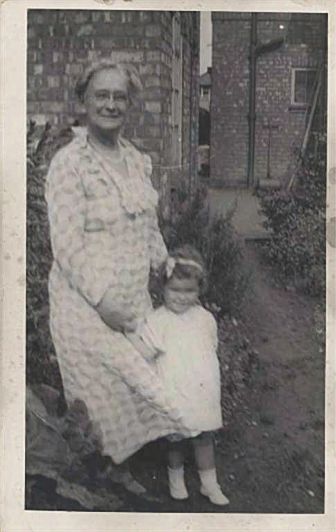
Time to revisit old family photos. This week I’m featuring my Granny Leighton, my father’s mother. I loved visiting her, she was the epitome of a grandmother, with her white hair done up in a bun, and her lovely smiley face. She even sat in a rocking chair by the fire knitting, when she wasn’t dashing around the kitchen, singing whilst she cooked.

Here she is with her sister, who wasn’t such a happy lady – I was rather scared of her. I don’t know when the photo was taken or where they were, but they’re sitting on a wall, maybe on holiday or on a day out, both with their knitting. Granny is on the right of the photo – smiling, Great Aunty Alice on the left – not smiling!

And here she is in her garden with my cousin, Sylvia:

And another photo taken in her garden, this time with her big black cat:

Granny and Granddad had a large garden, divided into many sections for flowers and vegetables, and they also had an aviary full of birds. I loved going there, although I was scared of my Granddad’s dog, which fortunately for me, he kept tied up to his chair when he was in the house. It was a horrible dog, with a very fierce bark and growl.

See more Saturday Snapshots at Alyce’s blog At Home with Books.

Book Beginnings on Friday

This morning I finished reading Faulks on Fiction by Sebastian Faulks, a book I’ve been reading slowly for a few weeks (my review coming soon). It’s time to choose another non-fiction book to take its place. It’s got to be a book I can read in small bites and not lose the thread, maybe a biography/autobiography, or a diary, collection of letters, or a history book.

I’ve looked at a few and have decided on this one:

The half-timbered mansion disappeared long ago, and the paved thoroughfare lies buried beneath the dust of centuries. The Great Fire tore the heart out of this corner of Elizabethan London, devouring books, buildings and streets. One of the few things that survived is a small and insignificant-looking map – crinkled, faded, but still bearing the proud name of its owner. (page 1)

This is the beginning of Giles Milton’s about the first English settlement in the New World in the sixteenth century. It’s Big Chief Elizabeth: how England’s Adventurers gambled and won the New World. I’ve read his earlier book Nathaniel’s Nutmeg, which is a fascinating tale of the ‘competition between England and Holland for possession of the spice- producing islands of South-East Asia throughout the 17th century.’

I like the beginning of Big Chief Elizabeth, which within a few words captures the mystery and appeal of history for me. I’m looking forward to discovering more about the map and its owner.

Blurb from the back cover:

Big Chief Elizabeth has it all: gallant English seadogs, coiffured courtiers, exotic locations and lots of fights with pirates, Spaniards and Indians. (Sunday Telegraph)

Plus I’m interested to read Giles Milton’s newest book, Wolfram: the Boy who Went to War.

Book Beginnings on Friday is hosted by Katy at A Few More Pages.

S is for Smailholm Tower and Sir Walter Scott

I took these photos of Smailholm Tower, near Kelso in the Scottish Borders on a grey day in November last year. It’s open to the public, but in the winter it’s only open at the weekends  and we went on a weekday! We keep meaning to go back and see the inside.

I think it’s an impressive sight!

It’s a peel tower perched on top of a rocky crag, originally built in the 15th/16th centuries to protect its occupants from English raiders. It’s now a Scheduled Ancient Monument in the care of Historic Scotland.

Although the Tower now stands alone on the crag it was once the centre of a small castle toun. Sir Walter Scott stayed with his grandparents who lived at Sandyknowe Farm in the hollow near the Tower, where his parents hoped his delicate health would improve. It was there that his love of the Borders began as his aunt and grandmother recited to him ballads and Border tales and legends.

For more S posts visit ABC Wednesday.

Westwood by Stella Gibbons: a Book Review

I found Westwood by Stella Gibbons a slightly disappointing book. I liked it, but didn’t love it, as I’d hoped I would. I do enjoy descriptive writing, and there are some beautiful descriptive passages, but there were far too many, even for me, which eventually made me wish Gibbons would just get a move on. Lynne Truss in the introduction wrote that she loves it deeply and it made her laugh and weep. I found it amusing in places and also touching. It’s a slow meander through the characters, their lives and their houses.

Margaret Steggles, a plain young woman finds a ration book on Hampstead Heath which provides her with an introduction into the lives of Gerard Challis and his family, his beautiful wife, Seraphina, his self-absorbed daughter Hebe and her spoilt children and Zita the family’s maid. Margaret idolises Gerard, who is a playwright. He in turn falls under the spell of her best friend, Hilda. The contrast between Margaret and Hilda is marked. Margaret is serious, somewhat of a snob, ‘not the type to attract men’, and impressed by the artistic circle surrounding the Challis family. Hilda, a beautiful young woman who attracts many male admirers has no trace of romance in her nature and Margaret realises that Hilda ‘would not or could not be serious’. Margaret becomes obsessed with Gerard’s house, Westwood and longs to be there whenever she can. Feeling that she has outgrown Hilda, she cultivates a friendship with Zita.

This is not a wartime novel, although it is set in London just after the Blitz and there are some wonderful descriptions of the city and its unexpected green and unspoilt places amidst the ruins of bombed houses. Although the war is not really in focus, the atmosphere of the times infuses the novel. The nature of war itself is discussed by Grantey, the family’s old nurse in her conversation with Hebe:

… it’s all part of God’s plan for doing away with war for good and all.

All those dreadful explosions and atrocities and secret weapons they keep on talking about, … and not knowing when you go to bed at night if you’ll be alive when you wake up in the  morning – that’s all part of God’s plan. He’s letting it get worse and worse, so’s it’ll destroy itself, like; it’ll get so bad not even wicked people’ll want it , and then it’ll stop. (page 277)

Really???

It’s a novel about relationships, about friendship, about hope and longing and above all about disappointment and ‘coming to terms with life’.

*Slight spoiler alert follows*

*I wouldn’t have known without Lynne Truss’s introduction to the book that Gerard was based on the writer Charles Morgan, who had annoyed Stella Gibbons, and Gerard’s characters in his dreadful plays are parodies of Morgan’s female characters. Morgan had claimed that a sense of humour was lacking in writers.The pompous Gerard is the butt of the humour in the novel  – in particular the scene where his grandchildren find him in a compromising situation in Kew Gardens – that did make me smile.*

  • Paperback: 464 pages
  • Publisher: Vintage Classics (4 Aug 2011)
  • Language English
  • ISBN-10: 009952872X
  • ISBN-13: 978-0099528722
  • Source: I bought it
  • My Rating 3/5

Stella Gibbons’s more famous novel is Cold Comfort Farm. I used to think I’d read it, now I’m not so sure. I like Westwood just enough to make me curious to look out for it. If you’ve read it, or Westwood, what are your views?
I Never Knew That About England by Christopher Winn

I came across I Never Knew That About England by Christopher Winn, soon after I decided to read my way around Britain in my Britain in Books project. This book is a collection of stories ‘that have England as their backdrop’.

It’s arranged alphabetically by the 39 traditional counties of England, so it fits in very well with my project. Winn writes in his preface that he has made every effort to get the facts right, but notes that many of the stories

are not eternal truths but have been handed down through time, sometimes by word of mouth only. Details can vary according to different sources, but the essential substance and essence remains. (page 7)

The book is a miscellany of stories, anecdotes and a ‘smattering of fascinating facts and figures.’  I’m going to dip into it every now and then and post little snippets as they appeal to me, starting with my home county of Cheshire.

Cheshire - click on image to enlarge

Cheshire is in the north-west of England, bordering Wales. Readers of Mrs Gaskell know that Cranford is based on the town of Knutsford, but what I never knew is that the village of Mobberley, near Knutsford, where one of my aunties lived, is the birthplace of George Mallory (1886 – 1924), the mountaineer who died attempting to climb Mount Everest. His father was the Rev. Herbert Leigh Mallory, the rector of Mobberley and it is said that he practised climbing up the church tower. I found this article in the Knutsford Guardian about the family home, Hobcroft House.

When asked why he wanted to climb Everest, Mallory replied: ‘Because it’s there’. It’s never been discovered whether Mallory did reach the summit. The camera Mallory and his companion Sandy Irvine took with them as they set out to make it to the top has never been found. Irvine’s body too has never been discovered, but in 1999 Mallory’s body was found on the North Face, 1,000 feet below the summit. There is a memorial window in the St Wilfrid’s Church dedicated to Mallory, inscribed:

lost to human sight between earth and heaven

Saturday Snapshot – A Walk Along the River Till

On Wednesday we walked alongside the River Till in Northumberland, England to its junction with the River Tweed, in Scotland.We started at the medieval Twizel Bridge – the bridge crossed by the English Army  on their way to the battle at Flodden in 1513. The bridge is now a pedestrian route, the traffic speeding along a new main road. Both bridges across the River Till are shown in my photo below. (The medieval bridge is in front of the new bridge) :

Here is a closer look at the medieval bridge:

As we went along the river bank the salmon were leaping out of the water, but no matter how quick I tried to be with the camera I couldn’t snap a fish as it leapt out of water. This is the closest I got:

The nearer circle is where the fish jumped out and the further one where it went back into the river!

We carried on down the river bank to Twizel Viaduct. This stands 90 feet over the Till and used to carry the Tweedmouth to Kelso railway line. It was built by the York Newcastle & Berwick Railway between 1846-9. This line closed in 1965:

The autumn trees still have most of their copper leaves:

But when we got to the junction of the Till and Tweed there were these leafless trees on the opposite side of the river. The angle of the trunks is just amazing:

We weren’t the only people out enjoying the autumn sunshine – the fishermen were there too.

There is a ruined castle on the ridge overlooking the Till, but more about that in a later post.

Saturday Snapshot post, hosted by Alyce, At Home with Books.