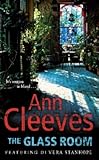
The Glass Room by Ann Cleeves

The Glass Room is the fifth book in Ann Cleeves’s Vera Stanhope series.

It’s going to be a contender for my best book of the year, because I loved it. It has everything I like in a crime fiction novel – setting, characters and a cleverly constructed plot. I didn’t guess who the murderer was but realised afterwards that all the clues had been there, skilfully woven into the narrative, hidden among the dead-ends and red herrings, so that I’d read on without realising their significance.

Set in the Northumberland countryside in an isolated country house, a number of aspiring authors are gathered at the Writers’ House, run by Miranda Barton, to work on their novels. It’s an old fortified farmhouse close to the sea, sheltered on the landward side by trees. DI Vera Stanhope’s neighbour, Joanna has gone missing and her husband, Jack is frantic to find her, so Vera, having tracked her down to the Writers’ House goes to see her, only to find that one of the visiting tutors, Professor Tony Ferdinand has been murdered in the conservatory, stabbed with a kitchen knife. And Joanna is the chief suspect.

If you’ve seen the TV series Vera, maybe you’ll have a vision of Brenda Blethyn as Vera, but that image gradually faded as I read this book. Vera is bigger, fatter, and ruder than the TV version, but above all she is a truly convincing character, exasperating and opinionated, and she can be a nightmare boss. She has no compunctions about breaking the rules, or doing things in her own way and she acknowledges that if any of the other detectives went freelance, playing the private eye, as she is doing in looking for Joanna, she’d give them ‘such a bollocking’. She cares deeply about her job and she does have a soft side, even if it is touched with cynicism:

And why had she agreed to do as Jack asked and chase around the countryside looking for Joanna? Because I’m soft as clarts. Because I like happy endings and want to bring the couple together again, like I’m some great fat Cupid in wellies. Because it would be bloody inconvenient living here without them next door. (page 10)

The interplay between the Vera and Sergeant Joe Ashworth is excellent. Joe isn’t as easily managed as Vera would want him to be and yet she likes that in him. And her relationship with the rest of her team leaves much to be desired, but she is human – and she gets results.

Alongside the mystery Ann Cleeves includes a commentary on writing and writers and on creative writing weekend retreats. This particular course shows the writing world in rather a bad light, as a place of people with huge egos, selfish and self- absorbed and with aspiring, insecure would-be-writers:

Writers were like parasites, preying on other people’s stress and misery. Objective observers like spies or detectives  (page 98)

All in all, this is a book I thoroughly enjoyed and one that kept me guessing to the end.

Mount TBR: March Checkpoint

It’s time for the first quarterly check-in post for Mount TBR. Last year I read 25 of my TBR books, so for this year I was determined to read more and rashly stated I was aiming to climb Mt Ararat – that is to read 48 books from my own bookshelves.

I have made a very slow start with just 4 books completed, so not very far up the mountain at all. They are:

  1. The Case of the Curious Bride by Erle Stanley Gardner
  2. The Lacuna by Barbara Kingsolver
  3. Cat Among the Pigeons by Agatha Christie (Poirot)
  4. Small Kindnesses by Fiona Robyn (no review)
The book that has been on Mt TBR the longest is The Lacuna by Barbara Kingsolver. Sadly, although The Lacuna is well written and well researched I felt there was something missing, the personal elements that brought the story to life for me were few and far between; I couldn’t feel involved and just wanted it to end. I persevered because it has had such good reviews and recommendations, but it dragged for me. It’s a long book too!

I wasn’t too impressed with the other books, either, but the stand-out exception was Agatha Christie’s Cat Among the Pigeons,  a Poirot mystery, which I thoroughly enjoyed and it was well worth the wait to read it.

Once upon a Time …

“Once upon a time” – words that conjure up a world of magic and enchantment. Words that promise to bewitch and beguile and whisk you away to a fairytale world. But fairy tales don’t always end “… and they all lived happily ever after.” I remember very well being frightened by the stories in a big illustrated book of fairy tales when I was a child – maybe it was the pictures, or the words, or the combination of the two. Whatever it was, fairy tales are not always nice and comfortable, of the “are you sitting comfortably? then I’ll begin” variety. They can be scary …

It’s time once again for Carl’s Once Upon a Time Challenge VII, which began on Thursday, March 21st and continues until Friday, June 21st.

Carl writes that It’s not really a challenge, more of a reading and viewing event that encompasses four broad categories: Fairy Tale, Folklore, Fantasy and Mythology, including the seemingly countless sub-genres and blending of genres that fall within this spectrum. The entire goal is to read good books, watch good television shows and movies, and most importantly, visit old friends and make new ones.

There are several ways to participate, and I’m choosing Quest the First:Read at least 5 books that fit somewhere within the Once Upon a Time categories. They might all be fantasy, or folklore, or fairy tales, or mythology€¦or your five books might be a combination from the four genres.

Quest 1

These are the books I’m choosing from, some of which I’ve had for ages and have never got round to reading and some of which are new ones which I’ve added during the last couple of years:

  • The Death of King Arthur – this is a translation of the 13th century French version of the Camelot legend.
  • The Ingoldsby Legends by Richard Harris Barham – a collection of myths, legends, ghost stories and poetry.
  • The Brief History of the Dead by Kevin Brockmeier – about a place between heaven and earth where everyone ends up after they die.
  • The Book of Lost Things by John Connolly – Twelve-year old David takes refuge in myths and fairytales.
  • Daughters of Fire by Barbara Erskine – a time slip novel focussed on the legends surrounding Cartimandua, a Celtic queen.
  • Helen of Troy by Margaret George – the myth narrated from Helen’s point of view.
  • Shadowland by C M Gray –  historical fantasy set in Dark Ages Britain.
  • The Owl Killers by Karen Maitland – a tale of witchcraft and pagan superstition.
  • Dreamwalker (The Ballad of Sir Benfro) by James Oswald – fantasy fiction – Welsh mythology and folklore.
  • The first four Merrily Watkins books by Phil Rickman –  The Wine of Angels, Midwinter of the Spirit, A Crown of Lights, and The Cure of Souls –  paranormal crime thrillers with supernatural and spiritual causes.
  • The Last Enchantment by Mary Stewart – a tale of Merlin and King Arthur and the third book in the Merlin trilogy. I read The Crystal Cave and The Hollow Hills years ago and don’t think I’ve ever read this one.
  • The Children of Hurin by J R R Tolkien – Tales of Middle-earth from times before The Lord of the Rings, set in the country that lay beyond the Grey Havens in the West.
  • The Hobbit by J R R  Tolkien – even though I’ve read The Lord of the Rings trilogy several times I’ve not read this!
  • A Connecticut Yankee in King Arthur’s Court by Mark Twain – fantasy fiction in which a Yankee engineer is accidentally transported back in time to the court of King Arthur.

I know I’ve got more but this is more than enough to start with.  It’s a mixed bunch and as I like making lists and don’t like making reading plans, I haven’t decided which ones to read over the next three months. Right now, I want to start them all!

Turn of the Century Salon: March

Turn of the Century Salon

The Turn of the Century Salon, is a monthly literary event where you can share recent posts related to literature or authors from the 1880s-1930s. One of Katherine’s suggestions for this month’s post is to find a work of art or music within the same time-period that reflect the book and share it.

After reading Siegfried Sassoon’s Memoirs of a Fox-Hunting Man I decided to read more of his works, including his poetry and bought The War Poems of Siegfried SassonWorld War One British Poets: Brooke, Owen, Sassoon, Rosenberg and Others, edited by Candace Ward. I’ve also borrowed Sassoon’s Memoirs of an Infantry Officer and Siegfried Sassoon: a Biography by Max Egremont and am slowly reading through these.

I’m familiar with some of the World War One war poets, such as Rupert Brooke (The Soldier – ‘If I should die, think only this of me: That there’s some corner of a foreign field That is forever England), Wilfred Owen (Dulce et Decorum Est), and Thomas Hardy (Channel Firing) and so on, but I hadn’t read any of Sassoon’s poems.

They are satires condemning the war. Sassoon described his poems such as The One-Legged Man as “satirical drawings”, which he intended to “disturb complacency”. Here is his poem In the Pink

So Davies wrote: ‘ This leaves me in the pink. ‘
Then scrawled his name: ‘ Your loving sweetheart Willie ‘
With crosses for a hug. He’d had a drink
Of rum and tea; and, though the barn was chilly,
For once his blood ram warm; he had pay to spend,
Winter was passing; soon the year would mend.

He couldn’t sleep that night. Stiff in the dark
He groaned and thought of Sundays at the farm,
When he’d go out as cheerful as a lark
In his best suit to wander arm-in-arm
With brown-eyed Gwen, and whisper in her ear
The simple, silly things she liked to hear.

And then he thought: to-morrow night we trudge
Up to the trenches, and my boots are rotten.
Five miles of stodgy clay and freezing sludge,
And everything but wretchedness forgotten.
To-night he’s in the pink; but soon he’ll die.
And still the war goes on; he don’t know why.

Looking for more information about this poem I found this description in Siegfried Sassoon: a Study of the War Poetry by Patrick Campbell (page 94):

‘The first of my outspoken’ war poems.  I wrote it one cold morning at Morlancourt, sitting by the fire in the Quartermaster’s billet, while our Machine-Gun Officer shivered in his blankets on the floor.  He was suffering from alcoholic poisoning, and cold feet, and shortly afterwards departed for England, never to return.  Needless to say, the verses do not refer to him, but to some typical Welshman who probably got killed on the Somme in July, after months and months of a dog’s life and no leave.  The Westminster refused the poem, as they thought it might prejudice recruiting!!’

Reading Sassoon’s war poems brings home the horrors of war, the deaths, the devastating injuries and the appalling indifference of the war leaders and the lack of understanding of the people back home.

Similarly some works of art were considered controversial and not suitable for public viewing. Such a painting is Paths of Glory by Christopher Nevinson showing the corpses of two dead British soldiers lying face down in the mud among barbed wire behind the Western Front. Their helmets and rifles lie in the mud next to them.

Paths of Glory by Christopher Nevinson 1917 Oil on Canvas Collection: © Imperial War Museum

This painting is held in the Imperial War Museum website. Its description is:

“The title is a quote from ‘Elegy Written In A Country Church-Yard’ by Thomas Gray. ‘The boast of heraldry, the pomp of pow’r, And all that beauty, all that wealth e’er gave, Awaits alike th’inevitable hour. The paths of glory lead but to the grave.‘ Whereas the poet reflects on bodies dead and buried in a church-yard, the so-called ‘Paths of Glory‘ have led these soldiers to death in a wasteland.

Paths of Glory‘ was famously censored by the official censor of paintings and drawings in France, Lieutenant – Colonel A N Lee. His concern presumably being the representation of the rotting and bloated British corpses at this stage in the war. The decision was confirmed three months before the opening of his exhibition at the Leicester Galleries in 1918 but Nevinson still included the painting with a brown paper strip across the canvas, blatantly inscribed with the word ‘censored’. As a result, Nevinson was reprimanded for exhibiting a censored image and for the unauthorised use of the word €˜censored’ in a public space. Predictably, the stunt created the publicity Nevinson desired. The painting was purchased by the Museum during the course of the exhibition.”

This was the ‘war to end war’! The pity is that it didn’t.

The Sleeping Policeman by Andrew Taylor

Tragedy is a word that has come to have several meanings. By most definitions, the Hanslope case had elements of tragedy. Afterwards, Dougal remembered that tragedy derives from two Greek words which can be translated as goat song.

And that was appropriate too, because in one sense of the word Graham Hanslope was undoubtedly a goat. Hanslope’s goat song ended in discord on the southbound platform of the Bakerloo Line at Paddington Station. It ended with the arrival of a tube train at a few minutes after ten o’clock on the morning of Saturday 16 February. It ended, as tragedies so often end, with death and the destruction of hope. (page 1)

I borrowed The Sleeping Policeman from my local library because I’ve read and liked some of Andrew Taylor’s other books. This book is the seventh novel in the William Dougal series. I haven’t read any of the earlier books, but I don’t think it made any difference; William Dougal, himself, has just a small, but important part in the book. (The sleeping policeman in question is not a police officer – it’s a speed bump!)

Dougal, a private investigator, is hired by Hanslope, a GP, to discover who is blackmailing him after had started an affair with one of his patients. But that isn’t the whole story because Hanslope has omitted to tell Dougal all the facts and has lied to him. What follows is a tense, taut mystery, resulting in a murder, which Dougal eventually solves.

None of the characters are very likeable, in fact some of them are downright nasty, but each one of them is a well-drawn cameo. There’s a reckless hit and run, corruption in the police ranks, a series of petty thefts, hostility between two families whose teenage daughters are too friendly for their parents’ liking and a journalist whose garden is filled with gnomes. I liked it immensely and am looking out for the other William Dougal books:

(Details copied from Fantastic Fiction)
Caroline MinusculeWaiting for the End of the WorldOur Fathers' LiesAn Old School Tie
Freelance DeathBlood RelationThe Sleeping PolicemanOdd Man Out