First Chapter, First Paragraph: Dictator

First chapterEvery Tuesday Diane at Bibliophile by the Sea hosts First Chapter First Paragraph Tuesday Intros, where you can share the first paragraph, or a few, of a book you are reading or thinking about reading soon. I’m currently reading Dictator by Robert Harris, the third in his Cicero trilogy.

Dictator

It begins:

I remember the cries of Caesar’s war-horns chasing us over the darkened fields of Latium – their yearning, keening howls, like animals on heat – and how when they stopped there was only the slither of our shoes on the icy road and the urgent panting of our breath.

It was not enough for the immortal gods that Cicero should be spat at and reviled by his fellow citizens; not enough that in the middle of the night he be driven from the hearths and altars of his family and ancestors; not enough even that as we fled from Rome on foot he should look back and see his house in flames. To all these torments they deemed it necessary to add one further refinement: that he should be forced to hear his enemy’s army striking camp on the Field of Mars.

Blurb:

‘˜Laws are silent in times of war.’
Cicero

There was a time when Cicero held Caesar’s life in the palm of his hand. But now Caesar is the dominant figure and Cicero’s life is in ruins. Exiled, separated from his wife and children, his possessions confiscated, his life constantly in danger, Cicero is tormented by the knowledge that he has sacrificed power for the sake of his principles.

His comeback requires wit, skill and courage ‘“ and for a brief and glorious period, the legendary orator is once more the supreme senator in Rome. But politics is never static and no statesman, however cunning, can safeguard against the ambition and corruption of others.

Riveting and tumultuous, DICTATOR encompasses some of the most epic events in human history yet is also an intimate portrait of a brilliant, flawed, frequently fearful yet ultimately brave man ‘“ a hero for his time and for ours. This is an unforgettable tour de force from a master storyteller.

————————————————

I read in The Guardian that this last part of the trilogy marks the culmination of 12 years work. The trilogy as a whole has transported me back into the first century BC when Rome was engulfed in intrigue, conspiracies and civil war as the Roman Republic began to collapse and move into dictatorship and empire.  I’m loving the whole experience. Just as when I was reading the first two books, Imperium and Lustrum, I can’t wait to get back to it each time I have to stop reading.

Stacking the Shelves: 23 January 2016

STSmall

Stacking The Shelves is all about sharing the books you are adding to your shelves. This means you can include ‘˜real’ and ‘˜virtual’ books (ie physical and ebooks) you’ve bought, books you’ve borrowed from friends or the library, review books, and gifts.

Last night I finished reading Lustrum by Robert Harris, the second in his Cicero Trilogy (the first is Imperium). It ends as Cicero goes into exile and so this morning I had to buy the third book, Dictator, which covers the last fifteen years of his life.

Dictator

There was a time when Cicero held Caesar’s life in the palm of his hand. But now Caesar is the dominant figure and Cicero’s life is in ruins. Exiled, separated from his wife and children…

I’ve also borrowed these books from the library. My summaries are adapted from the blurbs.

Library bks Jan 2016

From top to bottom they are

  • Blue Genes by Val McDermid – I was put off reading her books several years ago when I just couldn’t stomach watching the violence and torture scenes in the TV series of The Wire. This sounds a bit different as it is a Kate Brannigan mystery, set in Manchester. The back cover reveals that Kate is having a bad week – her boyfriend has died, her plan to capture a team of fraudsters is in disarray and a neo-punk band wants her to find out who’s trashing their flyposters. It delves into the world of medical experimentation – I’m hoping it won’t be too gory!
  • Hunting Season by Andrea Camilleri – I’ve read a few of his Inspector Montalbano mysteries, but this is historical crime fiction set in Vigàta in Sicily in 1880, when a young man arrives in town and opens a pharmacy – then death arrives an the town and its most noble family will never be the same again …
  • Grace and Mary by Melvyn Bragg – he is one of my favourite authors. This novel is about memory and the slow fading of the mind as John visits his mother in a nursing home and finds that most of all she is longing for her mother, Grace, the mother she barely knew. Reaching from the late 19th century to the present, this becomes a deeply moving, reflective elegy on three generations linked by a chain of love, loss, and courage.
  • No Man’s Nightingale by Ruth Rendell, another favourite author. This is the 24th Inspector Wexford novel. The woman vicar of St Peter’s Church may not be popular among the community of Kingsmarkham. But it still comes as a profound shock when she is found strangled in her vicarage. Inspector Wexford is retired, but he retains a relish for solving mysteries especially when they are as close to home as this one is.

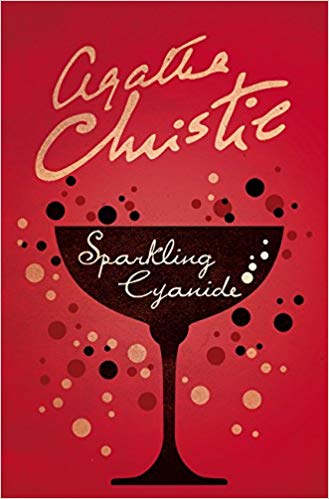
Sparkling Cyanide by Agatha Christie

Sparkling cyanideAC

Sparkling Cyanide (published as Remembered Death in America) was first published in 1945. It is a novel in which a crime is investigated a year after it was committed.

Rosemary, the wife of wealthy George Barton dies suddenly at her birthday party at a West End Restaurant, the Luxembourg, after drinking a glass of champagne laced with cyanide. Rosemary had been in a depressed and unhappy state of mind after having a bout of influenza.The official verdict was that she had committed suicide but a year on George, having received anonymous letters stating her death wasn’t suicide, is convinced that she was murdered. He arranges another party, this time for Iris, Rosemary’s younger sister, inviting the same guests, hoping to identify the murderer. But his plan goes awry, as after drinking a toast to Rosemary’s remembrance the party ends with yet another death.

Rosemary was a wealthy heiress in her own right and after her death her inheritance had passed to Iris. George had invited Colonel Race* to both parties, but he had been absent both times. He had known George since his boyhood but had only once met Rosemary, who he thought of as ‘a singularly lovely nit-wit – but certainly not a melancholic type‘. He helps Chief Inspector Kemp of Scotland Yard to investigate both deaths. As well as Iris and George the guests at the party were Ruth Lessing, George’s efficient secretary, and Rosemary’s friends, Anthony Browne, a man with a dubious past and a politician Stephen Farraday and his wife Sandra.

In a series of flashbacks Agatha Christie highlights each person and their relationships with Rosemary and it appears that each one, including George and Iris had a motive for killing her. I was convinced quite early on that one particular character had to be the murderer, but reading further on I began to have doubts, switching from one person to another. As it turned out I was right about my first suspect – Agatha Christie was expert at writing things that could be taken two ways. If I was right about the ‘who’ I couldn’t work out the ‘how’, particularly for the second death, but knew that where everyone sat at the round table was significant. When that was revealed I thought it was difficult to believe, which is why I don’t place it among her best books – but it’s still a very enjoyable read. And it was popular with the public achieving sales of thirty thousand in the first year of publication.

*Colonel Race – first appeared in The Man in the Brown Suit, also in Cards on the Table and Death on the Nile. His appearance in Sparkling Cyanide was his last. He was an agent working for the British Secret Service, often sent on difficult or sensitive missions. In this book he is over sixty, described as ‘a tall, erect, military figure with sunburnt face, closely cropped iron-grey hair, and shrewd dark eyes‘.

Reading Challenges: Mount TBR Reading Challenge and Vintage Mystery Cover Scavenger Hunt for the Golden Age in the category of ‘Bottle/Glass for drinking’.

Death Comes as the End by Agatha Christie

In 1944 Agatha Christie published Death Comes as the End and in 1945 Sparkling Cyanide, neither of them featuring Hercule Poirot or Miss Jane Marple. By chance these two books are the last full length crime fiction novels by Agatha Christie that I had left to read. There are plenty of short stories of hers that I still have to read and her Mary Westmacott novels as well as her plays, so it is not the end of my reading of her work.

Death Comes As The End

The idea to write a detective story set in Ancient Egypt came from a friend, Professor Stephen Glanville – Death Comes as the End was the result. It is set on the West bank of the Nile at Thebes in about 2000 BC. But in her Authors Note Agatha Christie explained that both time and place are incidental and any other time or place would have served as well. She based her characters and plot on some letters from a Ka priest in the 11th Dynasty:

The letters painted to perfection the picture of a living family: the father fussy, opinionated, annoyed with his sons who did not do as he said; the sons, one obedient but not obviously bright, and the other sharp-tempered, showy, and extravagant. The letters the father wrote to his two sons were about how he must take care of a certain middle-aged woman, obviously one of those poor relations who all through the ages live with families, to whom the heads of families are always kindly, whereas the children usually grow up disliking them because they are often sycophants and makers of mischief. (Agatha Christie’s Autobiography page 514)

From these letters she constructed her story, adding Renisenb, a daughter, Nofret, a concubine for Imhotep, the father, a spoilt younger son and a greedy but shrewd grandmother. He is besotted by Nofret who antagonises the family, setting Imhotep against them. Things come to a head after Nofret has manipulated Imhotep to disinherit his sons and marry her and she is found dead, apparently having fallen from a cliff. More deaths follow.

The mystery in this book is actually not too puzzling. For me, its interest lay in the setting and period details. Agatha Christie, according to her Autobiography had done a lot of reading from books lent to her by Glanville and had also bombarded him with questions about daily life and customs in the 11th Dynasty – such as what food did they eat, how did they cook it, did men and women eat together, what sort of rooms did they sleep in, where did they keep their linen, what sort of houses did they have, and so on?

The end result for me was of authenticity – it all came over as real, the characters were individuals, their relationships were convincing and although Agatha Christie wasn’t happy with the ending, which she changed on Glanville’s suggestion, I thought it was fine. And just as she had pleasure in writing it I had pleasure in reading it.

Reading Challenges: Agatha Christie Reading Challenge, Mount TBR Reading ChallengeVintage Cover Scavenger Hunt for the Golden Age in the category ‘A Green Object’.

A Month in the Country by J L Carr

A Month in the Country (Penguin Modern'¦‘Ah, those days … for many years afterwards their happiness haunted me. Sometimes listening to music, I drift back and nothing has changed. The long end of summer. Day after day of warm weather, voices calling as night came on and lighted windows pricked the darkness and, at day-break, the murmur of corn and the warm smell of fields ripe for harvest. And being young.
As an old man Tom Birkin is looking back to the summer of 1920 when he was asked to uncover a huge medieval wall-painting in the village church of Oxgodby in Yorkshire. J L Carr’s A Month in the Country is a beautifully written little book of just 85 pages, set in the aftermath of World War I. Tom, his ‘nerves shot to pieces, wife gone, dead broke‘,  is still suffering from shell shock after the battle of Passchendaele. Living in the church bell tower, he begins to uncover the painting, excited and engrossed in his work.

Another war veteran, Charles Moon is also in Oxgodby, an archaeologist, camping in a meadow next to the church, whilst he looks for a lost 14th century grave. There are also two more people who are relatively new to the village – the vicar and his beautiful wife, Arthur and Alice Keach. Tom and Moon decide their marriage is an ‘outrage’ and Tom finds her enchanting – reminding him of Botticelli’s Primavera.

I loved this quiet novel, in which not a lot happens and yet so much happens as Tom describes the events of that summer – his relationships with the local people as well as with Moon and Arthur and Alice Keach. There’s the unforgettable Sunday School outing and a visit to Ripon with the Wesleyans looking for an American organ to replace the harmonium in their chapel. It’s during this visit Tom learns more about Moon.

I loved the detail of the wall-painting – the original methods of painting, the colours, the people in the painting. It’s a masterpiece, a Doom, a Christ in Judgement painting. Tom wonders about the original artist, the nameless man and why the painting had been covered and as he uncovers more of the painting thinks that he has lived with a great artist and had shared with the unknown man the ‘great spread of colour’ and feels ‘the old tingling excitement’.

But above all it is the writing that I loved the most – words that took me back in time to that glorious summer in Oxgodby. At the end Tom looks back at that summer with nostalgia for the things that have disappeared, contemplating that

We can ask and ask but we can’t have again what once seemed ours for ever – the way things looked, that church alone in the fields, a bed on a belfry floor, a remembered voice, the touch of a hand, a loved face. They’ve gone and you can only wait for the pain to pass.

I wanted to read A Month in the Country because years ago I’d watched a TV adaptation of the book and loved it. So after I finished reading it I thought I’d look for the film and watch it again. But the film was lost for years and the only available copies now are rare and expensive. So, I won’t be watching it and thinking about it I realise that it would be a mistake to watch it – as I enjoyed the book so much. But it would be good to see the wall-painting …

Reading challenges: Mount TBR Reading Challenge and maybe What’s In a Name? in the ‘Month of the Year’ category if I don’t read a book naming a month of the year!

Vintage Crime Fiction

I’ve been thinking about joining Bev’s Vintage Mystery Cover Scavenger Hunt, but I didn’t think I had enough books in the Vintage Mystery genre to attempt it.

BUT, the Scavenger Hunt idea appeals to me and so I thought I would have a look at my own books, just to see exactly how many books I do have that match Bev’s definition of ‘Vintage Mystery’, which is:

* All books must be from the mystery category (crime fiction, detective fiction, espionage, etc.). The mystery/crime must be the primary feature of the book–ghost stories, paranormal, romance, humor, etc are all welcome as ingredients, but must not be the primary category under which these books would be labeled at the library or bookstore. 

*For the purposes of this challenge, the Golden Age Vintage Mysteries must have been first published before 1960. Golden Age short story collections (whether published pre-1960 or not) are permissible provided all of the stories included in the collection were originally written pre-1960.  Silver Age Vintage Mysteries may be first published any time from 1960 to 1989 (inclusive).  Again, Silver Age short story collections published later than 1989 are permissible as long as they include no stories first published later than 1989. 

And to my surprise, when I went to my shelves – instead of looking at my list in LibraryThing – I found I actually have 14 books first published pre-1960 and 7 first published between 1960 and 1989 (inclusive). My LibraryThing catalogue is certainly not complete!

So, in theory I do have enough books to attempt the Scavenger Hunt for both eras, provided that the covers show the objects listed for the Hunt! And as I do want to read all these books, it’s a no-brainer, so I’m going to do it. And I’m going in for both Eras!

The idea is  to find as many objects on the scavenger hunt list as possible on the covers of the mystery books you read. The minimum number of items to complete the challenge is six items from the covers of books read from a single Vintage Mystery Era.

These are my books in the Golden Age Vintage era. Some are Penguin books with no pictures on the covers and so I’ll look for alternative covers.

Vintage gold

And these are my books from the Silver Age Vintage era.

Vintage silver

The Challenge runs from January 1, 2016 to December 31, 2016. Sign up any time between now and November 1, 2016.  Any books read from January 1 on may count regardless of your sign-up date.

And “On the cover” may apply to either the front or the back cover of the book. For example, if you need a map or a chart for your scavenger hunt list, then Dell Mapbacks are perfect–with the map in question on the back cover. Also, the item should be found on the cover of the edition that you read. If at all possible either post a picture showing the item on the cover or provide a link to a page showing us. Exception:  If the edition you read has no picture whatsoever (hardbacks that have no dust jacket or e-copies, for example), then you may go on another scavenger hunt online to find a cover image–again, please provide a link to the edition used.

This is the list for the Golden Age Era there are 75 items!!! (The Silver Age Era lists the same items.)Scavenger Hunt1