Jane Austen at Home by Lucy Worsley

Jane Austen at Home

Synopsis (Amazon)

On the 200th anniversary of Jane Austen’s death, historian Lucy Worsley leads us into the rooms from which our best-loved novelist quietly changed the world.

This new telling of the story of Jane’s life shows us how and why she lived as she did, examining the places and spaces that mattered to her. It wasn’t all country houses and ballrooms, but a life that was often a painful struggle. Jane famously lived a ‘life without incident’, but with new research and insights Lucy Worsley reveals a passionate woman who fought for her freedom. A woman who far from being a lonely spinster in fact had at least five marriage prospects, but who in the end refused to settle for anything less than Mr Darcy.

My view:

I think it was a foregone conclusion that I would really enjoy Lucy Worsley’s Jane Austen at Home. I have loved Jane Austen’s books for many years, going back to when I was about 12 and read Pride and Prejudice for the first time. I’ve previously read Carol Shields’s biography Jane Austen and Claire Tomalin’s Jane Austen: a Life so there was really very little I learned reading Jane Austen at Home that surprised me or that I hadn’t known before.

I suppose what was new to me was the emphasis on what home life was like during the period of Jane’s life and seeing photos of the houses and places that she had lived or stayed in as a visitor. And I think I gained a better understanding of the social history of Georgian England and of Jane’s wider family connections and what her family and friends thought of her both as a person and as an author.

Lucy Worsley is an historian and has presented several television history programmes. I am not a great fan of her style – the play acting and dressing up – but she writes in a lively, chatty style and reading her book I could easily hear her voice. Jane Austen at Home is both very readable and very detailed, which is not an easy thing to achieve. There is an extensive section at the end of the book, listing sources, a bibliography, notes on the text and an index. There are two sections of colour plates.

Needless to say it has spurred me on to re-read Jane Austen’s books, and I shall probably begin with re-reading Emma, a book I’ve only read once.

I received an e-galley from the publishers via NetGalley for review and part way through reading it I bought a hardback copy to get the finished product.

  • Hardcover: 400 pages
  • Publisher: Hodder & Stoughton (18 May 2017)
  • Language: English
  • ISBN-10: 1473632188
  • ISBN-13: 978-1473632189
  • My rating: 4*

The Secret of Summerhayes by Merryn Allingham

In January I enjoyed reading The Buttonmaker’s  Daughter by Merryn Allingham and hoped there would be a sequel, so I was pleased when Midas Public relations on behalf of the publishers offered me a review copy of The Secret of Summerhayes.

The Secret of Summerhayes

Synopsis (publisher)

A war-torn summer

A house fallen into ruin

A family broken apart by scandal’¦

Summer 1944: Bombed out by the blitz, Bethany Merston takes up a post as companion to elderly Alice Summer, last remaining inhabitant of the dilapidated and crumbling Summerhayes estate. Now a shadow of its former glory; most of the rooms have been shut up, the garden is overgrown and the whole place feels as unwelcoming as the family themselves.

Struggling with the realities of war, Alice is plagued by anonymous letters and haunting visions of her old household. At first, Beth tries to convince her it’s all in her mind but soon starts to unravel the mysteries surrounding the aristocratic family’s past.

An evocative and captivating tale, The Secret of Summerhayes tells of dark secrets, almost-forgotten scandals and a household teetering on the edge of ruin.

My thoughts

I was hoping this would follow on from The Buttonmaker’s Daughter, which ended in 1914 at the beginning of World War One as I wanted to know what happened to the characters during the war, but The Secret of Summerhayes is set in Sussex in 1944 just before and during the D-Day landings in Normandy. So, forty years have gone by and only Alice Summers remains as one of the main characters. Alice’s daughter, Elizabeth had disappeared at the end of the first book and Alice is still hoping, forty years later, that she will return, especially as she has recently received anonymous letters that she thinks are from Elizabeth.

The two books are only loosely connected and I think that they can both be read independently. It’s hard to assess but maybe I would have enjoyed this second book more if I hadn’t read The Buttonmaker’s Daughter, as I kept hoping to find out more about what had happened to Elizabeth in the intervening years.

Summerhayes has changed, what is left of the gardens is overgrown and the house, except for an apartment for Alice, has been requisitioned by the Canadian army and an entire battalion had taken possession of the estate. Beth has been employed to look after Alice, now an old lady in her eighties, still sharp in her mind, although she is very disturbed by the anonymous letters and other unexplained accidents. The only other members of Alice’s family are Gilbert Fitzroy, her nephew and his young son, Ralph, who live at the neighbouring estate of Amberley, where Alice had lived until her marriage.

This is a slow-paced novel as Beth gradually learns a bit about the history of Summerhayes and in particular some of Elizabeth’s story and about the difficult relations between the Summer and Fitzroy families. I think  knowing what had happened in 1914 meant that some of mystery and tension just wasn’t there for me.  Beth becomes friendly with two of the Canadians, Eddie Rich and especially Jos Kerrigan, although she doesn’t want to get too close to Jos as the planned invasion of France draws nearer. Her relationship with Gilbert also complicates matters.

As in The Buttonmaker’s Daughter, the Italian garden plays a major role, but I think what eventually happened was rather predictable (I wonder though if I would think that if I hadn’t read the first book?) The characterisation is good and I liked the main characters very much. Although my knowledge of the events of D-Day is limited it seemed to me that the author has done her research and incorporated the facts seamlessly into the narrative. A list of sources and an author’s note would have been helpful.

  • Paperback: 350 pages
  • Publisher: HQ; First edition edition (27 July 2017)
  • Language: English
  • ISBN-10: 0008193851
  • ISBN-13: 978-0008193850
  • Source: review copy
  • My rating: 3.5*

The House by Simon Lelic

Publication date: 17 August 2017, Penguin

Source: review copy via NetGalley

Blurb:

What if your perfect home turned out to be the scene of the perfect crime?

Londoners Jack and Syd moved into the house a year ago. It seemed like their dream home: tons of space, the perfect location, and a friendly owner who wanted a young couple to have it. So when they made a grisly discovery in the attic, Jack and Syd chose to ignore it. That was a mistake. Because someone has just been murdered. Right outside their back door. And now the police are watching them…

Given the title, The House, I anticipated that the main focus would be a house. And it was, at the beginning, which really raised my expectations that this was going to be a suspense-filled creepy book with hints even of the supernatural. Syd found the house advertised on the internet; the owner had suddenly moved to Australia, leaving the house fully furnished and she was immediately smitten by it. Jack wasn’t so sure – he thought it was creepy, full of junk, with an overgrown garden. But they put in a bid and were amazed when they got it a bargain price.

Jack and Syd share the narrative, explaining how they came to buy the house and their feelings as they move in and experience strange, disgusting smells and scary noises in the night. Then Jack found something nasty in the attic, which I thought must be something so evil, because he didn’t want to tell Syd what it was. He began to worry why the owner had wanted him and Syd to have the house. It’s a nightmare scenario.

But then the focus changed and the mystery of the house was absorbed into a very complex story that is difficult to write about without giving away the plot. As I read on and found out more about Jack and Syd it became clear that this book is not really about the house – it’s about their past lives and in particular about Syd’s. I think that if I had known more about that before, I wouldn’t have chosen to read the book. It’s a story about despair, domestic violence, dark secrets and the effects of the past on the present.

Even thought the main issues are not topics that I want to read about, I did find the book compelling and it drew me along. The characters are believable, so much so that I didn’t like some of them; they are not people I’d want to meet. It was not what I expected from the title or synopsis – and there is nothing supernatural about it. Having said that it is well-written in a conversational style that makes each character easily distinguishable, with a well constructed plot.

My thanks to NetGalley and Penguin, the publishers for a review copy.

  • Format: Kindle Edition
  • File Size: 1289 KB
  • Print Length: 342 pages
  • Page Numbers Source ISBN: 0241983355
  • Publisher: Penguin (17 Aug. 2017)
  • My rating: 3.5*

Six Degrees of Separation: Pride and Prejudice to Digging to America

Six Degrees of Separation is a monthly link-up hosted by Kate at Books Are My Favourite and Best. Each month, a book is chosen as a starting point and linked to six other books to form a chain. A book doesn’t need to be connected to all the other books on the list, only to the one next to it in the chain.

This month’s chain begins with the universally loved classic, Pride and  Prejudice, by Jane Austen.

Pride and Prejudice

This is a long time favourite of mine, a book I first read when I was about 12 after seeing a BBC adaption. It’s full of wit and humour and timeless characters – foolish people, flirts, bores, snobs, self-centred and dishonest people as well as ‘good’ people like Jane Bennet, who is determined to see good in everyone. Since then I’ve read all of Jane Austen’s books, apart from her Juvenilia books.

17th July was the 200th anniversary of her death and my first book in the chain is a book published to mark that anniversary. It’s a book I’m currently reading: Jane Austen at Home: a Biography by Lucy Worsley.  it focuses on her family and the places she lived during her short life. It really is a fascinating book for Jane Austen fans.

Jane Austen at Home

This leads nicely onto the second book in my chain – another biography of a favourite author, seen through the places she lived. It’s Agatha Christie at Home by Hilary Macaskill, an overview of Agatha Christie’s life followed by descriptions of the houses and countryside she loved ‘“ from Ashfield in Torquay her first home, where she was born and brought up, to Greenway, a Georgian mansion above the River Dart, now owned by the National Trust.  A beautiful book, with many photographs.

Agatha Christie at Home

Next a book also by a Hilary, Ink in the Blood: a Hospital Diary by Hilary Mantel, a short memoir which she wrote during the summer after she won the Man Booker Prize for Wolf Hall, when she was very ill. She had a marathon operation, followed by intense pain, nightmares and hallucinations. Illness she found knocks down our defences, revealing things we should never see, needing moment by moment concentration on breathing, on not being sick and being dependent on others for your well-being.

Ink In The Blood: A Hospital Diary

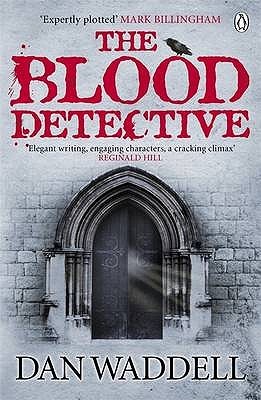
Blood provides the next link – The Blood Detective by Dan Waddell, crime fiction that absolutely grabbed me apart from the ending. It’s the sort of story that if I was watching it on TV I’d have to peep at through my fingers or even cover my eyes completely until the grisly bits were over. There are bits of graphic violence earlier in the book, which I could just about cope with, but the grisly stuff at the end was a step too far for me. It’s not just crime fiction though as DCI Grant Foster enlists the help of genealogist Nigel Barnes to track down the killer helping to solve the murders using family history.

The Blood Detective (Nigel Barnes #1)

Also crime fiction – and also a bit grisly is The Legacy by Yrsa Sigurdardottir, the first in the Children’s House thriller series. I loved it and once I started reading I just didn’t want to put it down, even though there are some particularly dark and nasty murder scenes, which would normally guarantee that I’d stop reading. It’s dark, mysterious and very cleverly plotted, full of tension and nerve-wracking suspense about three children, two brothers and their little sister who were adopted.

And so to the last book in my chain, Digging to America by Anne Tyler, also about adopted children. It  captivated me right from the start, with the description of two contrasting families waiting at Baltimore Airport for the arrival of two Korean babies they have adopted. The story develops as the two girls, Jo-Hin and Susan (originally Sooki) are integrated into their families ‘“ one American, the Donaldsons, outgoing and confident and the other the Yazdans, American/Iranian, reserved and restrained.

Digging to AmericaI never know when I begin a chain where it will lead. This one has gone from 18th century England to 20th century America, via Iceland, and passing through biographies, a memoir, and crime fiction. ‘Family’ is a theme in all the books in one way or another and adopted children feature in three of them – in Jane Austen’s own family one of her brothers was ‘adopted’ by a wealthy relation and another went to live with another family because of his epilepsy.
Quite surprising, really. I wonder where other chains will go?

A-Z of TBRs: A, B and C

I thought a fresh look at some of my TBRs might inspire me to read more of them by the end of the year. So here is the first instalment of my A – Z of TBRs (I’m thinking of making this a regular post).

TBRs abc_edited

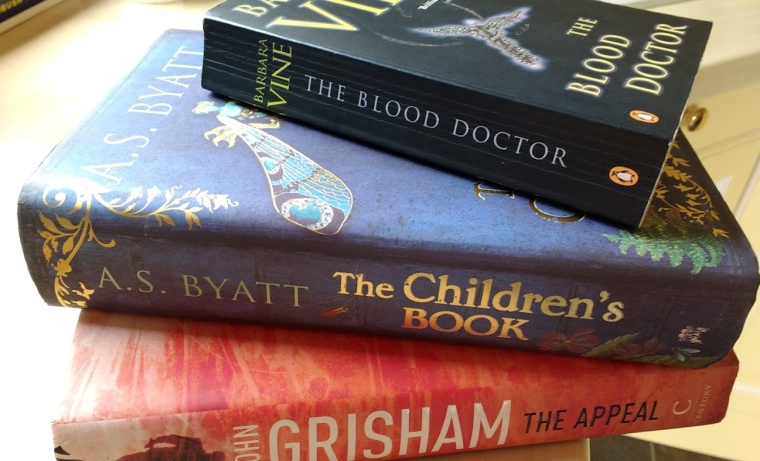
A is for The Appeal by John Grisham: a story of political and legal intrigue.  (On my TBR shelves since February 2008.)

People were hurrying from the courthouse from all directions when the Paytons parked on the street behind it. They stayed in the car for a moment, still holding hands For four months they had tried not to touch each other  anywhere near the courthouse. Someone was always watching. Maybe juror or reporter. It  was important to be as professional as possible. The novelty of a married legal team surprised people, and the Paytons tried to treat each other as attorneys and not as spouses.

B is for The Blood Doctor by Barbara Vine: a chilling tale of ambition, obsession and bad blood. (On my TBR shelves since July 2015.)

The Queen appointed him Physician Extraordinary in 1879. Most of her other doctors were in permanent residence but Henry, though sometimes staying a few days at Windsor, retained his professorship and his London home. Though he began on the lowest rung of the royal medical ladder, he enjoyed a special position. He was the Queen’s consultant on haemophilia.

C is for The Children’s Book by A S Byatt:  a saga about the years between the closing of the Victorian age and the dawn of the Edwardian, when a generation grew up unaware of the darkness ahead. (On my TBR shelves since August 2009.)

Everyone old and young, now gathered for a kind of sumptuous picnic. As happens in such gatherings, where those whose lives are shaped fortunately or unfortunately, are surrounded by those whose lives are almost entirely to come, the elders began asking the young what they meant to do with their lives, and to project futures for them.

If you’ve read any of these please let me know what you think?