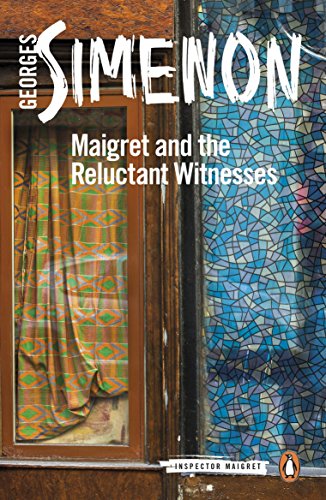
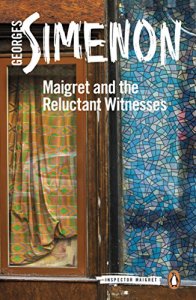
My Friday Post: Maigret and the Reluctant Witnesses by Georges Simenon

Every Friday Book Beginnings on Friday is hosted by Gillion at Rose City Reader where you can share the first sentence (or so) of the book you are reading. You can also share from a book you want to highlight just because it caught your fancy.

Maigret and the Reluctant Witnesses is one of the novellas I included in my Novellas in November post. It has 172 pages and is Simenon’s 53rd Inspector Maigret book, first published in 1959.

It begins:

‘You haven’t forgotten your umbrella, have you?’

‘No.’

The door was about to shut, and Maigret was already turning towards the stairs.

‘You’d better wear your scarf.’

His wife ran to get it unaware that this little remark would leave him out of sorts for some time, melancholy thoughts churning through his brain.

Also every Friday there is The Friday 56, hosted by Freda at Freda’s Voice. *Grab a book, any book. *Turn to Page 56 or 56% on your  ereader . If you have to improvise, that is okay. *Find a snippet, short and sweet, but no spoilers!

  1. Grab a book, any book.
  2. Turn to page 56, or 56% on your eReader. If you have to improvise, that is okay.
  3. Find any sentence (or a few, just don’t spoil it) that grabs you.
  4. Post it.
  5. Add the URL to your post in the link on Freda’s most recent Friday 56 post.

Page 56:

My job is to look for the truth, and that is what I’m doing. Your presence in fact would incline me not to look very far, because it’s very unusual for the relatives of a murder victim to send for a lawyer before they can even be questioned by the police.

Blurb:

When the head of a powerful Parisian family business is murdered in his bed, Maigret must pick apart the family’s darkest secrets to reveal the truth.

“The curious thing was that there seemed to be no grief here, only a strange dejection, a kind of uneasy stupor…”

Maigret is called to the home of the high-profile Lachaume family where the eldest brother has been found shot dead. But on his arrival, the family closes ranks and claims to have heard and seen nothing at the time of the murder. Maigret must pick his way through the family’s web of lies, secrets, and deceit, as well as handle Angelot, a troublesome new breed of magistrate who has waded into the case. And it’s the estranged black sheep of the family, Veronique, who may hold the key to it all with her knowledge of the depths to which the family will sink to protect their reputation.

Novellas in November

Although I’ll be taking part in Nonfiction November I’ve been wondering whether to join in with Novellas in November, a month long event co-hosted by Cathy of 746 Books and Rebecca of BookishBeck. Their definition of a novella is loose – it’s based on word count rather than number of pages – but they suggest aiming for 150 pages or under, with a firm upper limit of 200 pages. Any genre is valid. Each week has a theme:

2–8 November: Contemporary fiction (Cathy)

9–15 November: Nonfiction novellas (Rebecca)

16–22 November: Literature in translation (Cathy)

23–29 November: Short classics (Rebecca)

So, I’ve been looking on my TBR shelves and found these novellas – a mix of genres:

I don’t expect I’ll read all of these – but I should be able to read one or two, maybe three?

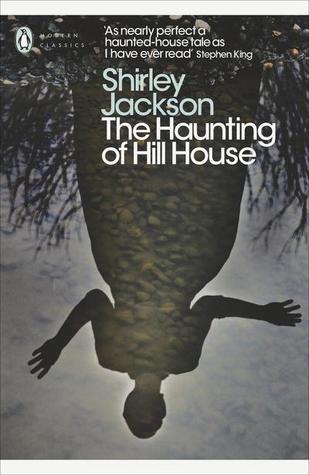
The Haunting of Hill House by Shirley Jackson

I read The Haunting of Hill House by Shirley Jackson at the end of September and it is one of the books that’s in my ‘to be reviewed pile’, which is getting far too big, as I keep reading book after book without writing about them!

About the book:

It is the story of four seekers who arrive at a notoriously unfriendly pile called Hill House: Dr. Montague, an occult scholar looking for solid evidence of a “haunting”; Theodora, the lighthearted assistant; Eleanor, a friendless, fragile young woman well acquainted with poltergeists; and Luke, the future heir of Hill House. At first, their stay seems destined to be merely a spooky encounter with inexplicable phenomena. But Hill House is gathering its powers—and soon it will choose one of them to make its own. (Goodreads)

This is a horror story, but thank goodness there is no gore. Instead it is macabre and has a chilling atmosphere. It’s more of a psychological study than a horror story and as such I don’t think it’s as good or as terrifying as her later book, We Have Always Lived in the Castle.

Dr. Montague, a doctor of philosophy with a keen interest in the supernatural and psychic manifestations had been looking for a ‘haunted’ house to investigate all his life. So, when he heard the stories about the strange goings on at Hill House he decided he would spend three months living there and see what happened, and he set about finding other people to stay there with him.

Eleanor is the main character in the book, next to the House itself, and what happens is told from Eleanor’s point of view. As a child Eleanor had once seemed to activate a poltergeist, although she doesn’t remember that. As an adult she had spent eleven years looking after her invalid mother and it had left her a lonely, embittered spinster of thirty two. After her mother died she sees Dr. Montague’s invitation to spend the summer at Hill House as something she had been waiting for all her life, an opportunity to change her life. Theodora is not at all like Eleanor – her ‘world was one of delight and soft colors’ and after arguing with her friend with whom she shared an apartment, she accepted Dr. Montague’s invitation too. The third person to accept was Luke, the nephew of the owner of Hill House, who would one day inherit the House. He was a liar and also a thief.

These four people arrived at Hill House where they were met by the Dudleys – Mr Dudley, the surly caretaker and his dour wife, the housekeeper. Neither of them live in the house but having told the guests which rooms they were to sleep in, and the arrangements for meals, they leave them alone at night. They leave before it gets dark.

Eleanor realises she should have turned back at the gate and a voice inside her tells her to ‘get away from here, get away.’ There are stories about the tragedies connected with the house, scandal, madness and a suicide – when a girl hanged herself from the turret in the tower. Dr Montague believes

the evil is in the house itself and that it has enchained and destroyed its people and their lives, it is a place of contained ill will.

Strange things happen, doors open themselves, the walls and floors are at odd angles, the rooms all connect so Eleanor and the others lose their sense of direction and get lost, the rooms they want to find eluding them. There are places where there are ‘cold spots’, and strange noises scare them at night. The tone shifts from the bright sunlight outside to the chill and foreboding of the house. Nothing is what it first appears to be and as I read on I felt I was sinking into the story in an unpleasant way – Eleanor becomes increasingly unstable and I began to realise that she is an unreliable narrator. The story took several ambiguous turns, so that I was not quite sure what was really happening. Was the house really haunted or was it all an effect of what was going on in their minds, or was it all just in Eleanor’s fevered imagination?

The book is well written, full of confusion and misdirection. There are moments of pure fear, a sense of excitement, friendship and even humour with the arrival of Dr Montague’s wife and her pompous friend Arthur Parker, and their ridiculous efforts with a ‘planchette’, a device similar to a Ouija Board. I thought was an odd interlude in the story, and not really necessary. The best parts are, I think, the descriptions of Hill House – the dark horror at the centre of the story.

No human eye can isolate the unhappy coincidence of line and place which suggests evil in the face of a house, and yet somehow a manic juxtaposition, a badly turned angle, some chance meeting of roof and sky turned Hill House into a place of despair, more frightening because the face of Hill House seemed awake, with a watchfulness from the blank windows and a touch of glee in the eyebrow of a cornice. …

It was a house without kindness, never meant to be lived in, not a fir place for people or for love or for hope. Exorcism cannot alter the countenance of a house; Hill House would stay as it was until it was destroyed. (pages 34 – 35)
My Friday Post: Last Bus to Woodstock by Colin Dexter

Every Friday Book Beginnings on Friday is hosted by Gillion at Rose City Reader where you can share the first sentence (or so) of the book you are reading. You can also share from a book you want to highlight just because it caught your fancy.

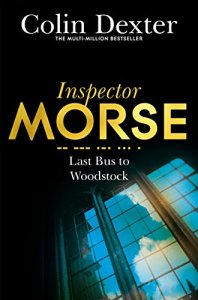
As I’ve nearly finished reading Daniel Defoe’s A Journal of the Plague Year I’ve been wondering what to read next. I had thought I might read Moon Over Soho by Ben Aaronovitch, which is the second Rivers of London book. But this morning I picked up The Last Bus to Woodstock by Colin Dexter and began reading and just carried on. It’s the first Morse book in which Morse and Lewis first met and worked together. Morse thought they would get on well together.

It begins:

‘Let’s just wait a bit longer please,’ said the girl in dark-blue trousers and the light summer coat. ‘I’m sure there’s one due soon.’

This is a scene at a bus stop where two girls are waiting for the next bus to Woodstock. One of the girls doesn’t want to wait, wanting to hitch a lift and they both left the bus stop – it was the wrong decision.

Also every Friday there is The Friday 56, hosted by Freda at Freda’s Voice. *Grab a book, any book. *Turn to Page 56 or 56% on your  ereader . If you have to improvise, that is okay. *Find a snippet, short and sweet, but no spoilers!

These are the rules:

  1. Grab a book, any book.
  2. Turn to page 56, or 56% on your eReader. If you have to improvise, that is okay.
  3. Find any sentence (or a few, just don’t spoil it) that grabs you.
  4. Post it.
  5. Add the URL to your post in the link on Freda’s most recent Friday 56 post.
  1. Grab a book, any book.
  2. Turn to page 56, or 56% on your eReader. If you have to improvise, that is okay.
  3. Find any sentence (or a few, just don’t spoil it) that grabs you.
  4. Post it.
  5. Add the URL to your post in the link on Freda’s most recent Friday 56 post.

She pointed to a large volume, also lying open on the carpet in front of the TV set. ‘Mary’s started to read it.’ Morse picked it up and looked at the title. Who was Jack the Ripper?

‘Mm.’

‘I’m sure you’ve read that.’

Morse’s moral began to sag again. ‘I don’t think I’ve read that particular account, no.’ (page 56)

Blurb:


The death of Sylvia Kaye figured dramatically in Thursday afternoon’s edition of the Oxford Mail. By Friday evening Inspector Morse had informed the nation that the police were looking for a dangerous man – facing charges of wilful murder, sexual assault and rape.

But as the obvious leads fade into twilight and darkness, Morse becomes more and more convinced that passion holds the key . . .

The Birdwatcher by William Shaw

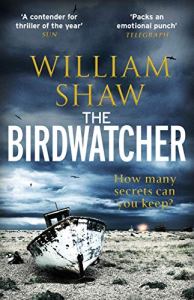
I read The Birdwatcher by William Shaw in the summer and didn’t get round to reviewing it. So, this is a short post summarising what I thought about it.

I enjoyed this book, set in Dungeness on the Kent coast. Sergeant William South is a birdwatcher a methodical and quiet man. Very much a loner, South is not a detective and has always avoided investigating murder. But he does have one friend, a fellow birdwatcher, Bob Rayner and one morning he finds Bob has been brutally beaten to death. DS Alexandra Cupidi, a new CID officer, is leading the investigation and Shaw is reluctantly assigned to her team. Having recently moved from London she relies on William for his knowledge of the area.

Alternating with the present day story is the story of Billy, a thirteen year old living in Northern Ireland during the ‘Troubles’. And hidden within that story is the reason for South’s reluctance to investigate murders. Life becomes uncomfortable for South as Cupidi takes over his house for the base for their investigation and also lands him with the responsibility of entertaining her troubled teenage daughter, Zoe after school – he introduces her to birdwatching.

Shaw is an excellent storyteller and I liked his writing style. This is very much a character-driven mystery as the suspense builds to a climax and his description of Dungeness, with its wind-swept shingle beach close to the Nuclear Power Station and Romney Marsh provides an atmospheric and vivid backdrop. I liked William, and was irritated by Alexandra. So I’m pleased to discover that this is a prequel to Shaw’s DS Alexandra Cupidi series. Currently there are five books, with the sixth to be published next year, so I have plenty more to read.

  • File Size : 3045 KB
  • Print Length : 337 pages
  • Publisher : Riverrun (19 May 2016)
  • Source: I bought it
  • Rating: 5*

WWW Wednesday: 21 October 2020

WWW Wednesday is run by Taking on a World of Words.

The Three Ws are:

What are you currently reading?
What did you recently finish reading?
What do you think you’ll read next?

I’m currently reading David Cameron’s autobiography For the Record and making slow progress. It’s interesting reading his version of events. I’ve not got much to say about it yet, though as I’ve only just got up to the 2010 election.

The other book I’m reading is Daniel Defoe’s novel, A Journal of the Plague Year, a most depressing book about the truly terrible details of the Great Plague of London in 1665 – 1666 in which killed an estimated 100,000 people—almost a quarter of London’s population—in 18 months.

I recently finished reading The Searcher by Tana French, her latest book published on 5 November. I enjoyed it, although not as much as The Wych Elm. It has a leisurely pace that I wasn’t expecting, but I loved the characters and most of all Tana French’s beautifully descriptive writing. I’ll be writing more about it in a later post.

Next I’m thinking about reading some escapism, maybe the second book in the Rivers of London series Moon Over Soho by Ben Aaronovitch. I loved the first book – pure fantasy.