The Time Machine by H G Wells

This morning the clocks went forward – does that mean we lost an hour? Quite by coincidence yesterday I read The Time Machine – it seems apt!

The Time Traveller has gathered together a group of his friends, who have names such as the Psychologist, the Editor, the Provincial Mayor and so on. First of all he treats them to an explanation of time – of how it is the fourth dimension, ‘with Time as only a kind of Space.’ He then tells them that he intends to explore time in a machine he has invented that transports him back and forth in time.

And to prove it he travels to the future – specifically to the year 802,701 where humanity has evolved into the Eloi, who are pretty little childlike people, strict vegetarians who live above ground and the Morlocks, bleached, obscene nocturnal beings who live underground. Their society is divided between these two – industry being carried out underground by the Morlocks and the Eloi above pursing pleasure and comfort.

On his return he describes his adventures. He was:

 … in an amazing plight. His coat was dusty and dirty and smeared with green down the sleeves; his hair disordered, and as it seemed to me greyer – either with dust or dirt of because its colour had actually faded. His face was ghastly pale; his chin had a brown cut on it – a cut half-healed; his expression was haggard and drawn, as if by intense suffering. … He walked with just such a limp as I have seen in footsore tramps. (page 15)

Whilst describing what happened to him the Time Traveller comments on the society he encountered. At first he thought it was a social paradise, but soon he realised the truth, that the perfection of comfort and security had actually resulted in the weakening of society with no need to struggle for survival or for work. And the truth about the relationship between the Eloi and Morlocks was devastating!

In addition he had soon realised that he had gone into the future particularly ill-equipped – without anything to protect himself, without medicine and without anything to smoke, or even without enough matches! And no camera:

If only I had thought of a Kodak! I could have flashed that glimpse of the Under-world in a second, and examined it at leisure. But, as it was, I stood there with only the weapons and the powers that Nature had endowed me with – hand, feet, and teeth; these, and the four safety matches that still remained to me. (page 69)

I was struck by Wells’s descriptions of the divisions in society between the Haves and the Have-nots and the conditions of the working class as a result of industrialisation in his own time, citing the new electric railways, the Metropolitan Railway in London, the subways and underground workrooms and restaurants:

Even now, does not an East-end worker live in such artificial conditions as practically to be cut off from the natural surface of the earth?

Again, the exclusive tendency of richer people – due, no doubt, to the increasing refinement of their education, and the widening gulf between them and the rude violence of the poor – is leading to the closing, in their interest, of considerable portions of the surface of the land. About London, for instance, perhaps half of the prettier country is shut in against intrusion. (page 62)

So, The Time Machine, which was first published in 1895, is a work of imagination and an early example of science fiction, but it is also a commentary on late 19th century society and a vehicle for H G Well’s views on socialism and industrialisation.

It’s a book I’ve had for a couple of years and so qualifies for the Mount TBR Reading Challenge and after I finished it I realised that it also fits in the ‘Time’ category for the What’s In a Name? Challenge too.
The King's Evil by Edward Marston

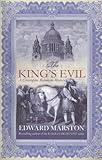
I’m still reading from my own unread books and turned to The King’s Evil for some historical crime fiction. It’s the first in Edward Marston’s Restoration series, featuring Christopher Redmayne, an architect and Jonathan Bale, a parish constable.
The King’s Evil is set in London in September 1666, just as the Great Fire of London has begun, eventually devastating a large part of the old medieval City of London. I liked Marston’s description of the fire, conjuring up the sights and sounds, the fear and panic it caused and the efforts to stop its spread – although I’m sure they didn’t use ‘dynamite’ to blow up houses to create a fire break. Anyway this anachronism didn’t spoil my enjoyment of this book.

Redmayne, a Royalist – a supporter of the Court and King Charles II – has designed a new house for Sir Ambrose Northcott and Bale is a Puritan who views Charles with great disapproval and is wondering if the fire is a consequence of the corruption in society as a result of the Restoration of the Crown:

England was once more ruled by a Stuart king. A monarchy which Jonathan had been pleased to see ended was now emphatically restored. As a result, London was indeed a wicked city and nobody was better placed to see the extent of its depravity than someone who patrolled the streets in the office of constable. Jonathan was a God-fearing man who always sought guidance from above and he was bound to wonder if the conflagration really was a sign of divine anger. There were Biblical precedents of cities being punished for their corruption. (page 26)

The two men are brought together with the discovery of Sir Ambrose’s dead body in the cellars of his partly built new house. It’s a good story with some interesting characters, including Jesus-Died-To-Save-Me Thorpe and Redmayne’s older brother Henry, elegant, fashionable and a dissipated rake, who had introduced Christopher to Sir Ambrose. But it’s the setting in time and place that interested me most – the period when Christopher Wren was the leading architect in rebuilding London – the bustle and energy of the times and the lingering conflict between Royalists and Parliamentarians.

The mystery of who killed Sir Ambrose moves along swiftly, with a few surprises along the way, as you would expect, but nothing too surprising. Redmayne travels to Sir Ambrose’s country house, Priestfield Place in Shipbourne, Kent and crosses the Chanel to Paris following the trail of the killer. It’s the ending of the book that let it down somewhat for me – it’s all a bit rushed and abrupt, but overall I enjoyed it and will read more in the series.

Edward Marston, who also writes under the name of Keith Miles, is a prolific author. He is a former chairman of the Crime Writers’ Association. He has several series of books, listed on his website and also on Fantastic Fiction.

The King’s Evil fits into several challenges I’m doing – The Mount TBR Reading Challenge, TBR Triple Dog Dare,the Historical Fiction Challenge, My Kind of Mystery Challenge and What’s in a Name (royalty category).

Ethan Frome by Edith Wharton

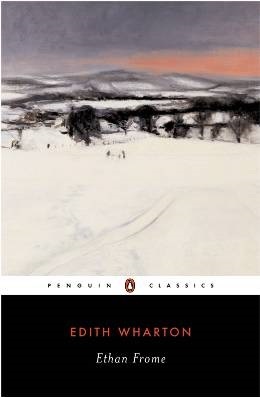
Ethan FromeWhat a fantastic book. Ethan Frome is a beautifully told tale – a tragedy, signalled right from the beginning of the book, when the unnamed narrator first saw Ethan Frome and was told he had been disfigured and crippled in a ‘smash up’, twenty four years earlier. Life had not been good to him:

Sickness and trouble: that’s what Ethan’s had his plate full up with ever since the very first helping.

I was a bit wary as I began reading Ethan Frome because I’d not long finished reading Doris Lessing’s The Grass is Singing and didn’t want to sink into another bleak and dismal book. I needn’t have worried, even though Ethan Frome is a tragedy there is light to contrast the darkness, and there is love and hope set against repression and misery. It’s another book (like The Grass is Singing) where I hoped the ending would be a happy one, although I knew it couldn’t be. 

It’s a short book (just over 120 pages) and deceptively simple to read, but there is so much packed into it. I enjoyed it very much.  As well as striking and memorable characters the setting is  beautifully described – a ‘mute and melancholy landscape, an incarceration of frozen woe‘, in the isolated village of Starkfield (a fictional New England village). Trapped in an unhappy marriage, Ethan’s life had changed when his father died and he had had to give up his studies to work on the farm. His wife Zeena had always been ill and needing help in the house, which was why her cousin Mattie came to live with them. At first it worked out quite well, but Ethan can’t shrug off a sense of dread, even though he could

… imagine that peace reigned in his house.

There was really even now, no tangible evidence to the contrary; but since the previous night a vague dread had hung on the sky-line. It was formed of Zeena’s obstinate silence, of Mattie’s sudden look of warning, of the memory of just such fleeting imperceptible signs as those which told him, on certain stainless mornings, that before night there would be rain.

His dread was so strong that, man-like, he sought to postpone certainty.

Edith Wharton (1862 – 1937) was an American author. Ethan Frome was first published in 1911 and is in contrast to some of her other books about the New York society of the 1870s to 1920s. It’s a rural tragedy of inevitable suffering and sadness that reminded me of Thomas Hardy’s books.

This book was the Classics Club Spin book for February/March and qualifies in the What’s in a Name 2014 in the Forename/Name category. It’s also a book I’ve owned before 1 January 2014 so is another book for the Mount TBR challenge.

What's in a Name 2014 – an Update

Whats in a name 7Charlie who hosts the What’s In A Name challenge on her blog The Worm Hole has added a a 6th category to the challenge. I was hoping she would as there has always been a 6th category for this challenge. Here it is in Charlie’s own words:

A book with a school subject in the title. And yes, that does mean you can get creative and use a magical academic subject if you wish €“ Hogwarts is a school, after all.

Examples of books you can choose: The History Boys by Alan Bennett, Angelology by Danielle Trussoni, Mastering The Art Of Soviet Cooking by Anya Von Bremzen

This sixth category will be considered a bonus. You can read for it or not €“ if you only want to read for the original five categories your last book of the five will still mean you have completed this year’s challenge.

I’ve had a quick look at my unread books (as I like to use challenges to read from my own books, rather than having to buy/borrow them) and have these to choose from:

History

The Brief  History of the Dead by Kevin Brockmeier
A Small Part of History by Peggy Elliott
The History of Love by Nicole Krauss

Languages

A Dead Language by Peter Rushforth
Italian Neighbours: An Englishman in Verona by Tim Parks

Music

An Equal Music by Vikram Seth

Art

The Lost Art of Keeping Secrets by Eva Rice

Shakespeare

1599: A Year in the Life of William Shakespeare by James Shapiro

Dancing

A Time To Dance, No Time To Weep by Rumer Godden

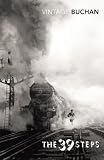
The Thirty-Nine Steps by John Buchan

Way back in 2008 I watched The 39 Steps on TV with Rupert Penry-Jones as Richard Hannay, so inevitably as I read The Thirty-Nine Steps I could see Penry-Jones as Hannay. The dramatisation, however, although there are similarities, is different from John Buchan’s book. There are a number of historical inaccuracies and some artistic licence was used – none of which I was aware of as I watched the film and I thoroughly enjoyed it. It made me want to read the book and it’s taken me until now to get round to it – I’d forgotten most of the details of the film, except for visions of Penry-Jones running away from his pursuers in the Scottish moors, scrambling through the heather.

John Buchan 1936

John Buchan began writing The Thirty-Nine Steps in 1914; it was first published in 1916. He was born in Perth in 1875 and after leaving Oxford University he had a varied career, as well as writing books and articles he was a barrister, a member of Parliament, a soldier and a publisher. He was created Baron Tweedsmuir of Elsefield in 1935 and became the 15th Governor-General of Canada, a position he held until his death in 1940.

Once I began reading The Thirty-Nine Steps I didn’t want to put it down. It’s a fast moving action-story, beginning with an international conspiracy, involving anarchists, financiers and German spies. Richard Hannay, having found Scudder, murdered in his London flat, fears for his life and goes on the run, chased by villains in a series of exciting episodes, culminating in the discovery of the location of the ‘thirty-nine steps’. Hannay is a remarkable character, resourceful, and a master of disguise. As well as fleeing for his life he is searching for Scudder’s notebook, which contains clues to the international conspiracy – Scudder was a spy.

The master villain is also a master of disguise, having the ability to ‘hood his eyes like a hawk‘ :

There was something weird and devilish in those eyes, cold, malignant, unearthly, and most hellishly clever. They fascinated me like the bright eyes of a snake. (page 119)

He can impersonate the British First Sea Lord at a top secret meeting with people who knew the real First Sea Lord very well and is also convincing as the very British gentleman, the plump, bridge-player Percival Appleton.

The Thirty-Nine Steps is to my mind a gem. There are other Hannay books – the Complete series is available on Kindle, The Thirty-Nine Steps, Greenmantle, Mr. Standfast, The Three Hostages, and The Island of Sheep.

And so one book leads on to yet more books!

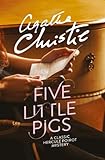
Five Little Pigs by Agatha Christie

There are many things I like about Five Little Pigs, a Poirot mystery first published in 1943. I like the plot and the way it’s structured, the characterisation, the dialogue, and Agatha Christie’s fluent style of writing. In addition the solution is convincing and satisfying.

Caroline Crale was convicted of the murder of her husband, Amyas and died in prison. Sixteen years later, her daughter, a child of five at the time of the murder, asks Poirot to clear her mother’s name, convinced that she was innocent.

Poirot checks the police records, talks to the lawyers who conducted the trial and to the five eyewitnesses, persuading them to write down their versions of events. He finds that she had ample motive for the crime, at no time had she protested her innocence, although she contended that he had committed suicide, and all the eyewitnesses thought she was guilty.

Inevitably there are different versions of the events and conflicting views of Caroline’s character, all very clearly set out. So what did actually happen? Was Caroline innocent or guilty?

Poirot, in his usual methodical manner, goes through the sequence of events, and having gathered together all the people involved, using logic and psychology to detect the incongruous he makes his denouement.

The description of Amyas Crale’s house, Alderbury appears to have been modelled on Agatha Christie’s own house, Greenway, complete with a Battery overlooking the river, just as at Greenway. The book was written in 1943, making it 16 years after 1926, the year of her disappearance before her divorce from her first husband, Archie Christie, so I don’t think that it’s a coincidence that Amyas Crale, a womaniser who was proposing to leave his wife for another woman has the same initials as Archie Christie!

I think the nursery rhyme theme of the title and the chapter headings is rather forced, as it doesn’t really throw any light on the mystery. It seems that Agatha Christie was a bit carried away with her ‘crimes of rhymes’, just as Poirot was obsessed with the jingle:

A jingle ran through Poirot’s head. He repressed it. He must not always be thinking of nursery rhymes. It seemed an obsession with him lately. And yet the jingle persisted.

This little pig went to market, this little pig stayed at home…’ (page 33)

This is the first Agatha Christie book I’ve read this year and I’m pleased it was such a good one!

Five Little Pigs is my 8th TBR book I’ve read this year in the Mount TBR Challenge, and the TBR Triple Dog Dare, the 2nd for the My Kind of Mystery Challenge and the 2nd for the What’s in a Name 7 Challenge (in the category, a book with a number written in letters in the title). And last, but by no means least, it’s the 56th Agatha Christie book I’ve read in the Agatha Christie Reading Challenge.