T is for … Teddy Bears

I am a teddy bear collector – an arctophile – and here are some of my little teddy bears. I have a collection of miniature bears (and one or two bigger ones too). Shown below is a selection of some of them.

Seated above are some little Steiff bears, which are smaller versions of the originals, Hermann bears, Boyds bears, Chad Valley bears and Merrythought bears amongst others and they all have names. Some are ‘One of a kind’, like Tyler Major, who is very heavy as he is weighted with lead shot. Then there is Edmund Bear from St Edmund Hall, Oxford University – he is wearing a navy blue jumper and a brown bow. The little dark brown bear at the front wearing a black hat and pink ribbons is Simone.

I began collecting them several years ago, beginning with Little Big Ted, who was taken by his maker to meet the Queen:

He is my favourite, as sadly I no longer have my childhood teddy bear.

To go with my bears I have a small selection of teddy bear books:

From top to bottom they are:

  • The Treasury of Teddy Bear Tales – a collection of twelve tales , from comic to nostalgic.
  • Make Your Own Classic Bears – 14 Heirloom Designs by Julia Jones. This defines a ‘classic’ bear as one with lightly curved paws, feet that are long in proportion to its height, a small head with a long, pointed muzzle, black boot button eyes and a nose and mouth either embroidered with black thread or made with an oval of black leather, and pads on its paws and either no claws or one stitched in black.
  • The Teddy Bear Book: a Voyage of Discovery into the Origins of Our Favourite Toy by Maureen Stanford and Amanda O’Neill – over 700 photos of teddy bears from all over the world. This is a mine of information on teddy bears from their history to their design, care and repair.
  • The Ultimate Teddy Bear Book by Pauline Cockrill – more photos of historical bears as well as modern teddy bear personalities, such as Winnie the Pooh and Rupert Bear, complete with a data panel of Bear Essentials to help distinguish between the different types of bear.

Some Teddy Bear History

In America: Morris Michtom (a Russian immigrant) had the idea of making a cuddly bear after seeing a cartoon of President Roosevelt refusing to shoot a tethered bear cub. His wife made the bears and sent one to the President asking  to call it ‘Teddy’ after his first name, Theodore.

In Germany: A seamstress called Marguerite Steiff made soft toys and her nephew wanted an alternative to a doll and he thought of a bear. The first one was ‘Friend Petz’ in 1903, shown at the Leipzig Toy Fair, where it was seen by Hermann Berg, an American buyer for a New York company. By the 1920s bears were being made in Britain as well as in Germany and the US.

This is an  ABC Wednesday post.

Weekly Geeks – Antique Books

This week’s Weekly Geeks question is:

The other day I was noticing the old books on my book shelf. Old, meaning books that were “born” a long long time ago. Books that were published AND printed a long long time ago. (Not simply books that have been sitting on our shelves forever!)And it made me wonder what old books other readers have in their collection.

So this week, write a post sharing with us what old antique books you may have on your shelves, and tell us the story behind them. Did you inherit from a relative? Are you a collector of old and rare books? Did you just discover a certain book in a used book store and couldn’t pass it up? What’s the very oldest book you have? Do you even like old books? Or do they creep you out? Do you read and enjoy your old books, or is it more a “look and don’t touch” thing?

I love old books as well as new books. I don’t own any antiquarian books – old, rare and valuable ones for example. My old books are just that – old. I don’t value them just as objects, but for their content and some of my old books are not in prime condition. They are well used and well loved.

The oldest books I have belonged to my parents. The earliest is Where Flies the Flag by Henry Harbour. The book has no publication date but was presented to my father for “Regular Attendance at Vicarage Lane Wesleyan Sunday School during 1921.”  The inscription notes that he had “Not missed during the year.” In 1921 my father was 7. This book is in good condition, although the pages are now brown with age and I’m not sure he would have read it then as it seems hard reading for a 7-year old.

Both my parents went to Sunday School and each year were awarded books for attendance. One belonging to my mum is the Empire Annual for Girls which was given to her in 1925 when she was 11. Another is The Girl Guides Book and inside this one she wrote that it was an award for 1st Prize for Sewing, so that must have been from her day school. I loved both these books when I was a child.

And shown below are two of my Dad’s books – My Adventure Book and The British Boy’s Annual – this one was a Christmas present. They are both un-dated, although from “The Editor Chats” I see that he was asking for postcards listing the stories or article that had appealed most strongly to the readers to arrive not later than March 15 1928, so it must have been before that. Talking about the readers of The British Boy’s Annual, it wasn’t limited to boys as the editor wrote that he’d had a complaint from a boy that his sister had found it so interesting that she kept worrying him to let her have it for a while. I found it interesting too.

My favourite book of theirs – I don’t know which of them originally owned it – is The Coronation Book of King George VI and Queen Elizabeth. I think this was published in 1936 as it was published before the Coronation in 1937, so I suppose it could have belonged to one of my grandparents originally.  It’s a history of the Royal Family and the Coronation ceremony, full of photos of the Family – including Queen Victoria with her children and grandchildren in the garden of Osborn House in the Isle of Wight in 1898 and our present Queen and her sister as children. Queen Elizabeth was 11 when her father ascended the throne.

I’ve spent hours as a child reading and looking at this book.

(Click on the photos to enlarge)

S is for …

… Secondhand books

Yesterday I went to Barter Books in Alnwick, a superb secondhand bookshop where you can not only buy books but exchange books. I took a pile along and came back with some more and am still in credit for more books for my next visit. It’s a great way to recycle books.

I have written about Barter Books before, but not posted any photos of what it’s like inside. It is in a huge old railway station, built in 1887 and closed to passengers in 1968.

(Click on the photos to see more detail)

There is a cafe in what used to be the station waiting room where we refreshed ourselves with coffee and toasted teacakes in front of a roaring fire. The painting on the wall above the fireplace shows the station as it was in 1908 when the future King George V and Queen Mary visited Alnwick.

We then browsed the shelves. There are all sorts of books, fiction, non fiction, first editions, valuable antiquarian books, signed copies, maps, dvds, pamphlets and so on.

In one section there is a miniature overhead railway line with trains passing every few minutes.

It’s a very special bookshop.

This is an an entry in ABC Wednesday for the letter S.

Weekend Cookery – Blondies

I haven’t done a Weekend Cookery post for a few weeks, so I thought it was about time I did.

My husband likes to cook and often cooks dinner, but he doesn’t bake. He’s a fan of Nigella and and also of Blondie. So, he couldn’t resist making Nigella’s recipe in the pullout in the Radio Times of Nigella’s Simple Treats.

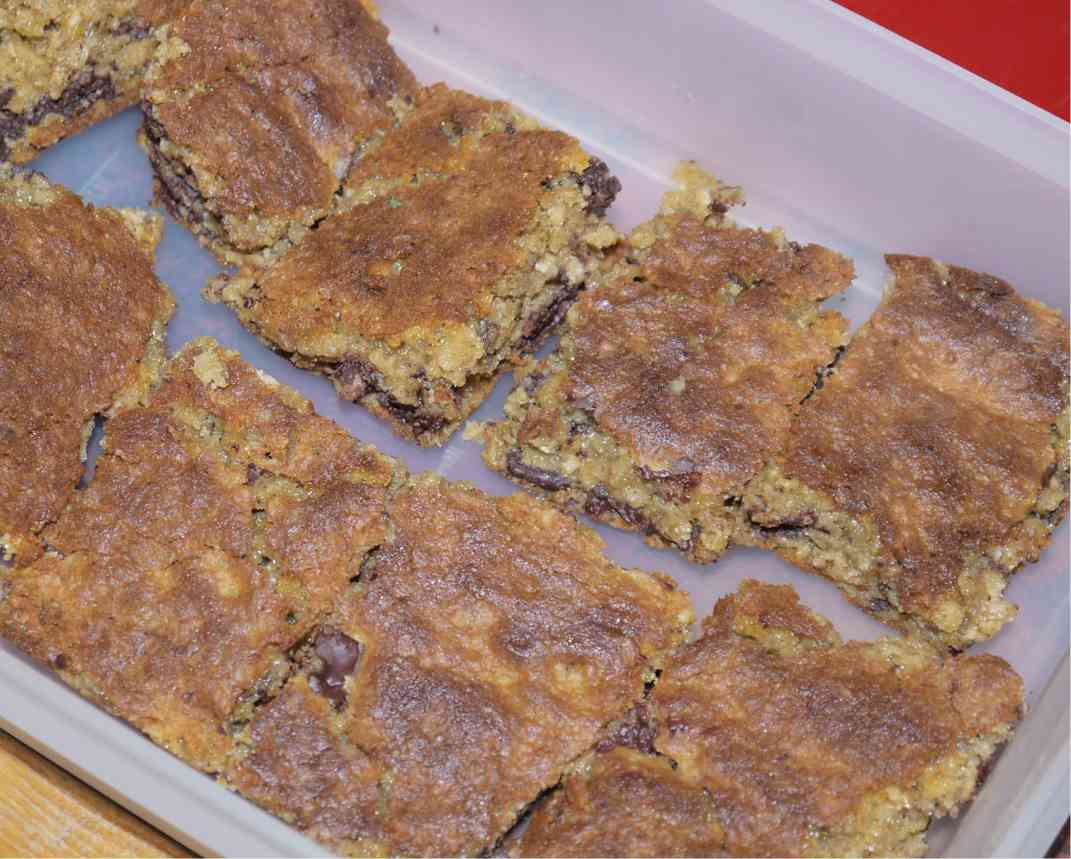
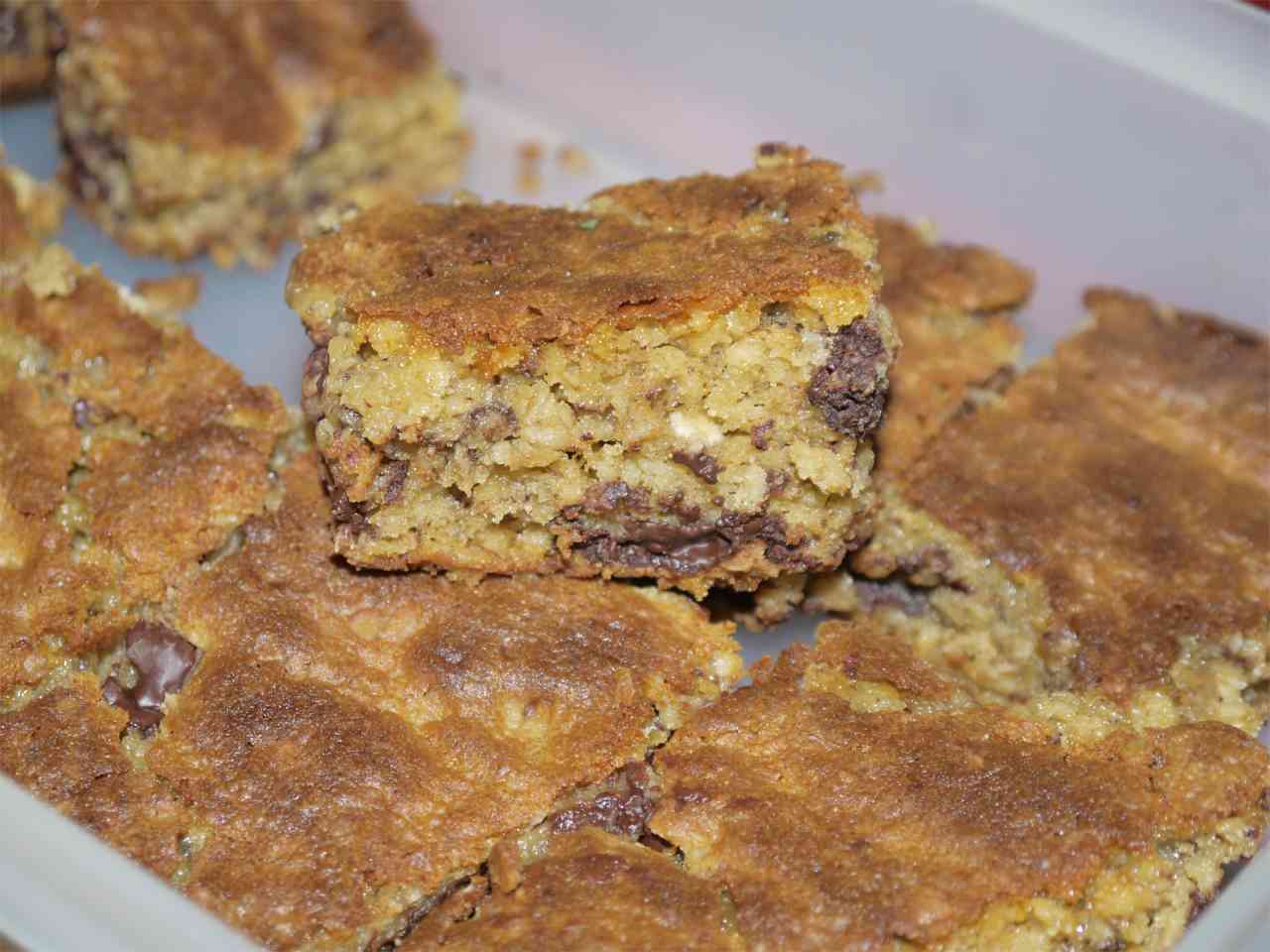
Here are Dave’s Blondies – they are absolutely delicious.

He made them by combining 200g porridge oats, 100g plain flour, and ½ teaspoon bicarbonate of soda in a bowl. In another bowl he beat together 150g soft unsalted butter and 100g light muscovado sugar until pale and then stirred in 1 can (397g) condensed milk, then add in the oats mixture. When this was well mixed he added in 1 egg and 170g of dark chocolate, chopped into small pieces.

He then put the lumpy mixture into a 9in square cake tin and baked it in a preheated oven at 180°for about 35 minutes. As Nigella describes it, it was ‘quite a pronounced dark gold around the edges and coming away from the tin’ and was still  ‘frighteningly squidgy, not to say wibbly.’

He let it firm up in the tin and then cut it into pieces. You can see in the photo below that they are a lovely consistency and the chocolate pieces are softly melted into the  chewy oaty mixture.

D's Blondies1

weekend cooking

Weekend Cookery is a weekly event hosted by Beth Fish Reads, where you’ll find more cookery related posts.

Edited 28 August 2021: The recipe is in Nigella Lawson’s book, Kitchen: Recipes from the Heart of the Home page 314.