ABC Wednesday J is for …

… the Jabberwock

From Lewis Carroll’s Through the Looking Glass, illustration by John Tenniel.

This was a great favourite of mine as a child and I still love the poem, Jabberwocky which begins:

Twas brillig and the slithy toves

Did gyre and gimble in the wabe;

All mimsy were the borogroves,

And the mome raths outgrabe.

Beware the Jabberwock, my son!

The jaws that bite, the claws that catch!

Beware the Jujub bird, and shun

The frumious Bandersnatch.

I had no idea what the words meant but I loved the sound of them and learned them off by heart. Humpty Dumpty explains to Alice that ‘brillig’ means ‘4 o’clock’, ‘slithy’ means ‘lithe and slimy’ and ‘toves’ are something like badgers  and lizards and corkscrews, to ‘gyre and gimble’ means to go round and round like a gyroscope and make holes like a gimlet and the ‘wabe’ is a grass-plot around a sundial – as shown in this illustration also  by John Tenniel:

An ABC Wednesday post.

The Sunday Salon

Today I’ve been reading more from Eden’s Outcasts: the story of Louisa May Alcott and Her Father. At long last, as I have been reading this book for ages, I have arrived at the time of Louisa’s life where she has written and published Little Women. Up to this point (about 60% of the book) most of it has been about Bronson Alcott, her father and it is Louisa who I find most interesting.

Louisa wrote in vortices – completely engrossed in her writing, with barely time for anything else, so intense was her concentration. Mostly she wrote in her bedroom at a desk Bronson had built for her, but sometimes she sat on the parlour sofa. Her family knew that if the bolster pillow next to her stood on its end they could speak to her, but if the pillow lay on its side they couldn’t disturb her. In two and a half months she had completed writing 402 manuscript pages and at the end of it she had briefly broken down.

Little Women was an instant success, the first printing of 2,000 copies sold out within days of the book’s release and another 4,500 copies were in print by the end of the year (1868). Three months later she had written the second part of Little Women – the book I know as Good Wives. She had

… plunged back into a creative cortex on November 1, vowing to write a chapter a day. She worked ‘like a steam engine’, taking a daily run as her only recreation and barely stopping to eat or sleep.  Falling behind the ambitious schedule she had set for herself, she spent her birthday alone’writing hard.’ (page 345)

She put her heart and soul into her writing.

Both Louisa and her father were complex characters and Matteson’s biography is detailed and in depth. It’s not a quick read, but then biographies never are in my experience.

ABC Wednesday – I is for Irises

Irises by Vincent Van Gogh, 1889

Van Gogh painted Irises after he committed himself to the asylum at Saint Paul-de-Mausole in Saint-Remy, France. He began the painting only one week after he entered the asylum. He was probably influenced by Japanese woodblock prints; the black outlines in Irises is typical of the Japanese prints.

Irises is on the list of the most expensive paintings ever sold, selling for 54 million dollars in 1987.

It’s beautiful.

The Sunday Salon

Yesterday I finished reading The Matchmaker of Kenmare by Frank Delaney and today I’ve been thinking what to write about it. I’ll publish my post on it later on this week. That has left me wondering what to read next alongside The Moonstone that I’m reading on my Kindle. I fancy something different from The Matchmaker, something more focused – maybe some crime fiction. So I looked at some of the books I’ve got lined up to read:

  • Tigerlily’s Orchids by Ruth Rendell. This was published last year which according to the Daily Mail is ‘Ruth Rendell … back to her creepy best.’  And  The Sunday Times is quoted as revelling ‘in the menacing potential of stillness … The suspense is genteel, but palpable … Ruth Rendell is in full control of her craft here.’ Ruth Rendell is an author I usually enjoy reading very much.
  • The Blood Detective by Dan Waddell, who is a new-to-me author. I’ve been enjoying his blog posts on Murder is Everywhere for a while so I looked for his books in the library. This is his first novel and it won the CWA John Creasey (New Blood) Dagger in 2009.  Before that he had written the book that accompanied the BBC TV series Who Do You Think You Are?, so it’s not surprising that The Blood Detective features a genealogist specialising in compiling family trees.
  • Drawing Conclusions by Donna Leon, published in hardback on 7 April 2011, my copy is from the publisher William Heinemann. This is the 20th Commisario Brunetti novel – he is called to investigate the death of an elderly woman who apparently died from a heart attack, although he thinks there is more to it. This looks so good.

As we’re halfway into March and I’ve got until the last Tuesday in the month when my book group meets to read Shirley Williams’s autobiography, Climbing the Bookshelves, I’d better get on with reading that. … But I just want to peek into the others first.

Saturday Snapshot

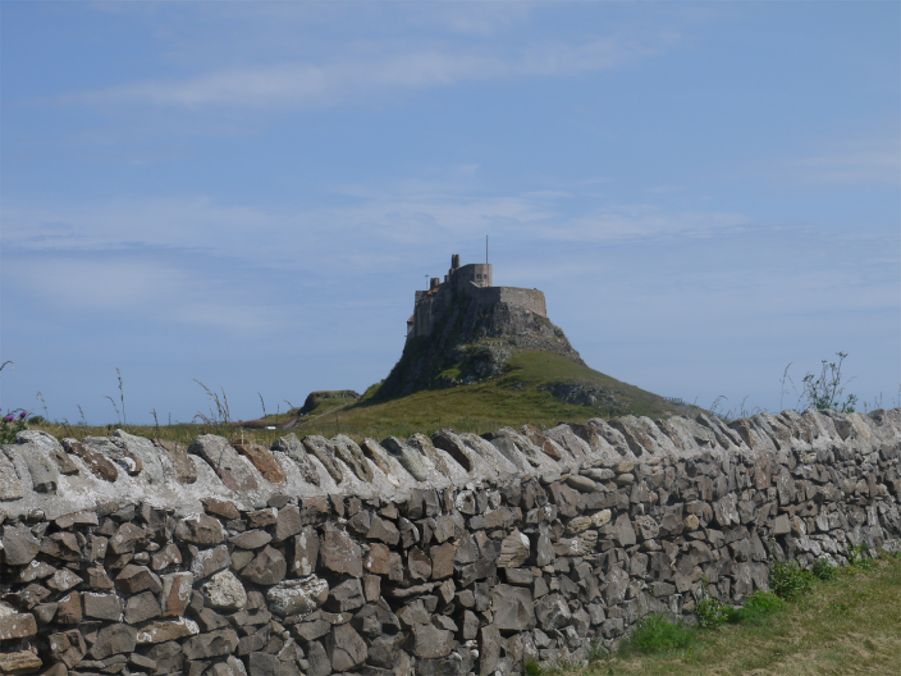
Lindisfarne Castle P1020110

We went to the Holy Island of  Lindisfarne in February one cold and misty day. The Island is reached by crossing the causeway at low tide. We went in the Lindisfarne Heritage Centre where we saw displays of the Vikings on the Island.

The Castle is perched on top of a craggy rock. It was originally a Tudor fort and was converted into a private house in 1903 by Edwin Lutyens. We only looked at it as we had to leave the island as the tide was coming in. It’s now owned by the National Trust and we’ll make sure we have time to look around next time we go over to the island.

To participate in Alyce’s Saturday Snapshot meme post a photo that you (or a friend or family member) have taken. Photos can be old or new, and be of any subject as long as they are clean and appropriate for all eyes to see. How much detail you give in the caption is entirely up to you. All Alyce asks is that you don’t post random photos that you find online.

ABC Wednesday – H is for Hunt

William Henry Hunt (1790 – 1864) was an English watercolourist. This is one of my favourite paintings – Primroses and Bird’s Nest.


Hunt specialised in still life compositions, mainly fruit, flowers, nests and eggs – he was known as ‘Bird’s Nest’ Hunt. This is one of his bird’s nest paintings, measuring just 7½ inches by 10¾ inches. I saw a variation of this painting at the Royal Academy of Art ofThe Great Age of British Watercolours 1750 – 1880 exhibition several years ago. The catalogue describes Hunt as an outstanding technician. His work was admired by many, including John Ruskin who took lessons from him in 1854 and 1861.

There are a few details about Hunt in The Pre-Raphaelites by Timothy Hilton, including a reproduction of this painting. Amazingly, Hunt said:

I feel really frightened every time I sit down to paint a flower.

I think his paintings are just so beautiful. For more information on Hunt’s method of painting see Craig’s comment below.

See more ABC Wednesday posts.