Saturday Snapshot – another look at the family album

Time to revisit old family photos. This week I’m featuring my Granny Leighton, my father’s mother. I loved visiting her, she was the epitome of a grandmother, with her white hair done up in a bun, and her lovely smiley face. She even sat in a rocking chair by the fire knitting, when she wasn’t dashing around the kitchen, singing whilst she cooked.

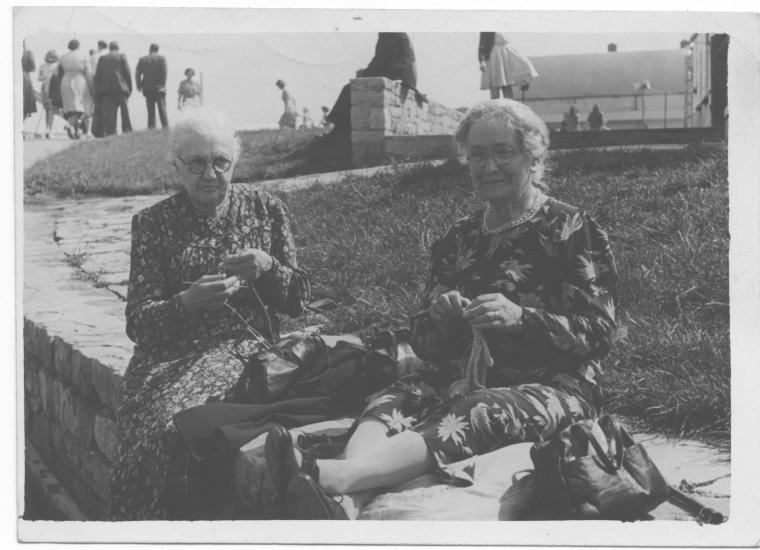
Here she is with her sister, who wasn’t such a happy lady – I was rather scared of her. I don’t know when the photo was taken or where they were, but they’re sitting on a wall, maybe on holiday or on a day out, both with their knitting. Granny is on the right of the photo – smiling, Great Aunty Alice on the left – not smiling!
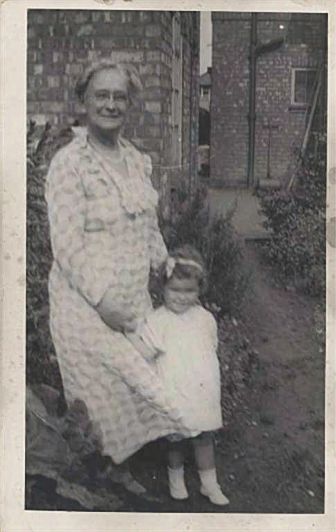
And here she is in her garden with my cousin, Sylvia:
And another photo taken in her garden, this time with her big black cat:
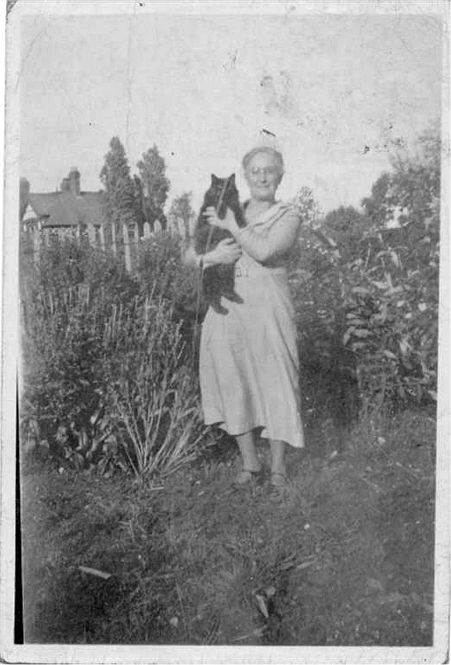
Granny and Granddad had a large garden, divided into many sections for flowers and vegetables, and they also had an aviary full of birds. I loved going there, although I was scared of my Granddad’s dog, which fortunately for me, he kept tied up to his chair when he was in the house. It was a horrible dog, with a very fierce bark and growl.

See more Saturday Snapshots at Alyce’s blog At Home with Books.
Book Beginnings on Friday

This morning I finished reading Faulks on Fiction by Sebastian Faulks, a book I’ve been reading slowly for a few weeks (my review coming soon). It’s time to choose another non-fiction book to take its place. It’s got to be a book I can read in small bites and not lose the thread, maybe a biography/autobiography, or a diary, collection of letters, or a history book.

I’ve looked at a few and have decided on this one:

The half-timbered mansion disappeared long ago, and the paved thoroughfare lies buried beneath the dust of centuries. The Great Fire tore the heart out of this corner of Elizabethan London, devouring books, buildings and streets. One of the few things that survived is a small and insignificant-looking map – crinkled, faded, but still bearing the proud name of its owner. (page 1)

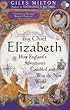
This is the beginning of Giles Milton’s about the first English settlement in the New World in the sixteenth century. It’s Big Chief Elizabeth: how England’s Adventurers gambled and won the New World. I’ve read his earlier book Nathaniel’s Nutmeg, which is a fascinating tale of the ‘competition between England and Holland for possession of the spice- producing islands of South-East Asia throughout the 17th century.’

I like the beginning of Big Chief Elizabeth, which within a few words captures the mystery and appeal of history for me. I’m looking forward to discovering more about the map and its owner.

Blurb from the back cover:

Big Chief Elizabeth has it all: gallant English seadogs, coiffured courtiers, exotic locations and lots of fights with pirates, Spaniards and Indians. (Sunday Telegraph)

Plus I’m interested to read Giles Milton’s newest book, Wolfram: the Boy who Went to War.

Book Beginnings on Friday is hosted by Katy at A Few More Pages.

S is for Smailholm Tower and Sir Walter Scott

I took these photos of Smailholm Tower, near Kelso in the Scottish Borders on a grey day in November last year. It’s open to the public, but in the winter it’s only open at the weekends  and we went on a weekday! We keep meaning to go back and see the inside.

I think it’s an impressive sight!

It’s a peel tower perched on top of a rocky crag, originally built in the 15th/16th centuries to protect its occupants from English raiders. It’s now a Scheduled Ancient Monument in the care of Historic Scotland.

Although the Tower now stands alone on the crag it was once the centre of a small castle toun. Sir Walter Scott stayed with his grandparents who lived at Sandyknowe Farm in the hollow near the Tower, where his parents hoped his delicate health would improve. It was there that his love of the Borders began as his aunt and grandmother recited to him ballads and Border tales and legends.

For more S posts visit ABC Wednesday.

Saturday Snapshot – A Walk Along the River Till

On Wednesday we walked alongside the River Till in Northumberland, England to its junction with the River Tweed, in Scotland.We started at the medieval Twizel Bridge – the bridge crossed by the English Army  on their way to the battle at Flodden in 1513. The bridge is now a pedestrian route, the traffic speeding along a new main road. Both bridges across the River Till are shown in my photo below. (The medieval bridge is in front of the new bridge) :

Here is a closer look at the medieval bridge:

As we went along the river bank the salmon were leaping out of the water, but no matter how quick I tried to be with the camera I couldn’t snap a fish as it leapt out of water. This is the closest I got:

The nearer circle is where the fish jumped out and the further one where it went back into the river!

We carried on down the river bank to Twizel Viaduct. This stands 90 feet over the Till and used to carry the Tweedmouth to Kelso railway line. It was built by the York Newcastle & Berwick Railway between 1846-9. This line closed in 1965:

The autumn trees still have most of their copper leaves:

But when we got to the junction of the Till and Tweed there were these leafless trees on the opposite side of the river. The angle of the trunks is just amazing:

We weren’t the only people out enjoying the autumn sunshine – the fishermen were there too.

There is a ruined castle on the ridge overlooking the Till, but more about that in a later post.

Saturday Snapshot post, hosted by Alyce, At Home with Books.

Saturday Snapshot: Bridges on the Tyne

Every now and then we go to Newcastle upon Tyne, usually only managing to go round the shops, but on Tuesday we decided to see a bit more of the city.

Even though it was a grey, misty day (as these photos, taken in the early afternoon, show) we decided to have a look at the River Tyne. The river is crossed by several bridges and went to the High Level Bridge, designed by  Robert Stephenson and built between 1847 and 1849. It’s a road and railway bridge. Below is the view of the pedestrian/road crossing below the railway line.

From this bridge we could see more bridges crossing the river. Below is the view of the Queen Elizabeth II Metro Bridge between Newcastle and the Gateshead Metro Centre :

We walked about halfway across the bridge to see more bridges  across the river. The photo below shows the Swing Bridge (red and white) and the Tyne Bridge, in the centre with The Sage, an international music centre in the background:

East of  the Tyne Bridge is the Gateshead Millennium Bridge (white):

Standing on the High Level Bridge, my eye was caught by this statue on the top of a building below:

This is King Neptune with two fishwives seated on both sides. This was the old fish market, erected in 1880.

Saturday Snapshot post, hosted by Alyce, At Home with Books.