First Chapter, First Paragraph

First chapterEvery Tuesday Diane at  Bibliophile by the Sea hosts First Chapter First Paragraph Tuesday Intros, sharing the first paragraph or (a few) of a book she’s reading or thinking about reading soon.

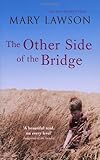
This is a book I’ve had for some time and haven’t read yet. It’s The Other Side of the Bridge by Mary Lawson. I bought this book because I’d read and loved Mary Lawson’s book, Crow Lake (link to my post on the book).

The Other Side of the Bridge begins: 
Prologue

There was a summer back when they were kids, when Arthur Dunn was thirteen or fourteen and his brother Jake was eight or nine, when for weeks on end Jake pestered Arthur to play the game he called knives. Jake had a great collection of knives at the time, everything from fancy little Swiss Army jack-knives with dozens of attachments to a big sleek hunting knife with a runnel down one side for blood. It was the hunting knife that was to be used in the game because according to Jake it was the best for throwing.

The only reason I haven’t read it yet is pressure of time  – and lots of other books that I’m dying to read. But should I read this one soon?

This is the blurb on the back cover:

Arthur and Jake are brothers, yet worlds apart. Arthur is older, shy, dutiful, and set to inherit his father’s farm. Jake is younger and reckless, a dangerous man to know. When Laura arrives in their 1939s rural community, an already uneasy relationship is driven to breaking point …

And this is what Penelope Lively wrote about it in the Guardian:

This is a fine book – an enthralling read, both straightforward and wonderfully intricate.

I think I’ll move it up the list of books-to-be-read.

Berwick's Elizabethan Ramparts

Following on from last Saturday’s Saturday Snapshots here are a few more photos of Berwick-upon-Tweed, which is the northernmost town in England. It’s a Border town that changed hands between England and Scotland 14 times until it finally became part of England in 1482. It’s a walled town; the original medieval walls were built in the 13th century and the Elizabethan Ramparts, dating from 1558 are virtually intact.

Berwick Elizabethan Ramparts

The fortifications replaced the medieval wall on the North and East sides of the town. The photo above shows part of the Elizabethan wall that is now the boundary wall of a car park.

Below are two photos of sections of the walls:

Berwick Ramparts 1

Berwick walls & bridges

The photo below shows a Russian cannon, captured in the Crimea. Before the Second World War this part of part of the walls was once bristling with artillery. All that remains now is this cannon which was brought back as one of the trophies at the end of the Crimean War (1854-56). The top of the barrel of the gun is embossed with the double-headed eagle emblem of the Russian Tzar.

Berwick Ramparts Canon

For more Saturday Snapshots see Alyce’s blog At Home With Books.

Book Beginnings

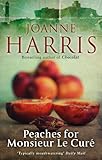
Peaches for Monsieur Le Curé: I really shouldn’t be reading this book yet as I’m still reading Joanne Harris’s The Lollipop Shoes, the book that precedes Peaches for Monsieur Le Curé, but I just had to see how it starts.

This is the beginning (and the whole of Chapter One):

Someone once told me that, in France alone, a quarter of a million letters are delivered every year to the dead.

What she didn’t tell me is that sometimes the dead write back.

Well, that seemed so familiar – and it is because here is the opening sentence of The Lollipop Shoes:

It is a relatively little-known fact that, over the course of a single year, about twenty million letters are delivered to the dead.

I’ve had The Lollipop Shoes for nearly five years and have only just got round to reading it. I bought it when it came out in hardback because I’d loved reading Chocolat and wanted to read more about Vianne Rocher – my post on Chocolat explains my love of this book. So far, though, it just doesn’t have the same enchantment as Chocolat and it’s giving me uneasy feelings. I don’t want to say too much just yet as I’ve only read half the book – but one of the characters is definitely not ‘nice’, she’s dangerous and devious, out to  change Vianne’s world.

In fact, when I first looked at The Lollipop Shoes I found I didn’t want to read it – it’s so different in mood from Chocolat. So it went back on the shelf until this week, when I read Christine’s review of Peaches for Monsieur Le Curé and I knew it was time to read Joanne Harris’s books. It sounds as though  Peaches for Monsieur Le Curé is just as enjoyable as Chocolat and maybe not quite so dark as The Lollipop Shoes, because she wrote: ‘it’s the kind of novel I’ll turn to on a grey day, when the world seems against me, and I want my spirits lifting without having to think too deeply about anything’.

For more Book Beginnings on Friday see Gilion’s blog Rose City Reader.

Saturday Snapshot: Berwick Castle

There is little left of Berwick Castle. Ruins are almost as enticing as libraries and bookshops to me. If there are any of these in an area I love to go and explore, so it’s amazing that after living near Berwick-upon-Tweed for over three years the most I’ve seen of Berwick Castle is the view of a wall from Berwick Railway Station. It was the building of the railway that caused the Castle’s final destruction when in 1847 substantial parts of the Castle were demolished to make way for the Station! Apparently the walls were so thick they had to use gunpowder to reduce them to rubble.

We were in Berwick on Wednesday; it was a dismal afternoon as rain blew in from the North Sea, not ideal for taking photos, especially on a camera phone. I’ll go back another day, when the sun is out, to take more photos.

The photo below shows the approach to the Castle ruins from Coronation Park above the River Tweed. The Park was created to celebrate the coronation of George VI in 1937. The area at the top of the Park was known as Gallows Knowe. It was the place of public executions in Berwick, the last being in 1823 – maybe the very place where we stood to take photos.

Berwick Castle grounds IMG_0459

The Castle was first recorded in 1160, probably built by King David I of Scotland, and was completely rebuilt by Edward I of England, after he captured it in 1296, with a strong circuit of walls,  towers and turrets, including royal apartments, a great hall and a chapel. Berwick- upon-Tweed is the most northerly town in England. a border town that changed hands between England and Scotland many times until 1482 when it was retaken from Scotland.

The photo below shows the castle mound, and the remains of the castle walls, including a rounded gun tower . On the right of the photo the White Walls are visible – this was a battlemented wall that still runs from the corner of the castle down to the River Tweed. It was built to defend the river approach to the castle and town around 1297 – 1298. Also, just about visible on the extreme right of the photo is the Royal Border Bridge carrying the railway line into Berwick Station.

Berwick Castle mound and wall IMG_0469The next photo (below) shows more detail of the Bridge and White Walls.

Berwick Castle and Royal Border Bridge IMG_0475For more Saturday Snapshots see Alyce’s blog At Home With Books.

Saturday Snapshot

This is the Flodden Visitor Centre. It’s in a former telephone box in the village of Branxton in Northumberland. Flodden Visitor Centre P1080503It claims to be the smallest visitor centre in the world:

Flodden Visitor Centre P1080499

It’s part of the commemoration of the Battle of Flodden which took place 500 years ago in September between the English and Scottish armies in the fields near Branxton.

Flodden Visitor Centre P1080501Inside there is a map showing the routes of the two armies and indicating several sites related to the battle. There are leaflets and even a button to press the hear about the battle.

If you are in London on 14 May you can get tickets for a lunchtime lecture on the Battle of Flodden 1513 by historian Clive Hallam Baker at the Tower of London. He is the author of The Battle of Flodden: Why and How.

Other books about Flodden, with links to my reviews:

Fiction:

Non fiction:

  •  Flodden: the Scottish Invasion of Henry VIII’s England by Nigel Barr
  • New Light on Floddon (sic) by Gerard F T Leather – I have not written about this short book published in 1938, which Leather, a member of the Berwickshire Naturalists’ Club had written after studying the battle for a talk. As he explained there were actually four distinct fights going on a more or less the same time and the old name of the battle was that of Branxton Moor, a more correct title, in his opinion, as the battle scene was a mile and a half from Flodden.

For more Saturday Snapshots see Alyce’s blog At Home With Books.

Weekend Cooking: Ultimate Chocolate Brownies

Slender Frenchwomen often told the co-founder of Green & Black’s chocolate that ‘they kept a bar of Green & Black’s in their desk drawer, to have a square at 4 pm which would keep them going till dinner …’ Could I be so disciplined and just eat one square?

Well, I can restrict myself to eating just one Ultimate Chocolate Brownie and whilst that can never really be thought to help keep anyone slender, eating one at 4 pm will certainly keep anyone going until dinner time!

Chocolate Brownie

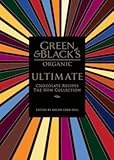
I made a batch recently using the recipe from Green & Black’s Organic Ultimate Chocolate Recipes: the New Collection. This is a book mainly about baking, and it makes my mouth water just looking at it, full of recipes for cakes, cookies, cupcakes, cheesecakes, tarts  soufflés, puddings, pies, and sweets such as truffles and chocolate marshmallows. They are all decadently chocolatey and scrumptious.

To make 24 chocolate brownies you need:

  • 300g unsalted butter
  • 300g dark (70% cocoa solids) chocolate broken into pieces
  • 5 large free-range eggs
  • 450g granulated sugar
  • 1 tablespoon vanilla extract
  • 200g plain flour
  • 1 teaspoon salt
  • Preheat oven to 180°C/gas mark 4
  • Melt butter and sugar together in a bowl over a pan of barely simmering water
  • Beat eggs, sugar and vanilla extract together until the mixture is thick and creamy and when chocolate and sugar have melted together beat in the egg mixture
  • Add flour and salted (sifted together first) and beat until smooth
  • Bake in a tin 30x24x6cm, lined with greaseproof or baking parchment for about 20-25 minutes until the top has formed a crust just starting to crack.
  • The brownie will not wobble but will be gooey inside
  • Leave in the tin for 20 minutes and then cut into 24 squares and remove from the tin

Eat and enjoy!

N.B. I wrote about Green & Black’s first cookbook in an earlier Weekend Cooking post where I described making chocolate mousse – Dark with Coffee.

weekend cookingWeekend Cooking is hosted by Beth Fish ReadsIt’s open to anyone who has any kind of food-related post to share: Book (novel, nonfiction) reviews, cookbook reviews, movie reviews, recipes, random thoughts, gadgets, fabulous quotations, photographs.  For more information, see the welcome post.