Two Short Reviews: Coffin Road by Peter May and The Wonder by Emma Donoghue

Two more short reviews as I try to catch up on the books I’ve been reading. Both are excellent books, each one with a great sense of location and descriptive writing bringing the scenes and characters vividly to life.
First, Coffin Road by Peter May, is a standalone novel, set on the Isle of Harris in the Outer Hebrides. I read it because I loved his Lewis trilogy. There are 3 strands to the story. There’s a mystery surrounding a man, washed up during a storm on a deserted beach on the Isle of Harris. He is wearing a life jacket, is battered and bruised – and has no idea who he is or where he is. The only clue to why he is living on Harris is a folded map of a path named the Coffin Road and following the route marked on the map he finds some hidden beehives that are familiar to him. In the second strand DS George Gunn investigates the murder of a bludgeoned corpse discovered on a remote rock twenty miles to west of the Outer Hebrides. And thirdly, a teenage girl in Edinburgh is desperate to discover the truth about her scientist father’s suicide.

It is fast-paced, almost impossible to put down, and full of intrigue and mystery. Each strand of the story kept me guessing, wondering what the connections between them were. It’s tense with the sense that time is running out for all the characters and I wasn’t sure whether any of them were reliable narrators or were who they appeared to be.

In addition the bees have a major role in the story. All the facts about the bees slot seamlessly into the story and I learned quite a lot about bees that I didn’t know before, especially their role in climate change.
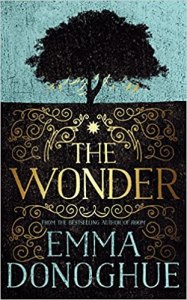
The Wonder is a very strange story. It’s uncomfortable reading, but I felt I just had to read it. And although it moves at a slow pace I read it quickly in large chunks. It is tense, full of atmosphere and just like Coffin Road, I found it almost impossible to put it down, such is the power of Emma Donoghue’s storytelling.

The plot is simple: it is set in a small village in the Irish Midlands in the 1850s. Eleven-year-old Anna O’Donnell stops eating, but remains miraculously alive and well. A nurse, Lib Wright, trained in the Crimea by Florence Nightingale, and a nun, Sister Michael are hired by a committee of influential locals to spend two weeks observing her to make sure she is not being fed secretly.

Lib observes Anna in scrupulous detail, noting Anna’s symptoms. At first she seems a healthy little girl but as the two weeks go by she develops worrying symptoms – downy cheeks, scaly skin, blue fingertips, and swollen lower limbs and hands. Lib begins to realise that it is not just a question of how Anna is managing to exist without food, but also why. What is motivating Anna to persist in saying she is not hungry and doesn’t need to eat? The answer seems to lie in her religious beliefs, and maybe religious hysteria is playing a part as well as the clash between medical science and faith. But is there more to it? Lib wonders about the family’s relationships and the effect of Anna’s brother’s death just a few months before Anna stopped eating.

As Donoghue explains in her author’s note The Wonder is an invented story, inspired by almost fifty cases of so-called Fasting Girls in the British Isles, Western Europe and North America between the 16th and 20th centuries. A film of the book is available on Netflix, but I don’t think I could bear to watch it.

The Island by Victoria Hislop: A Short Post

I have been struggling to write posts recently. I haven’t been able to settle down to writing after finishing a book, either because I’m too eager to read the next book, or like Heavenali I’ve been so distracted and mithered by other things going on in my life, mostly minor that shouldn’t really bother me, but do, that I am finding it hard to concentrate on writing.

So, that is why I haven’t written about a number of books I read earlier this year. Some of them are books that qualify for the Wanderlust Bingo CardThe Island by Victoria Hislop, The Fellowship of the Ring by J R R Tolkien, The Night of the Mi’raj by Zoë Ferraris and Coffin Road by Peter May. These aren’t the only books I’ve read that need to write about, but it’s a start.

The first one I’m writing about is The Island by Victoria Hislop, her debut novel and one of my TBRs. It’s been on my bookshelves for years and I did start reading it soon after buying it, but I didn’t get very far and put it back on my bookshelves. Since then I’ve read three other books by Victoria Hislop and enjoyed them so I decided to try it again, especially as it fills the Island Square (set in Greece) on the Wanderlust Bingo card. I began reading it in August, when I took it away with me, visiting family, but didn’t find much time to read it and had to set it to one side. After I returned home I went on to read other books until October when I picked it up once more.

It is historical fiction set in Plaka on the island of Crete and in Spinalonga, a tiny, deserted island just off the coast of Plaka. I wasn’t very sure I would like it when I read the first chapter about Alexis Fielding longing to find out about her mother’s past. Sofia had never told her anything about it and all that Alexis knew was that Sofia had grown up in Plaka, a small Cretan village before moving to London. She gave Alexis a letter to take to an old friend, Fotini, promising that through her she will learn more. And once Fotini entered the story I was hooked as she told what had happened to Sophia’s grandmother, Eleni and her daughters, Anna and Maria after Eleni caught leprosy and was sent to live on Spinalonga.

Beginning before the Second World War the story moved between Plaka and Spinalonga and I loved all the details of Elena’s life on Spinalonga, but then when the narrative moved on to describing her daughters’ lives I began to lose interest. Instead of a fascinating historical novel about leprosy it changed into a historical romance, which I didn’t enjoy as much as the earlier part of the book. Overall, I think it’s too long and drawn out, and the ending is a bit too neat. So I’m giving this book 4*, combining 5* for Eleni’s story and 2-5* for both the beginning and the ending.

I’m hoping to write similar short posts for the other three books.

White Rose, Black Forest by Eoin Dempsey

Rating: 3 out of 5.

This is the second of several short posts as I try to catch up with writing reviews of books I read earlier this year.

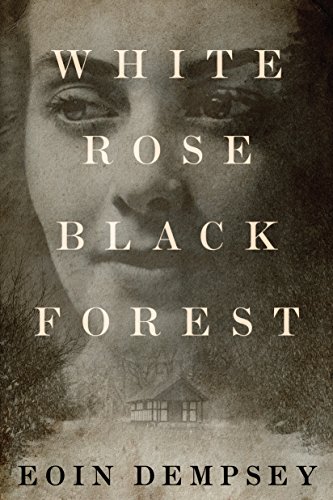
White Forest, Black Rose by Eoin Dempsey is a World War 2 novel which is different from other books set during the War that I’ve read before, told from the perspective of a German who opposed the Nazis. It is set in the Black Forest, Germany in 1943, where Franka Gerber is living alone in an isolated cabin, having returned to her home town of Freiburg after serving a prison sentence for anti-Nazi activities.

It is December and the Forest is blanketed in deep snow when she discovers an unconscious airman lying in the snow wearing a Luftwaffe uniform, his parachute flapping in the wind. Taking him back to the cabin she saves his life, but whilst he is unconscious she hears him speak in English and so it seems that he is not who she first thought he was. Both his legs are broken and, having been a nurse, Franka is able to set the bones, and tries to discover his true identity. Trapped in the cabin they both gradually reveal details of their past lives and learn to trust each other.

It is a tense, claustrophobic novel and as soon as he is able to walk they decide to leave the cabin and so begins a race against time, as they are hunted by the Gestapo. Can they trust each other enough to join forces on a mission that could change the face of the war and their own lives forever?

White Rose, Black Forest is a novel inspired by true events, although the author doesn’t clarify what is fact and what is fiction. I enjoyed it, especially the historical aspects. The White Rose movement in Germany was a non-violent intellectual resistance group in Nazi Germany, who conducted an anonymous leaflet and graffiti campaign that called for active opposition to the Nazi regime.

It slots into the Forest box in the Wanderlust Bingo card and is also one of my TBRs, a book I’ve owned since 2018.

State of Wonder by Ann Patchett

Once more I’m behind with reviews of some of the books I’ve read in June, July and August, so this is the first of several short posts as I try to catch up with writing reviews.

Rating: 5 out of 5.

I loved State of Wonder by Ann Patchett!

After a slow start I began to realise that this was a book I was really going to enjoy. In some ways it is similar to Heart of Darkness by Graham Greene, but set in the Brazilian jungle along the Rio Negro instead of the Belgian Congo in Africa. It slots into the River box in the Wanderlust Bingo card. It is also one of my TBRs, a book I’ve owned since 2015 and so qualifies for the Mount TBR Challenge.

Dr. Annick Swenson, a research scientist, is developing a drug that could alter the lives of women forever. But she refuses to report on her progress, especially to her investors, whose patience is fast running out. Anders Eckman, a lab researcher, is sent to investigate. When Dr. Swenson reported that Anders had died of a fever in a remote part of the jungle, Dr. Marina Singh, a former student of Dr. Swenson, is sent to find out what has happened to him.

From that point onwards it gets more and more complicated. First of all it’s very difficult for her to meet Dr. Swenson, and when she does eventually reach her there are all the dangers of the rain forest to deal with, including deadly snakes, hundreds of insects, mysterious natives and exotic diseases plus the intense heat. There are also secrets and lies that are only gradually revealed.

The novel raises questions about the morality and ethics of research into the use of extreme fertility treatments and drug studies in general, along with the exploitation of native populations. It is wonderfully descriptive and I could easily imagine that I was there in the jungle, experiencing the oppressive heat and humidity. I found it all fascinating and I was totally absorbed in the story.

The Night Hawks by Elly Griffiths

Quercus| 4 February 2021|e-book| Print Length 321 pages| My own copy| 4*

Synopsis:

Dr Ruth Galloway returns to the moody and beautiful landscape of North Norfolk to confront another killer. A devastating new case for our favourite forensic archaeologist in this acclaimed and bestselling crime series.

The Night Hawks, a group of metal detectorists, are searching for buried treasure when they find a body on the beach in North Norfolk. At first Nelson thinks that the dead man might be an asylum seeker but he turns out to be a local boy, Jem Taylor, recently released from prison. Ruth is more interested in the treasure, a hoard of Bronze Age weapons. Nelson at first thinks that Taylor’s death is accidental drowning, but a second death suggests murder.

Nelson is called to an apparent murder-suicide of a couple at the isolated Black Dog Farm. Local legend talks of the Black Shuck, a spectral hound that appears to people before they die. Nelson ignores this, even when the owner’s suicide note includes the line, ‘He’s buried in the garden.’ Ruth excavates and finds the body of a giant dog.

All roads lead back to this farm in the middle of nowhere, but the place spells serious danger for anyone who goes near. Ruth doesn’t scare easily. Not until she finds herself at Black Dog Farm …

My thoughts:

The Night Hawks is the 13th book in the Dr Ruth Galloway books. I’ve enjoyed the earlier books, despite the fact that they are written in the present tense. But it’s been a while since I last read one, 5 years to be precise and I’ve missed a few of them as the last one I read was the 9th book, The Chalk Pit.

So, Ruth’s life has moved on the three books I haven’t read! There is a Who’s Who of the main characters at the end of the book giving their backstories which helps if you haven’t read the earlier books, and reminded me of who they all are and their relationships.

Ruth, the central character, is now Head of the Department of Archaeology at her old university, the fictional University of North Norfolk, having been promoted after the retirement of her old boss, Phil Trent. Her replacement as the archaeology lecturer is David Brown, who Ruth finds annoying. She doesn’t really know why as they have the same academic speciality, the prehistoric era, particularly as that is partly why she employed him to teach the courses that she used to teach. She is also a special advisor to the north Norfolk police.

Her complicated relationship with Detective Chief Inspector Nelson, the father of her daughter, Kate, now ten years old, continues in this book. Nelson thinks of himself as an old-fashioned policeman. But Superintendent Jo Archer is keen to bring the force into the twenty-first century and wants him to retire. He dismisses that idea, maintaining that the police force needs his experience and know-how. He has no plans to retire and avoids talking to her whenever he can.

A body is found on the beach at Blakeney Point, a young man who Nelson guesses is an illegal immigrant, an asylum seeker, and then a skeleton, buried in a mound of what appears to be Bronze Age weapons, discovered by the group known as the Night Hawks when they were searching for buried treasure.

The police are also investigating what at first appears to be a case of murder-suicide at Black Dog Farm, an isolated farm said to be haunted by the Black Shuck. Shuck is the name given to an East Anglian ghostly black dog that is said to roam the coastline and countryside of East Anglia, a large, shaggy dog said to be an omen of death. And there had been quite a few sightings of such a dog near Black Dog Farm.

I was thoroughly entertained by this mystery, glad to get re-acquainted with Ruth, her family and her friends and colleagues. There is a really strong sense of place, so much so that I could easily visualise the scenes and gain a sense of what it’s like to be there at the beach, with the shingle and the sand dunes at Blakeney Point and the north Norfolk countryside.

I hope to read books I’ve missed, namely The Dark Angel, The Stone Circle and The Lantern Men, before too long, and then the 14th in the series, The Locked Room.

A Town Like Alice by Nevil Shute

Rating: 4 out of 5.

First published in 1950 A Town Like Alice by Nevil Shute is one of those books I’ve been meaning to read for years and now I have at last read it. It was not quite what I had imagined it to be, about Alice Springs in Australia. It is actually set in three parts, with just the third part set in Australia, not in Alice Springs but in Willstown, a fictional town in the outback.

Narrated by Noel Strachan, a solicitor, this is the story of Jean Paget. It begins a few years after the Second World War, when he tells her she has inherited a considerable sum of money from her uncle. But it is held in trust until she reaches the age of thirty five. Until then she will receive about £900 a year to spend. She wonders what to do with the money and eventually decides she wants to go back to Malaya, where she had been a prisoner of war, to dig a well. She tells Noel about what had happened to her in Malaya.

The second part is about that time in Malaya during the War at the time when the Japanese invaded the island. Jean and a group of European women and children were forced by the Japanese to walk for hundreds of miles from place to place before finally managing to stay in one village. Able to speak Malay and being courageous and resourceful, she takes on the role of the leader of their group. She met an Australian soldier, Sergeant Joe Harman, also a prisoner, who was driving a lorry for the Japanese and they became friends with disastrous consequences. This section is the best in the book to my mind.

On her return after the War she writes to Noel telling him how she set about organising the villagers to dig the well so that the women would have fresh water close to their houses and also build a washing-house. And it is here that she learns more about what had happened to Joe and decides to carry on travelling to Australia to find him and thank him for the help he had given her and the other women.

The third part is set in Australia. Jean is an organiser and on her arrival in Willstown she discovers that this is a place where the young women leave as soon as they are old enough. There are no jobs or entertainment to keep them there. So Jean decides she wants to make the town into a town just like Alice Springs. And she does this with remarkable success building a workshop for the girls to make shoes and handbags, providing an ice cream parlour and a public swimming pool and shops. At the same time her search for Joe is eventually successful. She continues writing to Noel about her life in the Australian outback, letters full of detail about her enterprises and the difficulties of cattle ranching in such isolated places – a bit too much detail for me really. But the episode where Jean helped in rescuing an injured stockman is full of drama.

This is really just the bare bones of the story – there is so much more to it than that. Others have commented on the casual racism in the book. It tells it as it was, how people lived at the time, and reflects the attitudes that people had. Jean is of course the main character, a woman somewhat ahead of her time with great strength of character, determination and entrepreneurial skills. The resourcefulness she showed in Malaya is developed in Australia.

In his Author’s Note Shute explains that the forced march during WW2 took place in Sumatra and not in Malaya and the women in the group were Dutch and not British. As in his novel, the local Japanese commander was reluctant to assume responsibility for these women and, to solve his problem, marched them out of his area and took them on a trek all around Sumatra that lasted for two and a half years.

Jean Paget was based on Mrs Geysel, whom Shute had met when he visited Sumatra in 1949. She had been one of the Dutch party, then aged 21, recently married and with a young baby she had carried for over twelve hundred miles around Sumatra. A remarkable story that I really enjoyed.