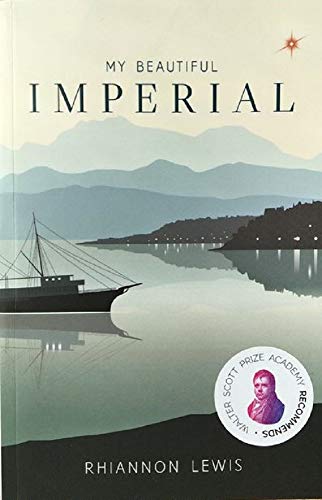
My Beautiful Imperial by Rhiannon Lewis

I’m cutting this fine as today is the last day of the Reading Wales Month 2025 hosted by Karen at BookerTalk.  Yesterday I posted my review of Resistance by Owen Sheers. I’ve also read My Beautiful Imperial by Rhiannon Lewis, a book that was a Mother’s Day present from my son, a few years ago. It was her debut novel and was listed by the Walter Scott Prize Academy as one of its 20 recommended historical novels of 2018. Originally from Cardigan, she now lives near Abergavenny. This short post really does not do justice to this beautiful book. I can only say that to realise how excellent it is, is to read it for yourself!

Victorina Press| 2017|395 pages| e-book |5*


I loved My Beautiful Imperial. It’s historical fiction set in the 19th century in both Wales and Chile. It begins in Wales in March 1865 with Davy Davies, a young teenager who is at the age when he must decide whether to work at the mill or to be a sailor like father, the captain of the Ellen of Cardigan. Life at home for him changed for ever after his young sister, Elen, was killed when their barn caught fire and his mother wrongly blames him for Elen’s death, and so he leaves home and he sets sail on the Royal Dane. As time went by he worked his way up the ranks until he became Captain of the Imperial, a steamship transporting mail and cargo up and down the Chilean coast. Then in 1891 his life changed when civil war broke out in Chile and his ship was commandeered by the government under President Balmaceda, to carry arms and transport troops.

It captured my imagination completely. I was caught up in this story of friendship, love, war and the dangers of life at sea and during the civil war in Chile history. It’s well written, so much so, that I didn’t want to put the book down. What makes it even more enjoyable is that Davy’s story is based on the actual events of the Civil War in Chile and the experiences of the author’s ancestor, Captain David Jefferson Davies. Rhiannon Lewis spent twenty years researching his life beginning with a book of etchings and an old photograph album. She discovered new evidence and has tried to make her book as historically accurate as possible, stating in her Author’s Note that it is ‘ultimately a novel and a work of fiction.’

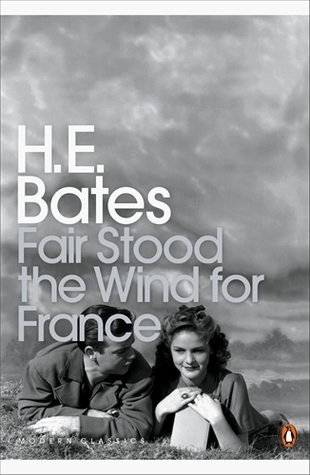
Fair Stood the Wind for France by H E Bates

Synopsis

When John Franklin brings his plane down into Occupied France at the height of the Second World war, there are two things in his mind – the safety of his crew and his own badly injured arm. It is a stroke of unbelievable luck when the family of a French farmer risk their lives to offer the airmen protection. During the hot summer weeks that follow, the English officer and the daughter of the house are drawn inexorably to each other…

My thoughts:

I bought Fair Stood the Wind for France by H E Bates in October 2018 when it caught my eye in Barter Books in Alnwick, mainly because of the title, which appealed to me. I knew nothing about it, but as it’s one of Penguins Modern Classics I added it to my Classics Club booklist. It’s my Classics Club Spin book for December, which is why I’ve read it recently.

I’m in two minds about this book. It begins really well and I was totally gripped by the first part of the book describing Franklin’s flight, with his crew of four sergeants, over France then the Alps and on to Italy. On his return flight when they were over France, they began to dive, rapidly losing height and he knew that the port engine had gone. The air screw (that’s a propeller) had broken, meaning they wouldn’t make it back to England and they crash landed somewhere in the countryside. They thought they were about west-north-west of the Vosges. From then onwards the story covers the period when Franklin whose arm had been very badly injured was cared for by Francoise and her family, hidden in their farmhouse. He falls in love with Francoise and she agrees to help him escape and marry him when they reach England.

But from then on as they made their way through Vichy France and eventually to Marseilles I felt the story dragged and I lost much of the interest I had had in the first part. Even though they encountered much danger and the tension rose, the action slowed down too much. I was relieved to finish the book.

As it was written and initially serialized weekly in the Saturday Evening Post from March 18 to May 6, 1944, and in Woman’s Journal (May-July 1944), it does give a contemporaneous account of the war portraying all dangers and the hardships they endured. It is really an extended short story, a love story, but one that didn’t particularly convince me. However, it does contain some beautiful descriptions of the French countryside and I loved the drama of the first part of the book.

  • Published by Penguin in paperback it’s also available as an e-book, published in 2005.
  • My Rating: 3.5 stars

Mini Reviews

I’ve been reading almost non-stop and not pausing long enough to write proper reviews, so it’s time for a brief look at some of the books I’ve read. These notes are not as detailed as I usually write, but when you read quickly this is the result!

Friend of the Devil by Peter Robinson, the 17th DCI Banks book 4*

Inspector Alan Banks and his team, the Western Area Major Crimes Squad, investigate the murder of 19-year-old Hayley Daniels who was found raped and strangled in the Maze, a tangle of narrow alleys behind Eastvale’s market square, after a drunken night on the town with a group of friends. There are plenty of suspects and it’s a matter of looking at who was where and when to find the murderer. It wasn’t who I thought it was.

DI Annie Cabbot, on loan to the Eastern area, is assigned to look into the murder of Karen Drew, a quadriplegic, who was found dead in her wheelchair on a seaside cliff. It’s only when Annie discovers the real identity of Karen Drew, that the question of why anyone would want to murder a quadriplegic, becomes clear. But who could have done it? Annie has to revisit an earlier case to find the culprit.

Although this can be read as a stand-alone novel, part of the enjoyment in reading the series in order is that you see the development of the main characters and their relationships over the years. The books are basically police procedurals but along the way there’s a lot about Alan and Annie as people rather than police officers. I have become fond of the regular characters in these books.

Watching the Dark by Peter Robinson, the 20th DCI Banks book 4.5*

This is the description on Goodreads: DCI Alan Banks reluctantly investigates DI Bill Quinn with Inspector Joanna Passero. Quinn, convalescing at St Peter’s Police Treatment Centre, was killed by a crossbow on the tranquil grounds, and left compromising photos. Quinn may be disreputable, linked to a vicious crime in Yorkshire and to a cold case – English Rachel Hewitt 19 vanished in Estonia six years ago.

Banks is not happy about this investigation, not only at the murder of one of their own officers, but because of the involvement of Joanna Passero who seems to him to be determined to prove that Quinn was a corrupt cop.

The team’s investigations lead them to a group smuggling illegal immigrants from Eastern Europe into the UK, taking Banks and Passero to Tallin in Estonia, whilst Annie heads the investigation in the UK. It’s remarkably complex. It’s also long, with many twists and turns, and it became too repetitive in the middle of the book, which is why I haven’t given it 5 stars. But I did enjoy it more than Friend of the Devil, especially the setting in Estonia. Robinson’s books are all definitely grounded in their settings, whether they’re in Yorkshire, Estonia, or elsewhere.

I have now read 20 of the 28 DCI Banks books.

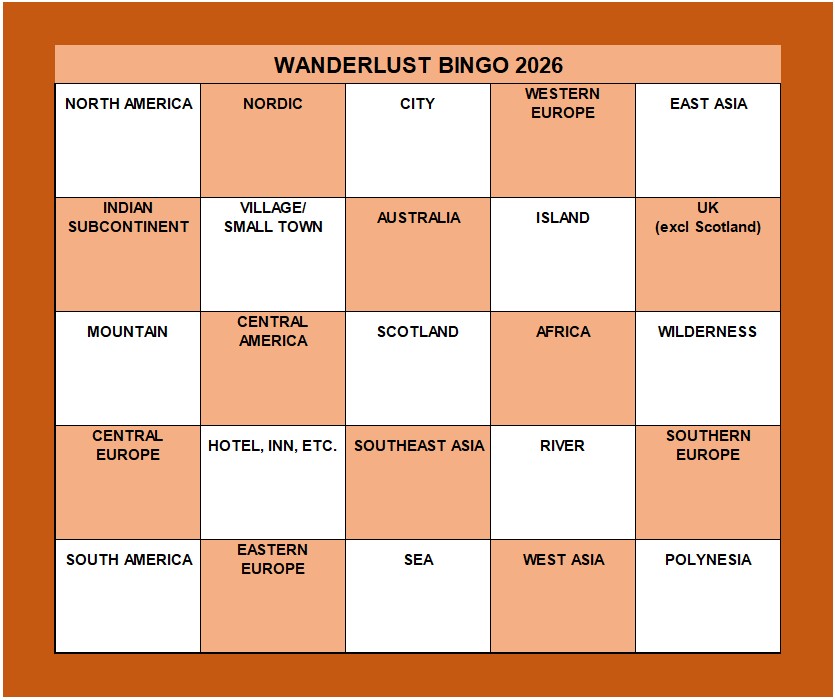
I think the setting in Estonia means I can add Watching the Dark to the Wanderlust Bingo card in Central/Eastern Europe square.

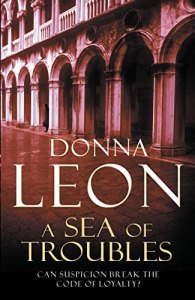
A Sea of Troubles by Donna Leon

A Sea of Troubles is Donna Leon’s 10th Commissario Guido Brunetti novel. I’ve been reading them out of order of publication on and off for several years now and this book is the earliest one in the series that I’ve read. Her books are crime fiction, but also discuss various social and cultural issues and A Sea of Troubles is no exception. 

Brunetti is one of my favourite detectives. He is happily married with two children. He doesn’t smoke or drink to excess and often goes home for lunch to his beautiful wife Paolo, who is a wonderful cook – in this book she treats him to a delicious apple cake made with lemon and apple juice and ‘enough Grand Marnier to permeate the whole thing and linger on the tongue for ever.’ (page 238)

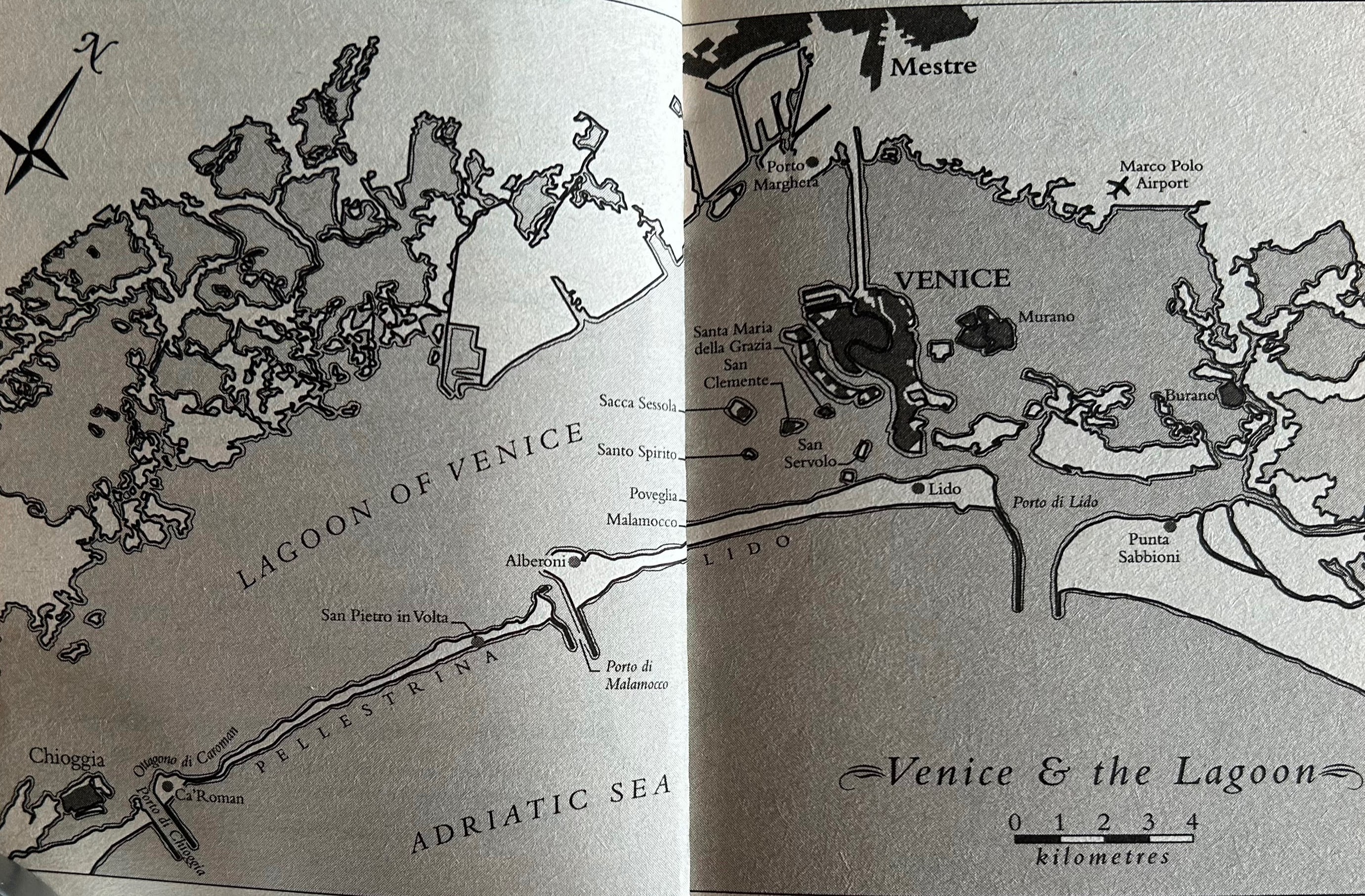
I read it eagerly, keen to get to the bottom of the mystery surrounding the deaths of two clam fishermen, father and son, off the island of Pellestrina, south of the Lido on the Venetian lagoon, when their boat suddenly exploded. As well as the mystery the issues Leon highlights in this book are concerning pollution and the overfishing of clams that is destroying the clam beds.

I was fascinated by the island, never having heard of it before. It’s a long and narrow island (11 km long, and 25 to 210 metres wide) that separates the Venetian Lagoon from the Adriatic Sea. Fishing is the primary source of income and alongside the inner side of the thin peninsular are scores of vongolari, the clam fishing boats.

Pellestrina is a closely knit community, the islanders bound together by a code of loyalty and a suspicion of outsiders. Brunetti is finding it difficult to penetrate their silence, as even though he is a Venetian, he is regarded by the islanders as an outsider, a foreigner. So when his boss’s secretary, the ever-resourceful Signorina Elettra, volunteers to visit her cousin who lives in the village there to see what she can find out, he lets her go. And then is most concerned when she falls for a young man on the island. And Paola begins to question why he is so interested in Elettra, having noticed that he had thought about little else than her for over a week. He then realises his feelings for Elletra are not so straightforward after all.

However, the crime still needs resolving and Brunetti finds himself in a web of political intrigue, corruption and secrets. From a slow start the ending is dramatic and action packed with Brunetti and Elletra in danger of their lives.

  • Publisher ‏ : ‎ Arrow; 1st edition (26 Feb. 2009)
  • Language ‏ : ‎ English
  • Paperback ‏ : ‎ 336 pages
  • Source: I bought it
  • My rating: 5*

Elizabeth Macarthur by Michelle Scott Tucker

In 1788 a young gentlewoman raised in the vicarage of an English village married a handsome, haughty and penniless army officer. In any Austen novel that would be the end of the story, but for the real-life woman who became an Australian farming entrepreneur, it was just the beginning.

John Macarthur took credit for establishing the Australian wool industry and would feature on the two-dollar note, but it was practical Elizabeth who managed their holdings—while dealing with the results of John’s manias: duels, quarrels, court cases, a military coup, long absences overseas, grandiose construction projects and, finally, his descent into certified insanity.

Michelle Scott Tucker shines a light on an often-overlooked aspect of Australia’s history in this fascinating story of a remarkable woman.

My thoughts

Two years ago I read A Room Made of Leaves by Kate Grenville, historical fiction telling the story of Elizabeth and John Macarthur, who settled in Australia at the end of the eighteenth century, which made me keen to find out more about them. In particular it was the epigraph ‘ Believe not too quickly‘, which is a quotation from one of Elizabeth’s letters, that highlighted for me that A Room Made of Leaves is a work of fiction. And then I came across Michelle Scott Tucker’s biography: Elizabeth Macarthur: A Life at the Edge of the World and I was delighted to see that Kate Grenville references this book as the standard biography in her Acknowledgements. So I bought a copy.

Elizabeth was born on 14 August 1766 in Devon, England and she married John Macarthur in October 1788. In June 1789 they sailed with their first child, Edward, initially on the Neptune, and then on the convict ship Scarborough to New South Wales where John joined his regiment, the New South Wales Corps, in the recently established colony of New South Wales. They went on to have four more sons, James (1793-1794), John (1794-1831), James (1798-1867) and William (1800-1882), and three daughters, Elizabeth (1792-1842), Mary (Mrs Bowman, b.1795) and Emmeline (b.1808).

For sixty years, Elizabeth ran the family farm in Parramatta, west of Sydney town – on her own during her husband’s long absences abroad, four years during her husband’s first absence, and nine years during the second, when she was responsible for the care of their valuable merino flocks, as well as the Camden Park estate and the direction of its convict labourers. By the time Macarthur came back from that second absence, he was overwhelmed by mental illness, and they spent the last few years of his life apart. He died in 1834. The house and gardens of her farm, aptly named ‘Elizabeth Farm’ is now an ‘access all areas’ museum. In 1850, she died in her daughter and son-in-law’s house at Watson’s Bay outside Sydney, overlooking the Pacific Ocean.

I was interested to see how the biography differed from Kate Grenville’s novel. Both interpret the facts, based on Elizabeth Macarthur’s letters, journals and official documents of the early years of the New South Wales colony, trying to explain what happened and why, dependent on the available evidence. However, fiction is more flexible than a biography and can fill in the gaps where the documentary evidence is lacking. And Kate Grenville has used her storytelling imagination in filling in the gaps in the records, in particular about her relationship with William Dawes, an astronomer with the Corps, who was mapping the night sky. He had an observatory near Elizabeth’s farm and it was there that she attempted to learn from him about astronomy. However, in A Room Made of Leaves, Kate Grenville embellishes the basic facts, whilst exploring what it could have been that made Elizabeth ‘blush at my error‘, as she described it in a letter to her friend, Bridget, claiming she had mistaken her abilities and she ended her astronomical studies. Michelle Scott Tucker comments that the evening visits to Dawes’ observatory were open to misinterpretation, whereas Kate Grenville’s version is much more explicit as she imagines what might have happened. Her book, whilst it is based on history is fiction, as she makes clear in her Author’s Note at the end of the book.

I have only just skimmed the surface of this book – there is so much more detail about the landscape, the indigenous population, the disputes between various sections of the colony, about farming and the establishment of the wool industry, not forgetting the details of the Macarthur family members, illnesses, and the position of the women within the community – Elizabeth wasn’t the only colonial woman who was responsible for her family farm. She was resourceful, a good farm manager and business woman, was respected within the colony, and was loved by her family. There are a number of reasons I recommend this book. There is a ‘Select Bibliography’ which looks comprehensive to me, copious notes citing sources and a family tree. It is thorough, well researched and It provides an insight into the early years of Australia’s colonial history and it is an extremely readable biography of a fascinating woman.

The Dancing Bear by Frances Faviell

Rating: 5 out of 5.

The Dancing Bear by Frances Faviell took me by surprise by how much I enjoyed it. I wasn’t expecting it to be so good.

Frances Faviell (1905-1959) was the pen name of Olivia Faviell Lucas, painter and author. After the war, in 1946, she went with her young son, John, to Berlin where Richard Parker, her second husband, had been posted as a senior civil servant in the post-war British Administration. It was here that she befriended the Altmann family, which prompted her first book The Dancing Bear (1954), a memoir of the Occupation seen through the eyes of both occupier and occupied. She later wrote three novels, A House on the Rhine (1955), Thalia (1957), and The Fledgeling (1958). These are now all available as Furrowed Middlebrow books.

The Dancing Bear covers the years from Autumn 1946 to Autumn 1949, with an Epilogue dated Autumn 1953 and, in this edition, an Afterword by John Parker, Faviell’s son. Her memoir is mainly about her friendship with the Altmann family – Frau Maria Altmann, her husband, Oskar and her children, Ursula, who works for a group of American service men, Lilli, a ballet dancer and son, Fritz, who was a member of the Hitler Youth and is now involved in the Black Market. Their eldest son. Kurt. is missing in Russia. Berlin had been divided into four sectors by the Allies – Britain, the United States, France and the Soviet Union – and Frances is horrified by the conditions she found. There were deaths from hunger and cold as the winter approached and queues for bread, milk, cigarettes, cinemas, buses and trams.

The complete and utter devastation of Berlin had shaken me profoundly. Nothing … had prepared one for the dead horror of this city. (page 15)

The complete absence of shops was something the Allied and German women felt. There was scarcely a single shop left standing in Berlin. The great stores and emporiums lay in dust, as did the great blocks of flats. One could not get the simplest articles except on the Black Market, and then only in exchange for cigarettes and coffee which had taken the place of money. (page 166)

The Altmanns live on the ground floor of a large ruined house – the upper storeys had disappeared and just the twisted iron girders remained, sticking up grotesquely against the sky. The ground floor looked very shaky and the windows were covered in cardboard and the door had been repaired from odd pieces of wood. It was freezing cold, and although they had a stove they had no fuel to light it and because electricity was rationed they had to use candles. There were two bedrooms, a small kitchen, a sitting room and a bathroom. With the help of her driver, Stampie, she does what she can to help them.

The British, unlike the Americans were forbidden to be friendly with the Germans, or to allow them in their homes or any of their buildings, clubs or messes and also to give them lifts, but these rules were frequently broken. At night Berlin ‘became a whirl of revelry’:

But if Berlin was a tragic city by day; at night it became a whirl of revelry. The Allies entertained on a scale which was extraordinary in a starving town, and if one went down to the Kurfurstendamm or the Kaiserdamm at night every cafe and night club was packed with revellers. (page 63)

I have only touched the surface of this book in this short post. It’s a moving memoir and I was fascinated by it all – the people, their situations, and their morale and attitudes as well as the condition of Berlin in the aftermath of World War Two. The realities of living under occupation are clearly shown, as well as the will to survive despite all the devastation and deprivation. I now want to read more of Frances Faviell’s books.

  • ASIN ‏ : ‎ B01M12EH2E
  • Publisher ‏ : ‎ Dean Street Press (3 Oct. 2016)
  • Language ‏ : ‎ English
  • Print length ‏ : ‎ 311 pages
  • My Rating: 5*