Notre-Dame de Paris by Victor Hugo

I have an old hardback copy of The Hunchback of Notre Dame (first published in 1831) in a very small font, too small for my eyes to cope with these days and a 49p e-book that I downloaded years ago when first got a Kindle. But I didn’t start reading it until a few months ago when FictionFan mentioned she was intending to read it and hold a Review-Along on her blog. I knew next to nothing about the book, not having seen any of the many films or TV versions, but I had read Victor Hugo’s Les Misérables back in 2008 and enjoyed it very much. So, I had high expectations that I would enjoy this one too.

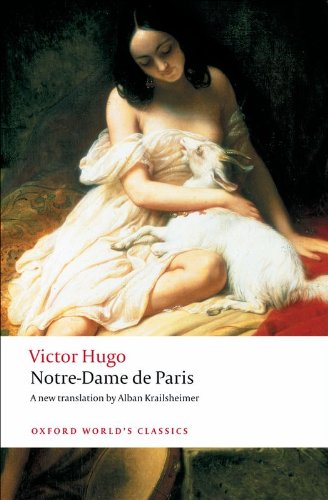
But when I began reading my e-bookI was so disappointed – I thought it was so boring and it was hard to read, the sentences stilted and stumbling and obtuse with no flow. I was tempted to abandon it, after all it is a long book, and there are plenty of other books I want to read. However, I persevered, thinking surely it would get better. It didn’t, so then I wondered if it was me or the translation and began to look for another edition and I ended up with the Oxford World Classics edition, translated and with an introduction by Alban Krailsheimer, Notre-Dame de Paris, which is so much better, so much easier to read!
Rating: 3 out of 5.

The English title is so misleading – this book is not just about the hunchback Quasimodo, the bell-ringer of Notre-Dame, it is historical fiction on a grand scale, with a large cast of characters. It revolves around four main characters – the beautiful gypsy dancer, Esmeralda who fell hopelessly in love with the handsome womaniser, Captain Phoebus de Châteaupers, who has no intentions of marrying her. She in turn is loved by Frollo, the Archdeacon of Notre-Dame and by Quasimodo, the deformed and deaf bell-ringer of the cathedral of Notre-Dame.

But that is not all – it is also the story of the cathedral itself, Notre-Dame de Paris, and Hugo describes it at great length, focusing on the Gothic architectural elements of its structure, particularly its use of the pointed arch and including its flying buttresses, clerestory windows, and stained glass. He was a great advocate for the preservation of its Gothic architecture and was also extremely upset about the changes to the cathedral, the repairs and additions that had been done over the years. And it is not just the cathedral, Hugo also devotes many pages to describing Paris, seeing it from a bird’s eye view and also to the invention of the printing press and its effect on culture, described by Hugo as ‘the greatest event in history’. These digressions were not what I expected to read – I just wanted to get on with the story. I was impatient with the digressions, but looking back at Les Mis, that is exactly what he had done in that book too, so I shouldn’t have been surprised.

The story of the main characters’ relationships is told in a complicated way, going forward and backward in time, filling in the background of the characters, whilst revolving around the events of 1482, during the reign of Louis XI (who makes an appearance in the book). And it is melodramatic, playing on all our emotions. Quasimodo was so named because he was found, abandoned on Quasimodo Sunday (that is the second Sunday after Easter) when he was four years old. He was ‘adopted’ by the sinister Archdeacon, Claude Frollo, and grew up in the cathedral, isolated by his deafness caused by all the years he’d spent ringing the bells, and feared because of his hideous appearance.

This book has everything! It is by turns a farcical comedy, a tale of obsessions and unrequited passions, of love and lust, of a terrible miscarriage of justice, of outsiders, of violent mobs, of cruelty, arrogant men, silly women, of monsters, of alchemy, of intolerance, of prejudice, jealousy, fury, torture, corruption and above all of tragedy. And it has a cast of colourful and distinct characters, that I either despised, loved or hated, including Esmeralda’s little goat Djali, who could dance and do tricks and spells (I loved Djali). It is difficult for me to love the book and equally as hard to dislike it as a whole, set firmly in its medieval time frame, against the dramatic backdrop of the cathedral (even though I grew impatient with all the architectural details). But I was convinced by the end of the book that Hugo had successfully brought the place and the people of 1482 dramatically to life for me.

My apologies to FictionFan for being nearly a week late to her Review-Along and thanks for nudging me into reading Notre-Dame de Paris at long last. I am glad I read it even if I can’t give it more than 3 stars – I  liked it, a good, enjoyable book.
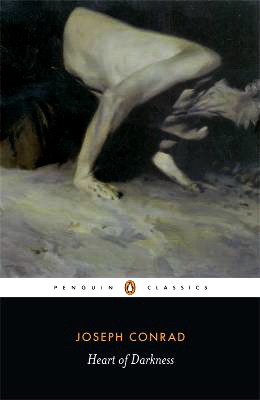
Heart of Darkness by Joseph Conrad

Rating: 3 out of 5.

Heart of Darkness, a novella by Joseph Conrad, was originally a three-part series in Blackwood’s Magazine in 1899. Although a gripping story, this was not an enjoyable book for me. But then, I suppose, it is not meant to be. Conrad was writing about the inhumanity of the way the native population in Africa was treated; the greed and cruelty of the Europeans to gain property, business, trade and profit, draining Africa of its natural resources. It paints an appalling picture.

It is a story within a story and has an inner core of mystery. It relates the story told by Charlie Marlow to his friends on a cruising yawl on the Thames as the day ended and dusk fell. He began by saying ‘this also … has been one of the dark places of the earth.‘ He was referring to the Roman invasion of the British Isles centuries earlier, feeling the utter savagery that closed around them as they set out to conquer the land.

Then he went on to tell them about another ‘dark place‘ where he worked as the skipper of a river steamboat, travelling up and down an unnamed mighty African river (assumed to be the Congo) between the stations of an ivory trading business. He hears about the mysterious Mr Kurtz, the ivory trading company’s agent in the interior. He was said to have supernatural powers. What happened to Kurtz, or rather, what Kurtz did, and what he became, were the questions I pondered as I read on. Marlow set out to find Kurtz, which took him deep into the jungle, and also deeper into the heart of the ‘Dark Continent’ and into the darkness of the human soul. Nothing is what it seems, and the mystery surrounding Kurtz has a feverish and nightmare atmosphere. The ambiguity and the vagueness left me feeling puzzled as well as horrified at what was implied. I think it is all the more horrific for not being crystal clear.

It is an horrific tale that I think shows the darkest depths of human behaviour. In doing so Conrad highlights the prejudices and the cruelty and shows how it was at that time – the graphic reality of what happened. It is a powerful criticism of colonialism at its worst, and full of imagery, casting a spotlight on the barbarity of the so-called civilised Westerners. These few words, uttered by Kurtz concisely summarise the whole story: ‘The horror! The horror!’

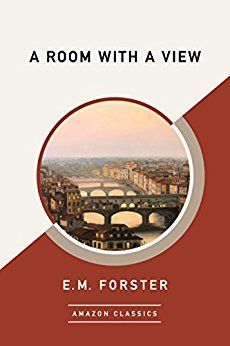
Book Beginnings & The Friday 56: A Room with a View by E M Forster

Every Friday Book Beginnings on Friday is hosted by Gillion at Rose City Reader where you can share the first sentence (or so) of the book you are reading. You can also share from a book you want to highlight just because it caught your fancy.

This week I’ve started to look at A Room with a View as this is the book I’ll be reading next for the Classics Club Spin. It was first published in 1908, set in Italy and England about a young woman, Florence and was E M Forster’s third book.

The Book Begins in Florence:

‘The Signora had no business to do it, said Miss Bartlett, ‘no business at all. She promised us south rooms with a view close together, instead of which here are north rooms, looking onto a courtyard, and a long way apart. Oh, Lucy!’

Also every Friday there is The Friday 56, hosted by Freda at Freda’s Voice, where you grab a book and turn to page 56 (or 56% of an eBook), find one or more interesting sentences (no spoilers), and post them.

Page 56:

The well-known world had broken up, and there emerged Florence, a magic city where people thought and did the most extraordinary things. Murder, accusations of murder, a lady clinging to one man and being rude to another – were these the daily incidents of her streets?

Synopsis from Goodreads:

Set in freewheeling Florence, Italy, and sober Surrey, England, E. M. Forster’s beloved third novel follows young Lucy Honeychurch’s journey to self-discovery at a transitional moment in British society. As Lucy is exposed to opportunities previously not afforded to women, her mind – and heart – must open. Before long, she’s in love with an “unsuitable” man and is faced with an impossible choice: follow her heart or be pressured into propriety.

A challenge to persistent Victorian ideals as well as a moving love story, A Room with a View has been celebrated for both its prescient view of women’s independence and its reminder to live an honest, authentic life.

I think I’m going to enjoy this book.

The Classics Club Spin Result

The spin number in The Classics Club Spin is number …

which for me is A Room with a View by E M Forster. The rules of the Spin are that this is the book for me to read by 30th April, 2022.

This has been on my Classics Club List for ages, so it’s time I read it – I think I saw the film years ago.

Set in freewheeling Florence, Italy, and sober Surrey, England, E. M. Forster’s beloved third novel follows young Lucy Honeychurch’s journey to self-discovery at a transitional moment in British society. As Lucy is exposed to opportunities previously not afforded to women, her mind – and heart – must open. Before long, she’s in love with an “unsuitable” man and is faced with an impossible choice: follow her heart or be pressured into propriety.

A challenge to persistent Victorian ideals as well as a moving love story, A Room with a View has been celebrated for both its prescient view of women’s independence and its reminder to live an honest, authentic life. (Goodreads)

Did you take part in the Classics Spin? What will you be reading?

Classics Club Spin

It’s time for another Classics Club Spin.

I have a new list, so plenty to choose from for this spin list. Before next Sunday, 20th March create a post that lists twenty books of your choice that remain “to be read” on your Classics Club list.On that day the Classics Club will post a number from 1 through 20. The challenge is to read whatever book falls under that number on your Spin List by 30th April, 2022.

Here’s my list:

  1. Sense and Sensibility by Jane Austen
  2. Another Part of the Wood by Beryl Bainbridge
  3. The Mousetrap and Selected Plays by Agatha Christie
  4. Heart of Darkness by Joseph Conrad
  5. The Case of the Gilded Fly by Edmund Crispin
  6. The Stars Look Down by A J Cronin
  7. Moll Flanders by Daniel Defoe
  8. Nicholas Nickleby by Charles Dickens
  9. The Black Tulip by Alexandre Dumas
  10. The Birds and other short stories by Daphne du Maurier
  11. A Room with a View by E M Forster
  12. Brighton Rock by Graham Greene
  13. Strangers on a Train by Patricia Highsmith
  14. The Hunchback of Notre Dame by Victor Hugo
  15. Go Set a Watchman by Harper Lee
  16. A Town Like Alice by Neville Shute
  17. On the Beach by Nevil Shute
  18. Tortilla Flat by John Steinbeck
  19. The Invisible Man by H G Wells
  20. Between the Acts by Virginia Woolf

I ‘d really like The Hunchback of Notre Dame by Victor Hugo to be picked as that is a book I’ll definitely be reading for FictionFan’s Review-Along to be reviewed on 20th April – that would be my ideal choice. Failing that, I’d like a shorter book! Maybe The Birds and other short stories by Daphne du Maurier. Any of one them would be OK, although I probably wouldn’t be able to finish it in time …

So, I’ll be looking out for number 14!

Nineteen Eighty-Four by George Orwell

3*

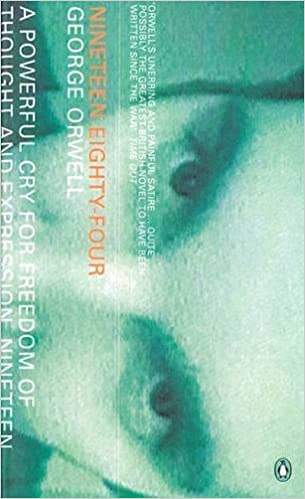
I bought a paperback copy of Nineteen Eighty-Four (its original title) in 2008, but have only just read it. It is George Orwell’s last novel, written in 1948 and presents his vision of a dystopian society, a totalitarian state complete with mass surveillance, where individuality is brutally suppressed.

Synopsis from the back cover:

In Orwell’s frightening vision of the future, society is under the control of Big Brother. Every aspect of life is closely monitored, whilst any hint of unorthodoxy is ruthlessly suppressed by the Thought Police. The Ministry of Truth, where Winston Smith works, is the Party’s Propaganda Machine. A secret rebel, Winston yearns for liberty and finds new hope when he falls in love with the earthy, uncomplicated Julia. Instead he discovers a nightmare world of terror where the price of freedom is betrayal.

Winston Smith’s attempt to find liberty and individuality plunges him into a truly horrific version of hell. The world is ravaged by war with three superstates, Oceania, Eurasia and Eastasia battling for total control. Winston lives in Airstrip One (Britain) in Oceania. His job is to rewrite history and destroy the old records, in accordance with the current circumstances. He secretly opposes the Party’s rule, led by the mysterious Big Brother, and dreams of rebellion. But faced with the Thought Police, the Hate Week sessions the surveillance through the television screens, cameras and hidden microphones monitoring his every move and thought, he realises it is a futile hope and that he is likely to be caught.

This really is the most depressing book and in places it is boring, especially in the middle section of the book devoted to Goldstein’s book. Goldstein, the leader of the Opposition Party to Big Brother, is always the subject of hatred at the Hate Week sessions. There are also passages that I could hardly bear to read – torture scenes that I did not want to visualise – it is a harrowing book. But it was interesting to see where the terms, Big Brother is Watching You, Room 101 (you do not want to be sent there!) Thought Police, Newspeak, Doublethink, holding two contradictory thoughts at the same time, and Thoughtcrime originated.

Nineteen Eighty -Four has received very many accolades and 94% of the people who have rated it on Goodreads ‘liked’ it – 79% giving it 5 or 4 stars .This is possibly the least enjoyable book I’ve read, horrific in content, lacking in convincing characterisation, and has a poor plot. It is depressing and dreary in the extreme, but I can see why it can be considered a brilliant book in its depiction of a dystopian society. It is seriously thought provoking!

‘George Orwell’ was the pen name of Eric Arthur Blair (25 June 1903 – 21 January 1950). He ‘was an English author and journalist. His work is marked by keen intelligence and wit, a profound awareness of social injustice, an intense opposition to totalitarianism, a passion for clarity in language, and a belief in democratic socialism.’ (Goodreads)