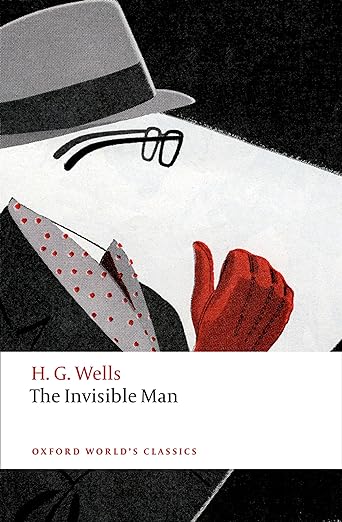
The Invisible Man by H G Wells

The Invisible Man is my Classics Club spin book The rules of the Spin are that this was the book for me to read by 3rd March 2024 and I did. In fact I finished it about two weeks early and only got round to writing about it a few days ago. The Invisible Man was first published in 1897, a science fiction novel, originating in Pearson’s Weekly. But it was not quite what I expected. And I certainly didn’t expect it to turn into slapstick comedy.

Synopsis from Amazon

‘The man’s become inhuman … He has cut himself off from his kind. His blood be upon his own head.’

One night in the depths of winter, a bizarre and sinister stranger wrapped in bandages and eccentric clothing arrives in a remote English village. His peculiar, secretive activities in the room he rents spook the locals. Speculation about his identity becomes horror and disbelief when the villagers discover that, beneath his disguise, he is invisible.

Griffin, as the man is called, is an embittered scientist who is determined to exploit his extraordinary gifts, developed in the course of brutal self-experimentation, in order to conduct a Reign of Terror on the sleepy inhabitants of England. As the police close in on him, he becomes ever more desperate and violent.

In this pioneering novella, subtitled ‘A Grotesque Romance’, Wells combines comedy, both farcical and satirical, and tragedy – to superbly unsettling effect. Since its publication in 1897, The Invisible Man has haunted not only popular culture (in particular cinema) but also the greatest and most experimental novels of the twentieth century.

My thoughts

Griffin, a scientist, is a stranger to the village of Iping in West Sussex, staying at the Coach and Horses Inn. His story is a sad one. Whilst experimenting he has managed to make himself invisible, and dresses from top to toe in clothes, which even in winter makes him stand out from the crowd. Everything he does leads everyone to wonder what is wrong with him and draws attention to himself. What follows grows in intensity, as Griffin causes first confusion, then panic and finally madness. There’s a lot of shouting, pushing and fighting and surprisingly (to me at any rate) quite a lot of comedy – after all the invisible man is as naked as a new born baby.

I enjoyed it. There’s not much to the plot, it’s mainly a character study really, but what an amazing personality. And being invisible is not what he had thought – having to walk around with no shoes or socks on, especially in winter is not funny, neither is the sight of undigested food floating around mid-air. But it is worse than that because Griffin is only at the start of his escapade. By the end he is stark staring bonkers. Wells demonstrates the dangers of using science beyond control. Griffin has succeeded in lowering the refractive index of his body to make it invisible – ‘Either a body absorbs light or reflects it, or refracts it, or does all these things. If it neither refracts nor absorbs light, it cannot of itself be visible.’

Sadly, the end is all violence and drama!

The Classics Club Spin Result

The spin number in The Classics Club Spin is number …

20

which for me is The Invisible Man by H G Wells. The rules of the Spin are that this is the book for me to read by 3rd March 2024

Synopsis from Amazon

‘The man’s become inhuman … He has cut himself off from his kind. His blood be upon his own head.’

One night in the depths of winter, a bizarre and sinister stranger wrapped in bandages and eccentric clothing arrives in a remote English village. His peculiar, secretive activities in the room he rents spook the locals. Speculation about his identity becomes horror and disbelief when the villagers discover that, beneath his disguise, he is invisible.

Griffin, as the man is called, is an embittered scientist who is determined to exploit his extraordinary gifts, developed in the course of brutal self-experimentation, in order to conduct a Reign of Terror on the sleepy inhabitants of England. As the police close in on him, he becomes ever more desperate and violent.

In this pioneering novella, subtitled ‘A Grotesque Romance’, Wells combines comedy, both farcical and satirical, and tragedy – to superbly unsettling effect. Since its publication in 1897, The Invisible Man has haunted not only popular culture (in particular cinema) but also the greatest and most experimental novels of the twentieth century.

I was hoping I’d get one of the shorter books on my list – this one is just that at 192 pages. I’m looking forward to reading it.

Did you take part in the Classics Spin? What will you be reading?

Classics Club Spin

It’s time for another Classics Club Spin.

Before next Sunday, 21 January 2024 create a post that lists twenty books of your choice that remain “to be read” on your Classics Club list. On that day the Classics Club will post a number from 1 through 20. The challenge is to read whatever book falls under that number on your Spin List by 3rd March, 2024.

Here’s my list:

  1. Sense and Sensibility by Jane Austen
  2. In Cold Blood by Truman Capote
  3. The Case of the Gilded Fly by Edmund Crispin
  4. The Stars Look Down by A J Cronin
  5. Dombey and Son by Charles Dickens
  6. Nicholas Nickleby by Charles Dickens
  7. The Lost World by Arthur Conan Doyle
  8. The Black Tulip by Alexandre Dumas
  9. The Birds and other short stories by Daphne du Maurier
  10. North and South by Elizabeth Gaskell
  11. Brighton Rock by Graham Greene
  12. The Great Fire by Shirley Hazzard
  13. Strangers on a Train by Patricia Highsmith
  14. Brave New World by Aldous Huxley
  15. Daisy Miller by Henry James
  16. Go Set a Watchman by Harper Lee
  17. How Green Was My Valley by Richard Llewellyn
  18. Friends and Heroes by Olivia Manning
  19. Fire from Heaven by Mary Renault
  20. The Invisible Man by H G Wells

Which one/s would you recommend?

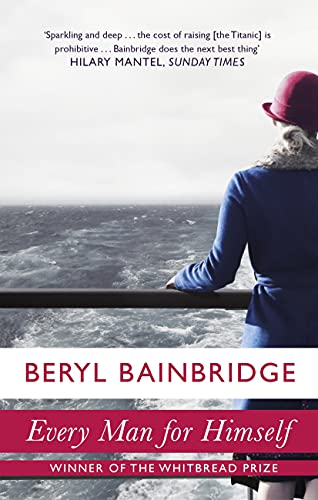
Every Man For Himself by Beryl Bainbridge

Rating: 3 out of 5.

Every Man For Himself was the winner of the 1996 Whitbread Novel Award and was shortlisted for the Booker Prize in that year.

For the four fraught, mysterious days of her doomed maiden voyage in 1912, the Titanic sails towards New York, glittering with luxury, freighted with millionaires and hopefuls. In her labyrinthine passageways the last, secret hours of a small group of passengers are played out, their fate sealed in prose of startling, sublime beauty, as Beryl Bainbridge’s haunting masterpiece moves inexorably to its known and terrible end.

This is one of her historical novels, so it’s no surprise that this is a disaster novel. It’s the story of Morgan’s voyage divided into four days as he tells it. It’s mainly the story of the young rich people as they drink and party their way across the Atlantic. Morgan is part of the crowd but he is not rich, and although he has connections, he’s a young American who has to earn his living. We only see a glimpse into his background and I found it confusing for quite a way into the book. But eventually we learn more about him and things became clearer,

By the time he writes about day 4, the sinking itself, the pace speeds up, and the story came to life for me. I think Bainbridge conveys what it must have been like –

There was such a dearth of information, of confirmation or denial of rumours – the racquet court was under water but not the Turkish baths; a spur of the iceberg had ripped the ship from one end to the other but the crew was fully equipped to make good the damage and were even now putting it to rights – and such an absence of persons in authority to whom one might turn that it was possible to imagine the man in the golfing jacket had spoken no more than the truth when presupposing we were victims of a hoax. (page 179)

I could easily imagine what it was like to be a passenger, people rushing about the boat, trying to get on the lifeboats and being separated from friends and family. And the final scenes bring home the reality that it really was a case of every man for himself with the callous attitude towards the steerage passengers, the lack of lifeboats and the disregard of the ice warnings. And so the boat described as unsinkable, sank.

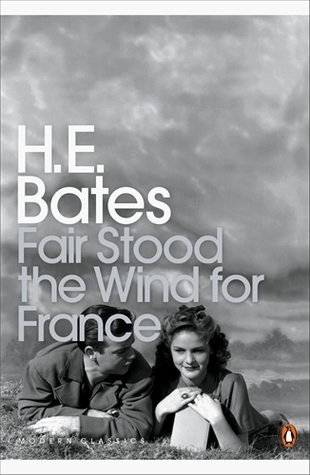
Fair Stood the Wind for France by H E Bates

Synopsis

When John Franklin brings his plane down into Occupied France at the height of the Second World war, there are two things in his mind – the safety of his crew and his own badly injured arm. It is a stroke of unbelievable luck when the family of a French farmer risk their lives to offer the airmen protection. During the hot summer weeks that follow, the English officer and the daughter of the house are drawn inexorably to each other…

My thoughts:

I bought Fair Stood the Wind for France by H E Bates in October 2018 when it caught my eye in Barter Books in Alnwick, mainly because of the title, which appealed to me. I knew nothing about it, but as it’s one of Penguins Modern Classics I added it to my Classics Club booklist. It’s my Classics Club Spin book for December, which is why I’ve read it recently.

I’m in two minds about this book. It begins really well and I was totally gripped by the first part of the book describing Franklin’s flight, with his crew of four sergeants, over France then the Alps and on to Italy. On his return flight when they were over France, they began to dive, rapidly losing height and he knew that the port engine had gone. The air screw (that’s a propeller) had broken, meaning they wouldn’t make it back to England and they crash landed somewhere in the countryside. They thought they were about west-north-west of the Vosges. From then onwards the story covers the period when Franklin whose arm had been very badly injured was cared for by Francoise and her family, hidden in their farmhouse. He falls in love with Francoise and she agrees to help him escape and marry him when they reach England.

But from then on as they made their way through Vichy France and eventually to Marseilles I felt the story dragged and I lost much of the interest I had had in the first part. Even though they encountered much danger and the tension rose, the action slowed down too much. I was relieved to finish the book.

As it was written and initially serialized weekly in the Saturday Evening Post from March 18 to May 6, 1944, and in Woman’s Journal (May-July 1944), it does give a contemporaneous account of the war portraying all dangers and the hardships they endured. It is really an extended short story, a love story, but one that didn’t particularly convince me. However, it does contain some beautiful descriptions of the French countryside and I loved the drama of the first part of the book.

  • Published by Penguin in paperback it’s also available as an e-book, published in 2005.
  • My Rating: 3.5 stars

The Classics Club Spin Result

The spin number in The Classics Club Spin is number …

2

which for me is Fair Stood the Wind for France by H E Bates. The rules of the Spin are that this is the book for me to read by Sunday the 3rd December 2023.

Synopsis from Amazon

When John Franklin brings his plane down into Occupied France at the height of the Second World war, there are two things in his mind – the safety of his crew and his own badly injured arm. It is a stroke of unbelievable luck when the family of a French farmer risk their lives to offer the airmen protection. During the hot summer weeks that follow, the English officer and the daughter of the house are drawn inexorably to each other.

I’m looking forward to reading it.

Did you take part in the Classics Spin? What will you be reading?