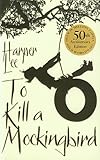
To Kill a Mockingbird by Harper Lee

 I often find with well-known books that all the world seems to love that they don’t live up to the hype, but To Kill a Mockingbird certainly does! It’s a wonderful book!

It was first published in 1960 and is set in the Deep South of  America in the 1930s. To Kill a Mockingbird is narrated by Scout (Jean Louise Finch) as she looks back as an adult to the Depression, the years when with her older brother, Jem, and their friend, Dill, she witnessed the trial of Tom Robinson, a black man accused of raping a white girl. Scout’s father, Atticus, a lawyer defends Tom. It’s also the story of Boo Radley, their neighbour, a man who is never seen, who is said to only come out at night. The children are scared of him, people said he was ‘a malevolent phantom‘, but their curiosity makes them fascinated by the idea of getting him to come out.

It’s the story seen through the eyes of a child, but narrated by an adult. And it’s told as a series of episodes in the fictional town of Maycomb, revealing the hypocrisy, prejudice and social injustice of the times. I was immediately drawn into Scout’s world, seeing Maycomb and its inhabitants through her eyes.

Maycomb was an old town, but it was a tired old town when I first knew it. In rainy weather the streets turned to red slop; grass grew on the sidewalks, the court-house sagged in the square. Somehow, it was hotter then; a black dog suffered on a summer’s day; bony mules hitched to Hoover carts flicked flies in the sweltering shade of live oaks on the square. Men’s stiff collars wilted by nine in the morning. Ladies bathed before noon, after their three o’clock naps, and by nightfall were like soft tea-cakes with frostings of sweat and sweet talcum. (page 5)

Scout is a feisty character, always prepared to stand up for what she thinks is right, but Atticus, who also stands for justice and the moral and ethical ideal, has to reign her in sometimes. The book is full of strong characters and for me the outstanding scenes are those when Atticus sat reading outside the jail to stop the lynch mob attacking Tom and the trial itself at the court-house. It is all so vivid I believed I was right there with them.

There is so much to think about reading this book and I could write page after page! But here are a few quotations that particularly struck me:

‘First of all,’ he [Atticus] said, ‘if you can learn a simple trick, Scout, you’ll get along better with all kinds of folks. You never really understand a person until you consider things from his point of view -‘

‘Sir?’

‘- until you climb into his skin and walk around in it.’ (page 33)

and

 Shoot all the bluejays you want, if you can hit ’em, but remember it’s a sin to kill a mockingbird.

… Mockingbirds don’t do one thing, but make music for us to enjoy. they don’t eat up people’s gardens, don’t nest in corncribs, they don’t do one thing but sing their hearts out for us. That’s why it’s a sin to kill a mockingbird. (pages 99 – 100)

and

‘People in their right minds never take pride in their talents,’ said Miss Maudie. (page 109)

and

People generally see what they look for, and hear what they listen for … (page 192)

On equality:

We know all men are not created equal in the sense some people would have us believe – some people are smarter than others, some people have more opportunity because they’re born with it, some men make more money than others, some ladies make better cakes than others – some people are born gifted beyond the normal scope of most men.

But there is one way in this country in which all men are created equal – there is one human institution that makes a pauper the equal of a Rockefeller, the stupid man the equal of any college president. That institution, gentlemen, is the court. (page 226)

The sticking point, however, is that a court is no better than the people sitting on the jury …

Barnaby Rudge by Charles Dickens

I knew absolutely nothing about Barnaby Rudge: a Tale of the Riots of ‘Eighty before I started to read it. It’s not a book that I’ve seen dramatised. But whilst reading (very slowly) Claire Tomalin’s biography, Charles Dickens A Life I came across the following information. In May 1836, the year that Dickens, then 24, married Catherine Hogarth on 2 April, he agreed he would write a three volume novel, called Gabriel Vardon by November. But by November he was trying to withdraw from the agreement, due to his commitments in writing Pickwick and Sketches by  Boz. He began writing Gabriel Vardon in 1839 and it was only in February 1841 that its serialisation began. By then he had renamed it as Barnaby Rudge.

It’s a murder mystery as well as a historical novel, mainly concerning the events surrounding the Gordon Riots of 1780. The Riots began in protest to the Catholic Relief Act of 1778, which granted Roman Catholics exemption from taking the religious oath when joining the British Armed Forces and granted them a few liberties, previously denied to them. Led by Lord George Gordon the protests quickly turned violent, Parliament was invaded and Newgate prison was burned to the ground. I was rather surprised that Tomalin gave away most of the plot in describing Barnaby Rudge and gave away the identity of the murderer. I don’t intend to do the same as it spoilt the mystery for me.

Barnaby Rudge begins in 1775, five years before the riots as a group of customers in the Maypole Inn in the village of Chigwell, on the borders of Epping Forest and about 112 miles from London, recollect the murder of Reuben Haredale, the owner of The Warren, 22 years earlier to the day. His steward, a Mr Rudge was found months later, stabbed to death.The murderer had never been discovered. Reuben’s brother Geoffrey had lived at The Warren with his niece, Emma ever since.

From then on the book becomes much more complicated with many characters and sub-plots. There is the love story of Emma, a Catholic and Edward Chester, the son of Sir John Chester, a Protestant and opponent of her uncle, who is dead against their marriage. Also crossed in love are Joe Willet, whose father John Willet is the landlord of the Maypole and the captivating Dolly Varden whose father Gabriel Vardon is a locksmith. Barnaby Rudge is a simple young man, living with his mother. His pet raven, Grip goes everywhere with him. He’s a most amazing bird who can mimic voices and seems to have more wits about him than Barnaby. Grip is based on Dickens’s own ravens, one of whom was also called Grip. (Edgar Allen Poe was inspired by Dickens’s portrait to write his poem The Raven).

It’s a long book and in parts loses its impetus, but picks up when Dickens jumps five years forward into the Riots and I was taken aback by his vivid and dramatic descriptions of the violence and horror:

If Bedlam gates had been flung wide open, there would not have issued forth such maniacs as the frenzy of that night had made. … There were men who cast their lighted torches in the air, and suffered them to fall upon their hands and faces, blistering the skin with deep unseemly burns. There were men who rushed up to the fire, and paddled in it with their hands as if in water; and others who were restrained by force from plunging in, to gratify their deadly longing. On the skull of one drunken lad – not twenty, by his looks – who lay upon the ground with a bottle to his mouth, the lead from the roof came streaming down in a shower of liquid fire, white hot; melting his head like wax.

And then there is the attack on Newgate prison, the release of the prisoners and finally the scene as the mob set fire to the prison, scenes that rival the storming of the Bastille in A Tale of Two Cities.

By the end of the novel the murderer is revealed and all the plot strands are completed. There are a number of themes running through the novel – the relationship between fathers and sons, the position of authority, justice and the question of punishment for crime, and religious conflict. Dickens paints a picture of London, the dirt and poverty, the terrible condition of the roads, the perils of footpads and highwaymen which is in contrast to the countryside that still at that period surrounded London making it a cleaner, purer place to live in. There are detailed descriptions of the old inn, the Maypole and Vardon’s house and shop with their individual irregularities and strangeness.

And alongside all this are the characters, the restless innocent that is Barnaby, his over-protective and distracted mother, the melodramatic servant Miggs, the pure evil of Hugh, an idle servant at the Maypole who becomes one of the leaders of the riots, and Mr Dennis, the hangman to name but a few.

It wasn’t such a success as some of Dickens’s other novels but I think that that is not a fair reflection of its qualities. It’s almost a book of two parts and the dramatic second half, to my mind, more than makes up for the slow beginning which I had to read slowly and carefully. The portrayal of Barnaby Rudge is also masterly – a sympathetic but totally unsentimental characterisation of his ‘madness’ and his underlying common sense.

Barnaby Rudge was number 6 in the Classics Club Spin, which is the reason I’ve been reading it this June, rather than later.  I’ve had the book on my Kindle since March 2013, so not as long as some of my to-be-read books, so it also counts towards the Mount TBR Reading Challenge and the Historical Fiction Challenge too. There are numerous editions of Barnaby Rudge and each one gives different page numbers, depending, I suppose on the format and font size. The Kindle edition estimates its length at 845 pages, so it also counts towards the Tea and Books Challenge.

The Classics Spin

The Classics ClubThe Classics Club Spin

  • Pick twenty unread books from your list. This could be five you are dreading/hesitant to read, five you can’t WAIT to read, five you are neutral about, and five free choice.
  • Number them from one to twenty.
  • On Monday a number will be drawn.
  • That’s the book to read by July 1.

I decided the simplest list way to do this was to choose books from different centuries, which gave me three sections and for the final five I’ve listed five really long books. These are all books I want to read but I am hesitant about some of them, especially some of the longer books – even some of the books not included in the ‘Long books’ section are long too! I’m really hoping for a shorter book.

The first five are 17th & 18th century, the second group are 19th century, the third 20th century and the last five are ‘Long books’.

  1. Don Quixote by Miguel de Cervantes Saavedra 1605 
  2. A Journal of the Plague Year by Daniel Defoe 1722
  3. Moll Flanders by Daniel Defoe 1722
  4. Gulliver’s Travels by Jonathan Swift 1726
  5. Lady Susan, The Watsons, Sanditon by Jane Austen poss 1794 first pub 1871
  6. Barnaby Rudge by Charles Dickens 1841
  7. Mary Barton by Elizabeth Gaskell 1848
  8. Barchester Towers (Barsetshire Chronicles, 2) by Anthony Trollope 1857
  9. The Mill on the Floss by George Eliot 1860
  10. Lorna Doone: A Romance of Exmoor by R D Blackmore 1869
  11. Ethan Frome by Edith Wharton 1911
  12. The Voyage Out by Virginia Woolf 1915
  13. Out of Africa €“ Isak Dinesen 1937 
  14. To Kill a Mockingbird by Harper Lee 1960
  15. Love in the Time of Cholera by Gabriel Garcia Marquez 1985
  16. Gone with the Wind by Margaret Mitchell 1936
  17. Of Human Bondage by W. Somerset Maugham 1915
  18. No Name by Wilkie Collins 1862
  19. The Count of Monte Cristo by Alexandre Dumas 1844
  20. Parade’s End by Ford Maddox Ford 1924 – 28

Classics Club May Meme

The Classics Club

I recently joined the The Classics Club. Each month there is a meme – a question to answer and this is my first one.

Tell us about the classic book(s) you’re reading this month. You can post about what you’re looking forward to reading in May, or post thoughts-in-progress on your current read(s).

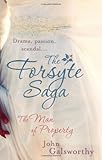
I’ve just started to read A Man of Property the first book in the Forsyte Saga by John Galsworthy, a book I’ve been meaning to read for some years. My copy contains this first novel plus Indian Summer of a Forsyte. It begins in June 1886 with an ‘at home’ at the house of old Jolyon Forsyte to celebrate the engagement of Miss June Forsyte, old Jolyon’s granddaughter, to Mr Philip Bosinney, an architect. The rest of the family all attend and are introduced to the reader, explaining their relationships. There is a family tree at the beginning of the book that helps me to understand who they all are.

I watched the first TV dramatisation of The Forsyte Saga way back in 1967 and the later production in 2002, so I know the story – or at least I remember the gist of it and can visualise Damien Lewis as Soames Forsyte and Gina McKee as Irene (I even remember Nyree Dawn Porter as Irene!)

I think the sequence of books in the Saga is a little confusing, so I’ve listed the books to clarify the sequence for myself:

The first trilogy, comprising:

  1. A Man of Property published in 1906 followed by Indian Summer of a Forsyte: a short interlude, published in 1918 (I have this book, which is the version shown above).
  2. In Chancery published in 1920 and another short interlude: Awakening (1920) – I don’t have this.
  3. To Let published in 1921 – I don’t have this.

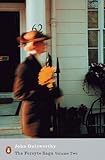
A Modern Comedy, written between 1924 and 1928. I have these books in one volume,  called The Forsyte Saga Volume Two comprising:

  1. The White Monkey (1924)
  2. The Sliver Spoon (1926)
  3. Swan Song (1928)

But there are also Two Forsyte Interludes: A Silent Wooing / Passers By (1928)
On Forsyte Change (1930), which I don’t own.

And a further trilogy called End of the Chapter (I don’t own this), comprising:

  1. Maid in Waiting (1932)
  2. Flowering Wilderness (1933)
  3. Over the River (1933)

I think I’ve got that sorted out now!

The Classics Club

The Classics ClubThe Classics Club is a club created to inspire people to read and blog about classic books. There’s no time limit to join.You simply sign up to read and write on your blog about at least 50 classic books in at most five years.

I’ve dithered about joining The Classics Club for over a year now and have finally decided to take the plunge. I’m good at listing books, even if after that I don’t read them all, or write about them.

The 50 books on this list are all books I own, either physical books on the bookshelves or e-books on Kindle  They do say that you shouldn’t plan too far into the future, and going off what’s happened in the last five years that’s a good thing, but I would like to think that I’ll read them within the next five years (that is by April 2018!!). I like the fact that this doesn’t have to be a fixed list – this is my initial list, which I’ve already changed since I started compiling it!

I’ve listed them in a-z author order.

  1. Lady Susan, The Watsons, Sanditon by Jane Austen
  2. Mansfield Park by Jane Austen (re-read)
  3. The Old Wives Tale by Arnold Bennett
  4. Lorna Doone: A Romance of Exmoor by R D Blackmore
  5. Lady Audley’s Secret by M E Braddon
  6. The Thirty Nine Steps by John Buchan
  7. The Making of a Marchioness by Frances Hodgson Burnett
  8. My Antonia by Willa Cather
  9. Don Quixote by Miguel de Cervantes Saavedra
  10. No Name by Wilkie Collins
  11. Lord Jim by Joseph Conrad
  12. A Journal of the Plague Year by Daniel Defoe
  13. Moll Flanders by Daniel Defoe
  14. Barnaby Rudge by Charles Dickens
  15. Nicholas Nickleby by Charles Dickens
  16. Little Dorrit by Charles Dickens
  17. Martin Chuzzlewit by Charles Dickens
  18. The Old Curiosity Shop by Charles Dickens
  19. Oliver Twist by Charles Dickens
  20. Pickwick Papers by Charles Dickens
  21. Out of Africa – Isak Dinesen
  22. The Adventures of Sherlock Holmes by Arthur Conan Doyle
  23. The Count of Monte Cristo by Alexandre Dumas
  24. Adam Bede by George Eliot
  25. The Mill on the Floss by George Eliot
  26. Silas Marner by George Eliot
  27. Parade’s End by Ford Maddox Ford
  28. The Women’s Room by Marilyn French
  29. The Forsyte Saga (1-3) by John Galsworthy
  30. Mary Barton by Elizabeth Gaskell
  31. North and South by Elizabeth Gaskell
  32. Wives and Daughters by Elizabeth Gaskell
  33. Notre-Dame of Paris by Victor Hugo
  34. To Kill a Mockingbird by Harper Lee
  35. Three Men in a Boat by Jerome K Jerome
  36. The Man Who Would Be King by Rudyard Kipling
  37. Love in the Time of Cholera by Gabriel Garcia Marquez
  38. One Hundred Years of Solitude by Gabriel Garcia Marquez
  39. Of Human Bondage by W. Somerset Maugham
  40. Moby Dick by Herman Melville
  41. Gone with the Wind by Margaret Mitchell
  42. Of Human Bondage by W Somerset Maugham
  43. Black Beauty by Anna Sewell
  44. Travels with a Donkey in the Cevennes by Robert Louis Stevenson
  45. Gulliver’s Travels by Jonathan Swift
  46. Barchester Towers (Barsetshire Chronicles, #2) by Anthony Trollope
  47. The Color Purple by Alice Walker
  48. The Age of Innocence by Edith Wharton
  49. Ethan Frome by Edith Wharton
  50. The Voyage Out by Virginia Woolf