The spin number in The Classics Club Spin is number …
8
which for me is The Black Tulip by Alexandre Dumas. The rules of the Spin are that this is the book for me to read by 2 June 2024.
Synopsis from Goodreads:
Set at the height of the “tulipomania” that gripped Holland in 17th century, this is the story of Cornelius van Baerle, a humble grower whose sole desire is to grow the perfect specimen of the tulip negra.
When his godfather is murdered, Cornelius finds himself caught up in the deadly politics of the time, imprisoned and facing a death sentence. His jailor’s daughter Rosa, holds both the key to his survival and his chance to produce the ultimate tulip.
The sixth Reading Wales celebration (aka Dewithon 24), a month-long event during which book lovers from all parts of the world are encouraged to read, discuss and review literature from and about Wales, began on Saint David’s Day, 1 March, and ends today.
I’ve finished reading two books one , I let You Go, set mostly in Wales and Maiden Voyages by Siân Evans, a Welsh historian, which I’ll write about in a later post.
A tragic accident. It all happened so quickly. She couldn’t have prevented it. Could she?
In a split second, Jenna Gray’s world descends into a nightmare. Her only hope of moving on is to walk away from everything she knows to start afresh. Desperate to escape, Jenna moves to a remote cottage on the Welsh coast, but she is haunted by her fears, her grief and her memories of a cruel November night that changed her life forever.
Slowly, Jenna begins to glimpse the potential for happiness in her future. But her past is about to catch up with her, and the consequences will be devastating . . .
My thoughts:
I loved I Let You Go, Clare Mackintosh’s debut novel, part psychological thriller and part police procedural. It won Theakston’s Old Peculier Crime Novel of the Year Award in 2016, beating J K Rowling writing as Robert Galbraith. I’ve had this book since 2017 and I started to read it then but it begins with a tragedy, as five year old Jacob is killed by a hit-and-run driver, and I didn’t feel up to reading it at that time and put it back on the shelf for a while. Clare Mackintosh, a former police officer, is a member of Crime Cymru, a consortium of Welsh crime writers who promote Welsh crime fiction.
This is a difficult book to review without giving away spoilers so I’m not going into detail about the plot. It is set partly in Bristol, England where Jacob is killed, and then moves into a small coastal village in Wales where Jenna is trying to make a new life for herself. It’s heart-wrenching reading as Jenna tries to put the past behind her and at times I thought this was a romantic novel. But it’s not, as it becomes clear that there are secrets in her past that haunt her. It’s almost a book of two parts and the second half is dark and violent, full of suspense and menace, and really shocking twists and turns. The characters are fully rounded, extremely well-drawn and realistic. The settings are vividly described, especially of the beautiful Welsh coast line. I could picture it so well and it made me long to be there.
After a slow start this became a book I didn’t want to stop reading. It’s a powerful novel that kept me glued to its pages and it’s one of the best books I’ve read this year. I’ll certainly be reading more by Clare Mackintosh.
It’s a blazing summer when two men arrive in the village. They’re coming for gold. What they bring is trouble.
Cal Hooper was a Chicago detective, till he moved to the West of Ireland looking for peace. He’s found it, more or less – in his relationship with local woman Lena, and the bond he’s formed with half-wild teenager Trey. So when two men turn up with a money-making scheme to find gold in the townland, Cal gets ready to do whatever it takes to protect Trey. Because one of the men is no stranger: he’s Trey’s father.
But Trey doesn’t want protecting. What she wants is revenge.
Crackling with tension and slow-burn suspense, The Hunter explores what we’ll do for our loved ones, what we’ll do for revenge, and what we sacrifice when the two collide, from the Sunday Times and New York Times bestseller Tana French
I’ve loved several books by Tana French, especially The Searcher, the first Cal Hooper mystery, so I was really looking forward to reading the second, The Hunter. I wasn’t disappointed and enjoyed this one almost as much. Like The Searcher this is a slow-burner, a book to savour, not one to rush through.
Two years have gone by since the events told in The Searcher. Ex-Chicago detective Cal Hooper is now settled in Ardnakelty, a remote Irish village and Trey Reddy is now fifteen. Trey’s father, Johnny who has been absent from the village for four years suddenly returns. But Trey is suspicious of her father’s true motives and doesn’t trust him, or the rich Londoner, Cillian Rushborough, Johnny met in London. The two of them are out to fleece the villagers, claiming there is gold on their land. But just who is scamming who?
I liked the slow build up to the mystery – there is a murder, but the body is only discovered later on in in the book. And it is the characters not the murder that are the focal point. I loved Tana French’s beautiful descriptions of the Irish rural landscape. It’s the sort of book I find so easy to read and lose myself in, able to visualise the landscape and feel as if I’m actually there with the characters, watching what is happening.
Many thanks to Penguin for a review copy via NetGalley.
I enjoyed Frances Faviell’s memoir, The Dancing Bear, which is set in Berlin just after the end of the Second World War, so I was looking forward to reading another one of her books. The Fledgeling (first published in 1958) is her third novel. It appealed to me because it’s also a book about the post war period, but set a few years later in Britain in the late 1950s. National Service was then in force meaning that all men aged 17 to 21 had to serve in one of the armed forces for an 18-month period. It was discontinued in 1960, with the last servicemen discharged in 1963.
It tells the story of 19-year old Neil Collins , who deserted from his National Service for the third time taking place over the twenty four hour period following Neil’s desertion. When the book begins and sets out to go to his grandmother’s small basement flat in London. Mrs Collins is bedridden and dying. She has strong ideas about duty and thinks Neil should go back and finish his National Service. Nonie, his twin sister, supports him, despite the fact that Charlie, her husband, thinks he is a coward and should finish his National Service. But Nonie makes plans to get him to Ireland where their Great Aunt Liz lived. The flat is small and Neil has to stay hidden whilst several people visit during the day – Miss Rhodes the social worker, some of the neighbours, and Linda, a little girl who regularly climbs in through the basement window to see ‘Gran Collins’.
Neil is in a ‘sickening state of collapse’, is desperate to get away, and he lives in fear of the military finding him and taking him back. And adding to his terror is his fear that Mike, a bullying fellow soldier who has made Neil’s life a nightmare, will catch up with him, to escape with him to Ireland. It all seems hopeless to Neil.
In an Afterword by John Parker, Faviell’s son, he writes that each of her books were inspired by episodes in her own life. And The Fledgeling, about a National Service deserter was based on an actual incident. I enjoyed this book. As I read it I could imagine the reality of the fear and desperation that the family were experiencing. It gives an excellent insight into what life was like in Britain in the 1950s, and in particular into the impact National Service had at that time.
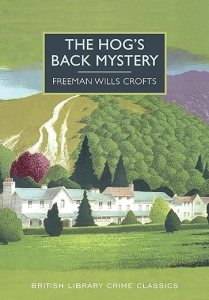
This is a British Library Crime Classic, first published in 1933, during the Golden Age of detective fiction between the two world wars. Dr James Earle and his wife live near the Hog’s Back, a ridge in the North Downs in the beautiful Surrey countryside. When Dr Earle disappears from his cottage, Inspector French of Scotland Yard is called in to investigate. At first he suspects a simple domestic intrigue – and then begins to uncover a web of romantic entanglements beneath the couple’s peaceful rural life.
I’ve only read two Inspector French books before. They’re puzzle-type mysteries. French is a most meticulous and methodical detective – maybe too meticulous and methodical, but he is a very likeable character. It begins leisurely introducing the characters and setting the scene. He pays great attention to all the information as he discovers it. This slows the pace down, going over and over the clues several times and he even lists them, giving the page numbers they appear on towards the end of the book. Crofts’ descriptions of the countryside are outstanding, giving it a great sense of place.
The more he (Inspector French) had explored the country, the more it had appealed to him. He loved the tree-edged out lines of its successive ridges,showing up solid beneath one another like drop scenes in a theatre. He loved its quaint villages with their old red-roofed half-timbered buildings and their still older churches. He liked following the narrow twisting deep-cut lanes. But most of all he delighted in the heaths, wild and uncultivated, areas of sand and heather and birches and pines over which one could wander as entirely cut off from sight or sound of human habitation as if one was exploring a desert island. (page 61 in my paperback copy)
Ideal countryside for burying a dead body.
Although this is a slower paced novel than I usually prefer to read and the detail is rather repetitive in places, I really enjoyed reading this book, and I’ll be looking out for more of Inspector French murder mystery novels.
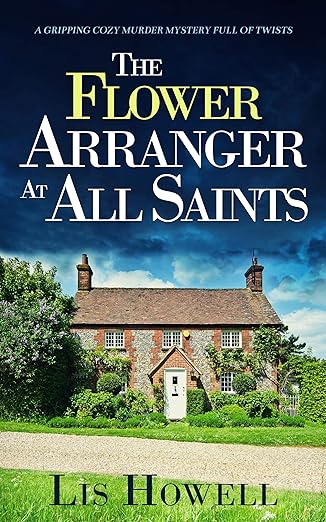
The Flower Arranger at All Saints by Lis Howell was one of Prime Reader’s free books last year that I downloaded. I loved it! it’s my first 5* read of the year.
Synopsis
In quiet Tarnfield, local rivalries and parish feuds simmer under the genteel surface. It’s the sort of place where everyone knows each other’s business. And a new vicar wants to shake things up in the community. Then Phyllis the church flower arranger is found dead before the big Easter service. With fingers pointing and tensions rising, the village is in turmoil.
Chaotic mum-of-two, Suzy Spencer, has just arrived in Tarnfield. She needs a fresh start after her husband betrayed her. Now she finds herself entangled in the mystery along with quiet widower, Robert Clark. The killer is set to strike again with another floral flourish. Despite their differences, can Suzy and Robert stop the murderer before anyone else suffers?
My thoughts
There is a lot to like in this book. The setting is Tarnfield, a fictional Cumbrian village. The setting is described so well that I could ‘see’ it all. It’s picturesque, quiet and secluded, where everyone knows everybody’s business. The church plays a huge part in village life, but traditions are being upended by the new vicar and his fondness for playing the guitar during sermons.
And the characters are so ‘real’. I believed in them and even though there are many of them they’re all easily distinguishable and I loved the biblical references and flower clues – they’re intriguing. The plot too kept me keen to carry on reading, wanting to know the identity of the murderer. As Suzy and Robert try to get to the bottom of the mystery many secrets are revealed – and it looks as though a relationship between the two of them is developing.There are more deaths and red herrings with several twists and turns before the culprit is found.
Why haven’t I come across this author before and her Suzy Spencer mysteries? The Flower Arranger at All Saints is the first in the series and luckily there are four more for me to read!
About the author
Lis Howell is from Liverpool, UK. She is the author of the Suzy Spencer cozy mysteries. They are set around the fictional town of Norbridge, Cumbria in the North of England. In her varied life, Lis has spent a short time running a post office in a Cumbrian village; and she lived for several years near Hadrian’s Wall between England and Scotland. Lis is an award-winning TV journalist based in London and is now an academic. Like Suzy, she’s a confused churchgoer, although she married a churchwarden! Anglican traditions feature in her books, along with modern media, family life and village intrigue.
I’m taking part in the What’s In A Name Challenge? this year and this book fits into the category of a NFL team (New Orleans Saints).